Disco is dead, baby, but not the genre so much as the man, Charlie Disco. Not that he remembers it, or being brought back to life and guided by a floating skull known as Vice. The only thing real is that his ex-bandmates have seemingly moved on, each finding success as rock stars, K-pop icons, and whatnot (some at the expense of his legacy). But utilizing the power of Beat Kune Do, Charlie aims to find out who murdered him and why, and maybe get the band back together in the process.
Amid the ludicrous setup lie some rather familiar themes – the consequences of fame, whether it’s delusions of grandeur or selling out to whoever pays top dollar. You know, the usual. It’s all Charlie can do to remind his bandmates of what matters, both through words and by knocking some sense into them (and their seemingly infinite supply of groupies). However, there’s clearly more going on – like something discordant that could unravel everything.
However, by this point, you’re probably wondering: What is Dead as Disco anyway? To put it bluntly, it’s a Free Flow combat-style beat ’em up. Similar to the Batman Arkham games, dishing out a consistent degree of punishment to enemies will build up a combo (known as Beats). The key difference is that you’re encouraged to slay to the beat, whether it’s to increase the damage of certain moves, replenish your Takedown Tokens faster, or to net a higher score than everyone else, among other things.
It may seem overtly simple, but that’s the core appeal and how Dead as Disco has quickly built a name for itself through several playtests and demos, crossing one million wishlists on Steam. It’s launching on Steam Early Access on May 5th and offers four opponents to tussle across their unique stages. You can travel back to the central hub, known as The Encore, to decorate, converse with characters, and unlock new skills. Or you could venture into Infinite Disco and undertake challenges, fighting waves of enemies on any track without conditions or engage in an endless dance of brutality. When that’s not enough, you can import your own tunes and finely customize the beat timing. Like Audiosurf with fisticuffs, and it’s awesome.
From the menus right down to the animated stills and character designs, Dead as Disco oozes style. Its aesthetics are clearly in tune not just with the presented genres of music, but the mentalities of NPCs themselves. The AI, Arora, for example, offers a mix of starry backdrops and a boss phase that occurs on a planetary ring as you deflect stars back at her giant form. Hemlock is more grunge – a dimly lit, neon graffiti-infused subway where the tracks become an impromptu mosh pit. I don’t even know where to begin describing Dex’s levels, which feel like a fusion of brutalist architecture and desolate monochromatic landscapes.
It defies description at times, especially when you’re transitioning from one section to the next at breakneck pace, like a psychotropic music video. And yet, amid all this, visual clarity remains relatively clean, ensuring that you always know where the next threat is coming from (even if you haven’t mastered the muscle memory necessary to conquer them all). Even the little visual flourishes, like the word “Perfect” bursting forth in a spray of color from an enemy, or Charlie’s animations upon completing combos, add to the overall charm.
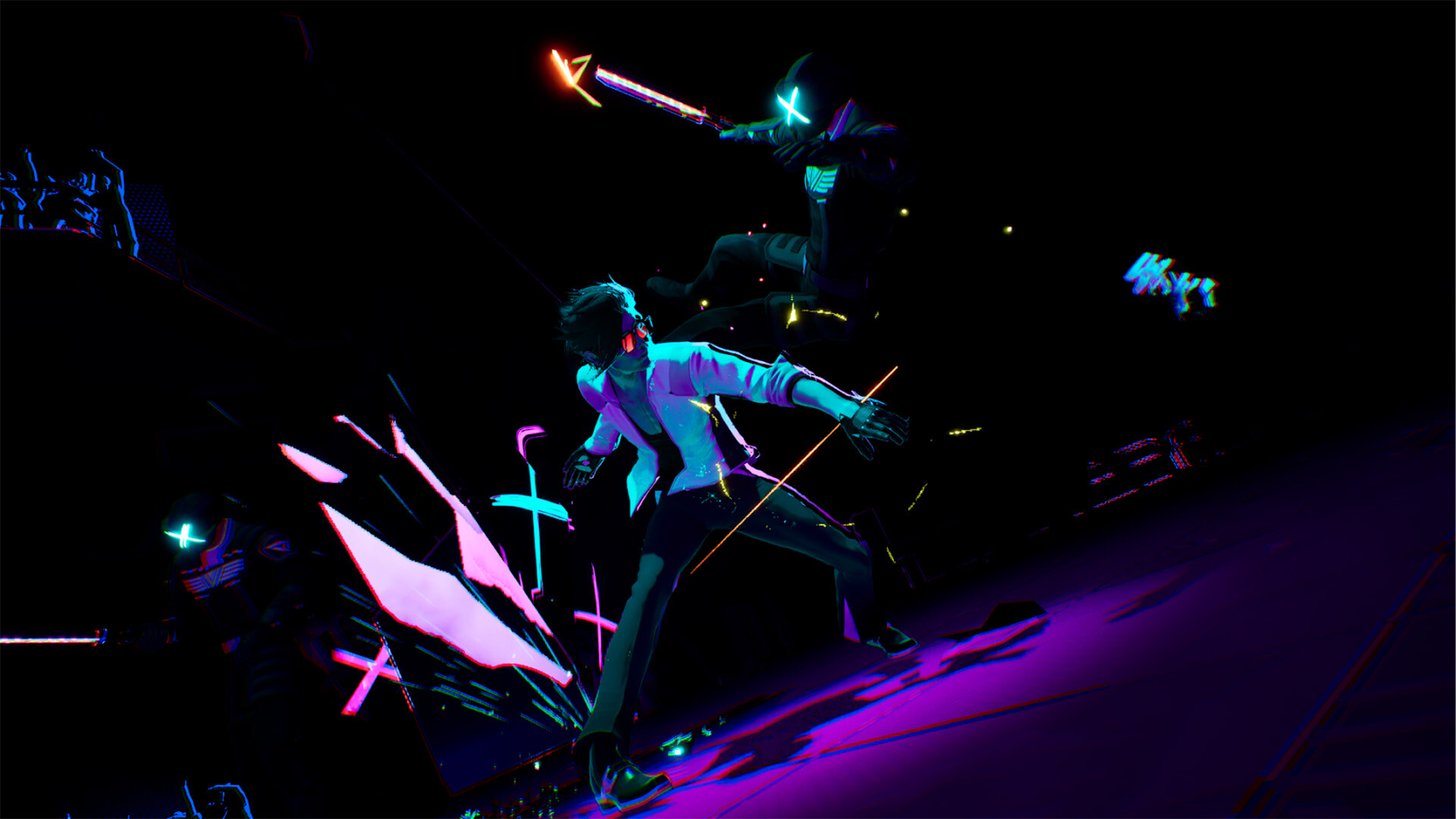
If you’ve played any of the Batman Arkham games, you’ll have a strong fundamental understanding of the combat. Press X to attack, Y to counter and A to dodge. When an opponent is dazed, press B for a finisher and once you’ve earned a Takedown Token, Y+B lets you execute it. Meanwhile, the Fever Bar is your ticket for unleashing abilities. A solid system and one that Dead as Disco takes to with relative ease, even if Charlie’s strikes may feel a bit weightier than expected. Of course, that window feels finely honed for several different purposes, whether it’s quickly transitioning into counters and perfect dodges, or properly timing your strikes to the beat.
But the best part is how it takes those fundamentals and adds its own unique abilities and nuances while still allowing for an extensive amount of freedom. Baseball sliding into enemies will launch them into the air; heavy kicks can send them into walls and set them up for finishers. Perfectly timed counters deal more damage; perfectly timed dodges into counters can lead to finishers. Finishers can provide a few seconds of invincibility, letting you avoid that charging headbanger or Riot Guard.
Sure, you could set up enemies for quick knockouts, clearing rooms with methodical finesse. But how about playing the drums on some poor sap’s face before knocking him out or tossing a drumstick from afar to keep a combo going while you sprint full force towards a target? The beat can serve as a strong guideline for how you should be timing those blows, but the nature of those hits is up to you. And if you’re a stickler for hitting to the beat, don’t worry – there are options for enabling a Beat Indicator and Beat Ring. You can even make it so that non-attacking enemies are indicated at all times.
Also, I can’t heap enough praise on the actual boss fights, even if it can be annoying to constantly sit through their cutscenes on subsequent retries without a skip button. Each of them feels mechanically unique, though you’ll have to get used to dealing with and dodging area-of-effect attacks. Arora, in particular, can get annoying since she’ll suddenly lob a projectile at you with little warning.
Defeating your ex-bandmates unlocks new attacks and skill trees, and while some upgrades, like extra hearts and Fever Bars, can feel straightforward, you can also transform certain abilities. Bass Invader, which sees Charlie swinging a guitar to knock back surrounding enemies, can become Super Bass Invader, where charging the attack results in a powerful ground slam that sends enemies up in the air. Considering you can only have four equipped at once, there’s definitely room for picking favorites, but you’re free to reset the skill trees at any time and play around with different options.
While its visuals are to die for, Dead as Disco would be nothing without some great music. There are over 25 tracks currently, and though your mileage may vary, I found Boom by bbno$ and the classic Maniac to perfectly fit the overall vibe. Even Arora’s original songs are pretty great, carrying a distinct K-Pop flavor.
Suffice to say, I really like Dead as Disco. Even in early access, it’s so polished, balancing style with substance while tapping into that aspect of mastery that made those Batman Arkham Challenge maps so immensely replayable. Even if there’s still a ways to go before the story is fully fleshed out, the amount of content is still pretty respectable at $25, whether you’re trying to master each chapter, complete all the challenges or rack up a high score in Infinite Disco. The fact that more abilities, customization options, challenges, bosses, skill trees, music, “the true end game”, and even co-op are also in the works is mind-boggling.
Charlie Disco may or may not find a resolution to all this, but one thing is for sure: The band’s getting back together and by the time Dead as Disco exits early access, it should be one for the ages. For now, however, it’s an excellent early access offering that masterfully blends 3D beat ’em up combat with some sick beats.
This game was reviewed on PC.