Every role-playing game fandom has “that game” which you either love or hate, and Dragon Quest is no exception. Regardless of the era, or which games you find the best, Dragon Quest 7: Fragments of the Forgotten Past is an experience that you either relish over its many, many more hours, or give up on after the slow start. Of course, there were various other complaints at the time, but the pacing, especially the opening, and the overall length, soured more than your fair share of fans.
With all that said, “streamlined” is the best word to describe Dragon Quest 7 Reimagined. While the 3DS remake took its own measures to make the intro more palatable, this one is aiming for a truly streamlined experience – one that keeps the pace moving while still delivering an adventure that only Dragon Quest can provide. So does it succeed? I would say, yes. Immensely so. In fact, it may well make a case for one of the finer entries in the series, and one of the better role-playing games you can play this year.
"Despite being based on a game that’s more than 25 years old, Dragon Quest 7 Reimagined managed to subvert my expectations in so many ways. Not only that, but it’s well-written…"
Your life is much less unassuming here than in previous titles – the word “hero” isn’t so much accurate as the term “adventurer.” As a resident of Estard, you work with Prince Kiefer to fix up a boat and set out to explore, despite everyone (including your mother) reminding you that this is the only island in the world. Things take a turn when Kiefer discovers some mysterious ruins, which demand some stone tablets in return for granting entry. One thing leads to another, and after Maribel, the mayor’s spirited daughter, joins in, you’re transported to a brand new world that’s clearly not Estard.
Right away, the pacing throughout all this is fantastic, from engaging with the combat system, getting to know all the important characters – from Kiefer’s father King Donald (and no, the Sutherland connection isn’t lost on me) to the protagonist’s skeevy uncle Pike – to traveling to the first world. So far, so good, but what about the rest?
I don’t want to delve into too many details about the entire plot set-up and its various revelations, but the basic goal is to search out more stone tablets, venture to other worlds, and so on. The key takeaway is that they’re all in some kind of bind. Take Ballymolloy, for example, where the legend of a warrior who stood up to the monsters is revealed to be a tragedy of epic proportions.
You’ll often step in and play the hero, but it’s not always so straightforward, which highlights the strength of Reimagined’s storytelling. Some places fall to tragedy, and there isn’t anything to be done. Others may see you win the battle, but the story is far from finished. It feels like opening new chapters in a book, except they’re all connected in exciting ways.
And while some felt like they ended sooner than I would have expected, I was always hankering to see what the next world held, which characters I would meet, who would temporarily join up to lend a hand, and much more. Despite being based on a game that’s more than 25 years old, Dragon Quest 7 Reimagined managed to subvert my expectations in so many ways. Not only that, but it’s well-written – even with such an extensive side cast, each one makes an impression, from the royalty to the downtrodden; from the cutpurse who betrayed me to the fortune-teller known as, what else but, Palmela. Conversations rarely felt bogged down by extraneous details.
"While it may feel overtly simple in the beginning, Dragon Quest 7 Reimagined’s combat system opens up delightfully over time, especially as you learn new skills, master your Vocation, and gain different monster hearts with unique benefits (like increased dodging, higher crit chance or defying death from a lethal attack)."
The main cast is equally as endearing, from Kiefer and his bright enthusiasm (that hides more than its fair share of self-doubt) to Maribel and her sometimes-spoiled-but-ultimately-good-hearted demeanour, to Ruff, who’s about what I’d expect given the predicament he’s gone through (but more charming). Other characters remain, and the current cast goes through their fair share of changes (again, no spoilers), and it’s all laid out so naturally that it rarely feels rushed. The voice acting is also superb, and the main cast especially shines in their roles (though the protagonist remains mostly silent).
The streamlining aspects also apply to the battle system, which receives the Tactics system seen in the HD-2D Dragon Quest remakes, Auto Battle, and Battle Speeds to adjust the speed of animations. You can adjust all of this on the fly, which is great, but the actual combat also shines in its relative simplicity. Enemies have unique tactics and elemental weaknesses, from the standard throwaway Slimes to the Mouseflaps who can simultaneously attack if there’s more than one. Multi-area attacks are especially useful for wiping the battlefield, but if battles have mixed groups of enemies, you need to prioritize which ones to attack.
Adding a further wrinkle to all this is the new Vocational Perks. After enough time in battle, characters can get “worked up,” and unlock a special move unique to their Vocation. From the start, the protagonist grants protection to everyone from a single hit – a clutch tactic when a boss is charging up for a particularly devastating attack. Maribel can make it easier to exploit elemental weaknesses, which works in tandem with her magical prowess. Kiefer, meanwhile, can throw all pretense of defense to enhance his attack and crit rate, though you could also opt to spend a turn doubling the damage of his next attack. And so on.
While it may feel overtly simple in the beginning, Dragon Quest 7 Reimagined’s combat system opens up delightfully over time, especially as you learn new skills, master your Vocation, and gain different monster hearts with unique benefits (like increased dodging, higher crit chance or defying death from a lethal attack). If there’s one drawback, it’s that it does take a bit of time before you unlock the ability to change Vocations and learn other Skills. The new Moonlighting, which allows for equipping two Vocations at once, effectively multi-classing to create wicked hybrid set-ups, takes more time on top of that. It’s not dozens of hours, to be fair, but if you battle regularly, your Vocations will be maxed out much before that destined time.
Thankfully, it’s an easy enough issue to ignore, especially when you’re consistently discovering new weapons, armor, accessories, and more to tune your party in different ways. And with the ability to change Vocations anywhere, it’s not difficult to jump to a new Job for the sake of experimentation.
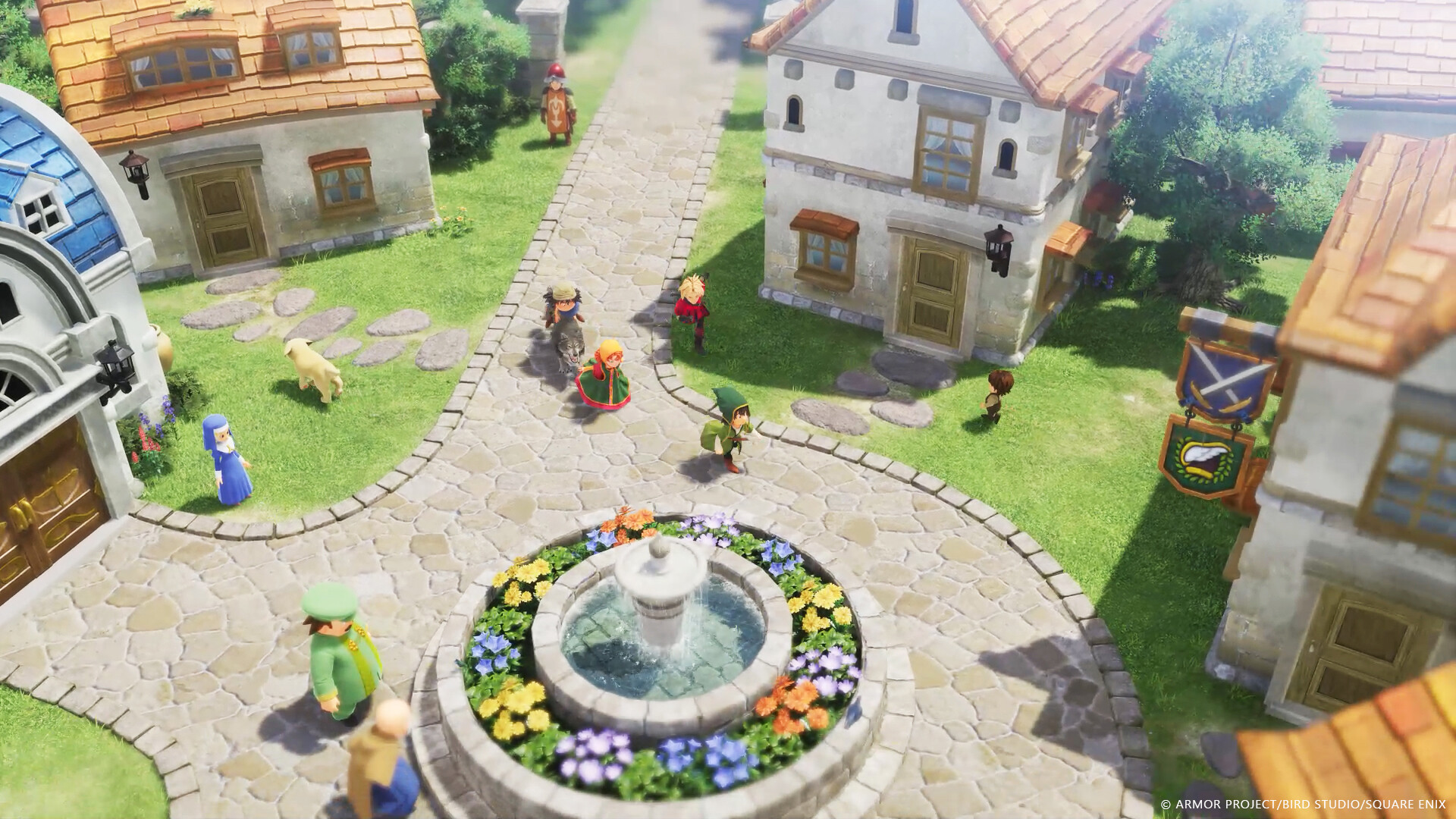
"Perhaps the only drawback for me is the strange depth of field effect, which also causes some pop-in for certain environmental assets. It was also present in Dragon Quest 3 HD-2D Remake, and while it’s not as annoying, I still found it distracting."
Even with such extensive streamlining, Dragon Quest 7 Reimagined is still a sizable experience. It’s also quite gorgeous, retaining the original’s aesthetic and seamlessly translating it into the modern age. The development team’s approach to creating the character models – where it handcrafted dolls for the main cast and scanned them in – and setting up the towns as these dioramas pay incredible dividends. Perhaps the only drawback for me is the strange depth of field effect, which also causes some pop-in for certain environmental assets. It was also present in Dragon Quest 3 HD-2D Remake, and while it’s not as annoying, I still found it distracting.
Regardless, Dragon Quest 7 Reimagined is a winner in almost every way that a mainline entry in the series should be. It has a compelling plot with lovable characters, interesting locations with unique tales, an enjoyable combat system with more than enough depth to its character-building, a stellar presentation, and yet, it all feels so seamless and easy to digest – like a cozy novel that you’re eager to return to. If you’ve ever balked at trying to play through the original, then it comes highly recommended.
This game was reviewed on PS5.
THE GOOD
Doll-like character designs and diorama environments look striking. Fully orchestrated soundtrack is a delight to listen to. Streamlined elements help the pacing immensely and discovering new islands rarely feels dull. New combat features make for increased build variety.
THE BAD
The bizarre depth-of-field effect returns and is still annoying. Takes a while before you get the option to choose other Vocations or multi-class. Some locations can feel slightly rushed.
Final Verdict
Whether it will bring on those who couldn't get through the original or not, Dragon Quest 7 Reimagined is a finely honed role-playing game and a fitting retake on a divisive classic.