Reach the end of the story in your own way” is a sentiment that constantly comes up in this day and age of role-playing games, and not just because the genre has become so fluid. Some stories are A to Z, progressing from one point to the next while filling the space with character development, random battles, and minigames. Others encourage defining your path – deciding what your journey should be, regardless of everything that happens. In both cases, your choices are ultimately yours on a personal level.
And to my surprise, it’s amply apparent in Playground Games’ Forza Horizon 6.
You could be forgiven for the confusion. “When was it announced to be an RPG?” Well, never, but that’s what we’re here to discuss. For me, it’s less that the genre’s tenets and features have become so intertwined with just about every single title out there, be it the RPG-ification of mainstream franchises like Spider-Man, and even College Football.
Yes, you could point out several RPG-lite systems in Forza Horizon 6. Base-building and really making a house feel like your own? Earning skill points? A post-game area that feels more like an end-game? It’s all here, and that’s before we get to the diluted version of the Hero’s Journey, where you start from relatively nothing and ascend the ranks to become a Horizon Legend.
Rather, it’s impressive how Playground Games laces in a real role-playing bent, complete with loot, to really make the player’s journey their own. Not that you’ll decide how to save the world or which of your companions will die, but what ultimately defines your playtime.
Past the amazing Prologue, which offers a quick montage of different activities – a Touge battle among sakura, a mountainside race in the snow, a mad rush to the Festival site before a rocket takes off – it’s clear that Forza Horizon 6 wants you to forge your own path, and that’s most apparent in the map. There are a plethora of points of interest to explore, and all the activities of past titles are laid out for you to just drive into, thanks to the new fog of war.
But it’s as much a narrative hook – alongside the returning Wristbands – as it is serving a gameplay purpose. You’re an outsider to both the competitive racing scene and Japan. And while the need for speed is strong, you’re not given free rein over the fastest cars immediately because you haven’t proven yourself. Think of it as the equivalent of starred quests and investigations in Monster Hunter, the Wristbands serve as a gate until you’ve cut your teeth in the Horizon Festival’s many races.
Yet Forza Horizon has always been about more than simply competing – it’s exploration, car culture, learning about the local customs, and truly becoming immersed in the world at large. The latter is especially important in a role-playing game because, without any emotional connection, you may as well be racing through beautiful movie sets that mean nothing to you. And while that might be the case for some, Playground Games has put in extensive effort to ensure that Japan actually speaks through the environment.
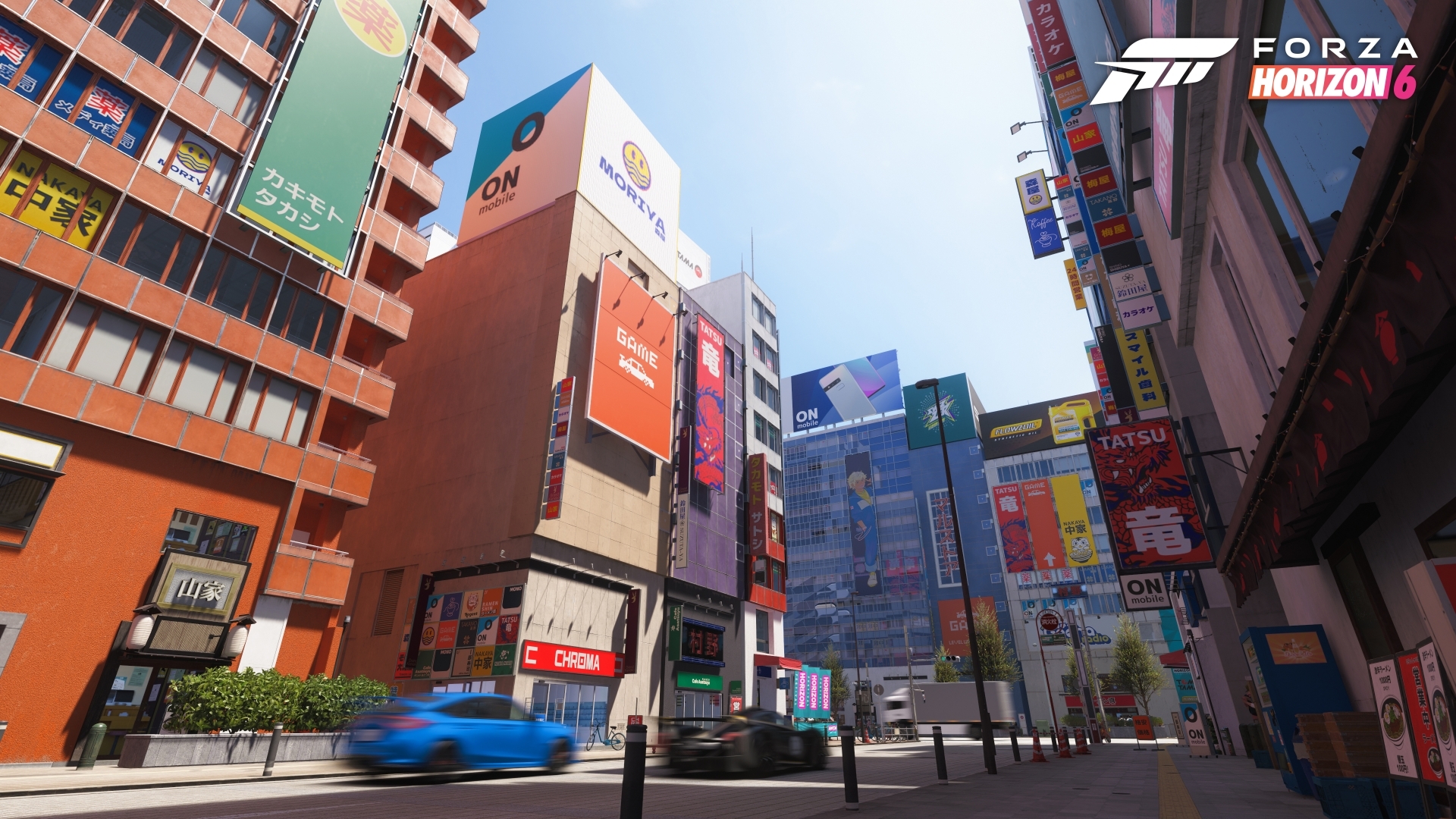
It could be late-night drives past the local konbini or the gradual transition from cityside to countryscape; gliding along the coast while listening to J-pop classics; or simply planning a trip to Mt Fuji. The attention to detail in the surroundings speaks to the player, and the non-verbal nature of it all is fascinating to witness up close.
Other stories can be more direct yet broader in outlook, as you focus on helping Yuji locate cars or embark on a tour with Mei. But once again, getting out there and discovering things first-hand is of the utmost importance. It could be something as straightforward as smashing billboards and mascots for XP or to earn those stamps in the Collection Journal, but it can also mean discovering something special in different regions, perhaps even photographing the different landmarks.
For some, these experiences could still very much qualify as the usual open-world affair, but Forza Horizon 6 makes their discovery more organic and incidental. You’re rewarded for getting out there and seeing what Japan has to offer – it’s just that cultural enrichment that goes hand in hand with the same. And if that’s not enough for those who want a more tangible reward, you’ll happen upon different Aftermarket Cars and Treasure Cars upon exploring, each differing from the base model in unique ways. They’re almost like loot in a sense, especially with how significantly they can change a familiar car’s performance.
It’s funny to consider all of this because the Forza franchise has tried a Car-PG approach before with Turn 10’s latest (and hopefully not last) Forza Motorsport. Each car had levels – racing would garner experience, and as you leveled up, more parts became available. The problem is that it felt like a grind, and the fact that such a major appeal of the genre – tuning and experimenting with different parts – was locked behind it proved frustrating.
Forza Horizon 6 sidesteps this by pretty much sticking to the tried-and-true formula of paying for parts. As long as you have the credits, it’s all yours at any given time, because, like many role-playing games, playstyles matter more than simply stat bumps.
Playground is instead more concerned about the experience of actually engaging with these vehicles and using them to uncover new things. Of going out and meeting the world on your own terms.
Think of it the same way as Crimson Desert, another game which staunchly considers itself an open-world game, albeit action-adventure, instead of an RPG. You could focus entirely on the campaign, venturing across all of Pywel and defeating the Big Bad while unlocking plenty of cool toys to play with. Or you could venture off the beaten path, solving puzzles, seeing breathtaking vistas up close rather than at a distance, or just improve your campsite in various ways. Weapon and armor upgrades exist alongside an extensive skill tree – across three characters no less – but these are systems that reinforce the main premise.
It’s the same thing in Forza Horizon 6. The open world is massive and, at times, seemingly boundless in the amount of content; you could see every single one of its hundreds of roads and become a Horizon Legend, unlocking Legend Island to push your limits even further. But there’s still plenty to discover, and so much to appreciate, as you hop in, pick a direction, and see what the game has to offer. Maybe it’s some new loot in the form of a car that you don’t own. Perhaps you’ll spend all day customizing The Estate, if for no other reason than to impress your friends.
And if you’re keen on playing the fashion game, take a trip to the local Car Meet and check out the many unique designs other players have. Then download them and make them your own (or just buy the stock version of a vehicle that looks appealing enough). Or do what I do: go off-road and rack up as much XP as possible, testing what inane thing could serve as a multiplier.
How is it that so many of these systems have existed in Forza Horizon throughout the years, and yet it’s never fully tipped over into the “RPG in everything but name” world? Who knows, but as with any franchise, all you need is to adjust a few variables, and the resulting experience could be completely different. So while Forza Horizon 6 is still the open-world racing sim that we know and love, with the most detailed world yet, it’s dipping its toes (tires?) ever more into a space where you decide how the story is going to play out, even if the end has already been written.
Note: The views expressed in this article are those of the author and do not necessarily represent the views of, and should not be attributed to, GamingBolt as an organization.