






Ever since its inception in 1912, the British Board of Film Classification has been the stalwart shining beacon of hope in an otherwise filthy sea of puerile perversion, or so the legend goes. Nowadays there is relatively little debate as to the clarity and the purpose of the system and has been legally binding since the Video Recordings Act of 1984, which sought that all commercially available video recordings had to be certified by the BBFC in order to receive a release.
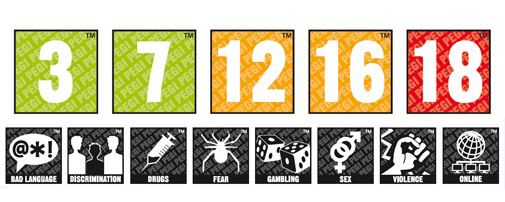 Move over BBFC, because as of today the organisation no longer certifies video games and instead the Pan European Game Information takes its place, becoming legally enforceable for the first time.
For several years, the BBFC and PEGI ran in tandem, both apportioning out certificates for games but had its pitfalls. Each system has its own criteria and as such led to some huge discrepancies, partly due to the fact BBFC classifications had their roots in film and don’t necessarily factor in the interactive element. For example the first Mass Effect game was rated 12 by BBFC and 18+ by PEGI, such huge differences meant suggest a significant inconsistency. As the Byron Review of 2007 stated, “having a dual classification system and two sets of symbols often made things confusing for the consumer”. Worse still was that whilst BBFC classifications were legally enforceable, PEGI weren’t not and even when PEGI ratings were often treated as such, they were still merely advisory.
Five years on and PEGI ratings are not only the sole ratings system for video games in the UK, they’re also legally enforceable for the first time. For selling a game to a child under the age of either the 12, 16 or 18 rated PEGI certificates, retailers could be faced with up to 6 years imprisonment and a fine of £5,000. This may be seen as taking a hard line with retailers, and rightly so in some cases, age restricted products should face universal sanctions, but the problems with video game classification grow far deeper.
Back in 2008, an Interactive Software Federation of Europe Nielsen report found that only 49% of parents surveyed found PEGI ratings ‘useful’ when purchasing a game and only 62% were even aware of the European game rating system, suggesting that vast swathes of European parents are either unaware, or simply disregard the ratings.
What could the reasons for this be? A parent wouldn’t often be found actively purchasing an 18-rated film for their children, so why are games seemingly exempt from what seems to many as ‘common sense’?
Games are a relatively young medium, having been around for a comparatively short amount of time compared to other forms, with even less time having mainstream acceptance. Is it possible that this, combined with a view that retail video games are still a pursuit for the juvenile, and as such an 18-rated game is still seen as being suitable for a 12 year-old? Or even something as simple as pier pressure?
Hopefully with the new enforcement of PEGI’s ratings will pave the way for new levels of consumer understanding. Each game now not only comes with an age rating from a single organisation, but PEGI ratings also include content descriptors, a collection of eight icons which aim to universally indicate the content and suitability of the game.
A change in attitudes towards game certification certainly isn’t going to happen over night and even now it seems quite a largely seismic shift in views has to occur following the full implementation of PEGI; an increasing number of ‘parents’ are gamers and have an increased level of understanding about the content of games, but what about those who do not?
The UK Interactive Entertainment organisation has recently launched the Control.Collaborate.Create campaign, which aims to promote the PEGI system, aiding parents in making informed decisions about which games are suitable. ‘Control’ is designed to give parents the know-how to control game content, like parental settings on games consoles, or a thorough understanding of the ratings system. ‘Collaborate’ seeks to encourage parents to directly engage in the games their children and playing and ‘Create’ promotes games as the fantastic, creative medium it is.
Similar is the website askaboutgames, which has involved famous faces like Jo Whiley, as well as competitions and blogs to help inform and educate, connecting players with games which they will get the most out of.
The implementation of a single certification system is certainly a start, and the robust of thorough nature of PEGI will hopefully stand it in good stead for the future. One problem is addressing the overall understanding of video games ratings and whilst a simplified, standardised system is certainly a start, we are far from the end.