






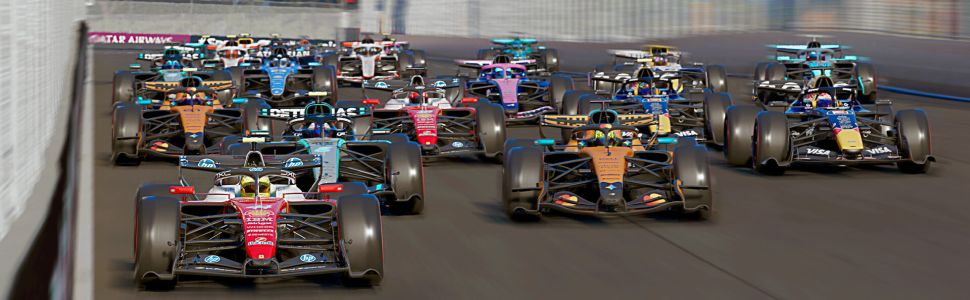
Formula 1 in 2026 is undergoing wholesale change. This season brings the largest overhaul in the sport’s history, introducing all-new, near-50/50 splits between internal combustion power and electrical energy alongside slimmer, more broadly deployable aerodynamics, all configured in smaller, lighter, more agile cars. The sport’s governing body, the FIA, wants to elevate moment-to-moment action with closer racing, fiercer battles, and more overtaking.
And, indeed, the season so far has seen plenty of exciting on-track passes, followed invariably by instant re-passes – the so-called yo-yoing effect – but the authenticity of hybrid car design is also coming under scrutiny: is racing now too artificial? Should drivers be pushing 100% of the time? Or, is battery conservation still a valid measure of skill?
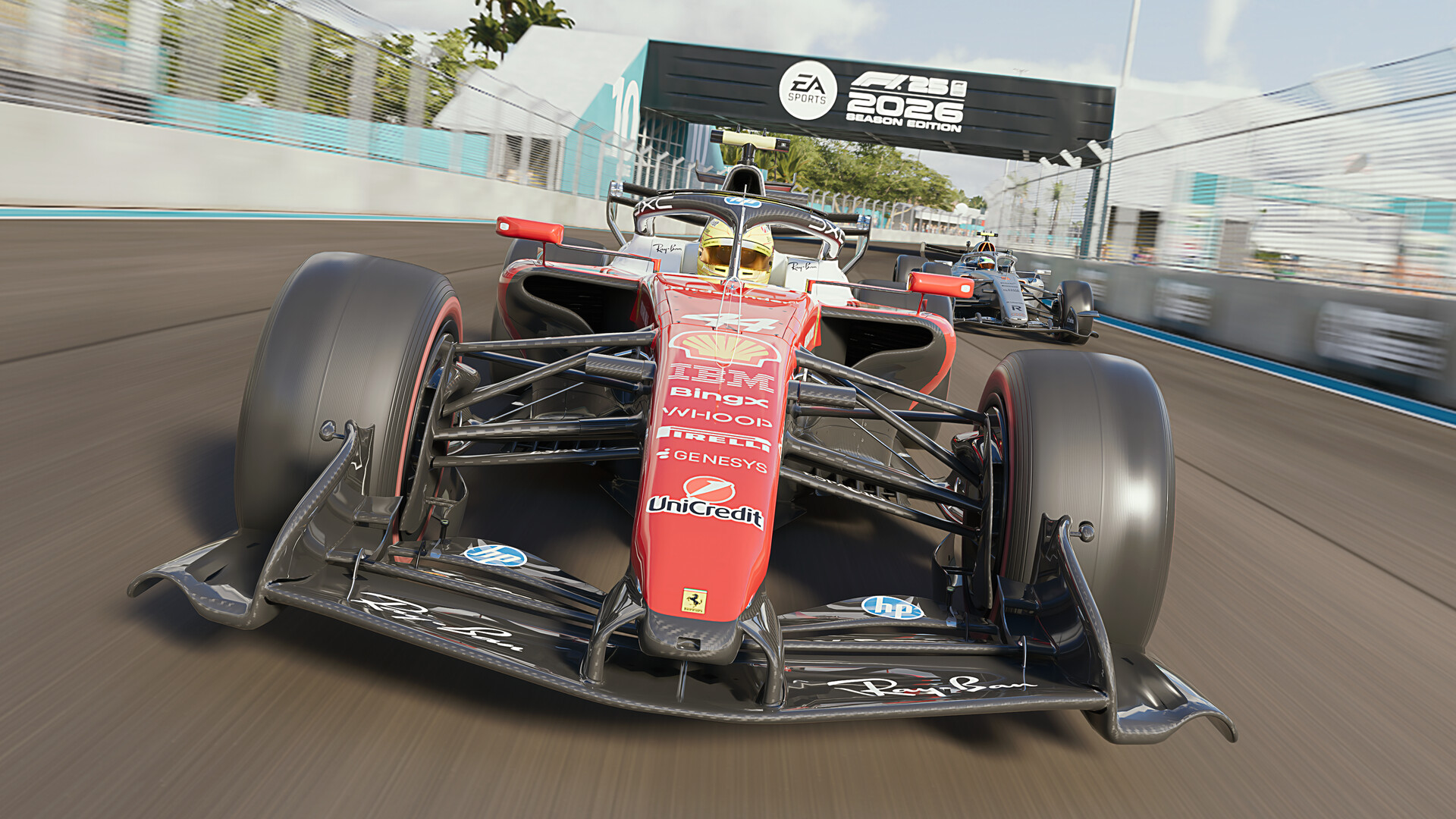
On first impression, F1’s real-life changes feel comparatively subtle in F1 25: 2026 Season Pack. The update refreshes this season’s driver line-up and liveries, introduces two new teams, and the all-new Madring circuit, but the dynamic potential of lighter, half-electric-powered cars is not immediately obvious. 2026 Season Pack is less about noticeable ‘car-feel’ swings and more about what the new regulations demand, in driving style and racecraft alike.
To acclimatise to the 2026-regulation cars I loaded into Time Trial – among F1 25’s modes incorporating 2026’s updates alongside Grand Prix, unranked multiplayer, split-screen, pro challenges, and career – with new teams Cadillac and Audi, the latter swapping Sauber’s lime green for titanium silver and flaming red.
The new Active Aero package allows front wings to open tandemly with rear wings in the same letterbox-style that defined the now defunct DRS. Both systems operate the same – open wings reduce aerodynamic drag for mild speed boosts, albeit there are more opportunities to deploy the system this season compared to the one-or-two DRS zones of earlier years.
Taking the all-American Cadillac for a spin round Austin and Miami, the car felt suitably reactive. Although – as I’ve already alluded – the difference wasn’t as pronounced as I expected. That said, as subtle as the shift in responsiveness is, I still felt a tweak of controller calibration was necessary. Specifically, I widened steering linearity to soften straight-line twitchiness.
However, these early impressions are incomplete without 2026’s revamped energy systems, so into a race weekend I went for my first taste of the new Boost and Overtake Modes. While Boost is available at any time, Overtake’s extra electrical horsepower confirms this mode as the true replacement for DRS. Not Active Aero, but the monumental power surge you access once you’re within one second of the car in-front at a designated point.
Overtake’s key distinction, however, is you have the entire next lap to expel its charge. In real-life F1, we’ve seen drivers use the system to get the jump on opponents, but also, there’s been plenty of battery-assisted overtakes in unconventional places. Indeed, in-game, along Circuit de Gilles-Villeneuve’s final-sector stretch, Overtake Mode was powerful enough that I careened past multiple cars before reaching the braking point at Montreal’s iconic Wall of Champions chicane. However, depleting my battery left me exposed to a re-pass on the start-finish straight.
Likewise, along the fleeting back-end of Melbourne’s Albert Park I breezed past the car ahead thanks to a mix of Overtake and open Aero. But, my opponent reappeared after the brisk left-right of turns eleven and twelve, presumably conserving battery along the straight with the plan to re-take the place immediately. They secured the pass long-before turn thirteen’s mid-weight braking zone, and having depleted my battery I was unable to counter.
"Clipping in the 2026 Season Pack is inconsistent."
So, the lesson: if you think hitting Overtake is a one-and-done manoeuvre, think again. Yes, opportunely deploying excess power is an effective attacking strategy, but you rely on your battery for defence, too. Upon this realisation, the subtleties of 2026’s battery-spec come to the fore: see, depletion comes at a much faster rate than last year, so you need to take a more active role in harvesting. In 2026, the real-life cars do this under-braking and by lifting and coasting – easing off the throttle early before engaging the brake – and by superclipping – that is, when the engine deliberately siphons power to the battery, creating a polarising scenario where cars slow at full speed, soundtracked by a dip in engine revs.
Clipping in the 2026 Season Pack is inconsistent. Where the relatively short run up to Austria’s sharp turn-three presented downturned engine power, coinciding with a welcome recharge, I didn’t experience the same effect on Shanghai’s 1.2km back straight – a place I’d expect superclipping to be prevalent. Some clarity would be appreciated; while your race engineer describes lifting and coasting, and suggests using boost on corner exit as a way to counteract any pre-corner shortfall, superclipping isn’t mentioned at all. Whether you’re a fan or not, clipping needs to be a fully-fledged feature to ensure the most immersive simulation.
So, the most effective recharging is done by lifting and coasting, which for most will mean adapting your driving style. I found that flowing tracks like Qatar’s Losail International Circuit made lifting and coasting – or, in other words, driving deliberately more measured – quite enjoyable. Throughout its long sequences and the absence of heavy-braking zones, Losail became an opportunity to refine my throttle control. And, during races, Qatar doesn’t demand energy management as strictly as the aforementioned Albert Park or Circuit de Gilles-Villeneuve – the latter going further to expose some bad habits too. Now, more than ever, nailing your exit to turn-ten’s hairpin is crucial to securing a pass on the following straight with battery to spare.
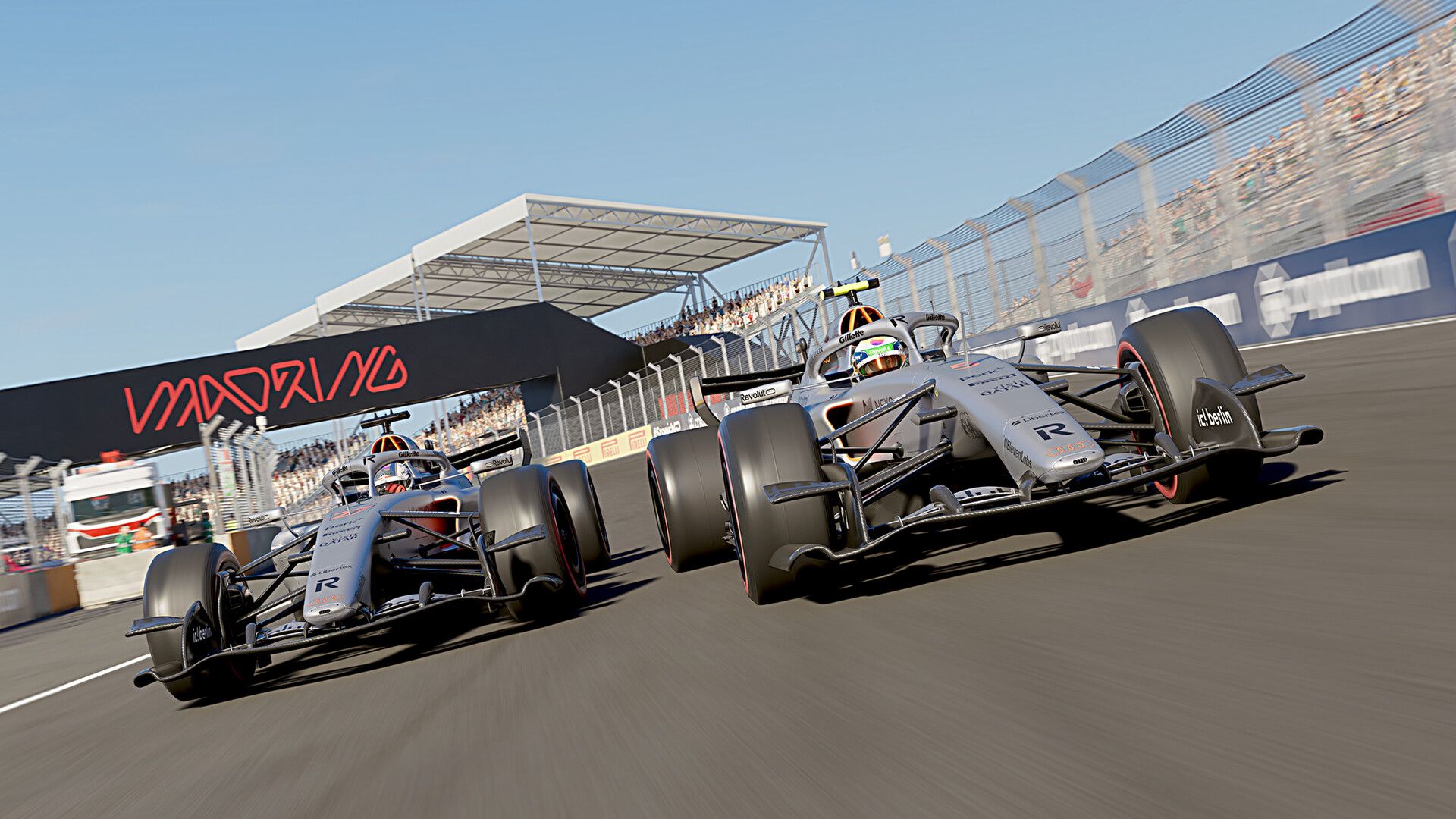
But, while some pre-existing circuits require fine-tuning muscle memory to extract the best performance, Madrid’s all-new Madring circuit is a different beast entirely. It’s tight, twisting, varied, and unfamiliar; a strange feeling, admittedly, racing around a circuit that real-life F1 has yet to visit. Alas, what’s unfamiliar forces proper learning, and a chance to explore potentially unconventional overtakes afforded by this year’s batteries.
See, before Las Vegas and Baku, F1’s street circuits were notoriously difficult to overtake. With Madring, its attacking potential would be unclear if it wasn’t for 2026’s regulation changes. There’s an early-lap opportunity to drag-race toward a tightening chicane where electrical horsepower gets the pass done early. If Madring had appeared on last season’s calendar, this manoeuvre wouldn’t have been viable.
Likewise, I was caught out on the briefest zip toward the final corner, showing that even marginal straights yield opportunities for passing. Whether these scenarios play out similarly when F1 visits the circuit is unknown, but Madring makes for an enjoyable experience in 2026 Season Pack regardless.
"My only gripe, really, is that the strategic potential in the 2026 regs isn’t fully explained."
And that’s the thing: the strongest critique of 2026’s regulation changes accuse the FIA of ‘gamifying’ Formula 1. And while that debate is ongoing, in F1 25: 2026 Season Pack those ‘game-like’ changes translate into a tactical tug-of-war, where energy management boils down to a risk-versus-reward mechanic. Whether you’re recharging for one final qualifying lap as the clock ticks down, or you’re desperate to stay ahead of the pack as your battery’s running on empty, F1’s 2026 regulations expand on-track tension. Through refined throttle control, tactical energy use, occasional ERS trains forcing you toward unconventional overtakes, or the dreaded speed differentials between power surging and battery harvesting cars, you’ve more on your plate in F1 25: 2026 Season Pack than ever before.
My only gripe, really, is that the strategic potential in the 2026 regs isn’t fully explained. Sure, your engineer outlines the fundamentals, but it would be appreciated if onboarding suggested more conclusive ways to use the battery-powered tools for tactical attack and defence. Likewise, practice programs appear unchanged. In my view, this is a missed opportunity to train you on how to extract your battery’s potential. Mid-race dynamic objectives have been updated – in one example my engineer asked me to deploy my battery past a certain threshold before the end of the following lap – but by this time you’re already in the thick of it. My strategic ideas glean from watching F1 for real; casual fans who don’t pay close attention to the sport will have to figure it out for themselves.
So, whilst F1 in 2026 is something of a revolution, in F1 25: 2026 Season Pack these sweeping overhauls are more of an evolution. While the changes aren’t as dramatic as you’d expect, newly meaningful strategy emerges during moment-to-moment racing once you’ve a handle on the battery’s tactical potential. What I’m most appreciative of, though, is that the 2026 Season Pack refines the experience in ways that demand more deliberate driving.
This DLC is more than a re-skin, and fans of the series should be eager to access the update before F1 27’s purported revamp.
This game was reviewed on the PlayStation 5.
Energy management makes racecraft more strategically intentional. Precise, more deliberate driving is encouraged. Flowing circuits, and the new Madring track, highlight satisfying car control.
Lack of proper onboarding for new systems. ‘New’ handling feels too subtle at first. Superclipping’s lack of clarity underlines small immersion cracks.