







In an era of live service commitment, roguelike challenge, ultra-serious prestige action, and endlessly monetised, competitive multiplayer, there’s an overriding feeling that mainstream games are becoming overly-engineered. Designed, principally, to keep us hooked indefinitely.
So, whilst Lego Batman: Legacy of the Dark Knight harbours an open-world checklist of sorts – the kind to keep you ticking over between meaningful story beats – it’s also bringing something deceptively simple that many modern blockbusters overlook: joyful, chaotic, family friendly play.
TT Games’ Lego franchise has always harnessed the child-like imagination a mass of unsorted Lego bricks imposes; the skittering cascade of plastic clicks as your hand wades through a loose pile, eruditely distilled into gleeful gameplay. If there’s one area the series risks over-playing, it’s nostalgia, which might have given TT a headache during development as Legacy of the Dark Knight spans influence from every Batman era – from Adam West’s campy 1960s turn, through Tim Burton’s high-fantasy to Matt Reeves’ contemporary gothic-noir.
Yet, Lego Batman avoids overly-romanticising the past, instead spinning The Dark Knight’s many archetypes into a singular, self-contained experience that is then fleshed out by the series’ trademark irreverence and fondness for unexpected cross-cultural references. So, whilst you might have expected the menacing cartoonishness of Jack Nicholson’s Joker, there won’t be many who foresaw an American Psycho gag in a Lego game.
The game treats nostalgia like a pile of bricks. It’s not recreating the past, but recombining it.
But, that’s not to say Lego Batman allows nostalgia’s pitfalls to dilute its ambition. Whilst it appears structurally simple – like the loose bricks analogy we keep returning to – this isn’t a narrow, level-based romp but a fully realised take on Gotham City, complete with open-ended exploration, multi-layered mission design, and a surprising degree of mechanical variety. Combat, for starters, borrows liberally from the rhythmic flow and reactive weight of Batman’s Arkham series, while stealth, gadget use, and character switching introduce a measure of flexibility that goes beyond simple button-mashing.
On paper, it’s easy to write this off as “just another Lego game”. Indeed, many already did before its flood of positive critical reception. What we know now is this isn’t a familiar formula applied to a globally-recognised license, but a curated distillation of what makes Batman work in the first place, dismantled and reassembled into something broad, well-considered, yet still playfully messy. The crucial thing to understand here is Lego Batman’s playfulness doesn’t oppose its ambition, but expresses it in a way that’s universally appealing.
Contrast this to the many big-budget games that are, for better or worse, structured around retention. Is there anyone else, for instance, who agrees that Marathon would draw more players if the extraction shooter also included a one-and-done single player campaign? Whilst an entirely different experience, of course, Lego Batman: Legacy of the Dark Knight still offers something radical: it’s a game that simply asks to be played before moving on. You can stray through Gotham at your own pace, unlock extra characters, or collect optional WayneTech. There’s no obligation to keep up with anything beyond your own curiosity.
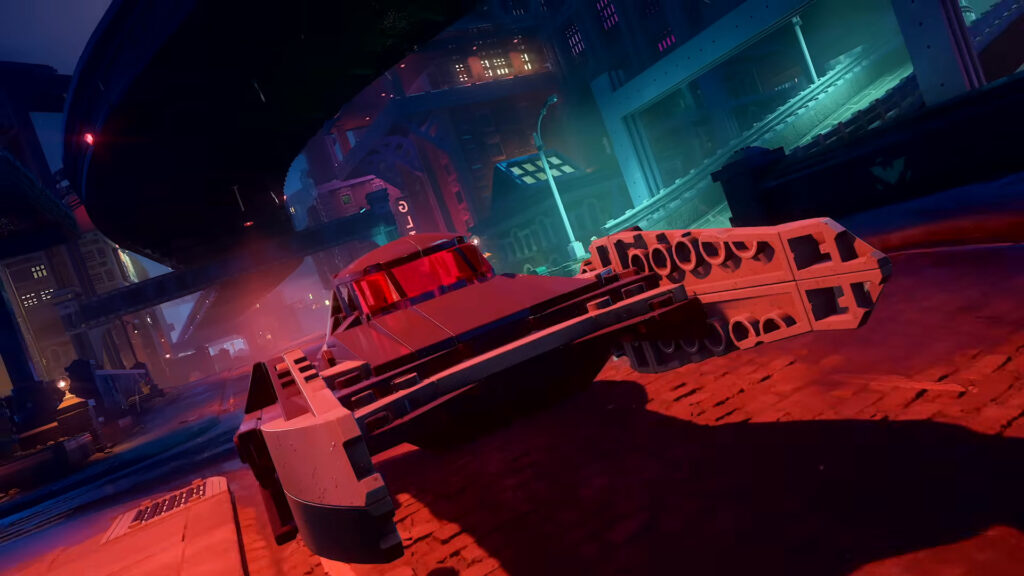
You’re loading the game up because you’re interested, then you’re doubling back for collectibles, and replaying missions with new abilities because it feels satisfying to do so. It’s a loop reminiscent of how most big-budget games used to be; complete experiences rather than eternal attention hoarders. You pick it up, shape your experience, then move on without the sense that something is occurring in your absence.
And then we have Lego Batman’s ability to portray The World’s Greatest Detective in a language shared by all ages. See, movie-going Batman is often exclusively dark, traumatic, and intense, whereas Legacy of the Dark Knight reintroduces theatrical absurdity. Even the most elegiac scenarios, like Bruce’s brutal Himalayan training at the hands of Ra’s al Ghul’s League of Shadows in Batman Begins is treated lightheartedly by TT Games. Adults will recognise the source material, while kids see colours, explosions, and chaotic stimuli. Both are valid experiences. The juvenile mindset enjoys smashing that pile of loose bricks, scattering them across the floor, while grown-ups envision building houses, bridges, and maybe even grander structures like citadels and cathedrals.
This is where the Lego series is uniquely placed to reach a wide audience without dumbing down the experience. Yes, younger players might be discovering Batman for the first time, the older generation might have grown up with Lego, casuals might want easy-to-learn systems, while completionists will be exploring every hidden collectible. Add to this Lego Batman’s suite of accessibility presets – from vision, motion, and motor function modifiers, to difficulty sliders, event skipping, and, perhaps the most crucial for any parents playing with their kids, the option to retain studs after defeat – then the possibilities become the sheer opposite of shallow. Accessibility, here, is how the game truly functions as a communal experience.
There is, however, mechanical nostalgia that younger players might not pick up on. Lego Batman’s combat echoes Rocksteady’s Arkham series precisely, not just to invoke its fluidity, punch, and potential, but as another finely-tuned, rose-tinted drip feed. Furthermore, it connects the game to a lineage of strong, single-player games while reassuring experienced players that there’s still plenty of meat to chew on. The idea Lego Batman suggests is that publishers shouldn’t underestimate the gravitas of single-player, as broadly speaking, superhero licenses, shared experiences, and big IP adaptations – IO Interactive’s upcoming 007 origin story notwithstanding – generally focus toward online ecosystems. Legacy of the Dark Knight’s reception shows that, instead, there’s appetite for generous, content-rich, self-contained single-player narratives.
There’s also something specifically important about how the game approaches shared play, where the borders created by separate screens, spaces, or even entire countries are eroded, turning Gotham into a city that can be navigated, disrupted, and laughed through side by side.
As anyone who’s completed one of a growing number of same-screen co-operative games will tell you, playing Split Fiction or Overcooked together on the couch changes a game’s rhythm. Progress becomes conversational, improvised, sometimes casually argumentative. It’s human interaction through digital collaboration, and it’s something which the Lego series has been a torchbearer for generations.
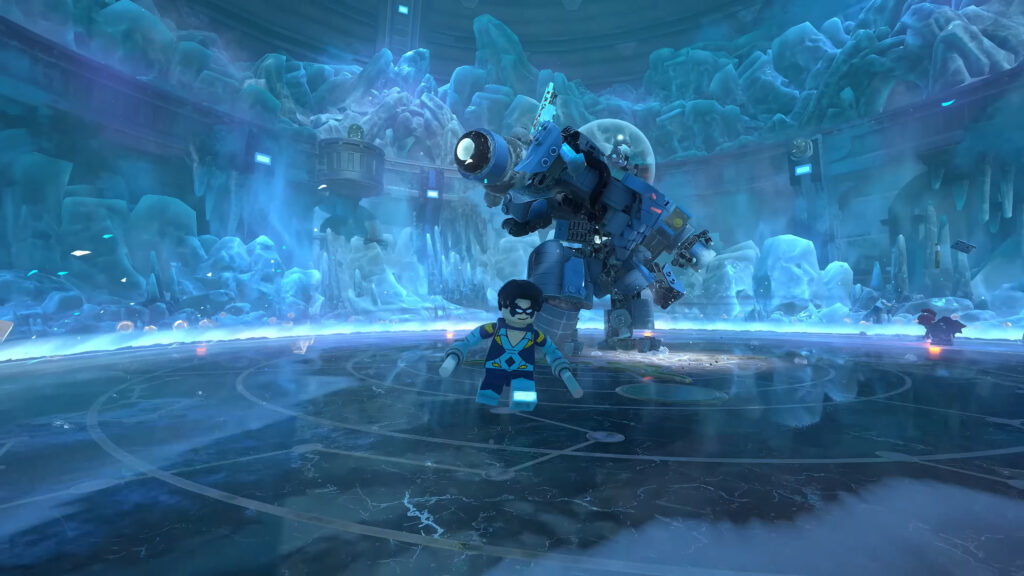
In a way, it mirrors the physical act of building freeform with Lego itself. Pieces are passed back and forth, ideas overlap, and structures take shape through collaborative input. Lego Batman’s digital experience captures the same tactile possibility, where on-screen movement, exploration, and combat becomes the allegorical product of two players working in sync.
Now, it’s tempting to label this as mere iteration. Another pass, it seems, at a roadworn formula. But Legacy of the Dark Knight shows that the Lego formula isn’t an issue. Like a box of bricks, its value lies in how it’s used. With a stronger identity, better systemic cohesion, and a clear understanding of what makes Batman compelling – areas that, admittedly, the Lego series has struggled with over the years – then the loose bricks feel newly purposeful.
And maybe this is the wider lesson licensed games can take away, that they don’t need to chase scale to find an audience. If they understand the fantasy running through its core – the gadgets, the villains, the vast showroom of Batmobiles, in Batman’s case – then the rest can be built around it. Lego Batman, then, succeeds precisely because it doesn’t reinvent his enigma, but reassembles the composite parts intently, brick-by-brick.
Note: The views expressed in this article are those of the author and do not necessarily represent the views of, and should not be attributed to, GamingBolt as an organization.