




Surprise! A maligned-at-the-time The Lord of the Rings title, which subsequently grew into a cult favourite, has received the remaster treatment. The Lord of the Rings: War in the North – Legacy Edition follows Elf Mage Andriel, Dwarf Warrior Farin, and Human Ranger Eradan as they run diversion tactics, thinning Sauron’s forces across Middle-Earth during Frodo’s quest from Rivendell. On paper, Tolkien fans have much to salivate over, as the trio clear destinations only mentioned in the author’s appendages while remaining unvisited in Peter Jackson’s trilogy.
Legacy Edition brings a suite of modernisations, and overall it’s a competent revival which makes the original more comfortable to play – especially for solo players. That said, nothing studio Aspyr Media brings fundamentally changes the path already laid by the old game. In short: the facelift is good, but some wrinkles can’t be ironed out.
"Disappointment fades as you level up each character, with more defining skills and abilities unlocked through their individual skill trees."
But, let’s start with a positive, and an important addition to solo play: character hot-swapping. Now, you don’t have to commit to a single archetype per campaign playthrough but can freely switch between them. Together with secrets and hidden areas now being visible to the whole party, plus health, mana, and XP permanently shown in the HUD, solo play is a much more viable endeavour than it was back in 2011.
Yet, as your War in the North journey begins, you won’t notice much distinction in each character’s combat style. Their early abilities feel remarkably similar in both manoeuvre and power. Dwarf Farin and Ranger Eradan even unlock comparative melee special attacks. It’s an initial disappointment, albeit rooted in the understanding the original game was heavily skewed toward three-player co-op. But, regardless, that disappointment fades as you level up each character, with more defining skills and abilities unlocked through their individual skill trees. Andriel the Elf Mage, for instance, learns increasingly powerful shockwaves for area-of-effect control, while Eradan can wield a blade in each hand.
As an aside, a pair of axes instead of a two-handed slab of steel isn’t necessarily the most optimal choice for Eradan, but visually it’s more striking. Through gradual stat increases and unlockable skills, character identity reveals itself, and synergies between team mates emerge. Although, a couple of noticeable drawbacks stop the process from being one of true experimentation. First, given Farin the Dwarf’s skill tree covers ranged specialisations, it seems prudent to invest stat points into his long-range ability, otherwise you won’t experience the full potential of his skill tree.
And second, and perhaps more glaring, the option to respec skill tree points comes at an exorbitant cost, leaving you committed to a particular build. So, if you decide mid-journey that you prefer Eradan with a weapon in each hand, you can’t take points out of his swordplay to reassign to dual-wielding, unless you save some mighty coin. Alongside the numerous quality-of-life updates Aspyr brought to the remaster, failing to soften the friction in character customisation seems a glaring oversight.
"The game’s underlying combat, for all these flashes of cinematic, arcade flair, is relatively basic."
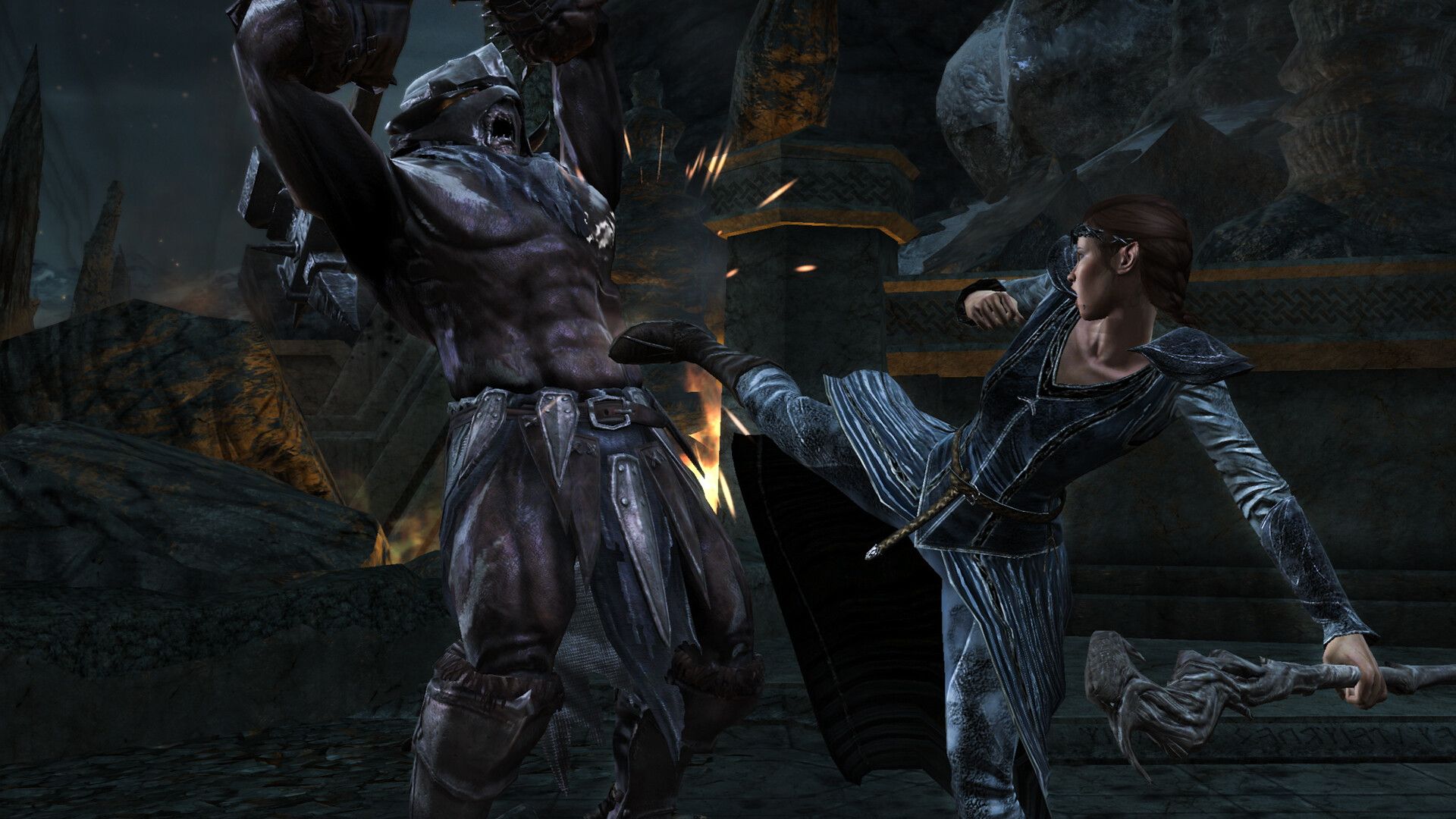
But, you don’t need to find your weapon of choice to find spectacle in War in the North’s combat. While its foundations are functional – light and heavy attacks, dodge rolls, blocks, and the aforementioned melee specials – there are glimpses of visual flair befitting of Peter Jackson’s blockbuster cinematography. For instance, enemies can be worked into a stunned state, indicated by a yellow arrow above their heads. Executing a heavy attack here unleashes a powerful stab, slash, or dismemberment; a critical strike or finishing blow often accompanied by a zoomed in slo-mo so you can savour a flailing Orc limb.
Chaining attacks together boosts the damage extolled too, displayed in an arcade-style on-screen multiplier. Chasing the highest strike numbers without getting hit yourself became a mini-game unto itself, partially alleviating the repetition in bashing light and heavy attacks while waiting for your special to cooldown.
See, the game’s underlying combat, for all these flashes of cinematic, arcade flair, is relatively basic. Broad hitboxes soften the frustration of frequently missing your swing, yes, but occasionally awkward camera angles and an oversensitive target lock-on – something Aspyr refined for this remaster – mean skirmishes, overall, lack the polish of modern titles.
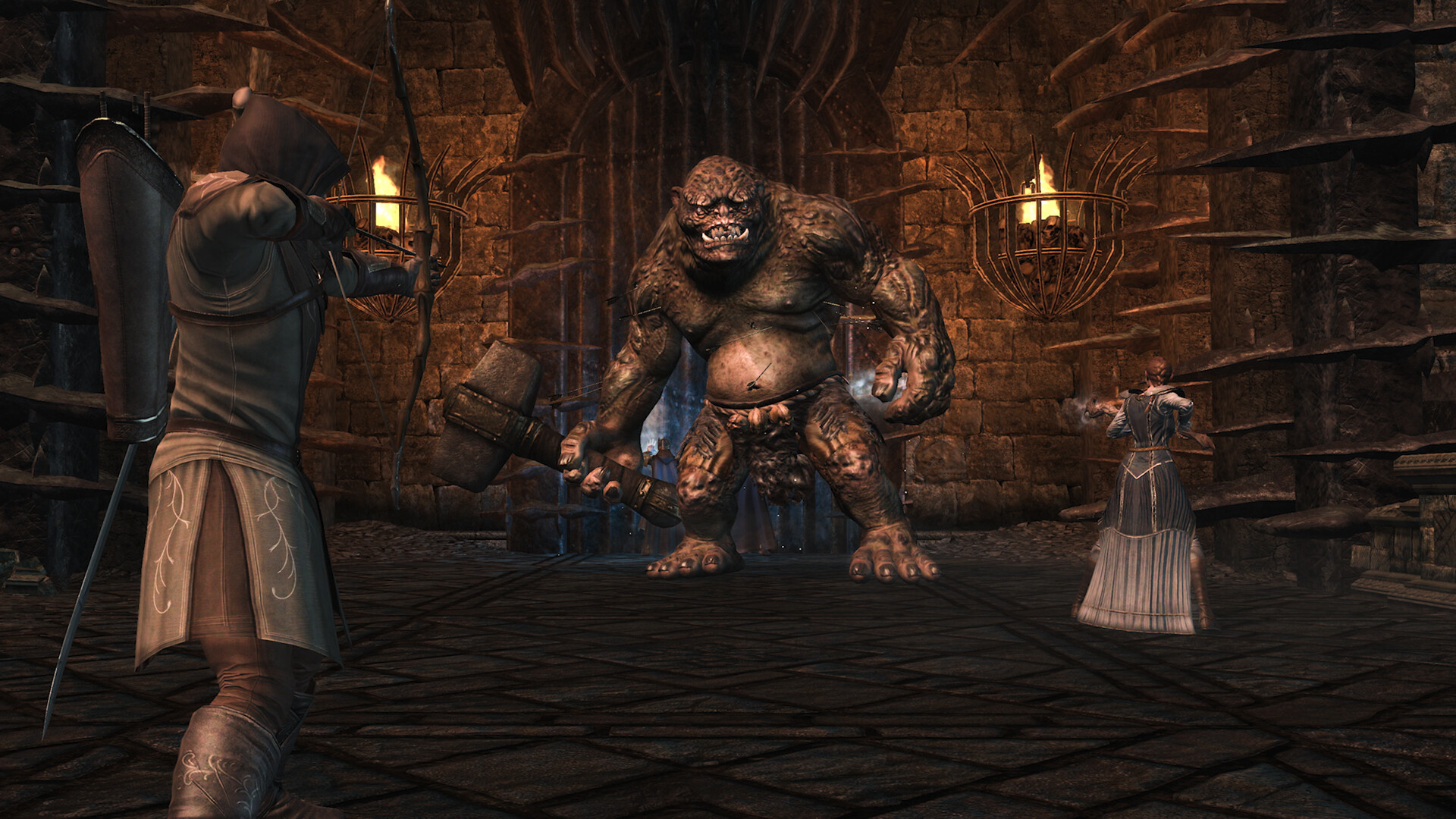
Worse still, enemy variety rarely evolves throughout long chapters, while trolls and other big enemies aren’t accompanied by recoil, feedback, or health bars. Structurally, you’ll be undertaking largely the same activities throughout each dungeon, too, with a loop following transitional spaces to arenas to waves of enemies back to transitional spaces, repeating for a couple of hours. This means that War in the North occasionally looks like the epic The Lord of the Rings action RPG it wants to be, but rarely feels like one.
So, whilst combat, in essence, is fun – especially when playing co-op – these grievances become incongruous: individual fights aren’t necessarily bad, it’s just that the game asks you to do them over and over again. Shorter levels could make progress more palatable, sure, and it’d certainly hasten the story, but when the same boss appears multiple times, hammering through chapters becomes attritional when it should feel varied and dynamic.
While the remaster does an amicable job of strengthening the solo experience, certain sequences expose the cracks Aspyr tried to hide. Case in point is the proliferation of turret segments in chapter one. Usually, in co-op, one player fires the turret while the others protect them, dealing with any enemies who filter through. But, despite the remaster refining your team’s AI, they still don’t appear interested in protecting the turret operator, leaving you exposed by an artificial difficulty spike. Couple this with limited healing resources, and difficult sections will need to be retried with an inability to restore health, making them doubly difficult.
"While the remaster does an amicable job of strengthening the solo experience, certain sequences expose the cracks Aspyr tried to hide."
If you do happen upon a shop between bouts, then you’ll have to manage the buying and selling of inventory and resources for each character if you’re fighting solo. It’s not a deal-breaker, but the still-clunky UI exposes some inefficiencies between collecting and outfitting each squad member. All in all, while solo play is more viable than ever, War in the North is still geared toward co-operative play – it’s the most ideal for minimal friction and maximum enjoyment.
Elsewhere, the original’s bugs and technical issues appear to have been addressed, while 60fps performance was smooth throughout, an occasional frame skip as enemies load into an arena notwithstanding. Auto-saving and free character swapping are genuine improvements, while Aspyr also preserves the original’s gritty Lord of the Ring’s atmosphere despite sharpening the fidelity. The remaster’s issues, really, are foundational. In other words: they’re unchangeable unless a more thorough revamp was undertaken.
Long, repetitive level design and enemy encounters, awkward cameras, functional combat – these can’t be as readily improved as HUD and technical performance can. Whether there’s an audience sizeable enough for a The Lord of the Rings game whose legacy is overshadowed by a pair Middle-Earth titles is debateable, but there’s an irony here as The Lord of the Rings: War in the North is exactly the kind of game that should be remade as what was originally there proved enough to capture a cult following.
Alas, if you loved War in the North back in 2011, this remaster is a considerably nicer way to revisit it. If you overlooked the original, then you’ll have to ask yourself if Legacy Edition fundamentally changes enough to warrant a second look.
This game was reviewed on PlayStation 5.
Freely switching between all three heroes makes solo play more enjoyable. Crunchy finishers, slow-motion critical strikes, and arcade-style damage multipliers add welcome combat spectacle. Smooth 60fps performance, clearer HUD, autosaving, and other modernisations make this remaster a comfortable way to revisit the original.
Long, repetitive chapters make progress increasingly attritional. Awkward camera angles, unreliable target lock-on, and limited enemy varied leave combat still feeling dated.