






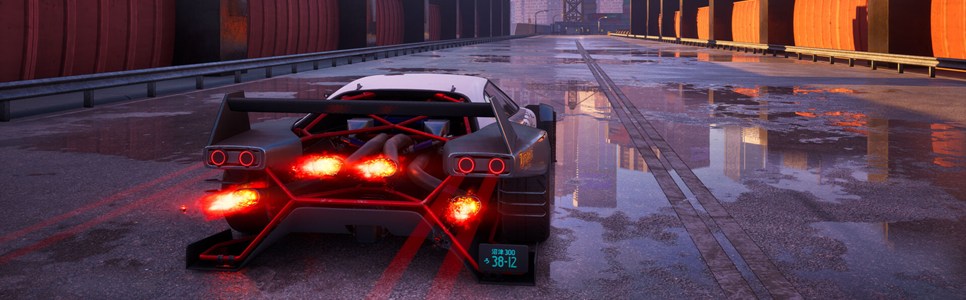
Milestone studio is best-known for their series of motorcycle sim racers, but the Italian team also has an outlandish side. Hot Wheels Unleashed, Monster Jam Showdown, and now Screamer; these racers are more than just fitting grippy tyres onto unconventional ideas to see how much traction they’ve got. They’re fully realised. And in Screamer’s case – complete with a heartfelt narrative, arcane controls, and what is best described as fighting game mechanics – unconventional might turn out to be an understatement. Before getting behind the wheel, here’s fifteen things that’ll give you a better idea of what this quirky racer brings to the grid.
An Arcade-Anime Racing Fusion
At its core, Screamer is an arcade racing throwback. It’s a reboot, after all, but that descriptor barely scratches the surface. Sure, the original’s Ridge Racer-style drifting is here, but Milestone – as closet anime fans – imbue this modern take with the style and tone of anime’s finest: Akira and Ghost in the Shell.
But wait, there’s more to this fusion: Milestone also harbours a deep love of fighting games – Tekken, King of Fighters, BazBlue, Guilty Gear, et cetera, and fighting’s influence bleeds through Screamer’s narrative setup, character drama, and on-road action. A melting pot of ideas, this may be, but rarely does an arcade racer merge spectacle, storytelling, and system-heavy gameplay with this much conviction.
Gameplay Revolves Around the Echo System
The backbone of Screamer’s gameplay is the Echo System, a futuristic tech installed on every car which fuels both racing and fighting via two intertwined resources: Sync and Entropy. Rather than simply accelerating and drifting, you’ll need to constantly manage the Echo System’s dual-gauges through skillful racing and well-timed actions. This system adds a layer of resource management rarely seen in arcade racers, where you’ll need to think beyond racing lines to consider timing, pace, and tactical use of abilities throughout each event.
Sync and What It Enables
Sync is your primary resource for maintaining competitiveness throughout races, with it accumulating independently as you drive. Once you’ve enough Sync, you can spend it on Boost (or Perfect Boost – a more substantial variant – if you time the release of your Boost input just right). Also, instead of Boost, you can wrap your car in a momentary Shield that’ll protect you from your competitor’s assaults.
Entropy and Its Combat Potential
Now, the other, offensive-minded side of the Echo System: Entropy. Using Sync generates Entropy, and this powers two attacks called Strike and Overdrive. Strike is a sharp burst of speed that’ll briefly turn your car into a powerful battering ram. Use Strike to rear-end an opponent and you’ll blast their chassis into flames Burnout-style. Yet, if you retain your Entropy, maxing it out instead of Striking, then you’ll unlock the ultimate driving weapon: Overdrive. When engaged, your car transforms into a comet-on-wheels; with shield engaged and fire trailing, destruction awaits. However, be careful: Overdrive is high-risk, high-reward. Your shield will deplete before your firepower subsides; thus, any wall tap and it’s you that KO’s.
Active Shift and Strategic Depth
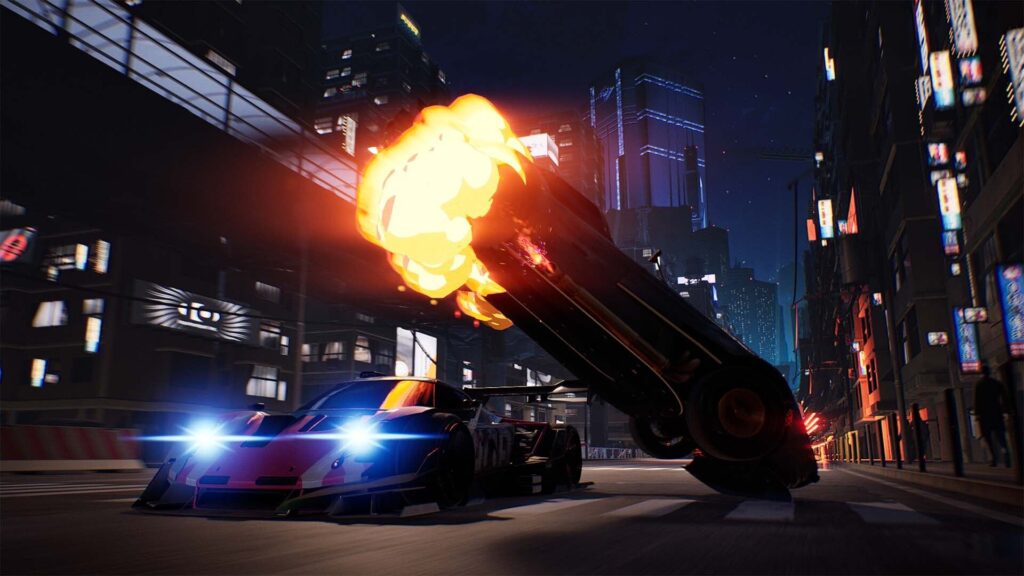
Your Sync meter charges passively throughout races through dexterous driving, but the rate it accumulates can be accelerated by performing Active Shift – an optional upshift executed at the precise moment your vehicle’s RPM passes a certain threshold, giving your engine a little push whilst filling your Sync meter. You’ll need to keep an eye on the speedometer in the bottom corner, meaning there’s an extra skill layered on top of the drift-heavy driving and Echo System management. When assessed altogether, Screamer provides a range of boosts, attacking, and defensive options, meaning races flow more dynamically than simple sprints to the finish line.
Twin-Stick Controls
Perhaps the most unorthodox aspect of Screamer is its twin-stick control scheme. You’ll steer with the left stick, while drifting is handled on the right, creating a setup which feels closer to a character action game than a racer. Early footage shows an expressive driving style is attainable, although there’ll undoubtedly be a learning curve. If it clicks – and, for anyone who’s dabbled in twin-stick shmups it likely will – then this control method could prove to be Screamer’s standout feature.
An Atypically Narrative-Heavy Racer
Unlike most racers, Screamer is placing particular emphasis on its narrative arc. The game centres on an underground, high-stakes tournament orchestrated by a mysterious figure (hello, Tekken influence). Each participating team is compelled to take part, and throughout the game you’ll flick between each entrant to experience their point of view. There’s deep, sometimes dark, character motivations, illustrated in that crisp, anime style. Story beats will play out on track too; perhaps those combat abilities will be put to good use ending someone else’s tournament? While other racers have taken stabs at meaningful stories before, Screamer’s narrative looks to be especially resonant, where progression isn’t just by winning races.
Team-Based Racing Structure
Rather than focus on individual exploits, Screamer brings a team-based structure. Each team consists of a leader and two support racers, with distinct roles across the lineup. The leader’s car is tuned for speed and precision, making it ideal for more experienced players, while support vehicles lean into combat and survivability.
Five Teams Compete
Five teams are set to compete in Screamer’s tournament, each bringing their own personality, motivations, and racing approach. There are The Banshees, who have entered the tournament for payback. Strike Force Romanda are an Idol band, recently reunited after a mysterious separation, their tournament participation supposedly a guerilla marketing tactic. Visionary scientists Jupiter Stormers bring corpo energy, with one member in particular seemingly bent on answering a personal vendetta. Anaconda Corp are a powerful band, invested heavily in above-board and seedy ventures alike, from politics to arms dealing. Criminal syndicate Kagawa-Kai are the most revered racers in the tournament – decorated, unstoppable, and ruthless.
Characters Bring Unique Abilities
Each of Screamer’s fifteen characters – split in three across five teams – brings their own unique passive ability. One racer banks extra Sync if they KO an opponent using Strike, another can chain Strikes together with a lower Entropy cost, while a third can extend their boost duration so long as you drive cleanly. With drivers focused on maximising resources, speeding to the finish line, or enacting all-out on-track warfare, the lines between racing and character-action are blurred; you’ll be choosing racers which fit your goals and playstyle.
A Dystopian Overworld Awaits
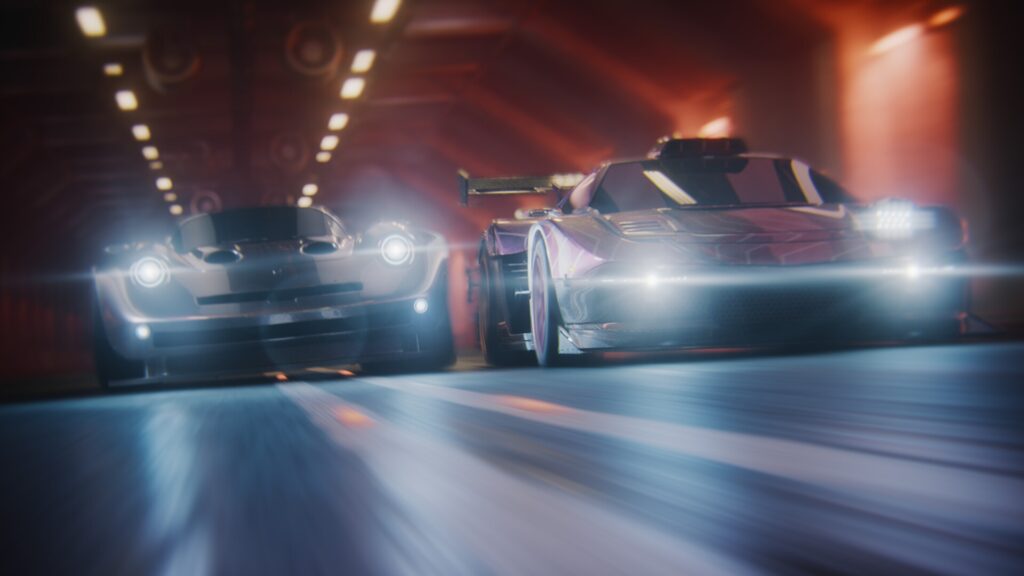
Befitting of its Akira inspiration, Screamer’s overworld is bleak and dystopian. Announced so far are three distinct biomes: Neo Rey is a steaming neon metropolis; a city of contrast not unlike Cyberpunk 2077’s Night City, utopian and nightmarish alike, with winding streets promising plenty of tight, high-octane racing. Sky Road Desert is a scorching wasteland, again reminiscent of Cyberpunk’s Badlands that surround its central city. The rather prescriptive sounding Forest #13 is one-part nature reserve, one-part geothermal power plant, an indication that even the countryside can’t escape the churning wheels of capitalism in dystopian fiction.
A Breadth of Customisable Game Modes and Multiplayer
Screamer ships with various game modes. Tournament is its de facto story mode, while the arcade menu brings a slate of customisable racing. A “Free For All” with all fifteen characters, plus Leaders only or Members only. Each features numerous augmentations: race duration, powerups, Sync generation rates, participant numbers, and more. Team Race pits each team of three against each other, with final scores determined by placement and KO’s. Score challenges, Overdrive-only races, time attacks, checkpoint races, there’s plenty here that’s tweakable. Multiplayer comes in online modes and up to four-player split screen.
Release Date, Platforms, and Price
Screamer will release to PlayStation 5, Xbox Series X|S, and PC via Steam and the Epic Games Store on March 26th. The base version is retailing at £49.99 / $59.99, while the digital deluxe version will set you back £59.99 / $69.99.
Digital Deluxe Inclusions and Pre-Order Bonuses
Pre-ordering Screamer’s Standard Edition nets you the Chromed Style Pack, which decks your cars out in a tasteful metallic finish. Pre-ordering the Deluxe Edition gives you the Iridescent Style Pack too, like chrome only shinier and more colourful. Speaking of the Digital Deluxe Edition, if you opt for this version you’ll gain customisation packs for each of the game’s five teams plus three days early access.
PC Requirements
Minimum PC requirements as per the game’s Steam listing including an Intel Core i5-9600K or AMD Ryzen 5 2600 CPU and GeForce GTX 1060 or Radeon RX 5500 XT GPU. Recommended specs detail an Intel Core i5-14600K or AMD Ryzen 7 7700X processor and GeForce RTX 4070 or Radeon RX 9070 XT GPU. No matter your setup, you’ll need 16GB RAM and 35GB storage.