






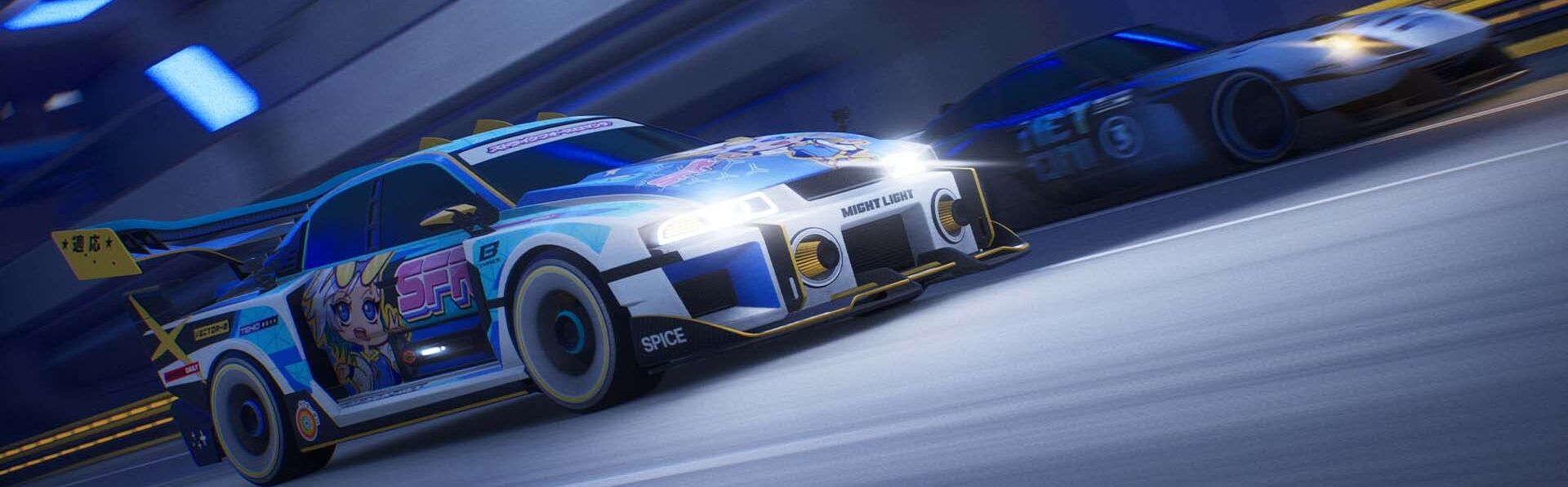
Screamer is an arcade racer which demands you rethink how you drive. Not long after getting behind the wheel, I threw out what I knew; it’s twin-stick control scheme – where the left steers and the right handles drifting – felt too alien.
Yes, I know other arcade racers have attempted such control schemes before; 2020’s Inertial Drift, for instance, already embraces twin-stick driving, but having not played it before I wasn’t primed. Shmups and other twin-stick shooters I have played copiously, but their training was no help here. No, Screamer feels a different beast entirely. The best way I can sum up its unfamiliarity is to ask you to imagine writing with your non-dominant hand: see, you know how pens work, and you might be able to grasp firm enough to put ink to paper, but the lines and squiggles that emerge aren’t your usual handwriting.
"Braking is ultra-sensitive. The slightest tap slows you enough to slide through almost any turn, whilst drifting, especially, needs only the deftest tilt of the thumbstick."
Thankfully, Screamer’s racing lines do become deliberate with practice (something that my left hand and a pen will probably never attain). Despite its unorthodox controls, Screamer shares common ground with any of your go-to arcade racers: pre-corner positioning, timing, and maintaining flow reveal themselves as you grow accustomed to your car’s particular brand of handling. Layer on boosts, perfect shifts, strikes, and other character-specific actions, and what initially felt clumsy transforms into one of the most mechanically involved racers I can recall.
Certainly, at first, Screamer’s vehicles feel heavy, powerful, and planted, like sci-fi muscle cars more than precisely tuned track weapons. This physicality only adds to the friction. Early on, I felt like machine and I were wrestling, with neither able to get a foothold over the other. But, after burning through the miles in Screamer’s numerous arcade modes I was surprised, actually, when I realised that these vehicles should be handled with finesse, not brute force.
Braking is ultra-sensitive. The slightest tap slows you enough to slide through almost any turn, whilst drifting, especially, needs only the deftest tilt of the thumbstick. Its sensitivity means that it’s often only feasible once a corner’s apex is passed, depending on your approach speed, trajectory, the width of the curve, tightness of its angle, and so on. Unwielding controls and my constant over-corrections gradually faded. Blasting through the unobstructed roads of Time Attacks and Checkpoint Challenges, eventually I found expressive driving. Drifts began to flow through sequences of corners, blending into one fluid, satisfying movement.
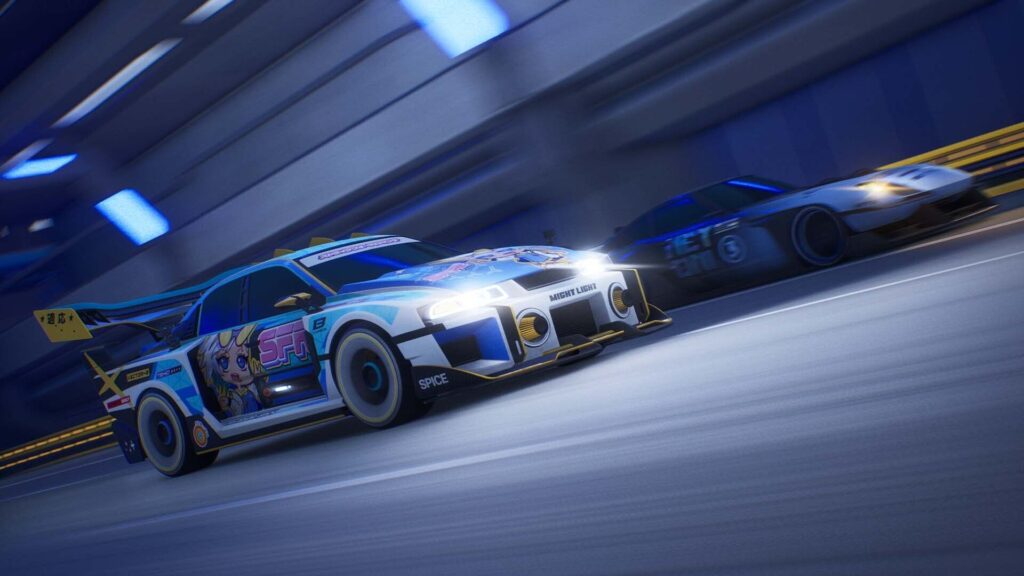
"Using Sync generates Entropy, which is your car’s fighting aggression and defence."
But, in Screamer, races aren’t just about clean lines. Upshifting gives driving a rhythmic pulse, where tapping the left shoulder button just as your tachometer hits the required RPM gives your engine a momentary push. Generous timing windows and clear visual cues signal the optimal moment to switch gears, alongside reinforcing controller vibration that makes it easy to keep focus on the road.
Crucially, the game avoids punishing mistakes too harshly, with early upshifts not killing your momentum outright; only denying you the micro-boost. This is a small, but important, distinction, and one I appreciated the developers for. See, while flow, fluidity, and momentum are achievable on isolated circuits, chaotic races make chasing perfection near-impossible.
Now, this isn’t a negative. I embrace the chaos. I’m just pointing out that the freneticness of Screamer’s wheel-to-wheel combat makes pre-corner positioning, apex kissing, and perfect drifts secondary to survival. In fact, upshifting became the only mechanic I was able to execute with consistently.
And that’s just as well: see, each of Screamer’s vehicles is outfitted with an Echo device, a futuristic contraption which gathers charge to be spent on two intertwined resources: Sync and Entropy. It’ll fill independently through collision-less driving and timely upshifts, with your Sync able to execute Boosts and Perfect Boosts, the latter a slightly more difficult version which relies on releasing its input command after a specific duration.
Using Sync generates Entropy, which is your car’s fighting aggression and defence. The Strike system slams you into opponents, blowing their chassis into flaming pieces. Overdrive transforms your car into a rocket ship, blasting any foe whilst keeping you momentarily invulnerable.
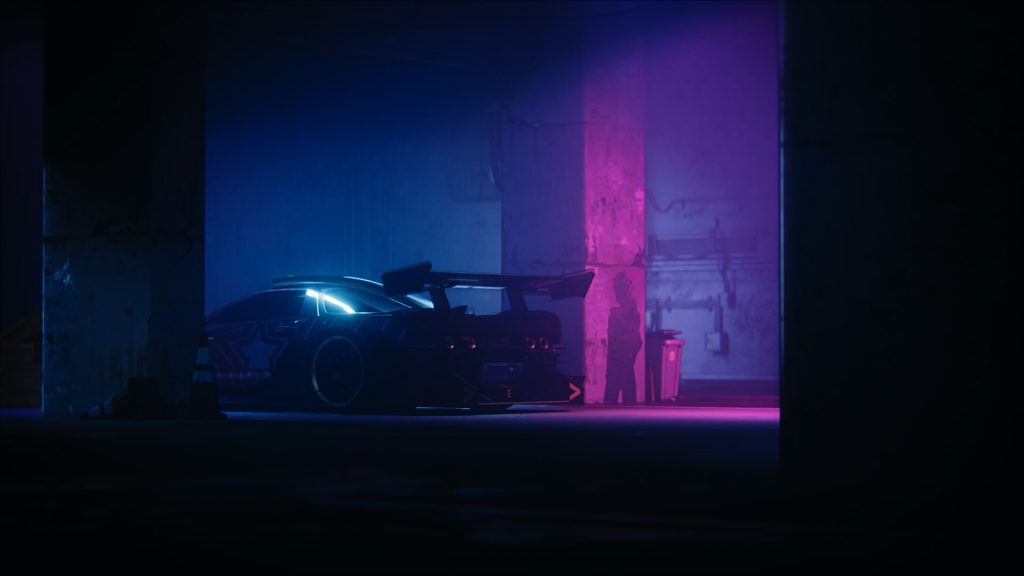
"Screamer’s story mode is where the game’s anime inspiration comes to the fore, where high-speed clashes within a dangerous tournament are framed within themes of revenge, rivalry, and corporate espionage."
When you’re in control of these systems, it feels great. A well-timed hit can swing momentum in your favour. The problem is that this sense of control is inconsistent. Opponent strikes can be difficult to anticipate, often arriving with little room to react, making certain collisions feel less like tactical plays and more like unavoidable setbacks.
Combined with the game’s lack of rubber banding, then falling behind can quickly become an unrecoverable struggle. Even if Sync generation increases when you’re further down the order, allowing more frequent boosts, its impact during the heat of battle is difficult to assess (on balanced difficulty, at least). The result: Screamer’s combat adds excitement and unpredictability, but occasionally at the cost of fairness, especially when you’re limping at the back of the field through no fault of your own.
Beyond the standard Arcade modes already mentioned, Score Challenge and Team Races highlight a couple of Screamer’s other imbalances. The former is one of the primary avenues for unlocking customisation options, where team “members” are pitted against “leaders”, highlighting a clear disparity between vehicle performance, where leader cars are noticeably faster and more competitive. Using member cars in this mode can feel like an uphill battle, creating a progression loop that feels needlessly punishing unless difficulty is lowered.
Team Races, meanwhile, hint at hidden strategic layers but they never quite materialise. The idea is that teammates balance aggression with track position, but the reality is too disorderly. With so much happening at once, it is difficult to influence outcomes beyond simply racing as destructively as possible and finishing highly. In practice, Team Races function the same as Free For All’s, just with more setup for the same payoff.
Screamer’s story mode is where the game’s anime inspiration comes to the fore, where high-speed clashes within a dangerous tournament are framed within themes of revenge, rivalry, and corporate espionage. Structurally, it unfolds through bitesize, episodic chapters which introduce the various teams, their motivations, and disquiet simmering within their ranks. There’s a clear attempt at building a cohesive world here, and it broadly works. The overarching narrative flows purposely, with intrigue steadily building the more each team’s backstory overlaps.
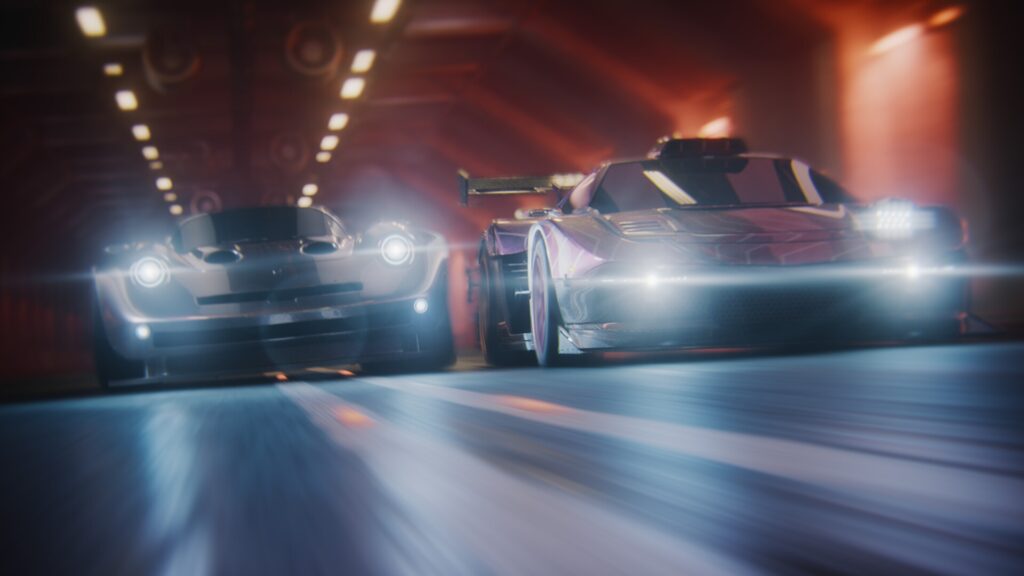
"Similarly, performance is solid, running smoothly and consistently on base PS5 amid the high-speed, effects-heavy racing."
My issue lies in its pacing. Early chapters are particularly staccato, packed with exposition and explanation with pockets of on-track action acting as punctuation rather than defining moments. Likewise, character work shows an unevenness. With the exception of fiery Róisín, whose strong motivation is elevated by memorable voice acting, each character failed to leave an impression on me. There are hints of grounded emotional arcs – Gabriel, in particular, begins to show flashes of familial burden – but much of the cast remains underdeveloped. There’s undeniable ambition here, but the presentation is too sluggish for the racing which surrounds it.
Visually, however, Screamer impressed me more than its pre-release footage suggested. Its neon-lit cityscapes, reflective surfaces, and bold contrasts give races a striking sense of atmosphere. The cars themselves range from pristine, kitted-out cyberpunk cruisers to weathered grand tourers, distinguishing the identity of each vehicle and its racer.
Similarly, performance is solid, running smoothly and consistently on base PS5 amid the high-speed, effects-heavy racing. This is something we’ve come to expect from Milestone and their prowess for optimisation. Another area the studio usually excels is sound design, yet it is a slight letdown here. Engine notes lack the raw aggression that the cars’ outlandish designs promise, creating a small but noticeable disparity between how these cars look and how they sound.
Ultimately, Screamer is defined as an arcade racer willing to take risks. Whilst initially awkward, and admittedly tiring on the hands during long sessions, its twin-stick driving is rewarding once mastered. The games supporting mechanics are deep, and while not always as strategic as they suggest, they bring an engaging loop beyond sprinting to the finish line. Issues with balance, progression, and an uneven story detract from the racing’s intensity, but overall the game’s strengths outweigh its drawbacks.
There’s something undeniably compelling here. Screamer is a racer which might not reinvent the wheel, but it stands out precisely because it dares to try.
This game was reviewed on the PlayStation 5.
Twin-stick driving, whilst initially awkward, emerges as a rewarding control scheme. In-car boost and combat mechanics give racing a pulsating edge. Graphics, performance, and attention to detail bring tangibility to the anime world.
On-track imbalance, from feeling a lack of tactical depth to downright unfairness. Stop-start story mode is let down further by forgettable characters. Sound design is middling, despite being one of Milestone’s usual strengths.