




Wrestling blends spectacle and melodrama with absurd athleticism. It’s sugar-coated entertainment; a soap opera in sport form, and WWE 2K26 understands this better than many of the series’ earlier entries. Through presentation upgrades, bolstered physics, and a raft of ridiculous props to bash your opponents’ heads with, Visual Concepts absolutely nails the mat’s theatrical chaos. Yet between matches, WWE 2K26 stutters as the surrounding gameplay often feels sluggish. In the ring, the action fizzes along. Outside, it struggles to keep pace.
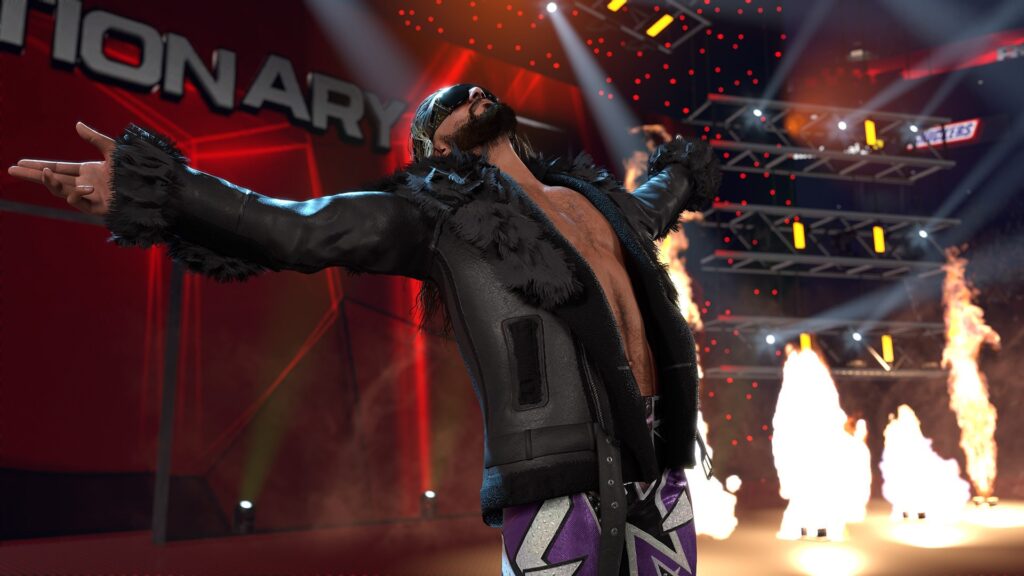
Even before the first bell, WWE 2K26’s focus on spectacle reveals itself. Interactive entrances, where you can spam pyro and crowd pleasing (or taunting) emotes on the walk to the ring project a self-curated atmosphere into an already-buzzing arena – for you and your opponent alike. Unexpectedly mercurial moments emerge: a chorus of boos overshadow the Undertaker’s gloomy entrance, for instance, his hooded silhouette lighting up as I button bash blue flames.
"Visual Concepts are leaning heavily into impact in this year’s iteration, with firmer bumps, tighter collision detection, and looser ragdoll physics elevating the drama of wrestling’s stage combat."
Then, seconds before the bell rings, you have the option to draw energy from the crowd, approach your opponent for a staredown, even offer them a handshake. Careful though, your opponent may land a cheap shot instead. Or, maybe, you’ll throw an unofficial blow yourself. I wouldn’t describe these actions as extensive, but they do bring an element of unpredictability which reinforces the sport’s theatricality. Yet, if you wish, you can skip all this pre-match pageantry and get straight to brawling – and this is where the game shines brightest.
Visual Concepts are leaning heavily into impact in this year’s iteration, with firmer bumps, tighter collision detection, and looser ragdoll physics elevating the drama of wrestling’s stage combat. Blows land with a satisfying thud, and your opponent recoils accordingly. Bodies connect with the ring’s environmental detritus with renewed force; chucking your opponent from the top rope onto steel steps, for example, lands sharply whereas earlier entries saw characters simply clip through to the floor.
However, it’s still not perfect – a table will slide under your feet, a traffic cone hits with the same force as Triple H’s sledgehammer, and ragdolled bodies will always recover no matter the height they’re launched from. More so, knowing that these mechanics were present earlier in the series makes it doubly frustrating that they’re not here now.
WWE 2K26 seems to be stuck in a middleground between arcade and simulation. Last year introduced slower, deliberate, and more methodical character movement, and whilst 2K26’s physics are undeniably crunchy the lack of material-specific consequences can be jarring. If you lob someone onto steel steps from an eight-foot height, that should be match-ending; not to mention the more ludicrous, damn-near fatal actions like slamming heads in ambulance doors.
We’ve seen motorcycle racing sim RIDE 6 toying with splitting arcade and simulation sensibilities into opposing styles that can be swapped in the game’s settings. Perhaps it’s time WWE 2K tried something similar? Of course, there are fans of the series who want to see the most outlandish moves that only a video game could produce, whilst others still appreciative of bloody mayhem might prefer more grounded action.
For me, I enjoy wrestling’s theatricality, and I understand that humour is a key part of the sport’s appeal. But should it overtake the more serious athleticism and melodramatic storylines? Having the option to switch between arcade-style lunacy and more realistic simulation settings could be the way forward. Visual Concepts – are you listening?
That said, I believe WWE 2K26 succeeds the most when it embraces wrestling’s absurdity. Of this year’s match types, the returning Ladder match is my favourite. I Quit is punishing, sure, doling out attack after attack to brute force your opponent into admitting they’ve had enough, whilst Dumpster is an unsurprising variation on Coffin and Ambulance matches.
Three Stages of Hell is a best-of-three mini-series, where you’re free to choose whichever match types you like. Of course, I find this works best when you select the most chaotic options: Hell in a Cell, Cages, Ladders, and so on. With stamina and injuries carrying over between rounds, Three Stages of Hell is a war of attrition, where grit can be a deciding factor.
The spectacle continues with WWE 2K26’s new and interactive environmental weapons. Two tables are now stackable while thumbtacks can be poured onto the floor to make a high-damage area (and permanent pins in your opponent’s back if you slam them just right). The shopping cart – found in the game’s newest backstage brawl zone The Scrapyard – is a humorous inclusion. Maybe this is supposed to be a comedy all along? Either way, you can dunk your stunned opponent into the trolley and parade them round the junkyard, smacking them in their slumber before tipping them over as they wake up.
Almost any arena – The Scrapyard included – reveals an issue with the game’s default camera. Throughout this scruffy backstage scrap, my vision was frequently impaired by stacked crates. Likewise, a concrete boundary masked my vision of Hulk Hogan as he strutted through the carpark, with the same issue arising behind near-sided barricades in more typical arenas. Third-person camera – introduced last year – alleviates this problem, immersing you closer to the action at angles you control. I struggled with the more fiddly inputs – pressing the right trigger to return the right thumbstick to its default purpose – so I would prefer the game’s default camera to be able to dynamically adjust to the proximity of the action. Likewise, an acrobatic, top rope finisher was spoiled somewhat by the camera cutting off at the torso and missing my pre-jump showboating. A minor niggle – I still won the match.
"The game’s revitalised commentary comes into its own during CM Punk’s Showcase too, expanding on the gravitas of each bout beyond a simple expanded script."
That moment was the climactic action of a thrilling CM Punk Showcase encounter. Through reliving the most pivotal moments in Punk’s career, and between-match narration from the man himself, this is the most engaging of WWE 2K26’s game modes. Punk’s detail adds context to each fight, and the whole experience is streamlined; you go from fight to narration to fight in slick, polished momentum. Detail extends to match recreation – arenas, entrances, outfits, even the bandages on Punk’s arms, are replicated true-to-life.
The game’s revitalised commentary comes into its own during CM Punk’s Showcase too, expanding on the gravitas of each bout beyond a simple expanded script. It’s another tick next to WWE 2K26’s rejuvenated presentation, and while the enthusiastic commentary isn’t as wide-ranging in other game modes, it’s definitely one of those iterative changes that enhances the game’s overall feel.
The slickness of Showcase mode isn’t replicated elsewhere, unfortunately. Throwing limbs in packed-out arenas, or duking it out in scrapyard brawls are the game’s strongest moments, so it’s a shame when the action is broken up by lengthy diversions that aren’t particularly engaging.
The Island comes with faction-based progression, upgraded quests, and a Mariana Trench-deep customiser, and whilst the mode pokes at an underlying narrative between warring organisations I just don’t find it as interesting as visiting CM Punk’s storied career. Worse still, wandering around feels clumsy, where awkward interactions with uncanny NPCs preface every fight. And these face-to-face meetings with some of wrestling’s biggest stars highlights the varying degree of attention each has received in development.
Some, like Randy Orton – standing at the entrance to The Scrapyard like a jilted security guard – are well realised in-game, whereas others are noticeably less detailed. With miniscule adjustments to ear lobe length and chin height sitting next to the more standard height, weight, and hair styles you have to wonder where the value in such complex customisation is if the character you create isn’t portrayed with the same fidelity as the sport’s biggest stars.
MyRise suffers from the same momentum-killing diversions as The Island. There’s a stronger narrative premise here, with this year’s iteration seeing you chart the resurgence of a once-retired star bent on making a tectonic comeback. But the in-ring action is broken up by strangely antagonistic backstage encounters and doomscrolling. If social media had any tangible effect on my character’s psyche then it might be worthwhile reading, but instead Liv Morgan’s detractive burn cuts to my heart and I have to reconcile that outside of the game.
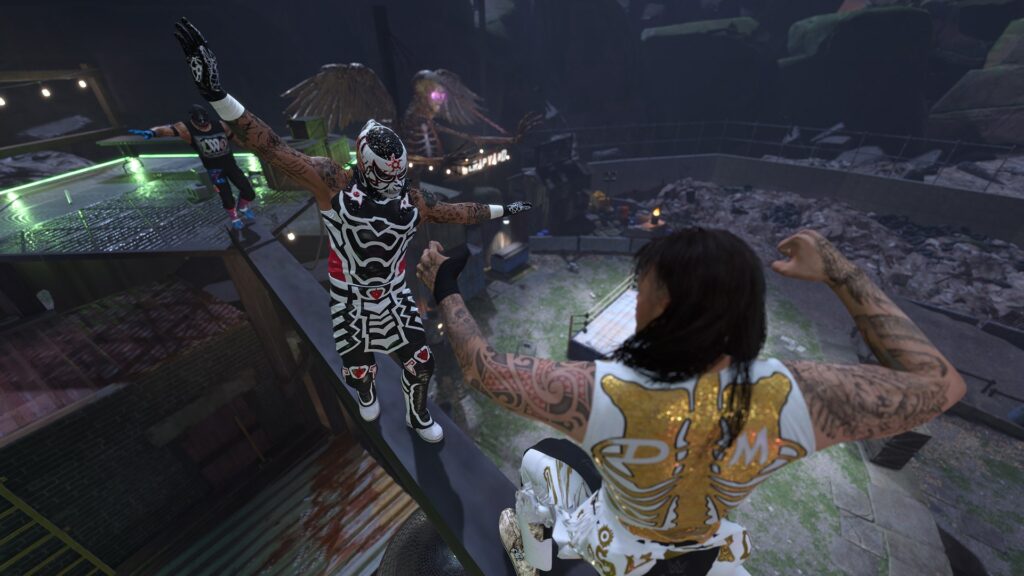
Wooden dialogue continues here too, although some of the choices I made for my character yielded some unexpected, and admittedly hilarious outcomes. See, for his appearance I chose a flamboyant archetype. A guy who styles himself after Skeletor. So, consequently, I’m adorned in gothic facepaint – backstage, in the ring, at the post-match press conference. It became comedy gold when I realised that, with his facepaint peeling off in the ring through sweat and having his face pummeled, he must have reapplied his makeup before speaking to journalists.
Also, through dialogue choices I decided that the reason for his soft-retirement was to raise a family. To MyRise’s credit, this dialogue choice shapes future conversations, with my character chatting in the gym about carpooling his kids. But now, of course, I can’t avoid the image of him driving his children to school with a face fully covered in skull paint.
This funniness, I’m sure, is inadvertent. Visual Concepts likely didn’t conceive the potential for slapstick when developing this year’s entry, but now I’m certain comedy must play a bigger role in wrestling than I first realised. And, honestly, I think it’s all-the-better for it. Yes, there’s drama. Yes, there’s intrigue. Gutsy people displaying feats of acrobatic prowess; strong, highly skilled, determined people. But the humour makes it approachable.
Anyway, let’s carry on. MyFaction is the usual card collecting fayre you’re familiar with if you’re a regular annual sports game player. Get stuff, compete, get more stuff, and so on. Except, whilst I won’t say WWE 2K26 does anything different, it does have a wide range of activities to get involved in. Faction battles, live events, tower gauntlet runs, and the new match type Quick Swap which presents a fighting game style switch between your faction players.
There’s a surprising amount of strategy bundled in with what is essentially a quickfire tag-team match. The obvious occurrence is size mismatch, but you’re free to swap whenever you’re lucid. Another gambit is to switch fighters when your resources are drained, but you should know that if you warp back into the ring your vitals won’t have recovered. So, the question is: should I go hell for leather with a character close to KO, or switch fighters knowing I could be vulnerable later? Signature moves and finishers carry between characters, so I found myself bringing my most powerful participant to the fray when my enemy was nearing their end.
To sum up: Quick Swap is a fun new match type, and it’d be great to see it amongst all the other single player options; although, admittedly, its instantaneous teleporting isn’t based on real life like WWE 2K26’s other match types, so it won’t fit in unless the series ever goes full-arcade.
Elsewhere, WWE 2K26’s suite of sandbox and management tools remain extensive, though you’ll likely get more out of it if you’re familiar with the series or wrestling on the whole than if you’re a newcomer.
Whichever mode you play through, chances are you’ll accumulate XP that fills your tier meter. When going up a level, you’ll unlock items in the new Ringside Pass progression system. Both free and paid-for tiers exist, yet the switch to this system has been understandably contentious amongst the community. What I wanted to know before diving in is how much commitment to the grind am I going to need? Well, after my first five hours with the game, I was two-thirds of the way through tier one. I’d completed three Showcase fights alongside testing various other modes, so, from that, I’d surmise that it’s going to take a long time to unlock all the rewards.
Look – regardless, the best part of WWE 2K26 is the fighting. Although, while I have gripes with the slow momentum outside of matches in certain modes, there’s a handful of issues inside the ring too. For one, the reversal system is now closely aligned with stamina; a move which reportedly opens more opportunities for tactical, nuanced play.
"If you’re a newcomer, leaning into the humour – intended to this extent or not – is perhaps your clearest entryway."
In my experience, I can’t think of a time when I wouldn’t attempt a reversal, stamina or no. And, your opponent’s attention can stray during matches too, where AI inexplicably spares me from further embarrassment by indecisively patrolling the apron instead of landing a killer blow. Even Rey Mysterio once absent-mindedly slid out the ring to my bemusement. To be clear, these moments aren’t constant, but the series really should get a handle on it as I’m sure plenty of you out there will find this inexcusable.
However, I stand by what I just said – that the fighting is the best part of the game. I mean, it should be right? But these issues suggest to me that the simulation still needs work to reach its immersive potential. That said, for a round of burly entertainment, there’s plenty to grab onto here. For veterans and wrestling aficionados, the strong roster, engaging CM Punk Showcase, and raft of fantastical match types should satisfy your appetite.
If you’re a newcomer, leaning into the humour – intended to this extent or not – is perhaps your clearest entryway. Embrace the sheer daftness of it all, from electric arena walk-ins to throwing a road sign at someone’s head. WWE 2K26 is at its best when it’s inside the ring, whether you’re unloading power and technique at your opponent or just chasing irreverent humour.
This game was reviewed on the PlayStation 5.
Weightier physics land blows with a satisfying crunch, CM Punk Showcase is slick, polished, Overhauled presentation embellishes wrestling’s spectacle.
Damage realism continues to be inconsistent and inconsequential, Sluggish pacing outside of Showcase kills momentum, Indecisive opponent AI, uncanny NPCs, and awkward dialogue needs attention.