





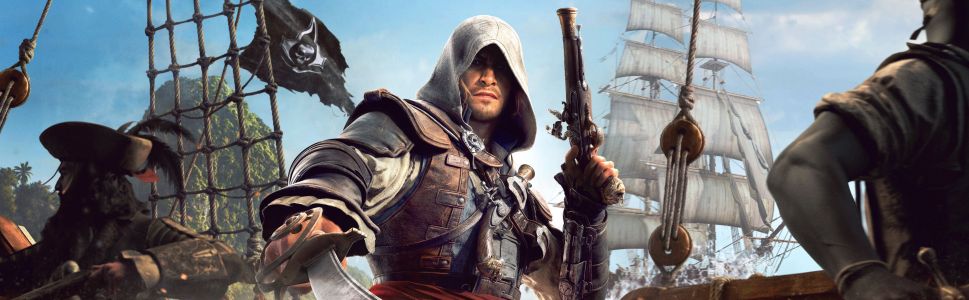
Our first leap of faith as a member of the Assassin Brotherhood is probably a memory that many of us hold dear to our hearts, with Altair’s fight against the Templars beginning a chapter that has been a major presence in modern gaming. It takes us back to a time when the developer’s innovations to its stealth-action formula were integrated well enough into its gameplay systems to make each successive addition to the franchise’s ranks stand out with something special to add.
Black Flag Resynced has served as a reminder of those times, and it’s no surprise that the game has sold three million copies in a week, with two of those coming in on its first day. For a game that’s nearly thirteen years old, with systems that predate the RPG-esque mechanics that are now a foundation of the franchise’s latest entries, that additional million shows off a launch momentum that even new games would be envious of.
We had a few thoughts about how returning to an older formula and giving it the reverence it needed has worked in the developer’s favor, while around a decade of making each entry in the franchise bigger, longer, and more RPG-driven hasn’t given the studio the results it was hoping for. We’re going to say it early: we don’t think the RPG trilogy and Shadows were misguided efforts to give a bold new direction to the franchise. But we do think they are evidence of a tendency for the developer to confuse meaningful evolution and constant expansion. Join us as we take you through why we think so.
The Origins Of A New Kind of Assassin
Let’s look at Origins first, and the reasons for its reinvention of the franchise formula. Although Syndicate did quite well to inject a bit of soul into its take on Victorian London, it was clear that Assassin’s Creed needed to move away from dense, icon-intense maps that felt more like busy work. The franchise’s annual releases were clearly slowing down on the innovation front, and the fatigue was setting in even among die-hard fans. It bears mentioning that Black Flag was praised quite highly as a great example of what the franchise was capable of even at the time, a detail that’s going to help cement Resynced’s reasons for success.
Bayek came along, and his easy charm and compassionate heart were immediately enough to sell the new RPG-based systems, and his story blended moments of humor and lightheartedness with emotional beats that weren’t afraid to go to very dark places when they had to. Bayek’s role as a Medjay was the perfect narrative justification for an adventure that took him all across a country-sized version of ancient Egypt where combat was completely rebuilt, and with exciting gear waiting to be discovered.
The quests and the newly added Exploration Mode worked well with Bayek’s new flying eagle, allowing for some creative builds that exploited either his immense skill with melee and ranged weapons, or his ability to go unnoticed if the situation demanded a quiet approach. As a response to genuine franchise fatigue, Bayek’s blend of stealth and action was the shot in the arm that Assassin’s Creed needed. But we think it’s where the developer needed to take the win as a one-time reset, but instead chose to make Origins the foundation of its next few titles.
Odyssey took things a step further, becoming a full-scale historical RPG that took us all around ancient Greece and let us walk as close to the Third Civilization as we had been previously allowed to. With choices and decisions affecting what happened, expanded build potential over Origins, the addition of naval exploration and combat, and the shift from an Assassin to a misthios did work well. It freed up combat expression for starters, as there was always the narrative justification for going in all guns blazing.
It made those battles for control of each of the game’s regions convey a sense of scale that felt so great at the time, while ancient Greece was a world that blended the charm of Kassandra (the canon hero, although Alexios was quite charismatic in his own way) with color, humor, and heart. The ship and crew were perfect callbacks to Black Flag, although the shift to more primitive weapons did make things interesting in ways we didn’t expect. This one was massive, and came with excellent replay value over its predecessors to boot.
But being a misthios came at the cost of being an Assassin. You could argue that Edward Kenway isn’t really an Assassin for most of Black Flag, but he’d kind of set out on a path to membership in the Brotherhood quite early on, and a major part of his character arc is earning its trust after his initial, if unwitting, betrayal.
Valhalla took this along to the logical extreme of such a change in direction, giving us a Viking-first take on the Assassins that blended in mythology and brought important implications for the present-day storyline. At its heart, its raids, choice-based narrative arcs, customization, and a massive post-launch expansion programme were all great additions on their own.
But its execution left a lot to be desired. Each of those ideas became a system that needed to be satisfied to sustain narrative progress, making the whole thing feel more like a checklist of tasks than an organically exploreable version of England. Ravensthorpe should have been where the RPG formula went home to roost, but instead became a stage where its flaws took the spotlight.
Valhalla tried to be a Viking saga, Assassin story, settlement builder, and a gear-driven action RPG all at once. But despite all those being worthwhile ideas, the game suffered because the developer couldn’t decide which one mattered most. Resynced, on the other hand, doubles down on the pirate fantasy to make everything you do in it service that illusion to great effect.
Resyncing The Right Details
It could have been too easy to look at Black Flag Resynced as another Odyssey or Valhalla. Edward’s slick new combat moves could have become the building blocks of an RPG-like system that could have fit well within the experience with a bit of tweaking. But thankfully, the developer remembered what made Black Flag so special back then, and that’s definitely good news.
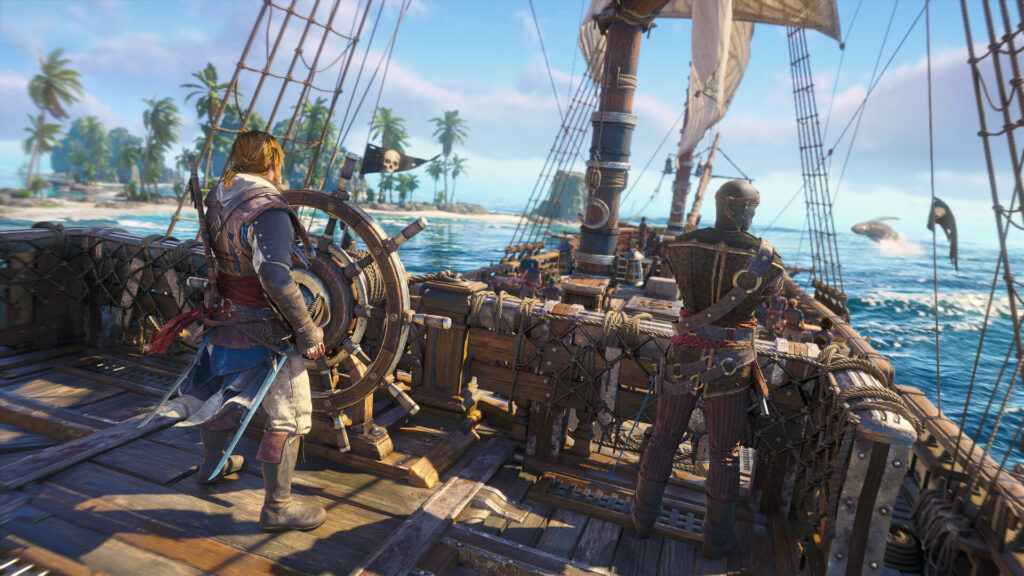
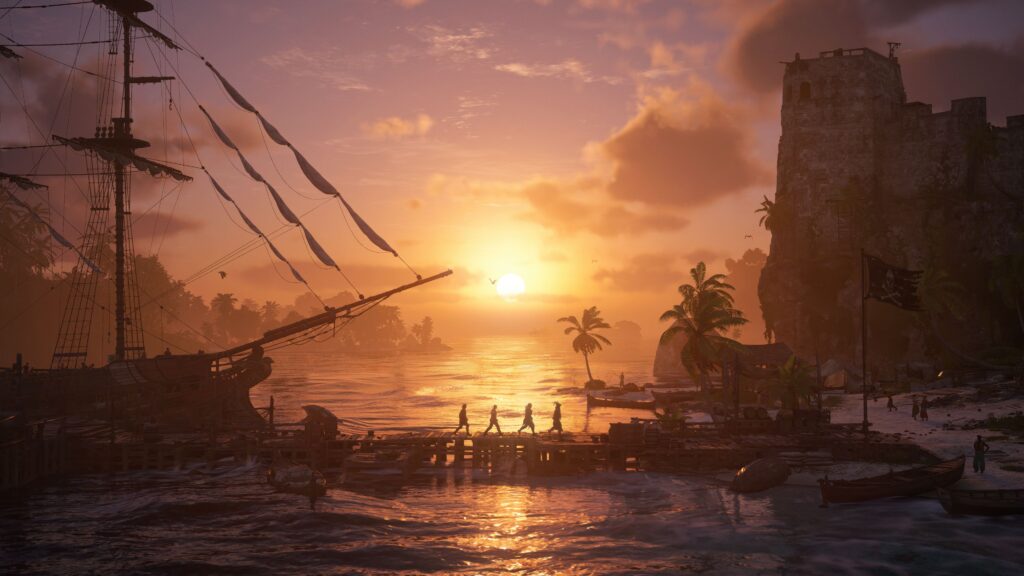
We had a clearly defined protagonist in Edward, while the story and gameplay’s pirate captain fantasy worked well within the larger conflict between the Assassins and the Templars. The Jackdaw continues to be a major draw, while raiding those warehouses is now more organic and better implemented thanks to the new stealth additions. It’s a focused adventure instead of an endless sandbox, and that does wonders for the kind of game it tries to be.
Even better is how annoyances from the original release weren’t just addressed, but done in a way that made them very easy to integrate into your playstyle. Failing tailing missions is in the past now, while social stealth and blending in became easier than ever. It’s seriously cool to have Edward walking along a busy street, in plain sight of his enemies and ever at the ready to make a quick disappearance thanks to the expanded Parkour and stealth systems.
The weather, settlements, and the general vibe of the world feel more alive, and the Caribbean simulation that the Animus is serving up this time around is all the better for it. It’s the same game in its size and scope, but Resynced brings cohesion to many new and old systems by centering them on three things: the pirate, the Assassins, and the Caribbean. In doing so, it presents a perfect balance between freedom and excess, almost as if Edward’s two identities came together to fuel a romp through a vibrant world.
The RPG era of Assassin’s Creed brought its own version of freedom, one that focused on narrative choices, builds, rare weapons, skill trees, immense quest density, massive maps, and loads of things to do. But they left behind the cohesion and narrative interspersing of systems that made the franchise shine.
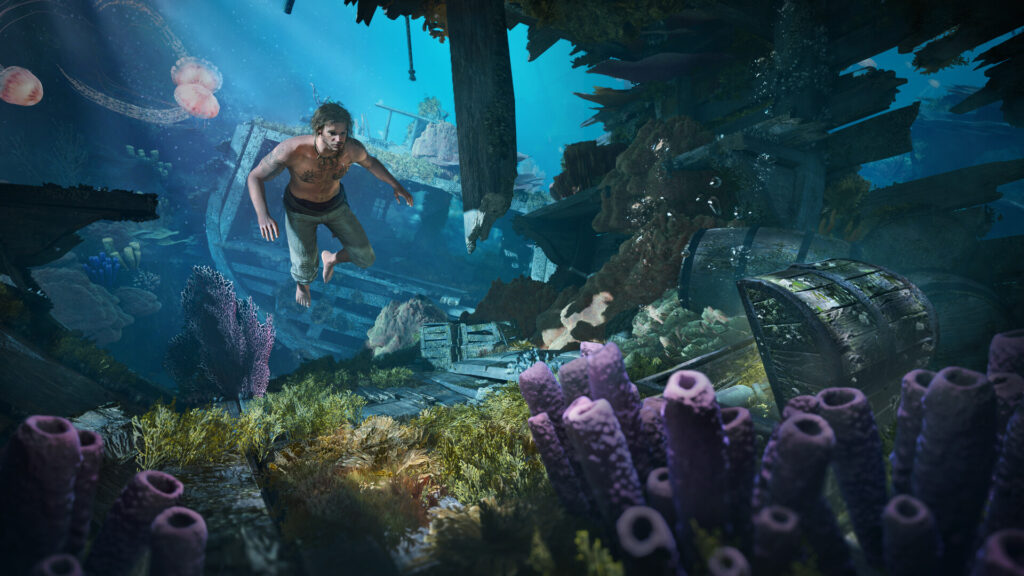
Resynced’s version of freedom is about sailing to places simply because they interest you, or to just dive off the deck of your ship because you thought you spied something of interest in the water. It’s about seamlessly switching from your Jackdaw’s cannons to your swords and pistols when you board a ship, and using the world around you to stay hidden from your targets until it’s too late. Its side content strengthens its fantasy, instead of expanding it for the sake of doing so.
And that makes a world of difference.
The Right Kinds of Change
You see, the RPG games became too massive for their own good in our book. We must give credit to Shadows for managing to balance the size and scale of Japan against meaningful progression for Naoe and Yasuke, a feat that it managed quite elegantly for the most part. However, its selling point was how it wove Japan into its very core, presenting a take that helped it sell the fantasy along.
It makes sense then that the developer turned to Black Flag, a game that was widely touted as the franchise’s high point. Where Origins took you too far down the path of the Medjay, and Odyssey made you more of a mercenary than an Assassin, Resynced doesn’t let its pirate and Assassin fantasies compete, but rather work together to make our time with Edward feel richer.
The problem isn’t the shift to an RPG-based formula. Each of the games we’ve been talking about has been a very enjoyable experience. But it does expose a troubling concern that the developer might not have been confident enough in any of the franchise’s identities, trying to replace each one with another. The original formula devolved into a repetitive loop of collectibles, combat, and fetch-and-carry quests, while the RPG structure was expanded so quickly and rapidly that it soon became excessive.
The studio has largely used broad reinventions as a means to address franchise fatigue, a facet that Resynced makes evident because its development philosophy was as straightforward as taking everything that made Black Flag good, what didn’t, and working from there to preserve what was loved while rebuilding what was not well received. Simple, efficient, and almost obvious, it’s a sort of clarity that the franchise has been missing in recent years.
Resynced’s sales are evidence of its merits, proving that there’s an audience for a polished, focused Assassin’s Creed story. But does that automatically mean that the RPG-era games were failures? Certainly not, and we can’t help but wonder if these two distinct design philosophies should even be pushed into similar trajectories.
Why can’t there be titles that can be large historical RPGs, while the franchise also brings in tighter action-focused experiences, high-quality remakes, and perhaps even a few experimental standalones? We are not saying the developer should make everything Black Flag, but rather think about what each individual game would require to stand out instead of applying a common checklist across the board.
The developer might have made Resynced to call back to the glory days of Assassin’s Creed, but just might have become a demonstration that the old formula could still work. All that’s needed is to ensure that there’s balance between its identity and design in a way that’s nuanced enough for an Assassin to carry the weight of expectations that are inevitably placed on them.
Edward’s done that well enough to earn his place among the Brotherhood’s best. There’s no reason why any of the Assassins we’re going to meet in the future can’t achieve the same now, is there?
Note: The views expressed in this article are those of the author and do not necessarily represent the views of, and should not be attributed to, GamingBolt as an organization.