






The original Backyard series of sports games were a great way for me as a kid to enjoy these sports, be with Backyard Soccer, Backyard Basketball, or Backyard Hockey. The original 1997 release of Backyard Baseball was essentially the first time I even saw the appeal of baseball as a sport. Almost three decades later, we now have a brand new Backyard Baseball game, and while it has likely been released for a core audience of young players, some of us older gamers also have plenty of nostalgia-related reasons to want to see the title succeed.
The first thing to really hit me about Mega Cat Studios’ take on Backyard Baseball was its visual style. Gone are the classic 2D sprites of players running around a backyard pretending that they’re in a high-stakes baseball match. Instead we now have fully-3D visuals that still manage to hang on to much of the personality of the originals, largely thanks to the fact that just about every athlete you can play as has a bespoke 3D model created for them, letting not only their playing style come across, but also their personality.
Personality is really the key word when it comes to discussing a game like Backyard Baseball. The core gameplay isn’t particularly deep, after all, and the title offers a rather simplistic take on the sport. What makes it actually appealing to just about anyone with a passing interest in sports is the fact just about every one of its aspects drips with charm. From the way each character moves around, to the overall presentation, which even manages to include a commentary table for what is ostensibly a bunch of young players enjoying baseball together, Backyard Baseball brings with it a great sense of childlike wonder for even mundane things.
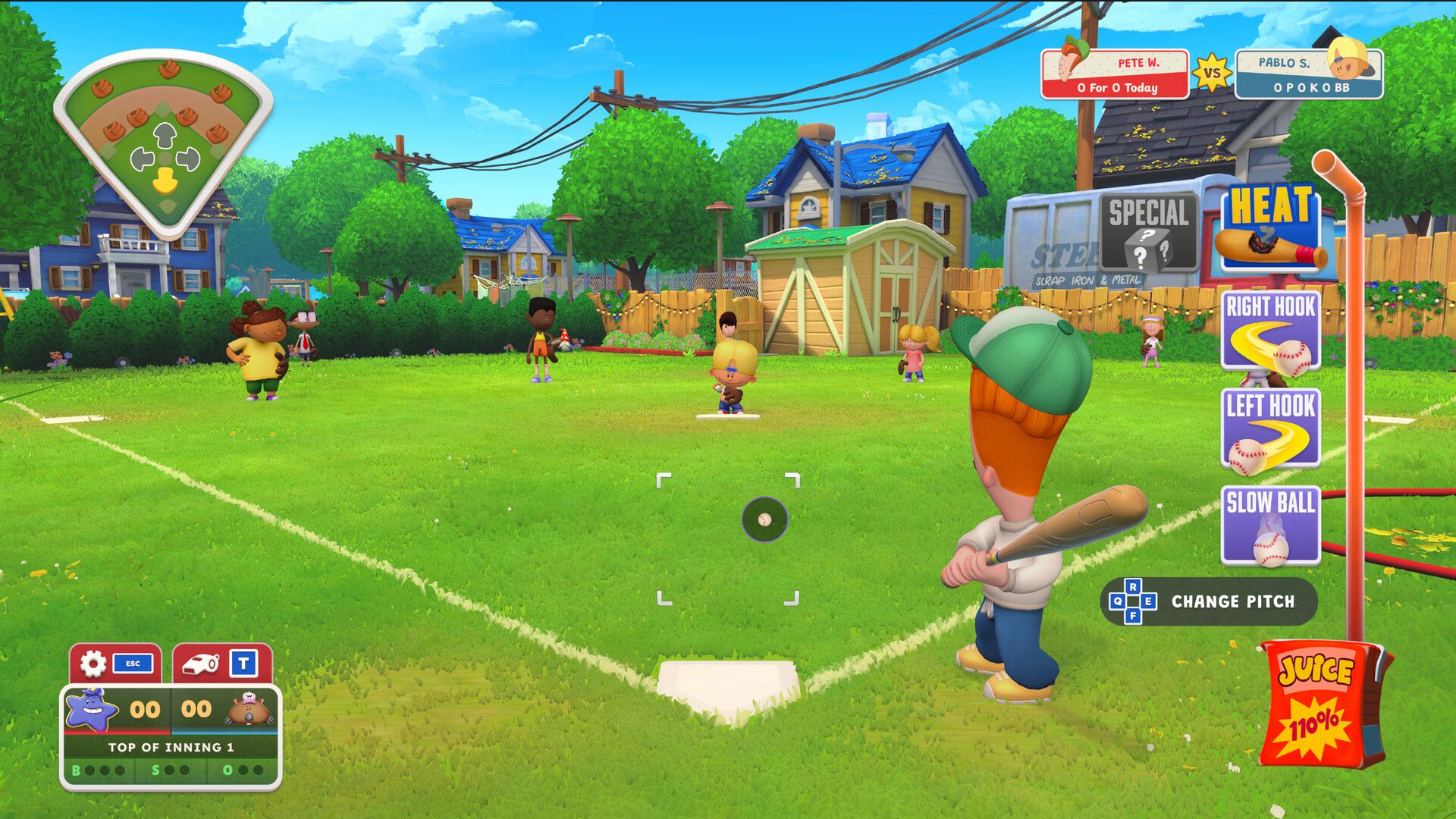
"Personality is really the key word when it comes to discussing a game like Backyard Baseball."
Gameplay-wise, Backyard Baseball doesn’t really bring in any radical new systems to its take on baseball. Depending on whether you’re batting or pitching, you only really have a limited set of options. Pitching, for example, has you pick a pitch type and a target box that would indicate a legal pitch. There is a small bit of depth in this system since each one of the characters is only really good at certain types of pitches. For example, if a player is good at throwing fast and slow balls, asking them to throw a curved pitch is likely to result in disaster for your team.
When pitching, you also have to take manual control over your fielders. From the moment the batter strikes the ball, you’re going to have to make sure that your automatically-picked fielder is in the right position to either quickly catch the ball for an out, or to quickly throw it along to one of the bases to prevent the batting team from loading them up.
Batting tends to be a much more simplistic affair; depending on your character, you get between 3 and 4 types of batting options to choose from before the pitcher throws the ball. Aside from actually striking the ball, the only real control you have over the game is whether your team mates are continuing to run along the bases or not.
Most of the depth in all forms of gameplay comes from the fact that each one of the 30 characters in the game is fairly unique in terms of stats, which define how well they can pitch, run, catch, and bat. While there are also options for special abilities, like a zig-zag pitch, these aren’t exclusive to certain characters. Rather, in the course of a match, you might see that your pitcher can throw a special ball, which is then randomly selected.
Of these, fielding often feels like the most underbaked gameplay system. Regardless of your character’s speed stat, they’ll feel quite sluggish at even the best of times. This means that, the moment the opposing team strikes the ball, fun essentially goes out the window and you’ll have to scramble to make sure that they can fill up the bases. The fact that you don’t get to manually pick which one of your fielders you take direct makes the whole affair even more frustrating.
There are a total of six distinct game modes. However, the core of Backyard Baseball is in its League mode, with many of the others essentially serving as ways for you to practice either batting, pitching, or fielding.
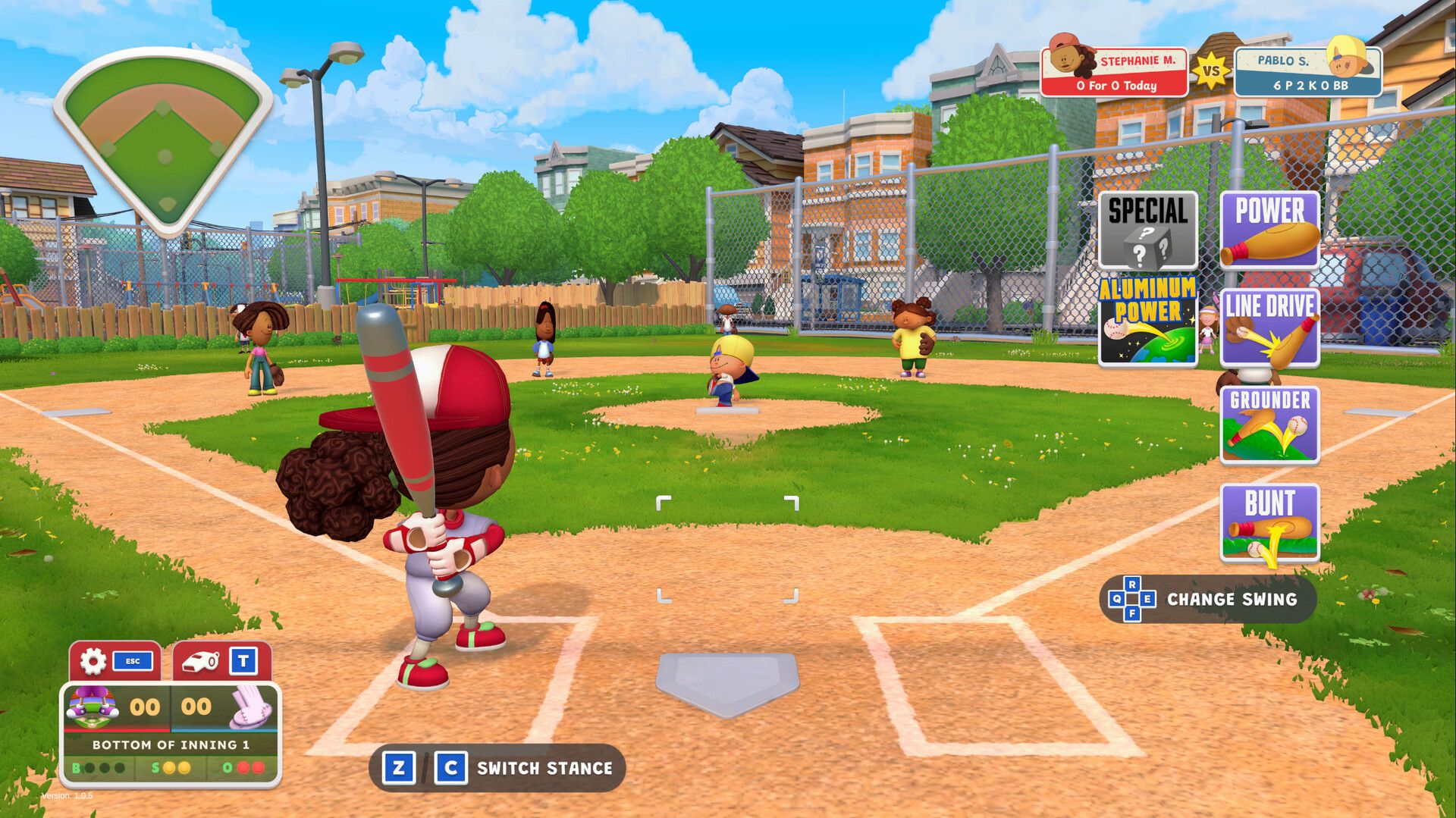
"Most of the depth in all forms of gameplay comes from the fact that each one of the 30 characters in the game is fairly unique in terms of stats"
Much like how young players would play sports in the real world, the roster in Backyard Baseball aren’t separated into distinct teams right from the outset. Rather, at the start of a league or even a pick-up game, both sides take turns picking players to fill out their teams. Players that don’t want to bother with the nitty gritty of staring at each character’s stats to decide whether to bring them in or not can breathe a sigh of relief, since there’s also an auto-fill option, which helps quite a bit when you’re just looking for a quick match.
While Backyard Baseball may not be particularly deep in gameplay terms, the game isn’t exactly trying to offer the best simulation of the sport out there. If that’s something you’re looking for, you would be better served by a game in the MLB The Show franchise or Super Mega Baseball 4. Backyard Baseball is instead ideal for those of us who don’t really enjoy the sport itself as much as they like to play video games. There are no illusions about the fact that this is a simplistic take on the sport, and Backyard Baseball generally feels better for it.
The biggest weakness of Backyard Baseball—aside from the fact that it’s an arcade-y sports game coming out in 2026 without a functioning way to play online multiplayer—is the fact that it has perhaps too many animations. Every batter coming to the home base for their turn has their own bespoke animation. Similarly, every match begins with a rundown on the event by two commentators. While these things certainly contribute quite a bit to the charm I was talking about earlier, at a certain point, you just want to get on with it, and constantly holding down a button to skip these cutscenes can feel cumbersome at the best of times.
Backyard Baseball is one of those games where, if I’m playing it, I’m generally having quite a bit of fun. Sure, it may not be as deep as other baseball offerings these days, but the experience generally tends to be quite engaging. However, when I’m not playing it, I have trouble mustering the will to start a match, thinking of all the cumbersome animations that you will have to see at least twice per inning, or how bad the fielding tends to feel.
Unfortunately, Backyard Baseball generally feels like a game that could have used a few more months in development rather than being shipped out in its current state. Thankfully, the title doesn’t really have many fundamental design flaws that would require ground-up redevelopment, and many of its issues can be fixed through post-launch updates. However, it isn’t an Early Access release, and even nostalgia doesn’t really do much to make Backyard Baseball an interesting way to spend a few dozen hours.
This game was reviewed on PC.
Plenty of charm all over the game thanks to its visual styles and distinct characters; Captures the feeling of children meeting up to play sports together; Simple but fun core gameplay.
The fielding system is incredibly sluggish; Too many cumbersome animations slow down the general experience.