





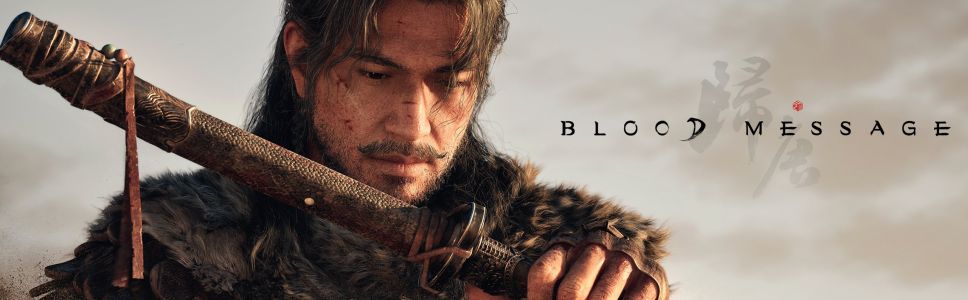
The reaction to Blood Message’s 19-minute gameplay reveal has been anything but quiet. Comments shared, moments dissected, details poured over, with the overall response being largely positive. But, beyond the initial hype, what stands out isn’t just spectacle.
Developed by 24 Entertainment Lin’an and published by the innumerably wealthy NetEase, Blood Message appears to be reaching for something more specific: a grounded, cinematic take on action-adventure that favours weight, desperation, and immersion over mechanical complexity. If this early look is anything to go by, the game appears less about what you can do, and more about how convincingly it’ll make you feel throughout every perilous step.
Set in the late Tang Dynasty in 848 AD, Blood Message frames its story around a nameless messenger tasked with delivering a fateful communication across a treacherous, thousand mile-long landscape. Watching the Official Story Intro preview which premiered at Summer Games Fest, Blood Message immediately grounds you in its specific history, showcasing cultural and environmental texture of the era, from war-torn settlements to harsh deserts and vast wildernesses stretching across East and Central Asia.
There are personal stakes to our messenger’s mission too – reuniting with and protecting his son – giving his journey an emotional weight beyond securing the future of his homeland.
Crucially, though, Blood Message isn’t a stylised, Wuxia-infused take on this period. Instead, the overriding experience draws from history rather than embellishing it with fantasy. And in doing so, its narrative themes match the action’s grounded tone.
Yet, despite this groundedness, Blood Message’s cinematics sell an illusion. See, at a glance, exploration treads familiar paths – squeeze-through gaps, leg-ups, contextual traversal – feeling instantly recognisable to anyone who’s spent time with Uncharted or The Last of Us. But Blood Message distinguishes itself from Naughty Dog’s output in how its cameras frame exploration. It’s rarely static, instead responding to and shifting with movement and character proximity in a way that evokes a handheld intimacy rather than a traditional cinematic perspective.
And this approach to camerawork pays off in smaller, easily missable details. In one early moment of the gameplay reveal, our protagonist drops to a knee following a surprise encounter. The camera pushes in close, hovering for a brief pause as danger emerges ahead. It only lasts a few seconds, and it may appear like simple direction, but this vanguard style underlines something remarkable – whilst these moments are undoubtedly choreographed, the camerawork makes them feel improvised. Capturing the rawness and minutiae as it happens, Blood Message’s presentation is paradoxical; every frame is meaningfully composed, yet seeming without a thought to composition at all.
And this paradox feeds into the game’s combat too, which appears systemically dense on first read but plays out stragglingly, forcing an element of improvisation which mirrors the unsteady cameras. You’ve access to the usual core manoeuvres: light and heavy attacks, dodges, blocks, parries, and counters, and while not mechanically novel, intrigue comes in laboured movement and animation variety.
In the gameplay reveal’s first multi-man skirmish, our protagonist is knocked off balance after parrying; the consequence, it seems, of having his feet unset following a brutal takedown. Executions are visceral, diverse, and dynamic, our protagonist plunging his blade into chests, slicing limbs, and breaking necks without hesitation. In one specifically grisly execution, our protagonist is interrupted mid-strike, with an extra on-screen input prompting you to continue his killing action. See, even the most conclusive actions can present strong reactions, and this is one of Blood Message’s standout combat features, demanding constant situational awareness.
Enemies won’t necessarily wait for you to finish off their ally either, swinging into the fray to create two-on-one pressure. Another one of the gameplay reveal’s emergent moments comes in a second, more chaotic fight. As our protagonist grapples an assailant, his comrade impatiently steps in, accidentally sinking a blade into his ally’s bicep.
The environment plays a role in how battles play out, too. Clay pots can smash an opponent’s face, enemies can be hoofed into storage shelves which then shatter and collapse around them, and troughs can be used as pools for disorientating opponents, dunking their head underwater before landing the killing blow.
And when the bout is over, our protagonist shows fatigue. He’s not a superhero, nor mage or acrobat, but a regular soldier thrust into a vulnerable situation, and the toll shows in his laboured movement. Fights aren’t necessarily about maintaining momentum, but grit and determination.
Between battle arenas, however, are stealth sections, and these follow the standard tropes too: tall grass, dark shadows, silent takedowns, including an Assassin’s Creed-like aerial assault. You’re likely familiar with Blood Message’s subterfuge stylings already, but there is a distinction found once-again in presentation. See, the gameplay reveal’s stealth sections showcase numerous takedown animations, and it’s here, away from multi-enemy chaos, that a question arises: how are these animations assigned? Are they contextual, systems-driven, chosen by proximity and direction of approach, or completely random?
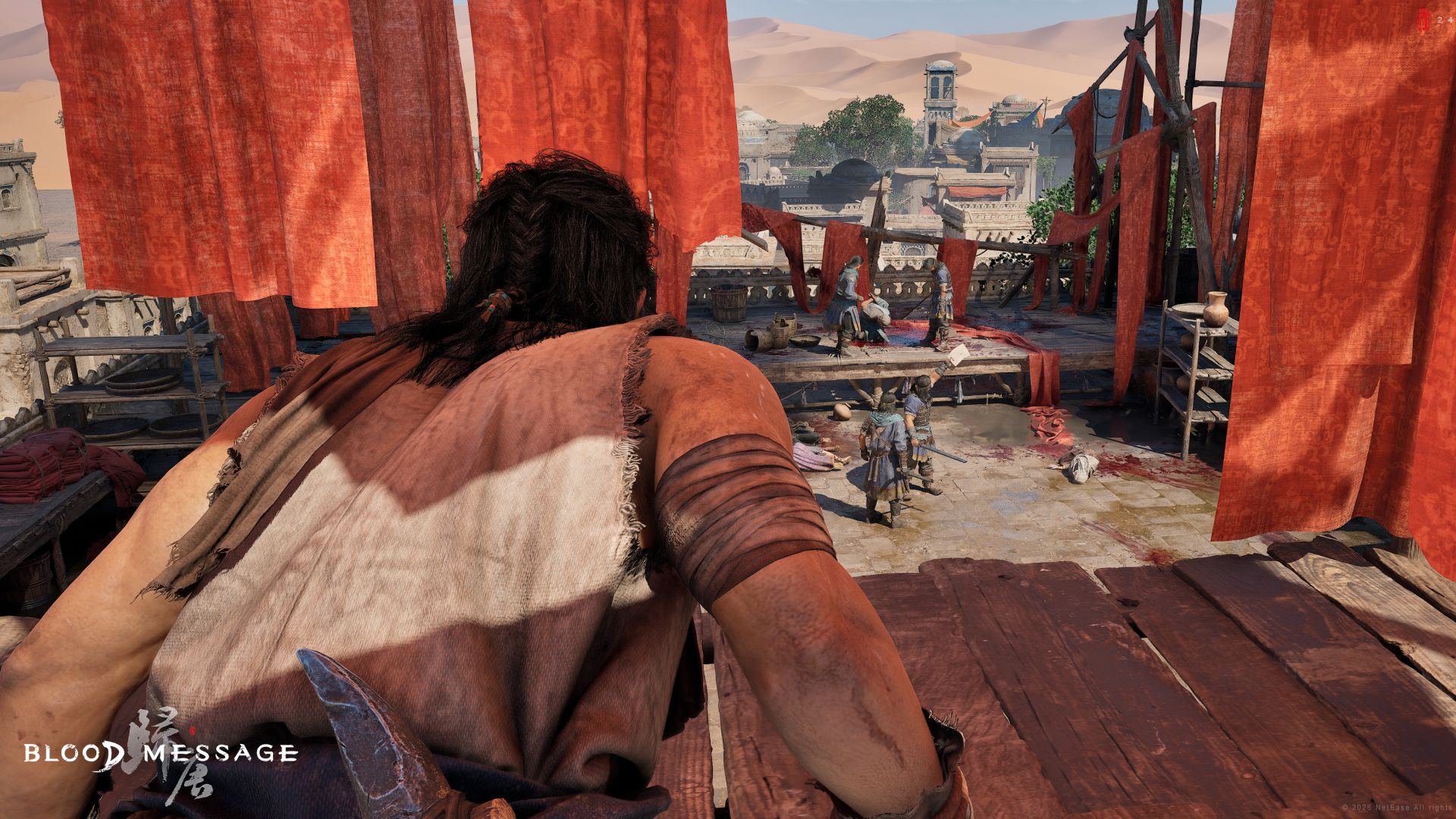
"He’s not a superhero, nor mage or acrobat, but a regular soldier thrust into a vulnerable situation, and the toll shows in his laboured movement."
It’s an interesting thought, sure, but the bottom line is this level of variety prevents the stealth sections from feeling too formulaic, at least during the footage’s 19-minute runtime. Another differentiator, perhaps, are environmental triggers, and we see two in the gameplay reveal: a flock of birds who alert a guard when disturbed, and a caged dog which draws an enemy’s attention as our protagonist passes its line of sight. The takeaway here, then, is that Blood Message’s stealth isn’t just about remaining invisible but maintaining situational awareness.
If you’ve any doubt Blood Message is a cinema-first experience, the reveal’s closing set-piece chase should convince you. Mechanically, the sequence can be broken down into a series of jumps, vaults, and QTEs, with lots of running in-between. The transition between gameplay and scripted events is seamless, lending the feeling of playing a movie over interacting with a defined system. The low input complexity ensures the chase’s dynamic design – the collapsing structures, clinging on by fingertips, leaping from rooftops – is meant to be experienced in one go, first time, rather than a sequence to be memorised and mastered. Combat and exploration aren’t quite as basic, but they share the same philosophy.
Visually, Blood Message impresses through texture and detail as much as spectacle. Weathered brickwork, worn fabrics, and dirt-streaked skin all carry a tangible sense of place, reinforced by enveloping illumination. Sound design follows suit, with subtle notes, like the countless creaks of aging wood, adding to the tactile immersion. And voice acting, despite the language barrier for English speakers, reinforces the game’s grounded tone, where feelings of confidence and desperation transcend borders.
While reaction is indeed positive, there is some criticism levied against Blood Message’s simplicity, with its over-familiarity luring it closely to Naughty Dog’s established formula. But there is a key question you can ask at this juncture: does simplicity matter when the story and execution are on point?
Look – while broader narrative details are currently unknown, Blood Message’s ‘cinematic-first, systems-second’ approach could deliver something genuinely special. Combat is visceral yet it isn’t deep, stealth is familiar but reactive, and set-pieces are guided and thrilling. The game is set to bring a cohesive cinematic vision where player expression takes a backseat for grounded action. Again, it’s less about what you can do, but more about how you feel when doing it.
Note: The views expressed in this article are those of the author and do not necessarily represent the views of, and should not be attributed to, GamingBolt as an organization.