







College Football 27 doesn’t reinvent the series outright, but it does introduce plenty of meaningful improvements across almost every facet of the experience. Whether you’re building a dynasty, creating your dream athlete, or soaking up the pageantry and atmosphere on game day, this year’s entry authentically pushes beyond last year’s offering with confidence. Here are fifteen of the biggest differences EA Sports College Football 27 is bringing over last year.
Dynasty Places Greater Emphasis on Coach’s Role
Like last year’s iteration, Dynasty Mode remains built around your coaching decisions, but College Football 27 asks you to mould your program around each school’s expectations and values. See, each school now has a clearer identity, shaped by organisational priorities, how much patience the board has for your process, and what the fans believe is important – winning a championship or getting one-over on your rivals, for instance. Your role as the coach is still central, yet College Football 27 brings new levels of external pressure.
Expectations Evolve as Your Program Progresses
And, your chosen school’s expectations aren’t set in stone. No, as your program progresses, so does their expectation of you, with evolutions determined by both the fanbase and the Athletic Director. Of course, if you’re doing well, projections rise, but if you’re underperforming then patience wanes. Yet, College Football 27 brings more nuance than a simple, binary up-or-down. Each success becomes a new baseline, yes, but each school’s demeanor dictates how responsive they are to success or failure too. For example, priorities can shift from winning championships to becoming a class-leader in recruitment. Furthermore, you can forge an elite team, but if you keep losing to your state rivals the fans will demand change.

All-New Dynasty Blueprints Finetune Program Control
While the Athletic Director’s expectations shape what success means at your school, College Football 27 introduces Dynasty Blueprints to put you in greater control of how you achieve this success. Here, Dynasty Points can be spent across three areas: coaching staff, school facilities, and Name, Image, Likeness (NIL). Investing in backroom staff streamlines your program’s efficiency, while spending on facilities supports long-term player development. Focusing on NIL gives you greater leverage to compete for the strongest talent, but no-two schools are the same. Blueprints are part of a wider program-building puzzle, but taken in isolation they highlight obstacles standing between your program and the Athletic Director’s expectations.
Scholarships No Longer Available in Pre-Season
As NIL has grown into a more significant roster-building, decision-making process with this year’s iteration, scholarships can no longer be offered during pre-season. See, real-life College Football has seen a rise in prospects who understand the terms they can command even before arriving on campus, with anticipated NIL influenced by star rating, position, school prestige, and so on. Mirroring this in-game, NIL is more of a long-term commitment, with scholarships now tied to your program’s ever-shifting expectations. For this reason, pre-season is now entirely focused on scouting, with the aim being for you to better identify targets that fit your program and then shaping NIL around your budgets and expectations.
My School Sees Expansion
Like last year, My School grades in College Football 27 continue to define your program’s potential, impacting recruitment, player management, and more. However, this year’s iteration expands and updates several My School grades in three key areas: Brand Exposure now tracks a school’s progress over a rolling five-year timeframe, while Championship Contender assesses your rank and rating to outline how likely you are to reach the championship finals in your present guise. Proximity to Home better calculates a precise distance between a recruit’s home and your school, giving you a major recruitment advantage for home-state players.

Weekly Practice Plans Bring Finer Control Over Wear and Tear
While College Football 26 allows you to test out plays and evaluate squad depth via Free Practice, College Football 27 brings more structured control to managing your roster. Weekly Practice Plans govern recovery times and practice limits, and can be customised player-by-player. And because you can adjust each individual player’s practice plan, College Football 27 allows you to carefully manage wear and tear, reducing the risk of injury.
Two New Coaching Archetypes
Coaching in earlier College Football games was built around the premise that no coach can be great at everything. And, while that philosophy still underpins your program’s progress in College Football 27, this year’s version introduces two new coaching archetypes: Visionary and Rainmaker. Available with pre-orders of College Football 27 or Madden NFL 27, Visionary tracks long-term career growth and professional potential through exclusive abilities that let you maximise practice sessions through deeper control over players preparation, recovery, and development. Rainmaker, available to MVP+ Members, hones in on Dynasty Blueprints, focusing on NIL, Dynasty Points, and making the most from your school’s resources.
College Football 27 Introduces Major Presentation Overhauls
As we mentioned in our already published “15 Things to Know” feature, one of the overarching improvements EA Sports is focusing on is more authenticity. This year, they’re ramping up the pageantry, atmosphere, and pre-match traditions, embellishing the individual personality of each school. Unique entrances, mascots, lighting, runout pyros, band tunnels, detailed traditions, crowd chants – College Football 27 brings plentiful updates to game-day atmosphere, ensuring that the presentation is more authentic and immersive compared to last year.
Rivalries Have Been Enhanced
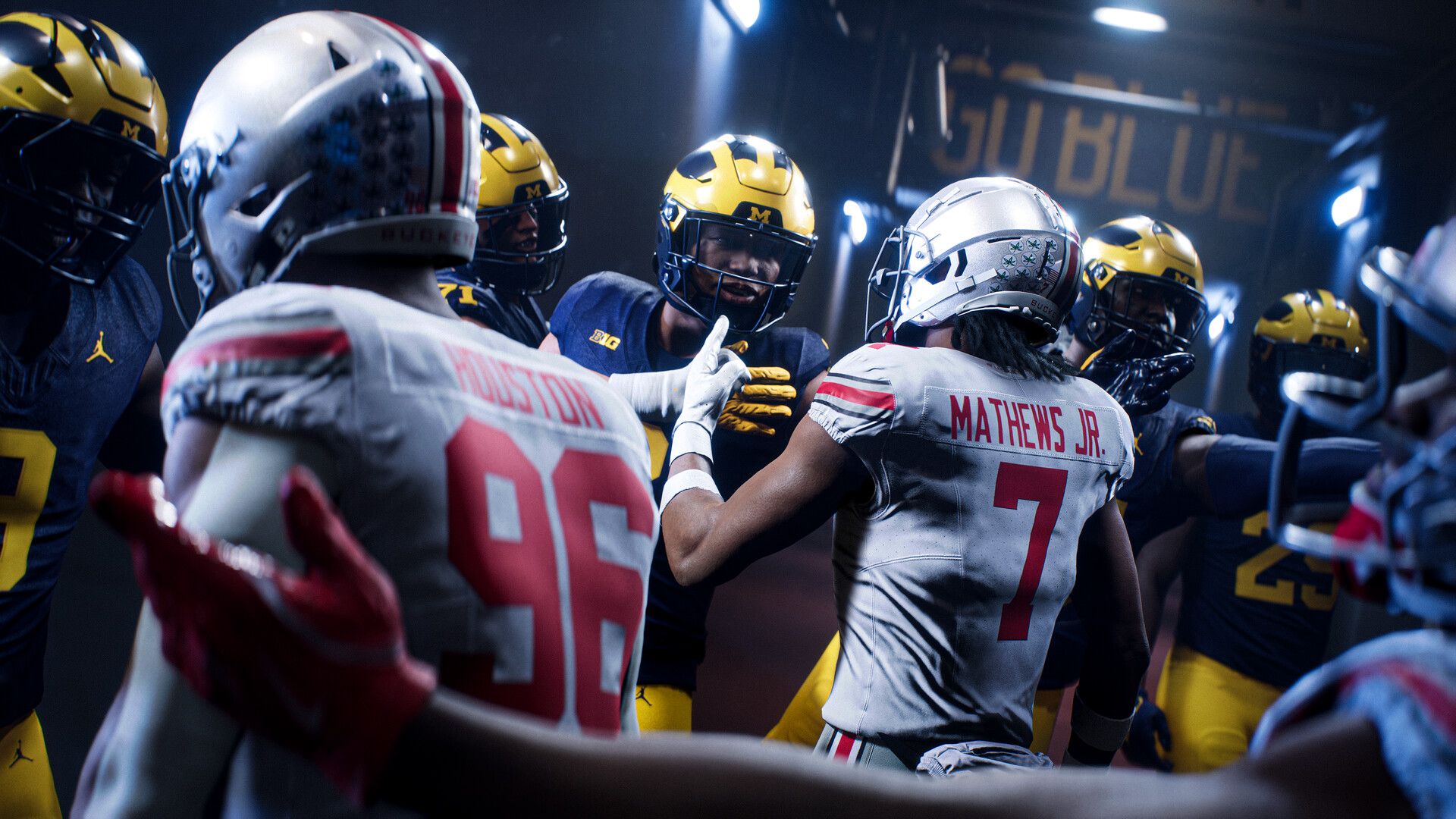
College Football 27 understands that big games hold a certain gravitas, and a school playing against their rival is one-such event. This year, the energy, the tension, and the atmosphere of a rivalry matchup has been intensified: commentary describes their history, rival trophies become available for winning a big game, and more aggressive, tempestuous animations support the rival games’ greater emotional weight.

Road to Glory Brings a New Presentation Style
A standout addition to College Football 27’s Road to Glory mode is an all-new presentation style which gives you a player’s eye-view of the action direct from the sideline. You’ll still experience the runout, the pageantry, traditions, and fan atmosphere, but for those moments you’re on the sideline you can observe the play, adjusting camera angles to get as immersive a view of the game as possible.
College Football 27 Features a New Broadcast Package
To make College Football 27’s TV broadcast match a real-life telecast, this year’s version features an all-new package. New visuals, banners, action shots, and playcall panels offer new ways to support the game’s emerging stories, while halftime show overhauls, commentary support, and refined camera framing boost authenticity. The broadcast team now includes ESPN sideline reporter Holly Rowe, who’ll provide updates on injuries, weather, individual performances, and more. Elsewhere, Joel Klatt joins the commentary team, with the booth on-the-whole bringing a stronger awareness of the on-field action.
Max Potential Redefines Custom Athlete Growth
In College Football 26, Player Potential was divided into three tiers – low, medium, and high – with each determining your player’s long-term ceiling. This year, that system has been replaced by Max Potential, giving you direct control over how high each of your custom athlete’s attributes can realistically develop. Working in tandem with Physique customisation, your chosen physical attributes establish a theoretical upper limit while Max Potential determines how much of that limit your player can eventually reach. Because raising attributes consumes a limited pool of points – and elite ratings become increasingly expensive to obtain – you’ll need to make meaningful trade-offs when shaping your build, creating a far more flexible and personalised progression system compared to last year. However, the real innovation over College Football 26’s more rigid archetype structure is Max Potential allows your player’s identity to emerge naturally from your investment decisions rather than being locked in from the outset.
Legends Templates are New Preset Player Builders
Yet, if you want to hit the ground running with an established foundation for your custom athlete, you can select an all-new Legend Template. These are preset player builds derived from the physical traits, archetypes, playstyles, and attributes of real-life College Football icons. Each Legend Template outlines a Max Potential allocation, so the long-term development strategies born out of wholly custom athletes are still replicated. In other words: you can shape a legendary athlete into the type of player you want them to become.
Mental Abilities Now Tied to Off-Field Decisions
College Football 26’s mental abilities functioned as fixed gameplay perks, remaining static throughout a career. College Football 27 now ties mental abilities to off-field activities, making the decisions you make during the week far more impactful on gameday. They’re upgradeable too, beginning at bronze tier, all the way through to platinum, with you progressing through each level by completing gameplay goals and objectives.
Coach Mode is a New Way to Play
An altogether different type of simulation, College Football 27’s new Coach Mode allows you to experience the action from the perspective of the person managing on the sideline. When enabled, the CPU handles the post-snap gameplay, leaving you to focus on the pre-snap decisions real coaches make and experience the pressure that goes with it. It’s a mode that places far less emphasis on stick skill and more about planning, strategising, and sequencing your squad, and it’s a mode EA Sports is looking to support post-release with new camera angles and immersive tools.