






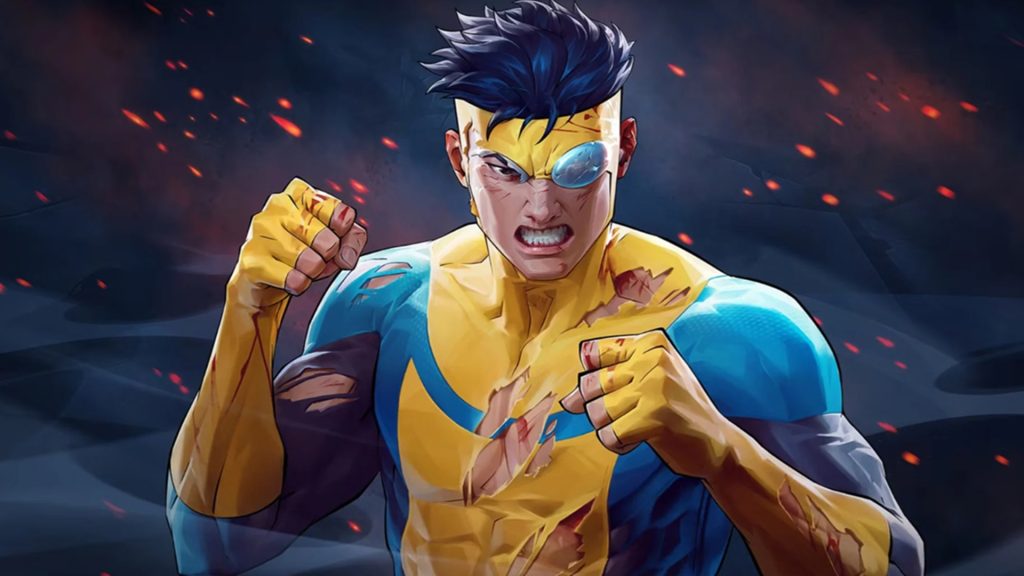
Invincible VS marks the long-standing comic and TV show’s first full step into video games. With its signature barefaced violence, often showing extreme, visceral gore, it’s a no-brainer that Skybound Entertainment, together with in-house studio Quarter Up, opted to create a fighting game adaption. Not an action-adventure, nor RPG, but an unapologetically brutal fighter.
Yet, straight off the bat, an interesting overlap emerges at the heart of Invincible VS’ target audience: fans of the series, casual players drawn in by its spectacle, and the competitive fighting game community the devs are openly courting.
"There are, however, moments when you’re learning the ropes of a new fighting game and your inputs can feel improvised, absent-minded, or rushed, like you’re swinging without purpose."
Yes, the game blends flashy momentum with approachability, but with the studio positioning it as a complex, tournament-quality fighter, the key question is does it satisfy both? Invincible VS makes a strong first impression, sure, but whether its systems hold up beyond their initial impact is where things may get complicated. There’s a wealth of offensive-minded manoeuvres on show, but its long-term competitive visibility hinges on how its defensive systems and high-level tech hold up under scrutiny.
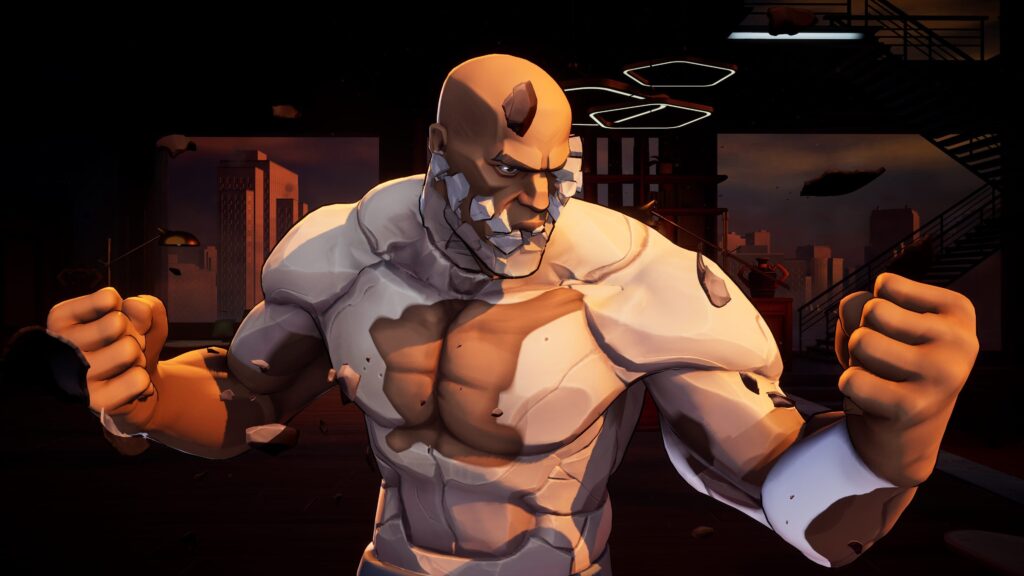
Before we get to that, moment-to-moment the game delivers a weighty slugfest, punctuated by stop-motion impact and, yes, heaps of splattering blood and bruising body parts. Inputs are responsive, and together with a simplified combo system – mashing light attack proves surprisingly useful, for instance – the fighting feels and looks good immediately. Your opponent’s animations appear readable, and therefore easier to respond intently.
There are, however, moments when you’re learning the ropes of a new fighting game and your inputs can feel improvised, absent-minded, or rushed, like you’re swinging without purpose. Invincible VS, to its credit, largely side-steps this feeling. Alongside repeatedly tapping light attack, there’s an easy light-to-medium-to-heavy combo which builds up enough frame advantage to end with a special. If you’re unfamiliar with fighting games, these comparatively basic systems will allow you to get into the flow quickly.
Before long, you’ll be delving into the game’s more high-level techniques. Aside from a few story events, you’ll be fighting in 3v3 matchups throughout, switching your allies into the fray multiple times during each bout. To do this, you’ll engage in the game’s tagging system: Neutral Tags are a straight-swap while Active Tags are a momentum-maintaining switchover which sees your teammate burst into the arena to take over your combo chain.
As you pummel your opponent, you’ll charge a Special Meter – indicated by the yellow strip in the bottom corner, turning a flaming purple when it’s reached its fivefold maximum. You can spend one bar to unleash a Super, and three for an Ultimate, the latter dealing an immense amount of damage in a cinematic, character-specific spectacle.
Another key resource is Boost, shown below your health bar to a maximum of three yellow rectangles. You can use this to dash across the arena, perform enhanced “Boosted” specials, and to counter a surging combo meter. The latter, as it happens, counts each hit you land, with the combo chain dropping once the meter is maxed. Through repeatedly hammering your opposition, frequently Active Tagging, and ending sequences with a Boost attack, you can theoretically keep combos going infinitely; swapping between characters, attacking, executing boosted specials, then switching to another one of your team to continue to loop.
It’s ultra-satisfying when you pull off these long combo chains, especially as your opponent is often left flailing, seemingly helpless, in the air. There’s little risk in using this strategy too, save for accidentally depleting your Boost Meter; keep ending your combo chain with a boosted special and you’ll feel as though you and your team are an unstoppable force.
But, there are a handful of defensive options, albeit most are more reliant on timing and therefore less immediately readable. First, you can block your opponent’s attacks by holding the direction away from their strikes, but if you’re looking to create space you’ll need to execute a Push Block. To scupper the opposing team’s Active Tag you can execute a well-timed Counter Tag. It won’t stop them from switching fighters, but it will halt their combo.
"For a game aspiring to tournament-level play, its onboarding does little to bridge the gap between accessibility and mastery."
Likewise, a Heroic Strike sees you absorb damage, morphing it into armour before retaliating with a hit. This will break your opponent’s stride too, but comes at the cost of one-and-a-half Boost Meters, making it a costly defensive manoeuvre. Assist Breakers are the easiest to accomplish, whereby an allie will break up your opponent’s combo for you before returning to the sidelines. You’ll need to keep an eye on their cooldown; if you’re in trouble the moment they’ve ejected from the arena you won’t be able to call their assistance.
What’s clear at this stage is that your offensive toolkit is broader and easier to deploy than your defence. Whilst this makes for exhilarating matches if you’re attacking, it raises the question about how consistently you can regain control once caught. And, we haven’t even covered the two other types of Active Tags yet: Heavy and Feint. Each disrupts the manoeuvre’s timing, the former taking a split-second to land a heavy blow while the latter cancels an attack outright, baiting the defender to execute a Counter Tag and thus leaving them vulnerable instead.
These more layered options suggest an unfurling mind game between you and your opponent, and whilst these techniques are covered in the game’s training mode the risk versus reward nature they exhibit isn’t made clear. For a game aspiring to tournament-level play, its onboarding does little to bridge the gap between accessibility and mastery.
For instance, failed Feints leave you in recovery frames, and therefore exposed to a counter. Heavy crouching attacks will launch your opponent into the air and can be tracked by holding down the heavy attack button, while Assist Breakers are followed by lengthy cooldowns. See, the deeper you look, the more nuanced these systems become.
Whilst, yes, offense is favoured by design, there’s a constant push-pull for both sides between risk-reward, vulnerability, cooldowns, and frame advantage shifts, all which the tutorial fails to meaningfully explain. You’re left to either experiment or seek external resources (this is why, perhaps, Skybound Games has uploaded a Pro Level Explainer video to their YouTube channel).
"The narrative itself, however, is more functional than memorable."
What this circles back to is our question at the outset: Invincible VS certainly caters to the casual crowd, but can it satisfy competitive players? Well, it certainly has the mechanical foundations of a competitive fighter, its rollback netcode performs smoothly, and optional motion controls offer a damage percentage boost, but the game’s long-term viability will depend on how its mechanical systems hold up once the FGC begins to push them to their limits.
Elsewhere, Invincible VS rounds out its package with a selection of familiar modes, headlined by a story campaign that leans heavily into the tone and presentation of its TV series source material. Designed to feel like a live-action episode, its cinematic framing and brisk pace give it an immediate sense of authenticity, with explosive cutscenes styled on the show’s visual identity while incorporating the game’s own stop-motion flair.
The narrative itself, however, is more functional than memorable. Without divulging spoilers, it centres on a high-concept premise that serves solely as a structure for connecting battles together. It’s not a particularly novel storyline, either. That said, the contextual framing does elevate the emotional impact of each bout, lending a sense of purpose beyond standard arcade ladders.
Its biggest limitation though is its brevity, clocking in at approximately one hour and concluding just as it feels as though it’s gaining momentum. More notably, whilst it’s designed as an entryway into the Invincible universe for first-timers, there’s a distinct lack of closure suggesting prior knowledge of the series is required. It’s an enjoyable diversion, but ultimately would be a better experience if it were a fully self-contained narrative.

"Overall, Invincible VS is a visually striking yet accessible fighter."
Arcade Mode, by contrast, is exactly what you’d expect. You select your fighters, choose a preferred difficulty and round conditions, then battle through a sequence of opposition teams, earning cosmetic rewards and profile decorations along the way. It’s straightforward but functional, providing a reliable format to engage with the game’s mechanics outside of competitive play. Each run culminates in a short, point-character-specific ending, adding some light world building and incentive to tackle another run with the remaining characters.
Overall, Invincible VS is a visually striking yet accessible fighter. Its immediate responsiveness makes it great for casuals, while hidden mechanical complexity and deep systems hold genuine competitive potential. There are, however, concerns around offensive balance and defensive clarity. Whether it fully realises its ambitions remains uncertain, but the foundation is strong enough to sustain high-level play for now, if not a lasting place in the FGC.
This game was reviewed on the PlayStation 5.
Simple, responsive inputs make executing combos an immediate blast. Striking visuals and stop-motion impact sells the game’s satisfying brutality. Mechanical systems reveal their complexity, providing solid foundations for competitive play.
Question marks surround offensive versus defensive balance. Training mode fails to teach mechanical depth. Brisk story mode brings derivative narrative whilst assuming prior series knowledge.