






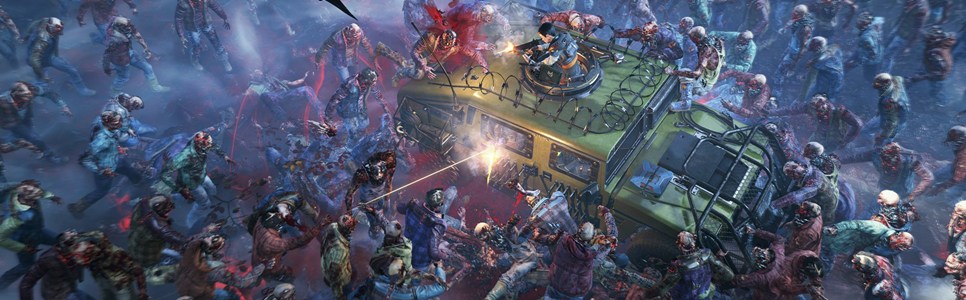
As we get closer to the release of co-op first-person shooter John Carpenter’s Toxic Commando, Saber Interactive’s chief creative officer Tim Willits was kind enough to answer our questions about the upcoming game. Throughout the interview, we spoke about a variety of subjects, including the evolution of enemy hordes, the role of vehicles in gameplay, and how the studio used its experience with simulationist driving games like SnowRunner to design some of the vehicle-oriented encounters.
Saber Interactive’s co-op action games have become known for how large the attacking hordes tend to be. How much of this feature was developed over the course of Space Marine 2?
At Saber, we have our own proprietary engine called The Swarm Engine, which we have developed for many years. With Space Marine 2, we pushed that technology much further. The scale became more epic. The battles became more cinematic. We refined animation blending, pathing, collision, and large-scale combat readability so players could fight enormous swarms without losing clarity. It wasn’t just more enemies, it was better enemies in bigger, more intense battle spaces, all coordinated with our signature AI Director.
Now with Toxic Commando, we’re blowing it out of the water.

"The scale became more epic. The battles became more cinematic."
We are introducing new enemy types, more randomness in swarm behavior, and a much more advanced AI Director. That AI Director constantly evaluates the battlefield and orchestrates encounters so they feel dynamic. On top of that, we’re doing it in a much larger world with vehicles, terrain deformation, and far more strategic options for players.
Because the world is bigger and more systemic, the swarms aren’t just something you shoot, but a coordinated attack where you and your teammates need to use everything in your arsenal to survive, with every battle playing out differently.
With Saber’s proprietary Swarm Engine, we can create truly unique, over-the-top battles at a scale that very few studios can achieve.
Aside from the standard hordes of enemies, what kind of special enemies can we expect?
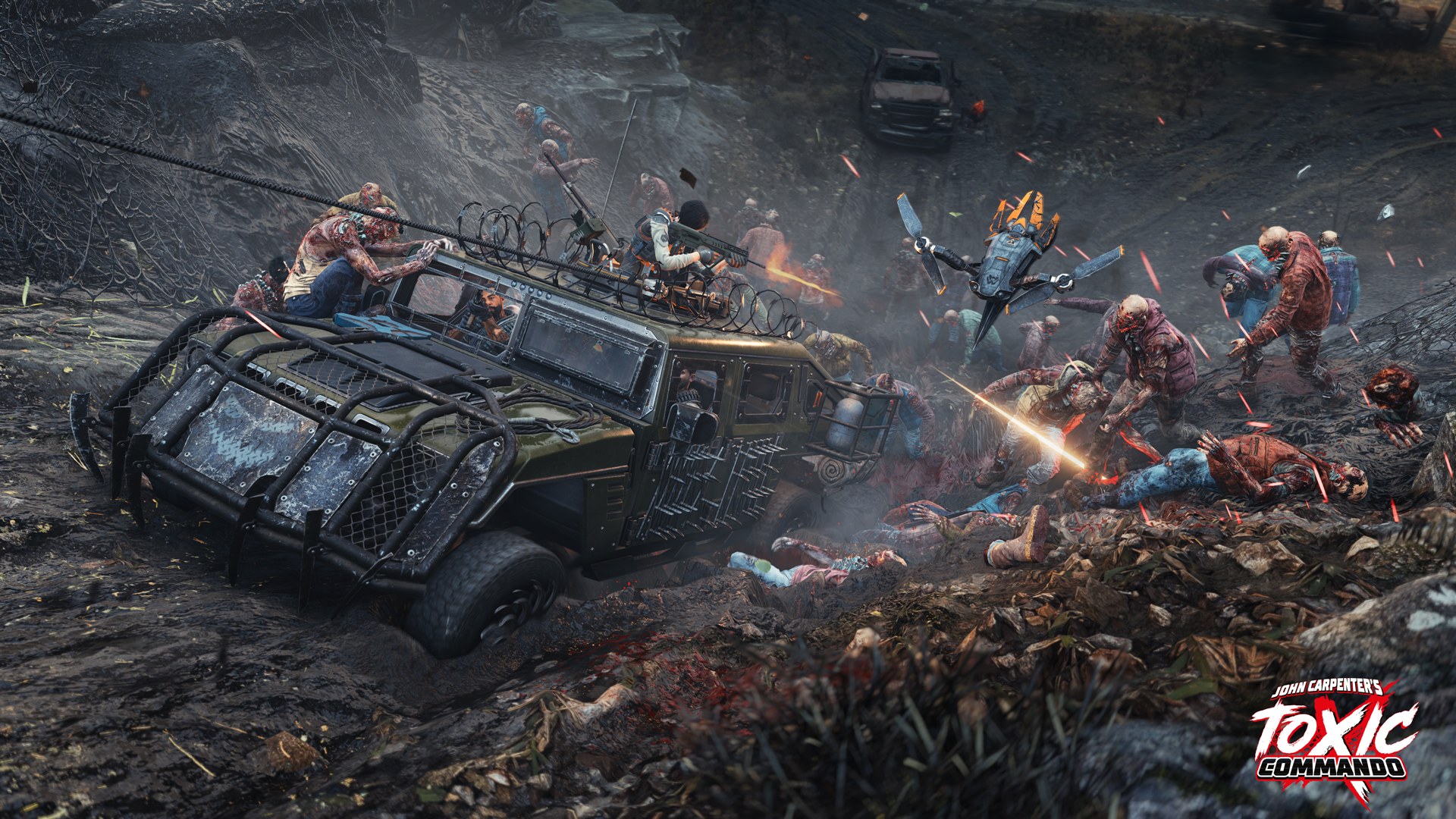
Aside from the standard hordes, we have designed a lineup of special enemies that adds a lot of variety to the battles. For example, the Skunk is infected with a toxic substance that releases a red infectious vapor, poisoning you over time while also boosting nearby enemies. So, if you ignore it, the entire horde suddenly becomes more dangerous. The Stalker is a ranged threat with both basic and charged attacks, but what really makes it unique is its ability to root vehicles in place. When that happens, you will be forced to jump out and destroy the tentacles blocking the vehicle. The Nuker is our explosive enemy that detonates in close proximity, and we’ve even added a Fire Nuker variant that leaves behind a burning hazard zone, turning safe ground into a temporary death trap. Then there’s the Goon, a big, tough disabler that will rush you, grab you, and pummel you to death if your friends don’t react quickly. These enemies aren’t just stronger versions of the horde, they are designed to create layered combat and force groups to change tactics. And of course, we have a few more surprises waiting for players to discover.
Will there be any epic boss fights that promote a greater degree of teamwork and problem-solving?
One of our main goals with Toxic Commando was to move beyond the traditional “big enemy with a big health bar” and create true event-style battles that require teamwork, coordination, and problem-solving. Thanks to our proprietary Swarm Engine, we’re able to combine massive, dynamic swarm encounters with unique special enemies and then layer in over-the-top, boss-like encounters. At the center of it all is the Sludge God, the creator of these creatures, who doesn’t just spawn enemies but creates chaotic battle situations by manipulating the environment and unleashing creatures that can be dynamic during the battles. Some encounters aren’t just about shooting a boss, they require players to manage the swarms while adjusting to environmental threats and responding to special enemies. We really focused on adding variety not only to the core combat loop but especially to the big event battles that really make the game fun to play.

"Thanks to our proprietary Swarm Engine, we’re able to combine massive, dynamic swarm encounters with unique special enemies and then layer in over-the-top, boss-like encounters."
How large of a role will vehicles play in the course of a standard mission?
Vehicles play a major role in a standard mission where they are not just transportation, but part of the core gameplay loop. The world in Toxic Commando is large and dangerous, so navigating the environment is far more effective in a vehicle, especially when the enemies start to close in. Players who aren’t driving can lean out the windows to fire their weapons or man mounted guns on certain vehicles, which makes travel a combat-filled experience. Your main truck is also equipped with tools that directly impact survival, including an EMP charge that can clear out large numbers of enemies and a grapple hook that helps pull you free from mud or other terrain hazards. Some of the most fun moments happen when multiple players each have their own vehicle, moving together across the map, forming a deadly caravan. It is always my most enjoyable moment in the game when we have multiple vehicles driving across the world.
Saber Interactive is also known for its ultra-simulationist driving games like SnowRunner. Will any of that DNA make it into Toxic Commando in terms of having to deal with crises that involve vehicles?
Yes, absolutely. At Saber we’ve developed a deep expertise in vehicle simulation through games like SnowRunner, and we’ve taken a lot of what we learned there and applied it to Toxic Commando. That said, we were very careful about balance. Our vehicles are rooted in realism with weight, traction, terrain interaction all parts of the experience, but they’ve been tuned to ensure that getting around the world feels fun and engaging rather than punishing. At its core, Toxic Commando is an action game with vehicles, not a hardcore driving simulator, so the priority was always making sure the vehicle gameplay enhances the experience instead of slowing it down. We had to strike a balance between authentic vehicle behavior and over-the-top action, and we feel we’ve found a sweet spot where the driving adds tension and strategy without ever distracting from the core combat experience.
How customizable will the vehicle be? Are we stuck with the mounted machine gun on top or can we swap it out for something else?
Vehicles in Toxic Commando have been designed around strategy and world unpredictability. Because vehicles spawn dynamically, both in terms of type and location, we’ve assigned specific mounted weapons to specific vehicle types. So, if you find a certain truck or armored vehicle, you’ll know what kind of mounted gun it comes with. We made that choice intentionally. While players can improve vehicles characteristics through their class progression tree, each vehicle’s features and abilities remain fixed and cannot be altered. This encourages players to think more strategically when using vehicles in the world. It also reinforces the dynamic nature of each mission. There may be times when you spawn into a level and there isn’t a vehicle nearby, forcing you to either search for one or push forward on foot. That unpredictability is part of the game, and it makes various sessions play differently. However, each vehicle is visually customizable — for example: changing the color, swapping out honk sounds, adding graffiti, modifying the headlights.

"Because vehicles spawn dynamically, both in terms of type and location, we’ve assigned specific mounted weapons to specific vehicle types."
Aside from the story itself, will Toxic Commando feature any other form of player progression?
Yes, Toxic Commando features player progression beyond the story itself. If you’re familiar with Space Marine 2, you’ll recognize many of the core progression philosophies we have in Toxic Commando. The game includes class-based progression tied directly to the classes you choose to play. The more you use a specific class, the more you advance it, unlocking improvements and strengthening that role over time. This progression carries outside of individual sessions, so even after a mission ends, you continue building your long-term class.
In addition to class progression, there’s also weapon progression and upgrades. As you play, you earn resources that can be spent on improving weapons and items, allowing you to tailor your loadout to your preferred playstyle. We wanted players to feel rewarded for time invested, while also giving them meaningful choices about how they evolve their characters. The result is a system that supports replayability, encourages experimenting with different classes, and reinforces that sense of growing stronger the more you play.
How can you describe the overall flow of a mission in Toxic Commando? Will it be more free-form, or a more linear experience where we’re basically running from point A to B?
Each mission in Toxic Commando is built around a clear overall objective, but how you get there is much more flexible. We didn’t want it to feel like a straight line from point A to point B. Instead, missions are structured to encourage exploration and player choice. Along the way, there are side objectives that can be completed in different orders, and finishing them provides valuable in-session rewards that can make the final encounter more manageable. Players can approach both side objectives and the main objective in different ways depending on how they want to play, available vehicles, and how many resources you think you may need for the final objective.
We also introduce a layer of unpredictability by randomly shifting certain objective locations, which helps make repeat playthroughs feel different. If a squad wants to, they can rush directly toward the primary objective, but in our experience the most fun comes from searching the world, hunting for side objectives, discovering rewards, securing better positioning, and really engaging with the environment. That blend of structured goals and free-form decision-making gives each mission its own feel while still supporting replayability and team-based strategies.

"We also introduce a layer of unpredictability by randomly shifting certain objective locations, which helps make repeat playthroughs feel different."
On PS5, PS5 Pro, and Xbox Series X, what performance targets are you aiming for in terms of resolution and frame rate? Are there multiple graphics modes planned?
On Xbox Series X, we’re targeting 2160p at 30fps in Quality mode and 2160p at 45fps in Performance mode. On PS5, we’re aiming for 2160p at 30fps in Quality mode and 1440p at 45fps in Performance mode. PS5 Pro targets 2160p at 30fps in Quality mode and 2160p at 45fps in Performance mode. We currently have two graphics modes planned — Quality and Performance — across both platforms.
Xbox Series S continues to be an important part of the ecosystem. What were the biggest technical challenges in scaling the game for Series S, and how did the team approach optimization?
The Xbox Series S is an important platform for Saber, and we fully support it. We’ve already put our proprietary Swarm Engine on the platform in previous titles, so going into Toxic Commando we had valuable experience in understanding how to scale large-scale battles and complex systems to run smoothly within its hardware profile. Our goal was never to compromise the core experience that defines the game, but to ensure that it performs consistently and feels great to play. We’re proud of how Toxic Commando runs across all platforms, including Series S, and we feel confident that players on every system will experience the intensity and scale that make the game special.
How are you leveraging features like the PS5’s SSD and DualSense, or Xbox’s Velocity Architecture, to enhance immersion and loading performance?
At this stage, we haven’t implemented any platform-specific features such as DualSense haptics, adaptive triggers, or Xbox Velocity Architecture.
With next-gen hardware allowing for larger worlds and more systemic complexity, was a version for Switch 2 ever considered? If not, was that primarily due to technical limitations, scope considerations, or platform strategy?
We have not ruled out the Switch 2, we will continue to assess the platform, and make a determination at a later date. We have a great track record with the Switch and we look forward to developing as much as we can on the Switch 2.
"There’s a strong emphasis on cross-class synergy in Toxic Commando."
With four distinct classes, how much ‘cross-class’ synergy is there? Are there specific ability combos that only a full 4-player squad can pull off?
There’s a strong emphasis on cross-class synergy in Toxic Commando. While each of the four classes is viable on its own and can contribute meaningfully in any squad, the system really shines when players coordinate their abilities. We intentionally designed class skills to complement one another. For example, crowd control abilities can set up high-damage plays, defensive tools can create safe zones for objective work, and support mechanics can extend survivability during overwhelming swarms. The goal is to reward coordination and communication without punishing experimentation. When a full squad syncs up and pulls off a coordinated chain of abilities during a chaotic battle, that’s when the system really shines.
Is the player progression (unlocks/upgrades) tied to the individual character, or is there a ‘Meta-Progression’ that benefits the whole squad?
Progression in Toxic Commando is player-based. Your class advancement, unlocks, and weapon upgrades are tied to your individual profile and carry across sessions, so the more you invest in a specific class or loadout, the stronger that character becomes over time. That long-term growth is personal and reflects how you choose to play.
That said, once you’re inside a mission, there are shared elements that encourage squad cooperation. Certain in-session resources, like spare parts can be used to build turrets and defensive structures, that everyone can use. There’s also a resource called “sludgite” that is shared across the group, so it doesn’t matter who picks it up. So while the overarching progression is individual, the moment-to-moment survival and tactical advantages inside a mission are very much a collective effort.
In SnowRunner, getting stuck is the game. In Toxic Commando, if a vehicle gets stuck in the mud during a multiplayer session, how does that shift the team’s priorities? Does it turn into a ‘horde defense’ moment while one player handles the recovery?
You’ve got to get out and push! I’m joking. But the mud can definitely become a problem if you’re not careful. While Toxic Commando isn’t built as a pure vehicle simulation, terrain still matters, and getting bogged down at the wrong moment can be a problem.
Luckily, your main truck is equipped with a winch that can pull you out of sticky situations. Other vehicles aren’t always as forgiving, and if you can’t get your way out quickly, teammates may need to jump out and defend while the driver works to free the vehicle. And in worst-case scenarios, the squad might have to abandon the vehicle altogether and push forward on foot.