






MLB The Show isn’t a typical sports sim. Baseball, rooted in player form and season stats, is a numbers game. Maximise batting percentage and your team scores more runs; split your pitches into logical yet undetectable patterns and you’ll strike out more batters.
A keen eye on the numbers underlines the sport’s psychological battle, with the face-off between pitcher and batter its epicentre. So, when we say MLB The Show isn’t like other sports sims, it’s because it must do two things: simulate baseball’s moment-to-moment action with precision whilst feeding you streams of data – stats, rates, attributes; continually engaging, page after page.
MLB The Show is a gold-standard baseball sim, with this year’s entry capturing the sport’s rhythm, complexity, and tactical depth through rejuvenated stat delivery. For batters, real-world pitch usage rates yield information you can take straight to the plate, while fielder reaction times are now digestible via a suite of new attributes. Support comes from expanded match day coverage and an abundance of all-new on-field animations – over 500, to be exact. The result is a package that remains one of the most authentic sports simulations available, even if some additions feel evolutionary rather than revolutionary.
"Among the new hitting interfaces is Fixed Zone Hitting, which prevents the Plate Coverage Indicator – the PCI – from resetting after releasing the analog stick."
Still, the defining strength of MLB The Show is its ability to capture baseball’s fundamental mind game. Every at-bat is a strategic battle of prediction, timing, and patience, with MLB The Show 26 continuing to emphasise the count’s dynamic moments.
When you’re batting, CPU pitchers will mix up their throws with convincing intelligence. Fastballs often establish the early rhythm, while sliders, sinkers, and off-speed fastball variants arrive to disrupt timing. Over the course of several exhibition matches, I noticed that the CPU was able to adapt its approach, occasionally establishing patterns before swiftly subverting my expectations. On one occasion, after two pitches landed on the left-side of the zone, a third delivery appeared headed for the right. I was anticipating this, but my swing was still ill-advised. The ball broke into a slider, veering wide of the plate. A little more discipline and I could have turned the tide in that particular war. Instead, momentum didn’t shift. I was out.
This moment illustrates how MLB The Show 26 can replicate the tension at the plate, with the pitcher’s confidence gauge playing a major role. See, confident pitchers locate the strike zone with greater consistency, while struggling pitchers scatter their throws more erratically (an effect I experienced many times when, after what I believed was perfect placement, I saw my pitch curve wide of the zone through low confidence). If the batter takes these balls – as in, lets them fly past without swinging wildly – then a pitcher’s confidence noticeably drops, creating opportunities for mistakes that skilled batters can exploit.
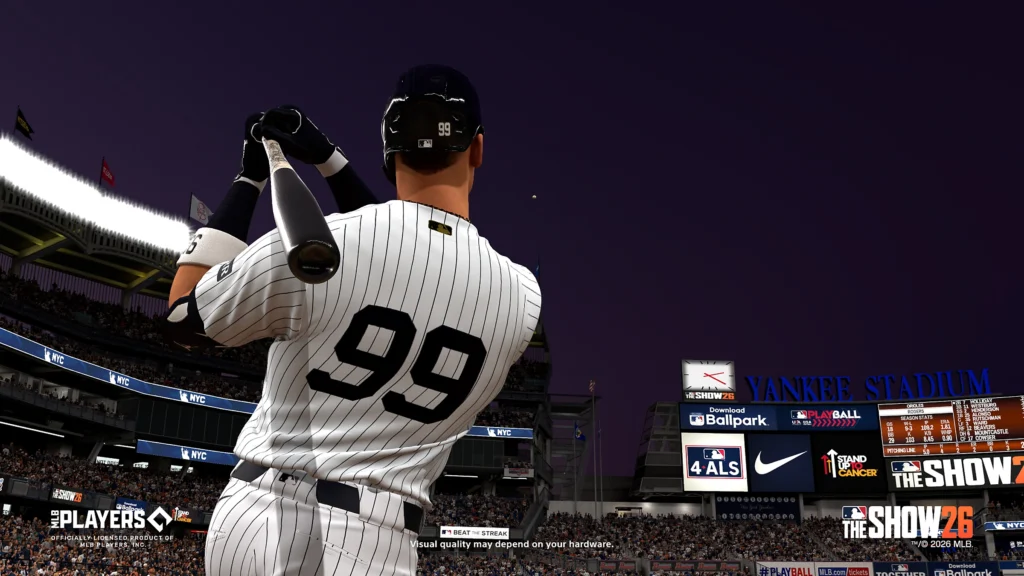
Hitting remains the game’s most demanding aspect. Timing, pitch recognition, and placement – alongside various batter attributes – all combine to determine the quality of contact. The sharp thwack of a perfectly timed hit is joyous to hear, but those moments occur infrequently making them feel earned and deeply satisfying when they do happen.
Among the new hitting interfaces is Fixed Zone Hitting, which prevents the Plate Coverage Indicator – the PCI – from resetting after releasing the analog stick. This experience makes Zone Hitting slightly more intuitive, with the extra swing control offered by either mode keeping this interface as the game’s most effective, although newcomers may find it intimidating.
More accessible is the newly introduced Big Zone Hitting interface, existing in a middle ground between Zone Hitting and directional or timing-based systems. Instead of precise PCI placement, Big Zone divides the plate into segments, allowing me to guide my swing toward a general area while focusing more heavily on my timing. See, with the strike zone visually separated, reading pitches became easier, and my attention shifted toward the crucial split-second decision of when to swing. Successful hits became more common, while leaving difficult pitches was more manageable.
"Bare Down Pitching puts your pitcher into boost mode, heightening senses to bring greater control and velocity in the biggest moments."
Ambush Hitting – introduced last year – also returns, where contact advantages can result from pre-selecting the correct half of the strike zone. In theory, this adds another layer of strategy or, at least, gives greater opportunity to break a pitcher’s flow. Yet, in practice, I felt my choice came down to educated guesswork rather than a readable tactical system. Later in my playthrough, as my confidence grew, I defaulted to always choosing the outside half of the zone anyway. That is where I most-consistently smacked the ball to an un-manned part of the field.
Real-world pitch history information is available through menus, and there’s lots of useful information within. At a glance, you’ll see which pitches your opposition favours in a given moment, which has more likelihood to be thrown if you’re in command of a right-handed batter, or the ranking of their pitch repertoire via their player card, and so on. It’s not an exact science – a pitcher who launches spinners four-percent of the time can still lob you the occasional spinner. Useful it may be, accessing it mid-game disrupted my flow. I’d much prefer referencing this information at the plate, especially during clutch moments.
And speaking of clutch, you’ve a new weapon to deploy at the mound. Bare Down Pitching puts your pitcher into boost mode, heightening senses to bring greater control and velocity in the biggest moments. And, depending on your pitcher’s clutch rating, you can stack Bare Down Pitches to use one after another. While sharp intakes of breath and tighter framing increase the drama, I rarely found this mechanic to be over-powered. In fact, batters often still dealt with my Bare Downs, if only to knock out foul balls and maintain the count.
Elsewhere, Road to the Show returns as the series’ flagship career mode. Partially rebranded to Road to Cooperstown, this iteration sees the early stages of your career expanded to include the final stretch of a high school season, with college scouts evaluating your performance.
"You’ll favour Franchise Mode if you’re the kind of player who prefers baseball’s strategic side, where long-term control over a team’s roster, finances, and trades coincide with the regular season."
Character customisation remains incredibly deep although, with the mode placing renewed energy on your individual progression to Hall of Fame status, it didn’t feel excessive. It was part of the journey, where goal-orientated progression revolves around performance grades, completing dynamic objectives, earning tokens to boost attributes, and unlocking perks. While the structure is easy to understand, progression pacing felt uneven early on, where an abundance of college offers came rolling in – along with an unexpected Blue Jays contract – despite, admittedly, a string of average performances. Still, the act of climbing the baseballing ladder is more compelling than ever.
Diamond Dynasty continues to serve the series’ live-service centrepiece, where you build custom teams through collectible player cards, completing challenges and events to strengthen your lineup. This year introduces a new Red Diamond rarity tier and expanded Parallel XP systems to allow greater stat customisation. While these additions deepen progression, the core appeal remains unchanged: quest for cards and reap the addictive thrill of ripping packs open and assembling your dream roster. Accessibility sliders are disabled in this mode to retain competitive balance, which makes the experience noticeably more challenging than exhibition play. For newer players, this might slow progression down to a frustrating grind.
You’ll favour Franchise Mode if you’re the kind of player who prefers baseball’s strategic side, where long-term control over a team’s roster, finances, and trades coincide with the regular season. The revamped Trade Hub provides a centralised interface for managing deals, alongside improved AI logic and a rumours system which hints at other teams’ needs across the league. This mode gives another example of MLB The Show 26’s ability to present an overwhelming amount of statistical data in simple structures. The Trade Hub’s layout tracked my thought process too; whether by design or coincidence, I found navigating through the various sub-menus fluid and frictionless.
Early on, I identified a lack of squad depth in first and third base positions, and there was a list of free agents easily accessible from this screen. After a quick browse, I opted to get the season underway instead. Vladimir Guerrero Jr. occupies first base for my chosen team (again) the Toronto Blue Jays, and I figured he’d be a big injury loss whichever position he played. However, before starting the season proper, I located the “positions” tab on the Trade Hub and selected 1B and 3B as positions I’d like to prioritise for recruitment, the intention being that opportunities for trade would come my way rather than I sift through reams of 1B player stats.
"For beginners willing to embrace its difficulty, or seasoned veterans looking for a refined baseball experience, MLB The Show 26 remains the benchmark."
So, despite the managerial complexity, I was able to leverage a foothold. In Franchise Mode, evaluating roster strength and negotiating trades doesn’t demand expert baseballing knowledge, just a little patience. I only spent a couple of hours in this mode, but immediately I saw sandbox potential that would keep me satisfied throughout an entire season.
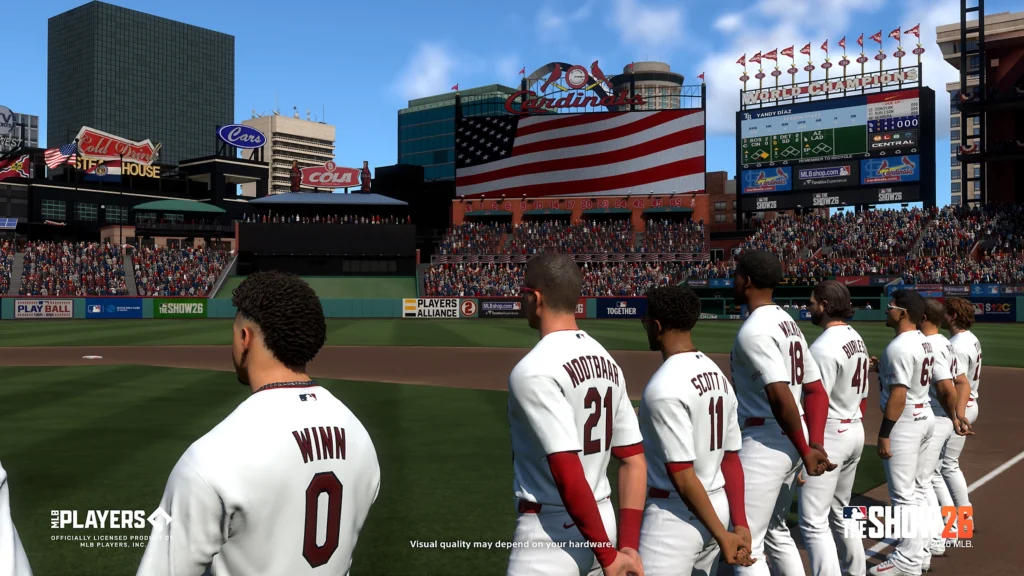
In summary, MLB The Show 26 isn’t a radical reinvention, but a continued effort to refine one of the most authentic sports simulations available. The famously steep learning curve persists, but once the mechanics click the essence of baseball reveals itself. Broadcast quality presentation, authentic, and varied, fielder animations – jump throws, slides, the odd fumble, even slowing to adjust footwork before throwing – plus hitting interfaces that bridge the gap between novice and expert, opportunities for deep, long-term experiences, and a true representation of baseball’s psychological warfare – the pitcher-batter mind game. All that’s critical is here.
Despite my usual gripes with the live-service loop (common in most modern sports sims, to be fair) MLB The Show 26 has very little superfluous fluff, and that’s including the smorgasbord of stats, abilities, gauges, attributes, form guides – numbers basically – that the game throws at you. For beginners willing to embrace its difficulty, or seasoned veterans looking for a refined baseball experience, MLB The Show 26 remains the benchmark.
This game was reviewed on the PlayStation 5.
With 500+ new animations and best-in-class presentation, The series remains a champion of authenticity, Big Zone Hitting offers an accessible stepping stone, Overall gameplay captures the tension of its real-life counterpart.
The game’s steep learning curve is still intimidating for unfamiliar players, Important tactical information sits within game-pausing menus.