





We don’t get a ton of games like Motorslice these days. A linear action-platformer with a massive sense of scale and a number of enormous bosses, Motorslice takes clear cues from classic action games, wearing its influences on its sleeve but packaging it all in a unique, self-aware setting filled with malevolent heavy machinery.
It sometimes leans a bit too much into its influences, bringing with it its own set of platforming frustrations and technical issues, but when it all comes together, Motorslice offers an incredibly engaging experience that invokes some of the best games of all time but adds its own twists that make it memorable on its own.
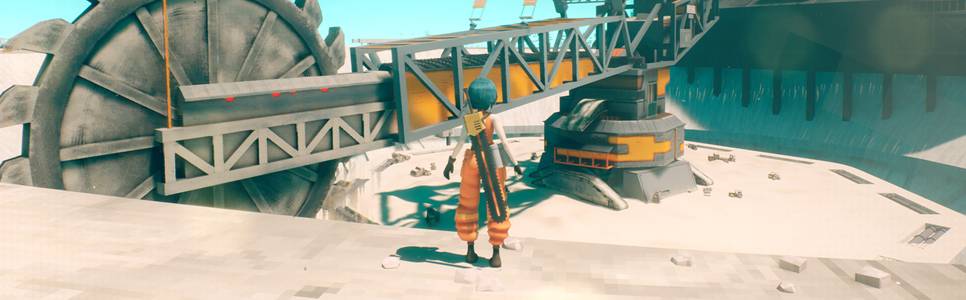
Motorslice puts you in the shoes of P, a chainsaw-wielding Slicer sent with a simple mission to destroy every machine she encounters, alongside her friendly drone Orbie. It quickly becomes clear that the world has been taken over by evil construction equipment that range anywhere from tractors and loaders to massive bulldozers and motor graders, and the only way to save this world is to climb to the top of the megastructure controlling these machines and destroying everything in the way.
It’s a compelling if somewhat familiar setup that paves the way for platforming challenges and machine obliteration, and the construction environment gives the entire game the kind of lighthearted enjoyability that comes with battling 80-foot-tall excavators.
"The game does a fantastic job at teaching you its rules through a gradual build in each level and forces you to come to grips with each of its individual systems."
Where Motorslice defines itself is in its clear influence from a handful of beloved action-adventure games, most notably Prince of Persia: The Sands of Time and Shadow of the Colossus. Most of the game is centered around platforming challenges, separated into five checkpoints each for all of its 8 main chapters.
These task you with wall-running, precision jumping, and climbing your way over and up various obstacles as you make your way to the top of the megastructure, and they increase in difficulty as you near the apex of the tower. The magnetic platforming and linear level design here highlight the admiration for The Sands of Time, and the platforming has built on that foundation to make what is a largely recognizable but nevertheless satisfying experience.
The game does a fantastic job at teaching you its rules through a gradual build in each level and forces you to come to grips with each of its individual systems. What starts as wall-running down straight corridors evolves into scaling massive moving machines and often keeping your feet off the ground for extended periods at a time. You can also challenge yourself with more obscure challenges to obtain Orb Drones, and while these don’t offer much aside from a collectible, the platforming challenges they offer are another way that it allows you to hone and show off your skills.
The platforming feels great most of the time, but in some ways it also takes some of the quirks and frustrations of its influences as well. It can often be immediately unclear which direction you’re meant to go, and because this is a game where platforming and movement are king, it can be a drag to spend time away from that while trying to eyeball the path forward. The platforming, too, can be finnicky, especially in the late game where precision is amplified and mistakes are punished.
You never quite know which direction P is going to jump when coming off a wall or whether she will jump straight up a wall or begin wall-running, nor is it always clear which platforms are reachable from a certain spot. Some of this encourages trial and error throughout each level, but as the levels get longer and retries become more arduous, the frustration that comes from seeming inconsistencies in the platforming logic grows. Add on top of this controls that can sometimes feel non-responsive, such as when you’re repeatedly wall-jumping, and there are certain moments where the platforming can feel more disheartening than satisfying.
Alongside the traditional platforming, Motorslice introduces its new titular mechanic as another way to quickly get around and frequently get past certain obstacles. Through this mechanic, P uses her chainsaw to cut up or across heavily delineated pieces of certain walls and traverse larger obstacles. This also provides for an additional wrinkle to platforming challenges, as P will often need to combine traditional platforming with motorslices to get past particularly long sequences. As a novel mechanic, this works for most of its usage but creates some of its own frustrations. In particular, the way that you initiate motorslicing is by holding attack while facing toward or to the side of a wall that can be sliced.
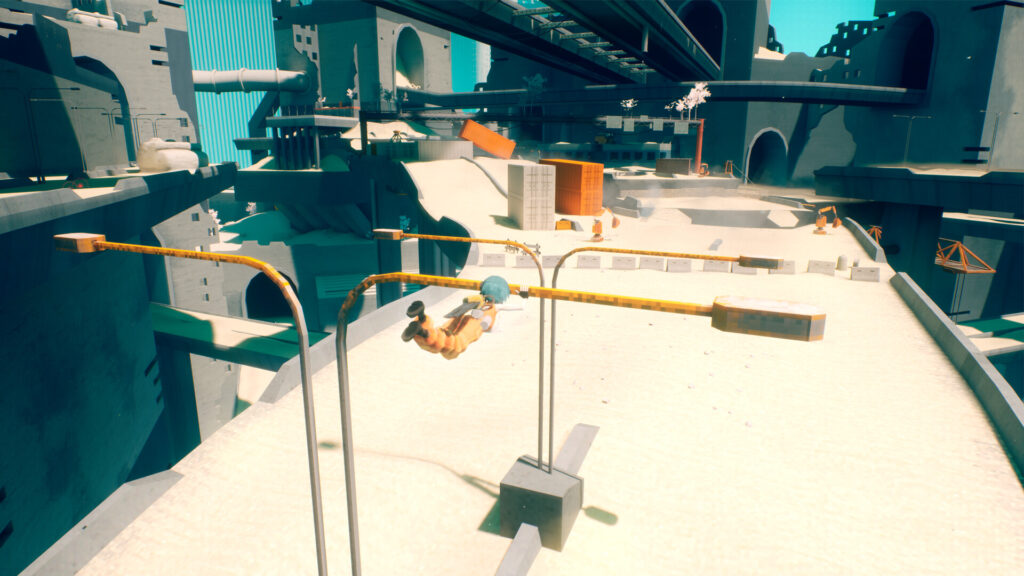
"Where motorslicing becomes most important, though, is in combat, especially in boss fights."
If you face toward the wall, you slice up, and if you face to the side, you slice sideways in that direction. This is intuitive enough and gets more natural as the game progresses, but the game does not allow you to switch directions easily despite having numerous challenges built around going both up and to the side without touching the ground, meaning that you have to let go and switch the direction P is facing in mid-air. When it works, it’s incredibly satisfying, but too frequently I found myself slicing in the wrong direction or falling off the wall entirely while doing these challenges.
Where motorslicing becomes most important, though, is in combat, especially in boss fights. Outside of bosses, combat primarily consists of fighting packs of grunt-like loaders and drones, most of which can be killed in one or two hits.
There’s a parry system and a charged attack on top of your normal attack, though aside from drones that can only be killed by parrying their projectiles back to them, I rarely found myself having to use any of my special abilities and never really struggled to progress through these combat sections.
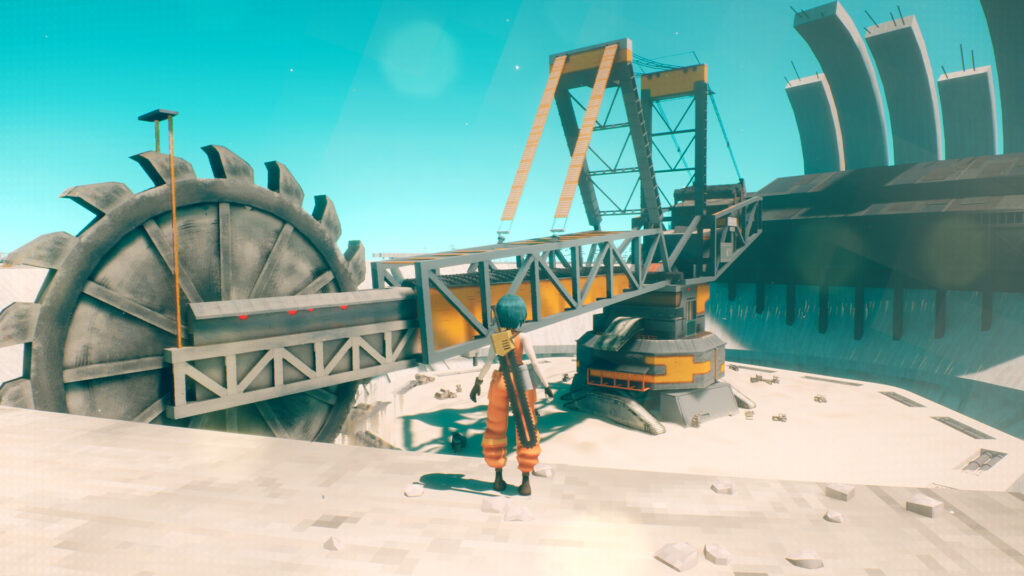
"The health bar represents the sections of the boss you need to slice through, and only once you’ve hit each section does the boss go down."
The bosses, however, are an entirely different beast. Each chapter greets you with a shot of a massive machine in the distance, and all of your traversal is in service of reaching this machine and ultimately destroying it. With these bosses, Motorslice takes a clear cue from Shadow of the Colossus, as each boss is less of a combat challenge and more of a puzzle in which you have to motorslice your way up and around the boss until it’s destroyed.
The health bar represents the sections of the boss you need to slice through, and only once you’ve hit each section does the boss go down. Bosses are an impressive feat of scale, and ascending them is often just as much about solving how to get the boss to the ground as it is about execution. I found these bosses to be the most interesting and memorable aspects of Motorslice, if only because of the impressive scale. They’re not particularly difficult, though I did find myself using the in-game hints in the final few chapters, but these are more about the frequently astonishing visual feast that you can experience while the camera zooms out and you take down colossus-style heavy machinery.
Intertwined between each chapter is a lightly-told but intriguing narrative that centers around P and Orbie learning more about the structure they’re scaling and the nature of the machines they’re destroying. It’s largely told through intermittent periods of slacking off where the two of them discuss their purpose and how they relate to the machines, and it’s almost entirely skippable if you only want to experience the gameplay.
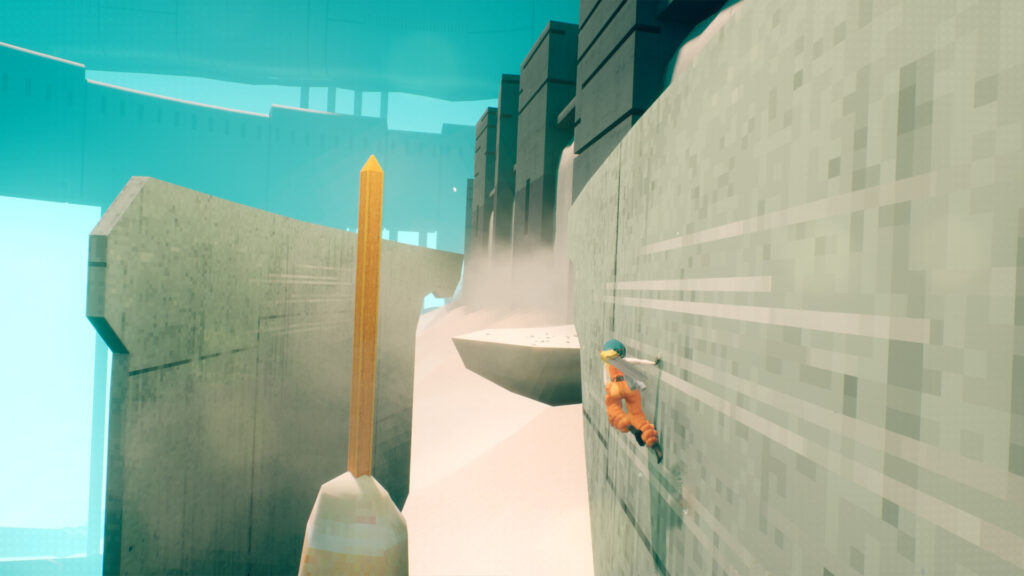
"Visually, Motorslice excels with a distinct art style and color palette despite often being drenched in the classic construction browns and yellows."
While the story isn’t outstanding for this type of setting, it adequately sets the tone for the rest of the gameplay and offers some questions about why we’re fighting these machines and what they actually want, and P’s writing and voice acting provide enough charm that I found myself wanting to hear her inner monologue.
Visually, Motorslice excels with a distinct art style and color palette despite often being drenched in the classic construction browns and yellows. The core visual feature, though, is its sense of scale through both bosses and large scalable or sliceable walls. It’s frequently awe-inspiring when it zooms out and shows you everything you’re conquering, and the stellar lo-fi score often kicks in at the perfect moments to round out the entire experience.
It’s a shame, then, that there are a number of technical problems at launch. I had around half a dozen crashes as well as a number of moments where I was sent through the floor or into an altogether unknown location, and a signature experience of my playthrough was the game soft-locking by sending me into an unknown level without a path forward and requiring me to reinstall the game and delete all save data. The developers have promised a day one patch and additional support after launch, and because of how smooth the experience is when it runs well, I hope these bugs are quickly resolved.
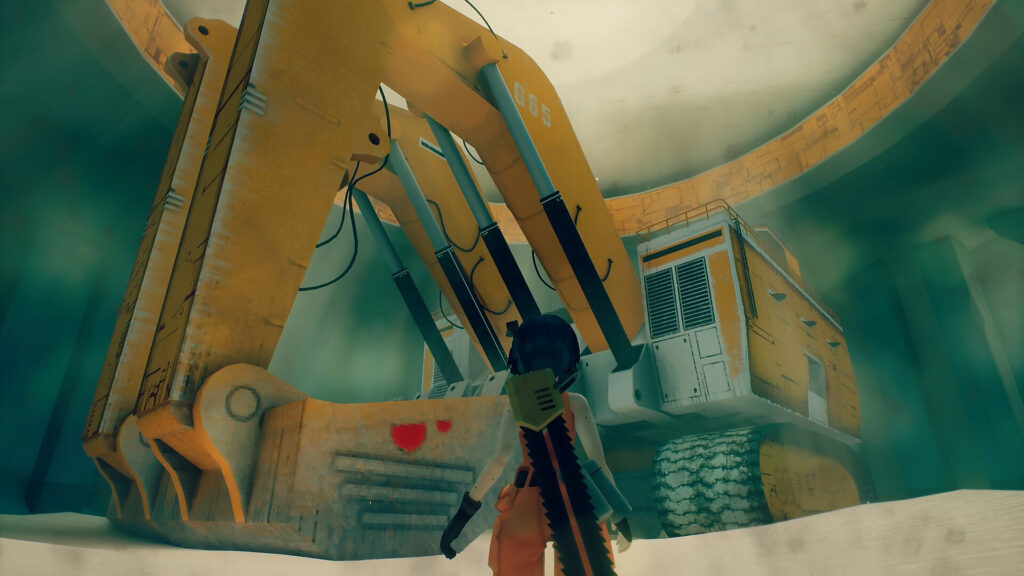
"The titular mechanic enables a new wrinkle to classic platforming challenges, and the game excels in its sense of scale, particularly when solving and taking down its impressively large bosses. "
While much of the experience will feel familiar for fans of old-school 3D platforming adventures like Prince of Persia: The Sands of Time and the bosses take clear cues from Shadow of the Colossus, Motorslice manages to put them together in a package that feels familiar but fresh.
The titular mechanic enables a new wrinkle to classic platforming challenges, and the game excels in its sense of scale, particularly when solving and taking down its impressively large bosses. It’s not perfect, as its controls and inconsistencies can cause some extended periods of frustration, but it succeeds for a game that is evidently attempting to recapture and bring forward the magic of some of the most important games of all time.
This game was reviewed on the PlayStation 5.
Satisfying platforming challenges, Impressive scale, Incredible boss fights, Interesting setup.
Some platforming inconsistencies, Unresponsive controls, Technical struggles.