





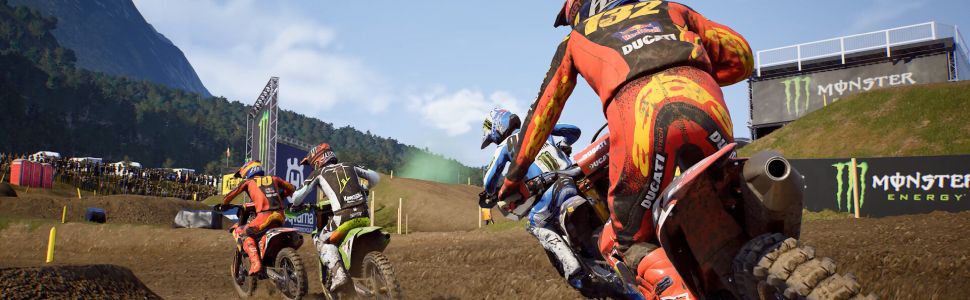
Motocross is messy. There are no perfect racing lines, no immaculate apexes, and very little time spent pinning the throttle. Instead, MXGP 26 constantly asks you to wrestle your bike into submission, balancing throttle, steering, and body weight while the track shifts beneath you. Momentum is everything, but so is reacting to whatever the dirt throws at you. One moment you’re carving through a corner; the next, you’re fighting to keep your wheels pointing in the right direction.
"MXGP 26 constantly asks you to wrestle your bike into submission, balancing throttle, steering, and body weight while the track shifts beneath you."
This is what makes MXGP 26 a different proposition to conventional circuit racers. It’s not about precision; more about managing instability. Jumps need to be measured and ruts need to be learned, yet the surface alters dramatically lap after lap. The result is a demanding racing game where simply staying upright can feel like an achievement.
And, keeping your rider seated takes more than simply memorising a circuit’s corners. MXGP 26 demands you learn how its jumps, ruts, and undulations interact with your bike. A jump, for instance, might look straightforward, but approach it with too much speed and you’ll overshoot the landing; too little and you’ll kill the momentum you need for the next obstacle. Ruts are equally important, capable of rotating the bike dramatically even if you’re travelling at modest speeds.
Loading into Time Trials at Foxhills, Loket, and Afyonkarahisar, I quickly realised that chasing the fastest lap wasn’t about outright speed. Each circuit required study, and I began remembering where the deepest ruts were, which jumps demanded a measured approach, and how to maintain momentum through a sequence of curves where simply braking, turning, and accelerating was ineffective. In other words, the fastest route isn’t always the smoothest. Sometimes, too, the track dictates your line, and threading the needle like you would with a superbike on the road gives way to attritional brute force.
In MXGP 26, you can’t impose the conventions of traditional circuit racing. The dirt is doing everything it can to disrupt you. The track is not your friend.
Moving onto Uddevalla in Sweden, this track, like the UK’s Foxhills, is a hard-packed soil surface, and it’s the standard surface type found in Motocross. Now, ‘standard’ is a loose description; the dirt still visibly shreds, with new trenches and ruts emerging during races. And, these changes affect future lines, jump approaches, corner speeds, the lot.
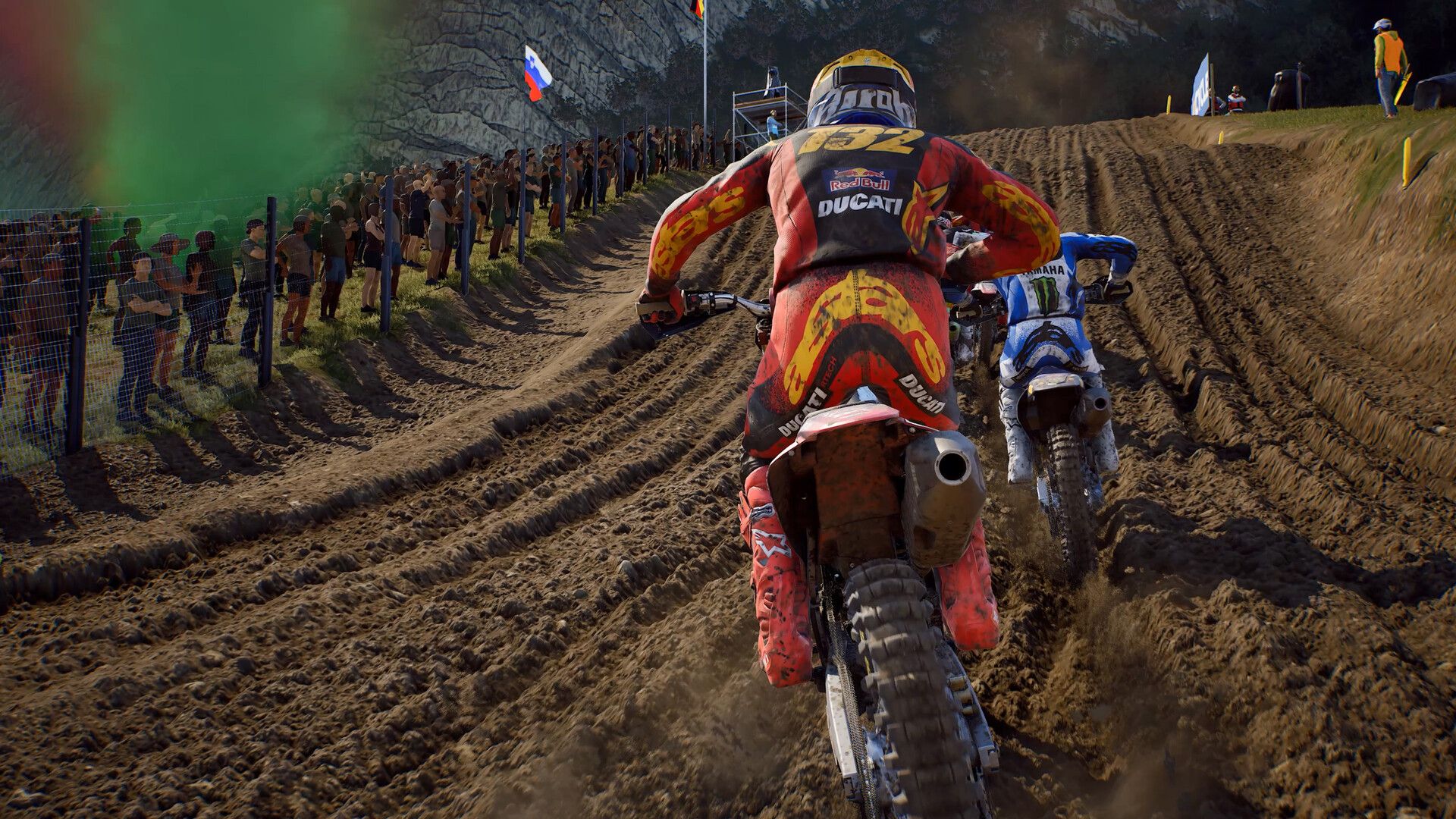
"In MXGP 26, you can’t impose the conventions of traditional circuit racing."
Switching to Latvia’s Kegums circuit, and increasing the Dynamic Deformation setting to maximum yielded an extreme amount of circuit disruption. Visibly, the deformation appears organically, with deeper ruts in single-file sections and new racing lines being chopped into the mud. Track evolution broadly reflects where riders are actually travelling, with the circuit becoming dramatically different over the course of a race. But, at max deformation, I began to question if the simulation became too unpredictable. See, while deep ruts can help you rotate through a corner, the track’s sheer shredded-ness can suddenly throw you off course too. At worst, the bike would be randomly flipped, but most often I was crawling through particularly destroyed sections. Crucially, I didn’t always feel like I’d made a meaningful mistake, or, likewise, if I’d carved round a bend with expert precision or whether my wheels fell into a groove through luck. At its most extreme, deformation felt haphazard, and reducing the setting back to default gave me a much more enjoyable experience.
I know what you’re thinking: “that’s Motocross.” And yeah, you’re right. But, while the developer deserves credit for translating hostile track surfaces into impactful gameplay, for me, extreme deformation turned races into acts of survival rather than opportunities to lean on my skills.
Kegums, by the way, is a sand-covered surface, and together with hard pack and clay they make the three surface types MXGP 26 divides its circuits between. Each supposedly demands a different approach, but having raced across all three I don’t believe the differences are as pronounced as the game would have you believe.
Hard pack, as I stated earlier, is the standard surface, and the easiest to establish a baseline. It’s relatively predictable to ride, although it’ll become scarred by other riders just as dramatically as the other two surface types.
Clay, meanwhile, is less convincing. The game describes it as unpredictable, warning that traction can disappear almost instantly, so I experimented with a shorter gear ratio and redistributed braking bias towards the rear while I acclimatised. While the bike felt marginally sharper on turn-in, I didn’t notice a meaningful change in how the surface itself behaved. After a race at Agueda, the clay didn’t feel sufficiently distinct from hard pack.
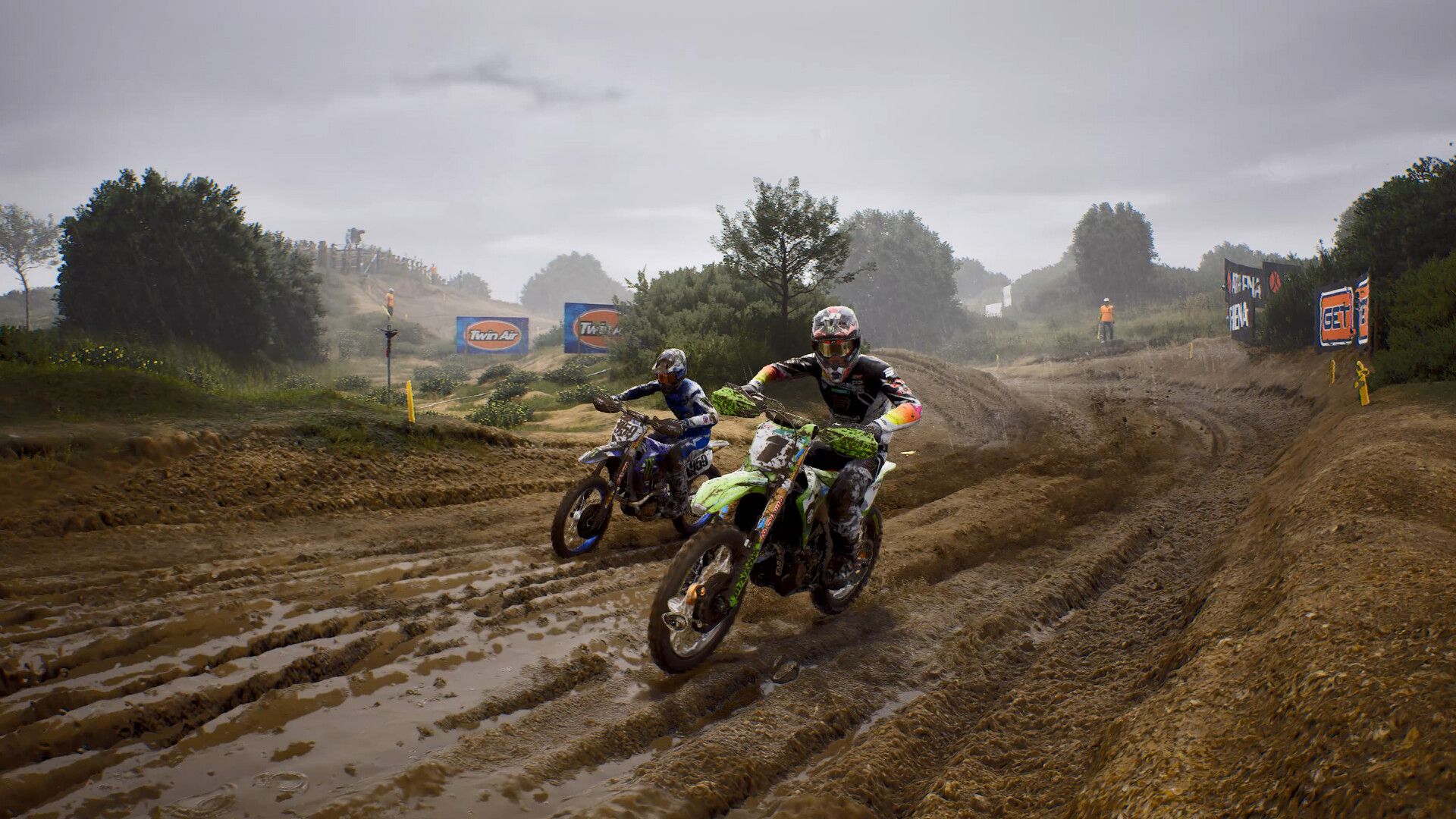
"I know what you’re thinking: “that’s Motocross.” And yeah, you’re right."
Sand, however, is a different story. Its constant little undulations make it more difficult to ride, with my bike frequently bouncing over the surface and lifting one or both wheels from the ground. Corner approaches were especially awkward, where the front tyre struggled to find enough bite. Moving the bike’s weight rearward is supposed to help maintain stability, although doing this too aggressively can result in an unwanted wheelie. Adjusting the setup to favour the rear made the back tyre more willing to step out, but on sand this proved useful. Of the three surfaces, sand therefore feels the most distinctive, changing how you manage the bike more significantly compared to the other two.
And, just a note on tinkering with your bike’s setup. If, like me, you’re not fluent in suspension tuning, the game explains the pros and cons of every adjustment. While my changes seldom felt dramatic, I did notice slightly more responsive handling with stiffer forks or marginally swifter acceleration with shorter gears. One oddity, though, is the option to ‘Apply Recommended Bike Setup’, which simply resets everything to the default medium setting rather than actually recommend a setup tuning for a specific track or surface.
Elsewhere, MXGP 26 gives you plenty of control over how demanding the riding experience actually is, with settings covering everything from brake assistance and slope steering to automatic rider weight distribution and the aforementioned track deformation. Slope steering proved particularly useful for me, allowing me to exploit the banking on the outside of corners without sacrificing as much speed. Reducing braking assistance, however, didn’t seem to have as strong an effect.
Yet, the biggest weak link I’ve found is with the game’s AI opponents. They frequently overshot jumps, miscalculated landings, spun out of ruts, missed corners, and generally behaved strangely, although these instances were usually concentrated at the start of races when the field was still racing closely. Yes, a rider launching himself into a hedge was occasionally funny, but more often it was distracting. For a game that works to make the act of riding so unpredictable, I didn’t expect the AI to introduce a different kind of unpredictability altogether.
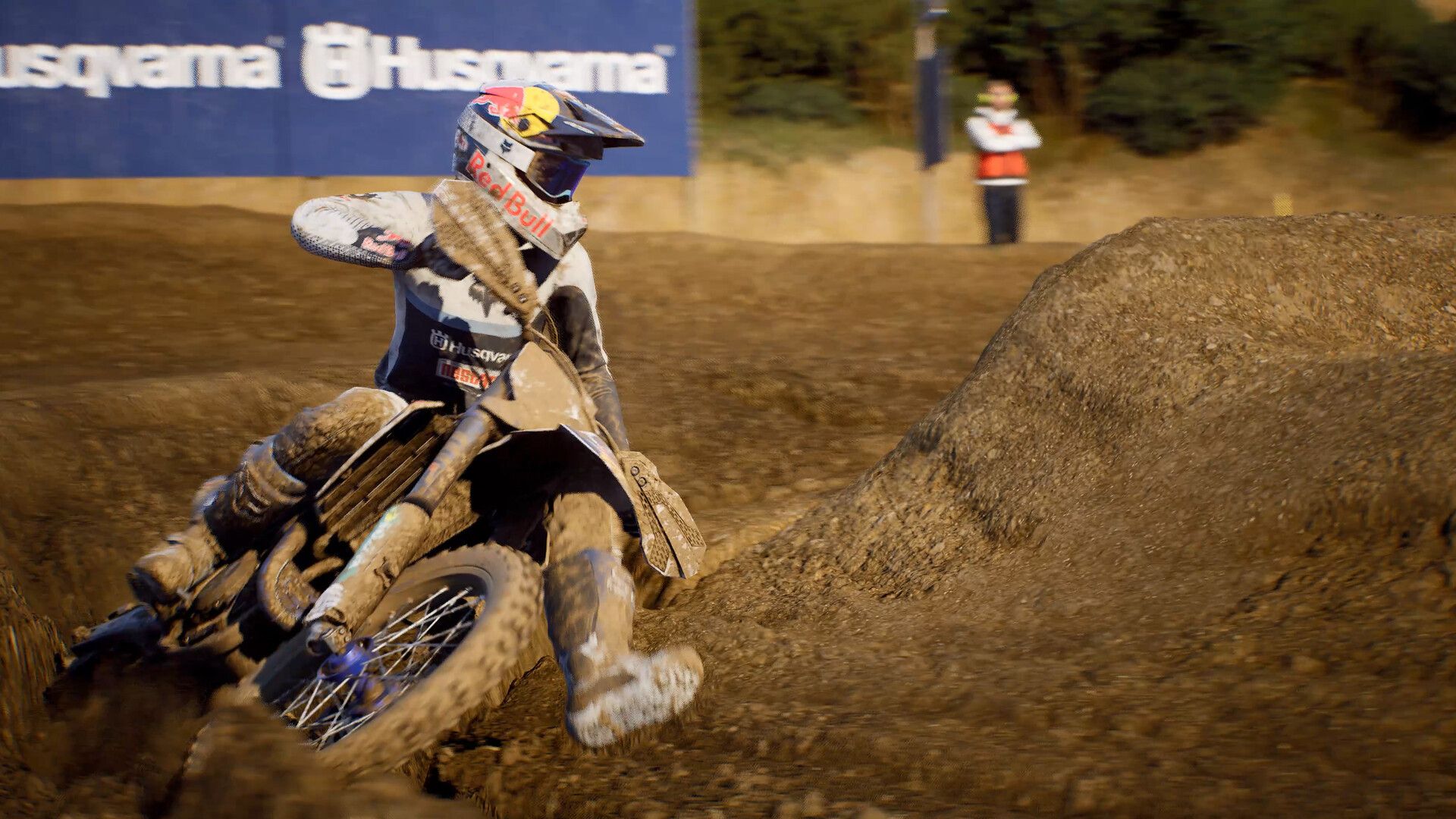
"The biggest weak link I’ve found is with the game’s AI opponents."
Outside of the core racing, MXGP 26 doesn’t offer much that fundamentally changes the experience. Badges earned through time attacks and racing provide tickets for equipment, while also unlocking additional bikes. This progression loop largely functions as a reward layer sitting on top of the racing, while championship mode follows a similar pattern by stretching the grand prix weekend structure across an entire season. Ultimately, MXGP 26 is focused on the act of riding rather than what happens around it.
Presentation-wise, there are obvious areas for improvement. While mud accumulation, rider animations, and bike models are on point, weather, crowd, and paddock atmosphere underwhelm. Rain, in particular, covers the track in glistening mud and slick puddles, and while it certainly looks dangerous I never felt as though the bike handled any worse than on a dry surface. Engine sounds heard across bike manufacturers do a decent job of communicating the effort imposed on the bike, sounding suitably aggressive, particularly when you’re modulating the throttle. Different surfaces, speeds, trajectories, and wheelspins produce distinct auditory feedback, too, but overall the game’s sound lacks the character to make each machine memorable.
Yet, all that said, it’s in the bikes’ handling where MXGP 26 makes the strongest impression. They’re unstable in a way that makes keeping them upright a challenge, but though feathering the throttle, manipulating your weight, and reacting to shifting terrain, the racing does become more manageable. It’s rarely predictable, and track deformation can occasionally push a bike’s instability too far, but when everything clicks – a scrubbed jump landing on a decline or a clean rut-assisted rotation – the satisfaction in control is excellent.
And that, in essence, is where you’ll find MXGP 26’s best moments, where you adapt to a track being progressively torn apart to maintain fluid momentum. Yes, the AI can frustrate, some surfaces feel insufficiently distinct, and the modes on offer are decidedly barebones, but none of that changes the fact there’s a remarkably edifying riding model underneath it all. Once you stop trying to eliminate chaos, embracing imperfect lines to work with the dirt rather than against it, MXGP 26 becomes a demanding but rewarding Motocross experience.
This game was reviewed on the PlayStation 5.
Technical riding model with demanding handling turns racing into a test of control. Tracks deform dynamically, creating new ruts, lines, and challenges. Sand meaningfully changes how you manage the bike, providing the clearest contrast between surface types.
Unpredictable AI opponents undermine convincing bike handling. Surface types other than sand lack distinction. Barebones modes and presentation add little to the core racing.