






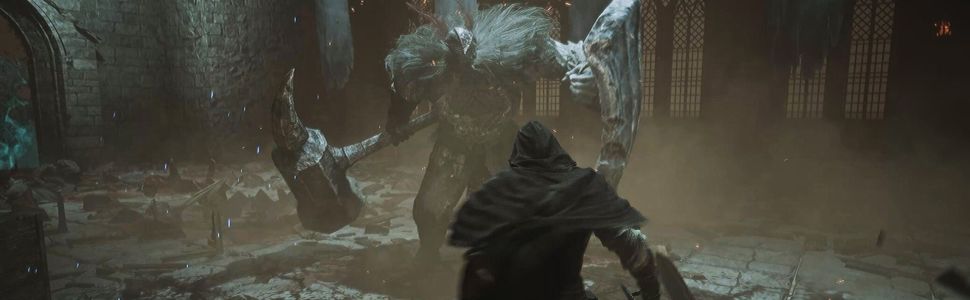
Emerging from a cave, The Relic: First Guardian strikes you immediately with its sombre tone. A trail leads to a burning farmhouse where a woman’s forlorn cry drifts between hissing wood and ember. The scene is depressing – gloomy, hazy, and grey. Accompanying the flames are orchestral strings which swell like a final sigh, exhaling with the same resignation as the calls for help. Both soundtrack and fire-trapped soul, it seems, have already lost hope.
To say this is an oppressive opening is an understatement. It feels like being dropped into a drum of treacle, where movement labours against the stench of death. Looking down, there are corpses everywhere. Fresh blood still glistens; wounds are ripe before decay.
Something terrible has happened here, and I’m compelled to find out what.
"To say this is an oppressive opening is an understatement."
Yet, treacle, as it happens, is an appropriate description for another reason. See, the slipperiness of your character’s traversal is as striking as the heavy atmosphere. He jogs, but his momentum resembles someone skirting along a patch of ice. It’s immediately jarring, and it’s not the only rough edge The Relic greets you with.
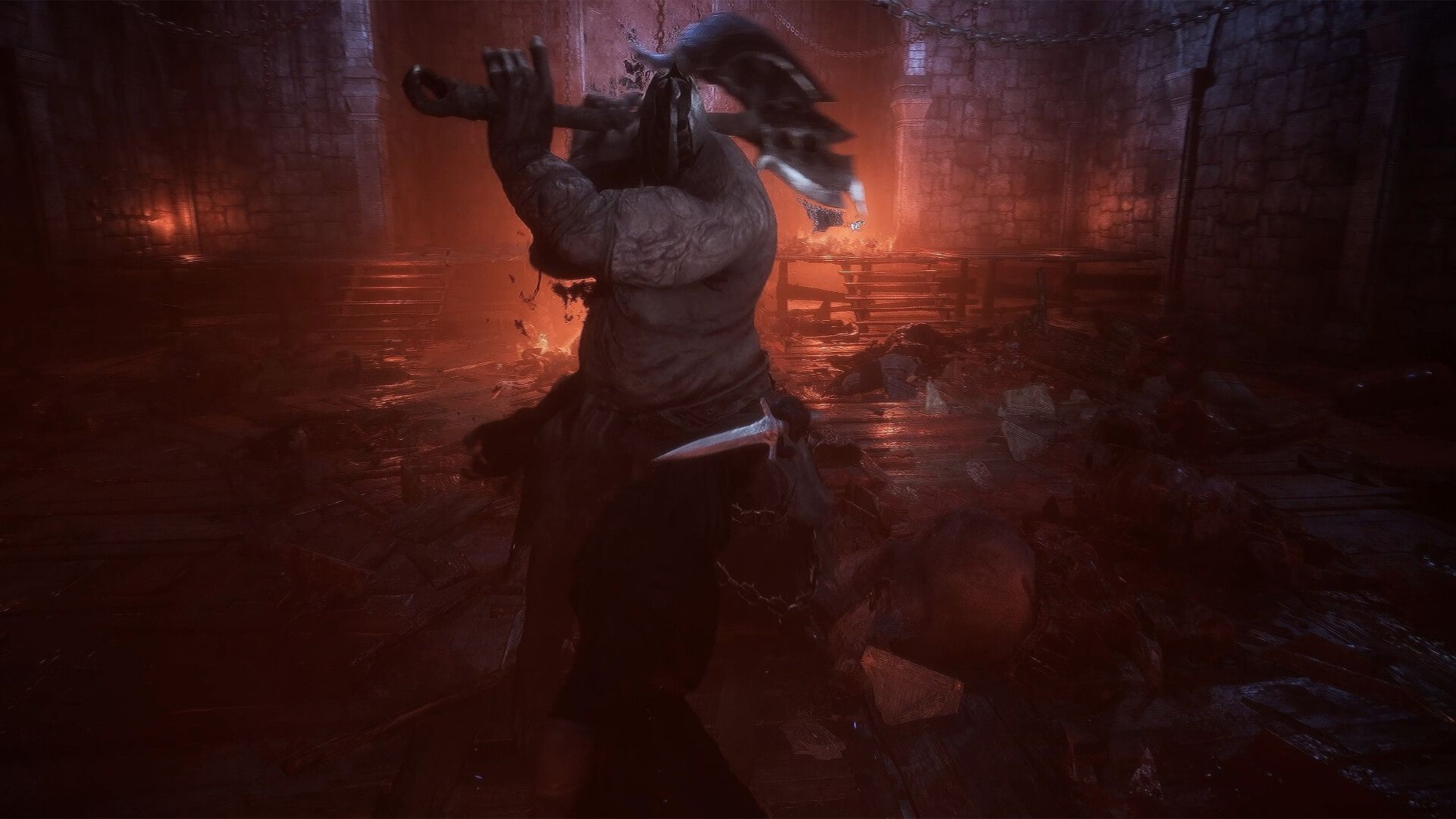
Camerawork consistently juts between trees, fence poles, and stone walls behind you, with its awkwardness exacerbated during combat when you’re locked onto an opponent. Enemies themselves show little variation in archetype and moveset. The large-framed axe man, for instance, follows a set pattern: swing, double swing, unblockable chop, axe throw, repeat.
Then there are the game’s NPCs, like the merchant I rescue alongside his daughter, who repeats the same short animation loop as we talk. His hands follow a circular motion like he’s describing the wheels of a bicycle. And, the village’s ransacked dwellers fare no better, operating on similarly short cycles. Worse still, their faces lack detail enough to convincingly show a grimace to match the desperation in their voices. On the whole, vocal performances are effective at portraying despair, even if their mannerisms don’t.
Then there’s an unintentional irony. The forest is currently undergoing some sort of violent pillage by the hand of a group known as the Looters. Yet, after clearing the village of assailants to explore the barn at its centre I find three gold coin purses. Surely this counts as looting too?
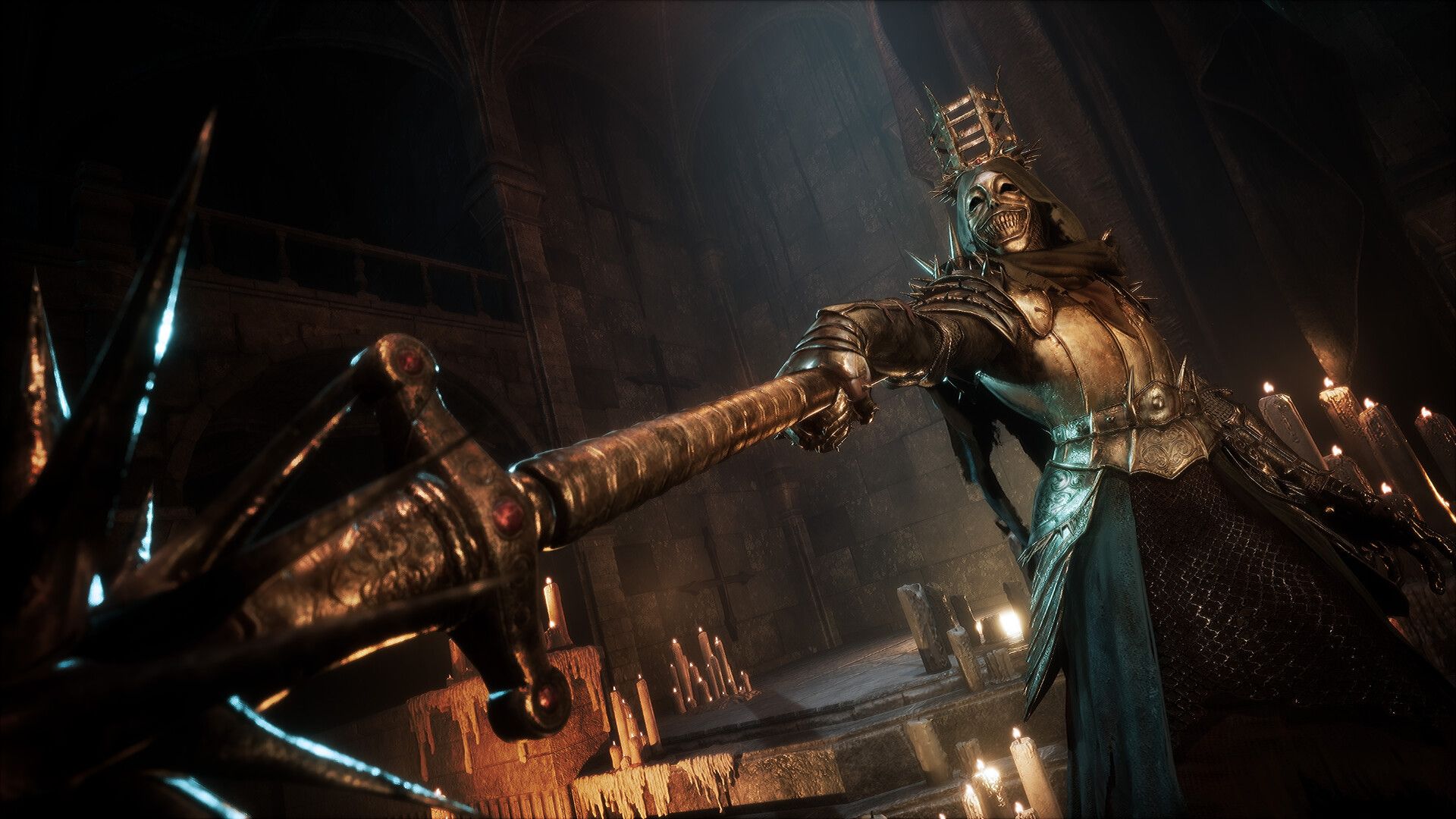
A handful of other technical hiccups slightly undermine the excellent atmosphere: foliage pop-in, disappearing NPCs, and inconsistent collision detection which sees a fleeing villager run right through me like I’m a ghost.
Still, venturing deeper into the forest, I overlook these niggles to follow the narrative breadcrumb trail. Occasional glowing nodes reveal fragments of story, and it’s an engaging way to learn about the recent tragedies befalling this particular stretch of woodland. Retelling the events like an audio-diary, one such tale describes villagers who barricaded themselves away from a band of Looters. Piece by piece, the story reveals a false promise, deception, and a survivor consumed by guilt. Delivering chapters in soundbites like this feels effective; like an engrossing book, I wanted to keep turning the page. There isn’t always a worthwhile reward at the end, just satisfaction in reaching a neat conclusion.
"A handful of other technical hiccups slightly undermine the excellent atmosphere"
While the atmospheric storytelling may be evocative, The Relic: First Guardian ultimately lives or dies by its combat. Showing Soulslike inspiration, you’ve access to a single attack, a block, parry, and dodge, and despite its early promise your moveset feels limited. The key distinction, however, is your stamina gauge which is tied exclusively to defense and evasion. You can’t spam-dodge or hold block as you’ll quickly drain your energy, ending up stunned and vulnerable. But, on the flipside, if you string a handful of parries together then your assailant becomes staggered. What’s more, timing windows feel generously wide, so it isn’t long before you’re deflecting strikes and swings with ease. It’s just, during these early skirmishes, you don’t have any devastating finishers – these come far later.
Elsewhere in your arsenal are Relic-powered elemental abilities which operate on a cooldown, as is space for the titular Relics themselves to provide passive bonuses when equipped – increased vitality, bonus HP for every enemy slain, boosted stamina, and so on.
Through exploration, you’ll learn that The Relic’s semi-open world isn’t as demanding as Dark Souls’ usual fare. Areas for rest function as bonfires, yet cleared enemies won’t respawn. There’s usually a reset area adjacent to a boss arena, too. Likewise, resources aren’t lost on death, nor does currency need retrieving from the place you fell.
Eschewing Soulslike’s typical punishment alleviates friction in exploration. In other words, you’re free to wander intuitively, scavenging resources, collecting story fragments, assisting country-folk, and finding more weapons to add to your sword-and-shield starter.
Speaking of weapons, you’ll find these by following the same glowing memories outlined earlier. In doing so, you’ll discover each one-of-a-kind weapon’s rich, often tragic backstory, simultaneously fostering attachment while grounding them in the world’s lore.
A blacksmith can upgrade your weapons too, but he’s encountered only sporadically. Worse, he demands a bounty of crafting resources to bolster your blade. Even after multiple hours of playtime, I still didn’t have enough. My desire to buildcraft grew tiresome the more downed enemies didn’t drop the fragments and shards I needed.
Still, each weapon has its own skill tree, with powerful specials and finishers unlocking more expressive combat. The power of the two-handed axe, for instance, is released by spinning scythes and towering cleaves, pulverising enemies with satisfying heft.
"Eschewing Soulslike’s typical punishment alleviates friction in exploration."
The catch is that those abilities, too, are painfully slow to unlock. Like the blacksmith’s upgrades, each ability costs an excess of currency – this time: Relic Energy, harvested from ancient locations found throughout the wilds. Most award 600 energy, while skills begin at 1,000 and rise thereafter.
Weapon skills aren’t the only Relic Energy sink either. Opening additional Relic slots requires abundant Relic Energy, alongside a rarely found Awakening Shard. Ultimately, the rate you acquire Relics outpaces your ability to use them, hindering the build potential in your inventory.
Thankfully, Relics can be freely swapped to suit different scenarios or playstyles, so limited slot availability isn’t the progression system’s biggest flaw. Instead, honing your character through weapon enhancements, skills, and Relics is an undeniable grind, leaving combat starved of meaningful growth for too long.
I yearned for more tools; more than the D-pad controlled consumables, more than the one-or-two skills I unlocked every couple of hours, with the limits to your arsenal becoming obtrusive during boss fights. Now, the first few you encounter can be parried and downed without issue, but as you venture deeper boss difficulty scales accordingly. Soon enough, they’re swinging multiple unblockable strikes, throwing fire, and generally demanding more than parrying and a pair of skills and Relic slots apiece can provide. Worse still, I experienced a couple of boss battles that were marred by sluggish framerates, skipping audio, and other technical gremlins. Luckily, despite these grievances, exploration remains invigorating throughout. If I was having trouble with a particular boss, there is always plenty of ground to cover elsewhere, where Relics and crafting resources are eventually uncovered. If only I could consistently find the blacksmith.
And exploration, again, speaks to The Relic: First Guardian’s great strength, where every village, rampart, or cave has a story to tell. Its world is often a miserable place to traverse, but through its inclement atmosphere shines pockets of humanity.
The Relic: First Guardian may never escape its technical shortcomings, but its melancholy world is well worth saving.
This game was reviewed on the PlayStation 5.
An atmospheric world rich in environmental storytelling. Exploration consistently encourages curiosity. Flexible buildcrafting has strong foundations.
Character progression slowed by an overly grindy economy. Combat takes too long to become expressive. Technical shortcomings undermine immersion.