





Few years in gaming have had the long-lasting impact that 2011 ended up having. Along with marking the release of one of the most popular RPGs of all time – The Elder Scrolls 5: Skyrim – the year also marked the original release of FromSoftware’s Dark Souls. 15 years later, a quick glance at your digital storefront of choice will show no shortage of games that have drawn direct inspiration from a genre that has come to be known colloquially as the Soulslike, and it is into this crowded market that developer One More Level has decided to throw its hat into following the success of its Ghostrunner series.
With Valor Mortis, however, One More Level hopes to be more than “just another Soulslike”. Rather, the team had larger ambitions across a variety of factors, from moment-to-moment gameplay, to level design and storytelling.
"The guns in Valor Mortis have less utility outside of combat, since they’re mostly just used to hit glowing blobs that sometimes block your way forward."
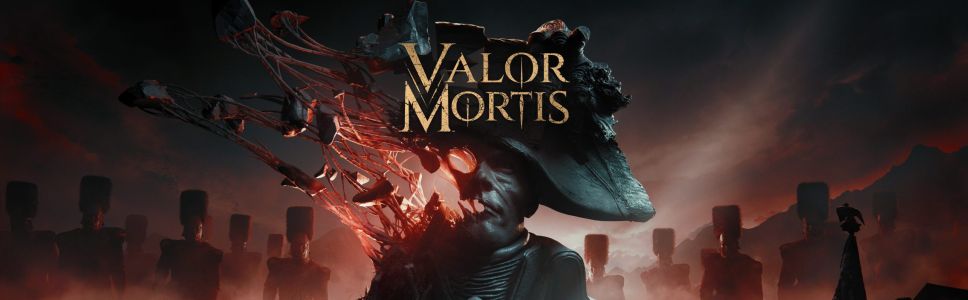
The core narrative of Valor Mortis makes use of a setting that isn’t quite utilized as much in games outside of a few strategy titles. Set during the Napoleonic Wars, some darker forces have played a role, resulting in the death of several soldiers, including the protagonist William. Awakened by the voice of Napoleon himself guiding you, you are given a simple task at first: regroup with any surviving soldiers you might find and figure things out from there. However, the dark forces have also corrupted many of the survivors, which means that William is in for the fight of his life as he makes his way through the game.
Along the way, there are several other characters that not only fill in gaps in the narrative, but also bring up questions of their own. Lucjan Skawinski is an especially interesting figure. He shows up early in the game, saving you after a disastrous boss encounter that you’re fated to lose, and gives you a vague hint about where you might find some other survivors. The moment you look elsewhere, however, Lucjan quickly vanishes, and in the process, sets up an entirely new mystery for you to decipher.
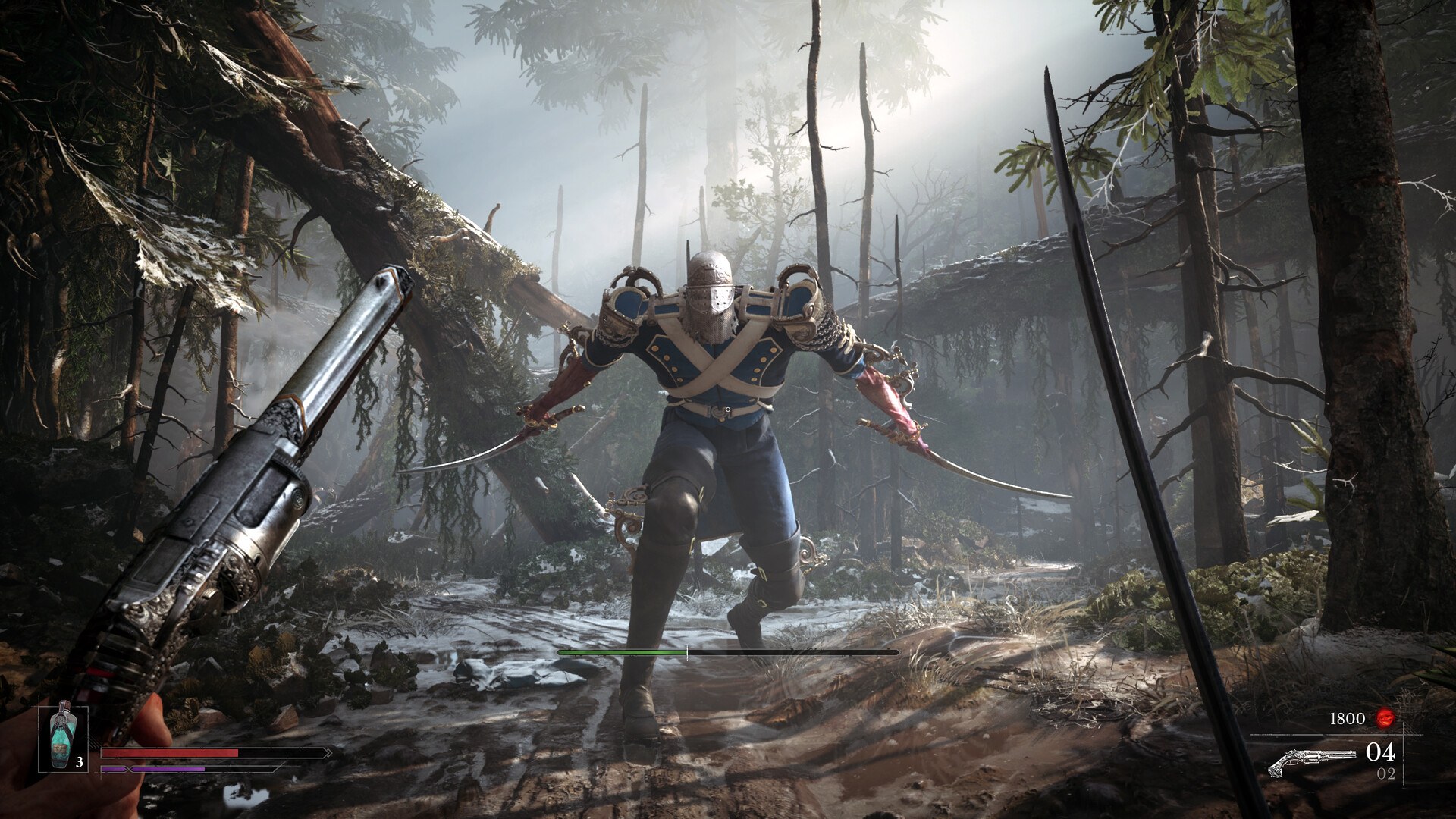
"The biggest way in which Valor Mortis sets itself apart from its contemporaries is by being played in first-person."
Valor Mortis uses more traditional means of storytelling. Rather than leaving things up to interpretation and giving you vague clues about a narrative through item descriptions, you’ll have full-on conversations with the various characters you meet throughout the game, and in the process, you’ll start learning definitive answers about things like the corruption that has spread throughout the soldiers and horribly mutated them, William’s own magical powers, and what exactly happened to Napoleon.
The biggest way in which Valor Mortis sets itself apart from its contemporaries is by being played in first-person. While this might sound like a simple change on the surface, it ends up having deeper implications in the moment-to-moment gameplay. The biggest one being your situational awareness is limited quite a bit by your field of view. This means that you can’t keep enemies behind or beside you in view as easily as you can with a third-person camera. However; playing Valor Mortis, despite its first-person perspective, never feels clunky by any means. Of course, the studio’s experience in working on first-person games has likely played a huge role here.
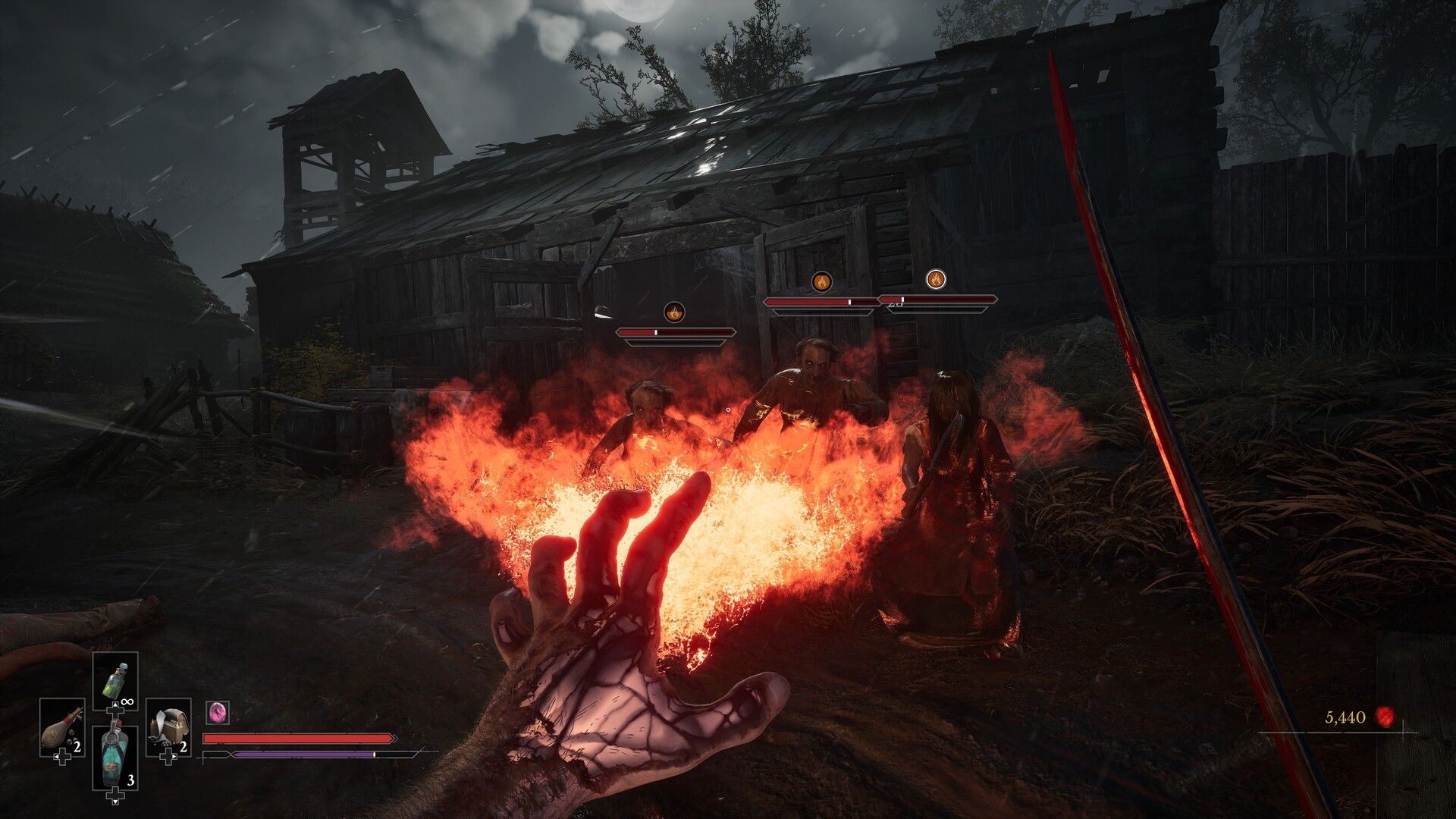
Speaking of the moment-to-moment gameplay, Valor Mortis gives you only a pair of attack buttons – one for a melee weapon and the other for whatever you might have equipped in your left hand. The former tends to mostly feature bladed weapons like your standard saber or a rapier, while the latter can be anything from magical spells to an assortment of guns. The melee combat itself feels fluid thanks to the phenomenal animations for attacks. Your starting weapon – the saber – is a slashing weapon, which means that its standard three-hit combo will have you waving it around as you smack enemies. These attacks also have a slight area-of-effect, giving you the ability to also slash other enemies that might be close to your main target. The rapier, on the other hand, mostly focuses on thrusting attacks. While this translates to not being able to hit multiple enemies without lining them up just right, it also means that each attack is swifter and typically tends to do more damage to weak points.
Your left-handed abilities can be a variety of magic spells, each of which have its own utility in and out of battle. In combat, the ability to set fire to an enemy should be quite obvious, and sustained use of the spell applies a long-lasting damage-over-time effect that can be quite effective against some of the stronger foes in the game. Outside of combat, the same spell can be used to burn away grotesque fleshy webs that block your path from an alternate route, a shortcut, or even just some extra loot.
"These core tools come together quite well to form a combat toolkit that feels complete."
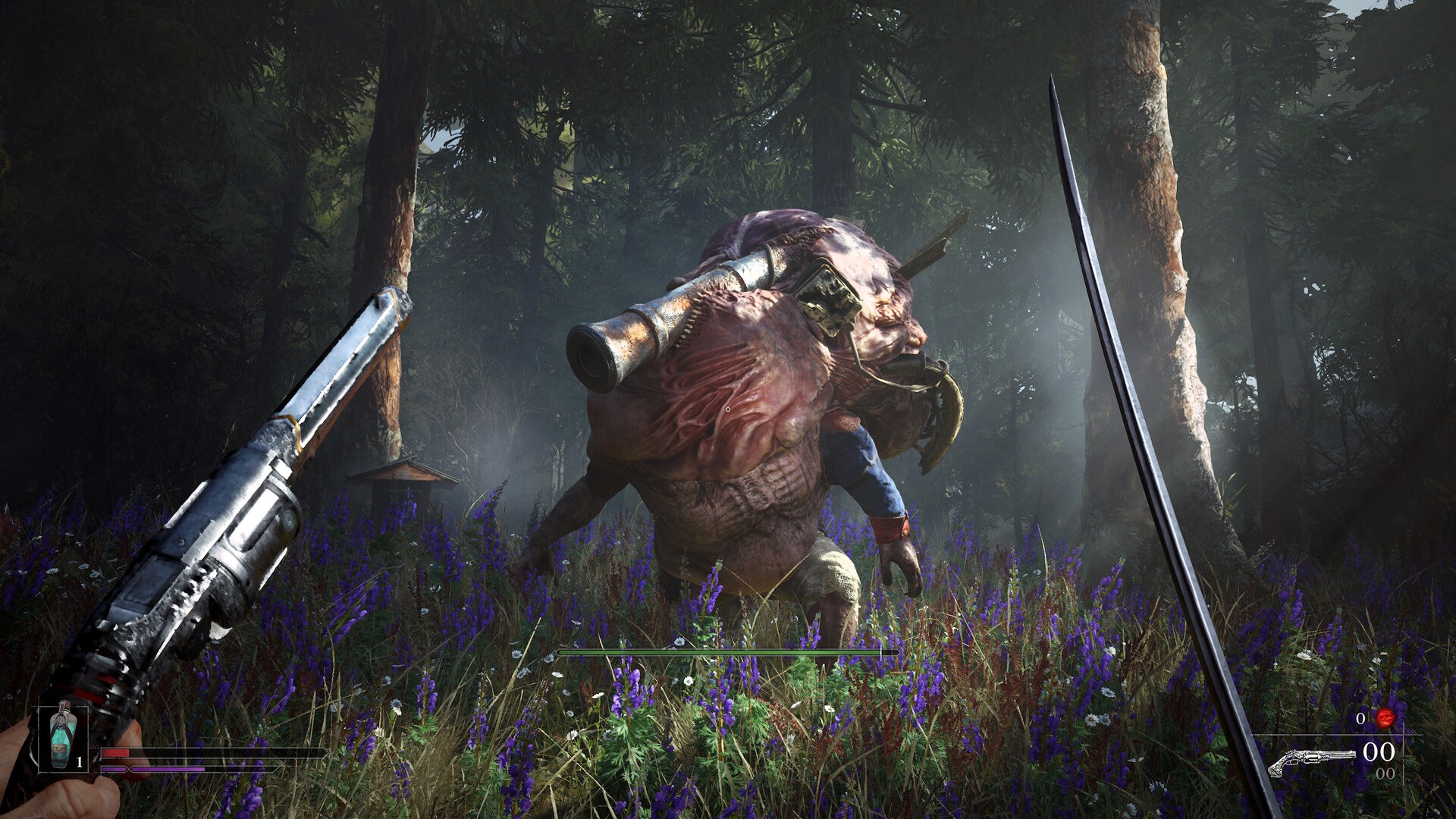
The guns in Valor Mortis have less utility outside of combat, since they’re mostly just used to hit glowing blobs that sometimes block your way forward. In fights, however, they tend to be immensely useful, giving you a quick way to target and take out an enemy’s weak point. Using an early-game example, a bomb-throwing enemy can be quite a menace, since it loves jumping around and spamming the ground with explosives. For a brief moment after it gets a bomb ready to toss, however, its explosives pouch is undefended, and quickly shooting it with a pistol or rifle will not only do massive damage to the enemy, but also force them to abandon bombs and instead use melee attacks.
On the defensive side of things, Valor Mortis gives you three main options – block, parry, and dodge. Since you don’t have a shield and only certain melee weapons can block, the mechanic works a bit differently than what you might be used to. Rather than completely blocking attacks at the cost of some stamina, you still end up taking a little bit of damage. However, damage taken while blocking is considered “recoverable”, and you’ll get the health back the moment you start counterattacking. Parrying, on the other hand, tends to be a more fruitful endeavor. Not only does it mitigate damage entirely, it also affects the enemy’s posture. The moment your target is thrown off balance, you can deal a massive amount of damage, which essentially takes out most standard enemies in a single hit. Parrying isn’t an instant-win button, however, as many foes will have a lot of posture, which means that their combo attacks will have to be quickly parried with precise timing.
Dodging is the universal “avoid damage” option, and is sometimes the only thing you can do when a particularly large enemy is gearing up for a massive unblockable and un-parryable attack. Thankfully, Valor Mortis is good at telegraphing these kinds of things, and the enemy will start glowing red when it’s time for you to dodge instead of block. When this isn’t the case, however, parrying almost always feels like the best defensive choice in most combat situations, with dodge filling in the other niche cases.
These core tools come together quite well to form a combat toolkit that feels complete. Even when you haven’t quite unlocked brand new spells or found that special sword, you never quite feel like you’re missing something, and you’ll always have just what you need to handle most of the situations you’re thrown into. When it comes to progression, however, Valor Mortis feels less like an RPG and more like an action-adventure game with a skill tree thrown in.
"Boss fights tend to offer some great spectacle that breaks up the typical fighting-and-exploring gameplay of Valor Mortis."
While much of the combat can be quite fun, especially once you get a better idea of parry timings for most of the enemies, there are a few spots where the difficulty scaling seems a bit off. Most of the regular enemies tend to be easy to handle, and many boss fights also expertly walk the fine line between intensity and fun, but every once in a while, the game will throw an encounter your way where enemies are considerably harder than anything else in the area. While encounters like this can be fun once in a while, the special feeling of finding and taking on a miniboss starts disappearing when you seem to run into one surprisingly often. Aside from these minibosses often being repeats of enemies you’ve fought in the past, they also tend to introduce abrupt difficulty spikes in what is otherwise a tense-yet-fun experience.
Thankfully, this isn’t too much of an issue when taking the whole game into account, and balance changes are easy to make even with post-launch updates. One of these updates already came in during my time reviewing Valor Mortis, and there have already been plenty of improvements.
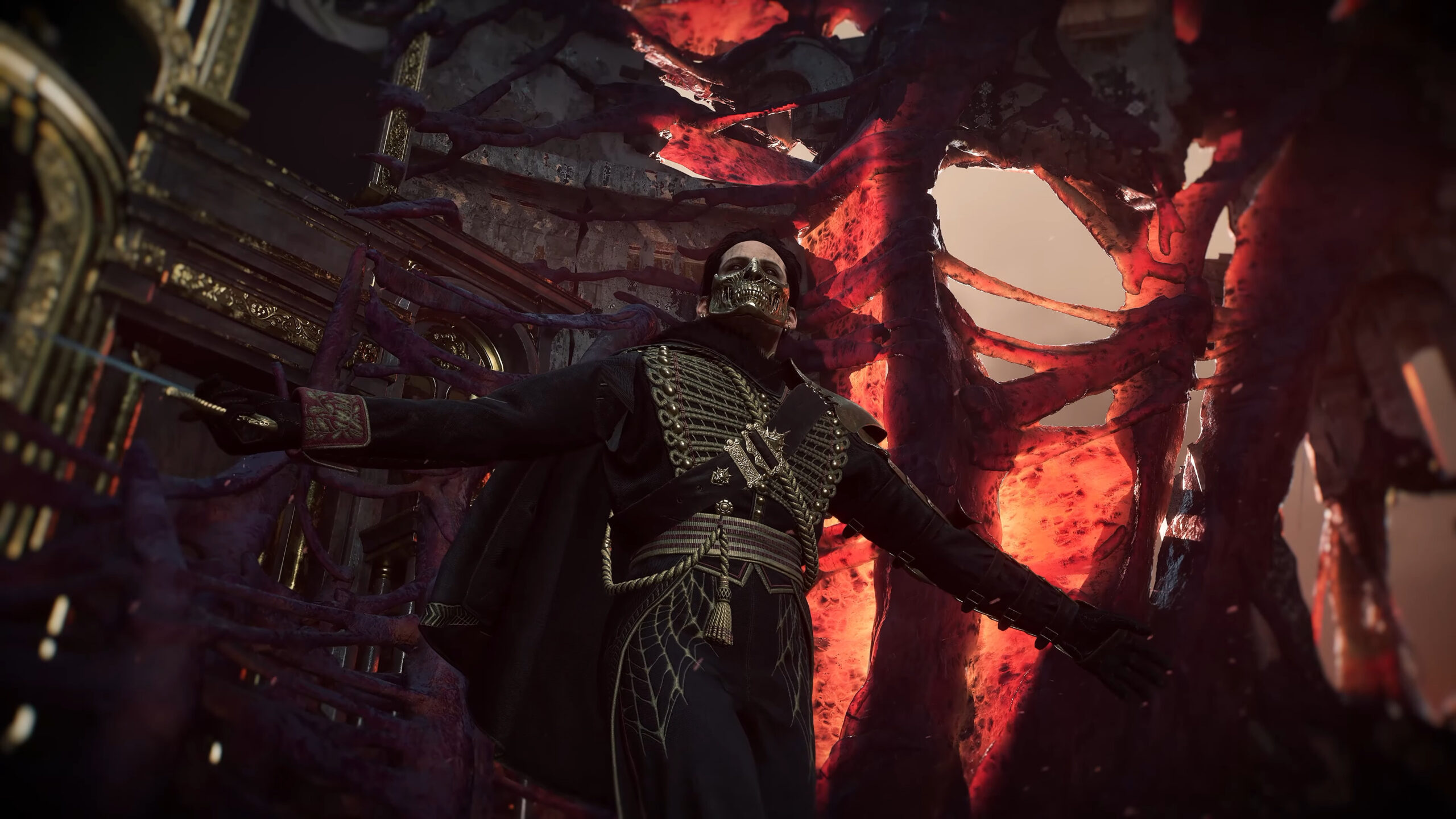
Boss fights tend to offer some great spectacle that breaks up the typical fighting-and-exploring gameplay of Valor Mortis. The creature design here is especially noteworthy, since the corruption that has overtaken the soldiers can manifest in a variety of interesting and disgusting ways. Most of the bosses are quite enjoyable, and I’d even go as far as to wish that there were a boss rush mode of some sort as an endgame activity. Enemies like the Orphan and The Entity are downright awesome when you first encounter them. In gameplay terms, the boss fights also do a great job of testing just how well you’ve grown accustomed to the combat system, forcing you to parry and dodge, and always making you look out for potential weak points that can be exploited with a well-aimed bullet.
In true Soulslike fashion, killing enemies will give you a currency called Catalyst. Dying means you drop all the Catalyst you’ve been carrying when you respawn at the last bonfire – I mean lantern – that you activated, and you’ll have to fight your way back through respawned enemies to get them back. The Catalyst can then be spent on a skill tree that offers passive boosts, like more health, stamina, posture damage through parrying, or melee damage, among other things. Throughout the skill tree there are also new passive abilities, like enabling slow-motion aiming when you’re using a gun while airborne.
"Another core progression system is the ability to improve your various weapons, spells, and even your healing flask."
None of the passives you unlock through this tree feel gameplay-defining. Rather, the presence of infinite nodes at the end that will keep boosting your damage, health and magic indicates that the game fully expects you to max out the entire tree. As you make your way through the tree, you’ll also get special slots where you can equip Ambers – awesome passive buffs that can help you refine your chosen gameplay style. If you find yourself healing often, for example, you can equip the Iron Grip Amber which makes the act quicker and less prone to interruption from enemy attacks. Using a lot of magic? Equip an Amber that boosts the regeneration of your spellcasting resource – dubbed Nephtoglobin. What makes Ambers a fun system is the fact that you have to explore every nook and cranny and complete sidequests to get them.
Another core progression system is the ability to improve your various weapons, spells, and even your healing flask. These aren’t game-changing, since they largely tend to be straightforward improvements. There are never really any interesting choices you’re forced to make throughout the game, unfortunately, and just boosting damage never quite feels as satisfying as unlocking a new playstyle.
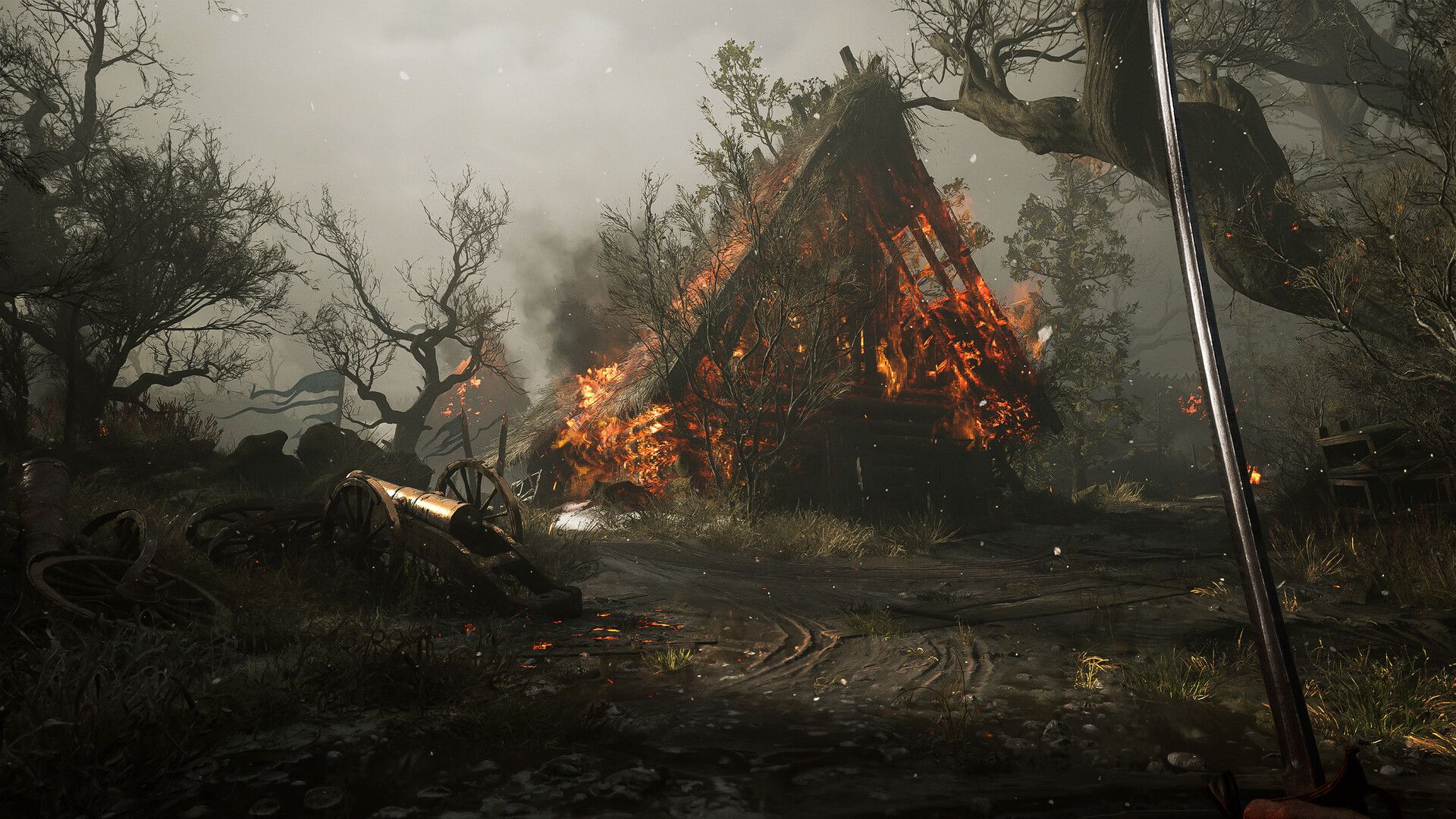
Which brings us to the level design. Valor Mortis is made up of linear levels that will take you from one point to the next, and offers few moments where you can truly get lost. This, however, is far from a bad thing. One More Level’s level-design skills are at full display here, since the team has been able to accomplish some impressive feats. Right from the get go, there’s some wonderful environmental storytelling in Valor Mortis, since you’re essentially roaming through a battlefield where hundreds fought and died. As you make your way through, you’ll eventually end up in the army camps, which paint a picture of how they treated their supply lines. Soon enough, you’ll get to the quarries, which served as a major defensive area for the soldiers, and so on.
In gameplay terms, each of these levels offers its own fun and unique challenges. Aside from the typical threat of standard enemies, you’ll also find some nooks to explore, which can range from having little more than a chest with some bonus loot, to a full-fledged cave system that tells its own story in conjunction with side quests, and even features some encounters you wouldn’t quite face elsewhere. As far as optional content goes, it’s quite well done in Valor Mortis. The game’s extensive use of shortcuts also goes a long way toward ensuring that none of the zones feel exhausting.
"In gameplay terms, each of these levels offers its own fun and unique challenges."
Every once in a while, One More Level also reminds you that the team has previously worked on the fantastic first-person platformer – Ghostrunner. There are a few platforming sections in Valor Mortis where you’ll find yourself jumping between ledges or swinging on horizontal bars to reach further along the level, and while these aren’t quite the same speed or challenge as the Ghostrunner games, they still do a great job of breaking up the action and giving you a chance to just sit back and stare in awe at your surroundings.
Visually, Valor Mortis is an absolute treat, and while the demo had a few performance issues, it looks like One More Level has managed to sort these problems out. With the game set to its High preset, I was able to get smooth and steady frame rates of over 80 FPS while playing at a resolution of 2560×1440. The game was reviewed on a PC with an AMD Ryzen 7 7800X3D CPU, 32 GB of RAM, and an AMD Radeon RX 7800XT GPU. Similarly, the audio also does a fantastic job of setting the scene. Along with combat feeling like an intense affair thanks to the excellent sound effects for swords, guns, and magic alike, even simpler moments of exploration present themselves with gorgeous soundscapes that feel equal parts serene and uncomfortable.
Another complaint I have with Valor Mortis has to do with its default keyboard and mouse control setup. When you first start up the game, you’ll find your hands cramping quite easily due to how awkward it is to need to keep a finger on CTRL and ALT – blocking/parrying and dodging, respectively. Thankfully, you can rebind these controls, and Valor Mortis even plays excellently on a controller, which ended up becoming my preferred way to experience the game.
Ultimately, One More Level doesn’t exactly want to reinvent the wheel with Valor Mortis. Rather, the studio is more keen on applying what it knows about creating compelling first-person gameplay to an entirely new genre – the Soulslike. It takes staples of the genre, and presents them in a new way, while also sanding down some of the aspects that may not fit the studio’s strengths. A core example of this can be seen in Valor Mortis’ progression systems, which are simple and still end up fitting the overall game quite well since the emphasis is largely on moment-to-moment gameplay. This leads to the game not only being a great entry point for newcomers to the genre, but also a great time for veterans of titles like Elden Ring or Lies of P.
This game was reviewed on PC.
Fun combat; Excellent level design; Gorgeous visuals and audio; Platforming segments are never frustrating and do a great job of breaking up the action.
Progression systems feel a bit light; The difficulty scaling needs more adjustment; Default keyboard and mouse controls are awkward.