






For Konami, Metal Gear Solid Δ: Snake Eater isn’t just shaping up to be one of the biggest games of the year but a pivotal moment for a company that’s spent nearly a decade alienating its fanbase. Following Metal Gear Solid V: The Phantom Pain, shifts into non-gaming ventures like useless pachinko machines, and fitness centers, coupled with the apparent abandonment of beloved franchises like Silent Hill, led many to question whether Konami had any real interest in serious video game development. While annual updates to eFootball and Yu-Gi-Oh! kept them technically active in the industry, they did little to shift player perception. Konami, it seemed, was no longer a serious creative force.
But that perception has been slowly changing. The return of Silent Hill 2, now remade by Bloober Team, has helped restore a measure of goodwill. There was scepticism at first; could an external developer wring the best out of Konami’s most revered horror title? Further, modern audiences have evolved since the benchmark-setting Resident Evil 2 remake in 2019 as now they have clear expectations: remakes must preserve legacy whilst modernising smartly. And Silent Hill 2, by most accounts, did just that. Nostalgia wasn’t copied or reinvented – it was re-established.
Now, Konami’s ambitions are greater. In Metal Gear Solid Δ: Snake Eater, the company isn’t just remaking a classic, but relaying the foundation of its most legendary franchise. Choosing to revisit Metal Gear Solid 3 first feels significant. By preserving Kojima’s quirkiness, the narrative’s Cold War operatics, and the original’s groundbreaking stealth, Konami is showing this remake is more than just visuals. It’s about reverence – a respect for the source material.
If Silent Hill 2 rebooted trust in Konami, then Metal Gear Solid Δ: Snake Eater is here to secure its future. Snake has more weight on his shoulders than ever.
Political melodrama delivered with cinematic aplomb characterises Metal Gear Solid 3. However, at its core, the game was a systems-driven stealth sandbox which Konami, together with support from Singapore-based studio Virtuos, have strived to preserve. Rather than overhaul the original’s systems, the pair have taken a conservation-first approach.
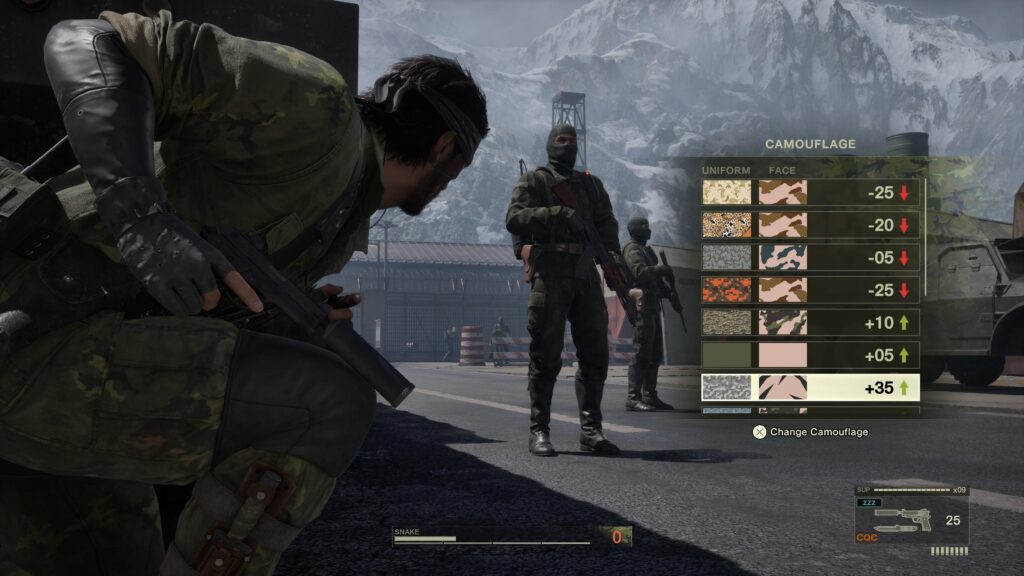
Exemplifying this is the ability for players to choose between modernised controls akin to current-day action games or opt for legacy controls which reinforce the original’s weight. Likewise, over-the-shoulder cameras positioning perspective in-line with Silent Hill 2 can be substituted in-place of legacy style top-down framing; perspectives which define vintage Metal Gear. Repurposing mechanics and features isn’t solely a nod for purists, but symbolic of Konami’s wider recognition that Metal Gear Solid 3’s original design has aged with grace.
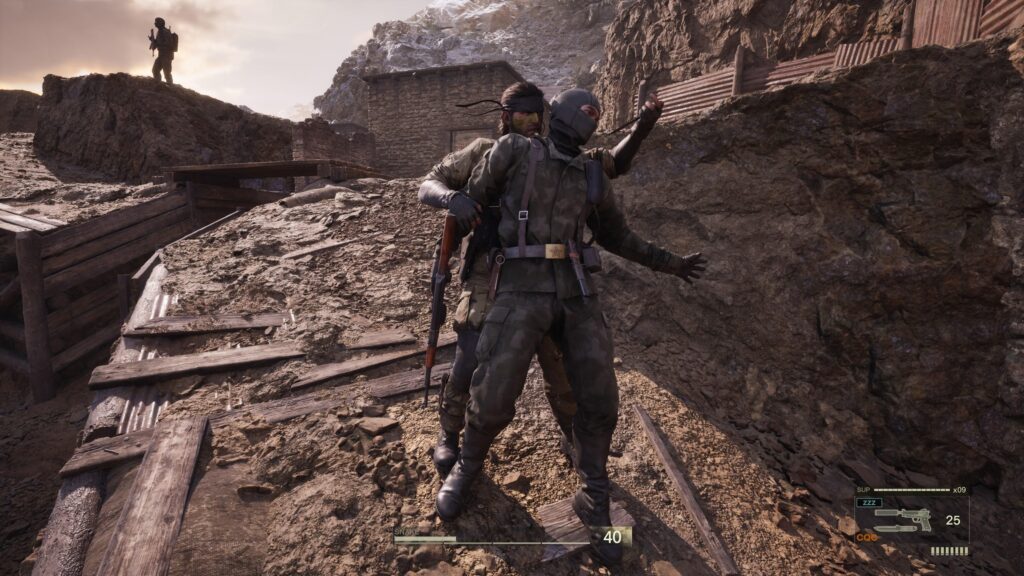
Similarly, Delta’s upgraded battle damage system showcases bruises and bullet wounds in real time, with injuries leaving their mark on Snake’s body permanently. The original Metal Gear Solid 3 challenged players to treat Snake’s wounds too, but Delta’s modern interpretation – made possible by abandoning Fox Engine in favour of Unreal Engine 5 – extends the original’s already robust survival mechanics by adding visual feedback on the game’s physicality.
But Metal Gear Solid Δ: Snake Eater isn’t purely rooted in the past. While Konami and Virtuos have taken a reverent approach to reconstructing Metal Gear Solid 3, that’s only part of the story. Delta is also introducing new content that reshapes modern Snake Eater into something of its own. Whether through competitive multiplayer modes or platform-specific side games, Δ: Snake Eater is showcasing evolution alongside conservation.
At the forefront of this evolution is Fox Hunt, a surprising new stealth-driven multiplayer mode that reimagines the Metal Gear Online formula. Whereas MGO thrived on explosive, competitive complexity, Fox Hunt scales back the havoc in favour of tension and unpredictability, with players assuming the role of either predator or prey in tight, cat-and-mouse encounters. Whilst details are limited, it appears that classes, loadouts, gadgets, and the grind typical of Metal Gear Online are being replaced in favour of something streamlined and cerebral.
There are those that’ll lament MGO’s absence in Delta, but Konami’s intent here is clear: this isn’t a tacked-on multi-player mode but an extension of the series’ iconic single player identity. Despite MGO’s loyal fans, its PvP mechanics leaned closely to conventional third-person fragfests, thus diluting Metal Gear’s DNA. Fox Hunt, by contrast, appears to reframe Delta’s core mechanics into a shared experience. Its inclusion is a risk for Konami, albeit calculated.
Elsewhere, demonstrating Konami’s inclination to maintain the series’ inherent weirdness, the wonderfully strange minigames present in Metal Gear Solid 3 are making a welcome return. In Delta, these side games are platform-specific. PlayStation and PC players are treated to “Snake vs Monkey”, the beloved Ape Escape crossover last seen in the original PS2 version. For Xbox, a slice of Konami’s own mascot history appears in place of Ape Escape via “Snake vs Bomberman”. These distractions aren’t vital to the core experience, but they demonstrate Konami’s intention to give newcomers a taste of something offbeat. Memorable deviations which preserve MGS3’s charm rather than reinvent it.
The word ‘Delta’ – by definition – denotes finite change; a new angle in the same triangle, a steady river’s flow into the ocean’s vastness. The fundamentals haven’t changed, but they’re not the same either. Delta is a carefully chosen word but there’s a sense that Konami is crafting this remake tentatively. They harbour a desire to re-establish their place amongst the pinnacle of modern gaming, but this is undeniably a litmus test for Metal Gear post-Kojima. The stakes are high, and that isn’t just because Kojima’s own production company just released a colossal Metal Gear-adjacent sequel in Death Stranding 2. The success of Metal Gear Solid Δ: Snake Eater could springboard further remakes – Metal Gear Solid, Sons of Liberty, perhaps Guns of the Patriots, or even a new entry entirely – whilst failure could relegate Konami back to the pit, proving that Metal Gear can’t exist without Kojima.
So yes, while Delta’s definition might not signify deviation, the release of Metal Gear Solid Δ: Snake Eater will mark a turning point for the series whether it succeeds or fails. Either: more games will come, or the series will become irrelevant on gaming’s modern landscape. This is why Konami is gunning for modernisation in graphics and gameplay whilst reusing the same vocal performances, and why they’ve enticed Cynthia Harrell back to re-record the original Snake Eater theme. Cultural significance carries emotional weight, and Konami are evidently reluctant to toy with player emotions. This remake isn’t a radical reinvention in the same way Resident Evil 2 was, or Dead Space, or Final Fantasy VII; even Konami’s own Silent Hill 2. But, arguably, Metal Gear Solid Δ is more of a landmark event than any of those games.
Strip away the melodrama and Metal Gear Solid has always been about what we can achieve and who we can become when faced with insurmountable odds. On what we can give the mission when it exponentially demands more. We carved this identity for ourselves through Snake in Metal Gear Solid 3 more so than any other entry in the series. It’s fitting then that the mission for identity and relevance isn’t just Snake’s anymore, but Konami’s. If nothing else, Metal Gear Solid Δ: Snake Eater is their chance to reconcile their audience, but there’s potential here for them to sculpt a new identity. Less-prescient but forward-moving.
Note: The views expressed in this article are those of the author and do not necessarily represent the views of, and should not be attributed to, GamingBolt as an organization.