






There is a cruelty flowing through The Blood of Dawnwalker’s opening hours. As Coen, I’m startled awake by my exacting father before I talk softly over breakfast with my siblings. From the off, the game gives me every reason to believe that my family should be my absolute priority, yet as soon as I leave the family home I’m beset by a village full of people who need my help. My mother is sick and her remedy is urgent, yet even my sisters distract me with a fishing trip. Then, I helped a fieldworker find his missing brother, I looked for a missing item, and tried to return a stolen banner to a frightened villager. I didn’t manage the last one, and by that evening my inaction cost her everything.
"There is a cruelty flowing through The Blood of Dawnwalker’s opening hours."
But, this wasn’t the only consequence. By choosing to help the people around me, by ignoring my father’s demands to exclusively pursue the remedy my mother desperately needed, I inadvertently shaped my version of Coen into an immature caregiver to his own family. The result was devastating, but what struck me most about this first day is that the game’s much-publicised 30-day countdown hadn’t even begun to exert any pressure. Even before Dawnwalker gave me a finite amount of time, I’d already seen the repercussions of wasting it.
At one point, Coen has the opportunity to spend a few rainy hours practicing Latin with Anca – the local herbalist – when instead they could have been pursuing his mother’s medicine. There’s a clear familiarity between the two, so my decision to stay with her felt like an indulgence. I chose to be distracted by her presence, so in that sense perhaps the vampire Coen becomes later isn’t just a supernatural transformation but the culmination of the person I’ve already chosen to make him.
These ideas are at the heart of The Blood of Dawnwalker. The game isn’t simply giving you choices to make for Coen, but instead scrutinising what he chooses to do in the limited time he’s given. Set in a medieval Vale overrun by vampires and military occupation, Rebel Wolves’ action-RPG gives its protagonist 30 days to rescue his family from the vampiric overseer who has taken control of his homeland. By day, Coen remains human, wielding swords and witchcraft. By night, he transforms into a vampire, with supernatural powers, predatory abilities, and an entirely different means of moving through the world. Quests, character relationships, and even Coen’s own progression eats into time’s finite resource.
There’s no denying Dawnwalker’s ambitious premise, but it is one that is initially threatened to be overwhelmed by its own rough edges. At first, its presentation is difficult to settle into, awkward character animation, and an unusually high contrast conspiring to make this otherwise beautifully crafted medieval setting feel more artificial than it should. The maximum targeted 40fps in the game’s balanced graphic setting I will be exchanging for the confirmed 60fps performance mode incoming with the game’s full release, but for now, in those early stages, I had to work for my immersion. That said, there’s something deeply compelling beneath the seams: this is an RPG with something meaningful to say about responsibility, temptation, and consequence, and I’m invested. The question, come the prologue’s end, is whether Dawnwalker can make its world recognise the monster I’m becoming.
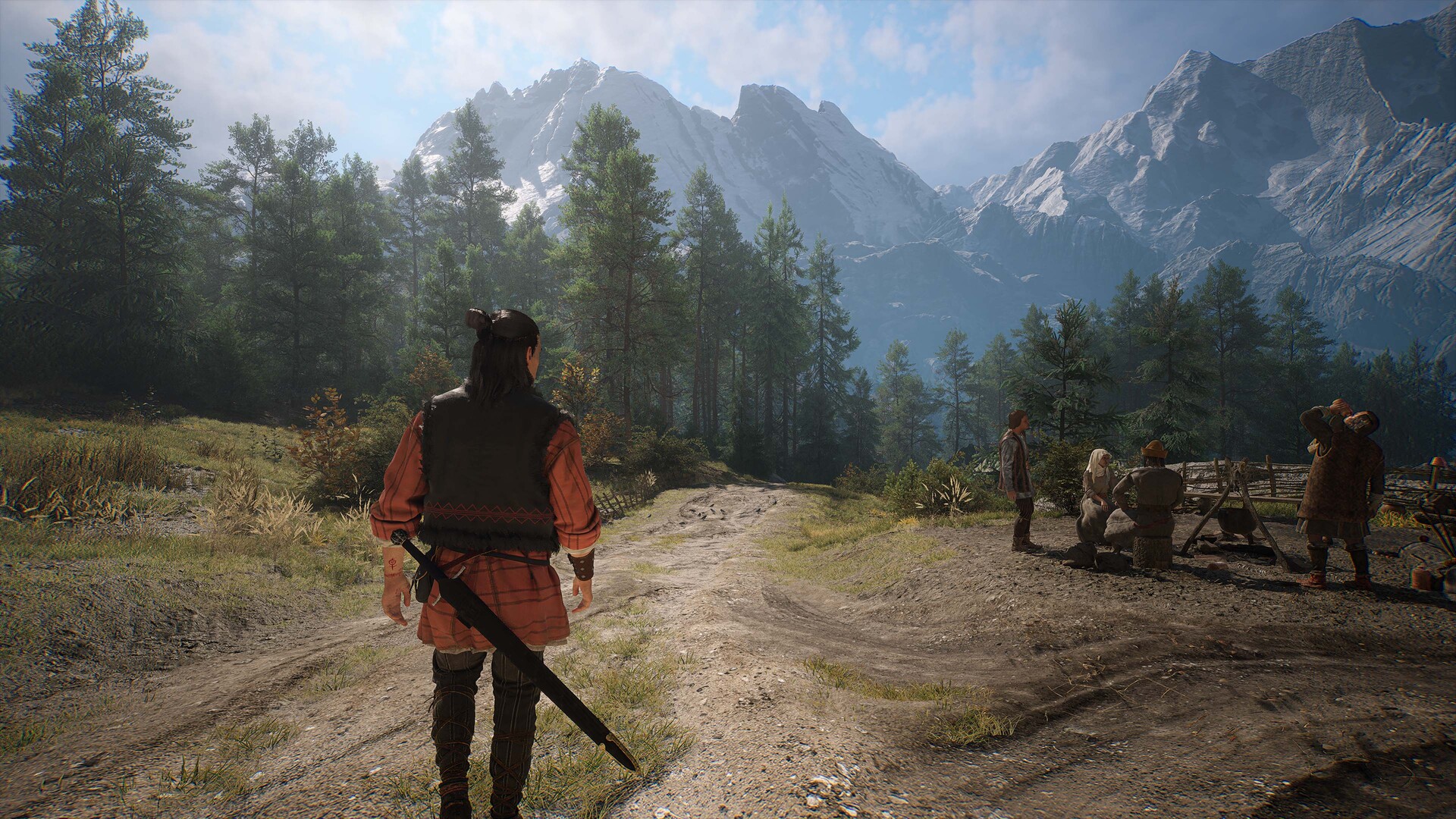
"The game isn’t simply giving you choices to make for Coen, but instead scrutinising what he chooses to do in the limited time he’s given."
Leaving my village with a handful of breadcrumb trails to follow, this is when the game’s 30-day countdown imposes itself. It’s among the game’s more intriguing ideas, but its effectiveness isn’t found in watching the days tick down. Time matters because there is always something else worth doing. Every quest, conversation, or ability upgrade becomes a negotiation with the responsibility that brought Coen outside in the first place. Yes, a month should be plenty of time to save his family, but the Vale keeps presenting compelling reasons not to pursue that goal.
The game divides each day and night into segments, with activities consuming portions at a time. Exploring is generally free, meaning you’re continually weighing up whether a certain task warrants its associated time cost. Traversing the world is not a race against the clock, but committing to helping people – like I did back in the village prologue – brings my family a step closer to death. This makes even mundane diversions feel deeply consequential.
Then there is the Court system which is essentially Dawnwalker’s way of making Brencis and his forces react to your growing presence in the world. The more missions and activities you complete, the more your notoriety increases, eventually causing Brencis to take notice and send people after you. It reminded me somewhat of Assassin’s Creed’s target-hunting systems, except here that progression is driven by your broader activity across the open world rather than simply working through a list of targets.
I really liked this because it adds an emergent layer to exploration and makes your actions feel like they have consequences. The only downside is that some of the activities feeding into the system can feel repetitive, though certainly not all of them.
The Vale is divided by more than vampires and humans, too. There are communities caught up in the political machinery of occupation, where soldiers round up people to harvest their blood while others profit from the overseer’s order simply because it pays. There’s an underground rebel force resisting oppression, but earning their trust requires me to spend time disrupting the operations of the occupying forces. I can liberate trapped prisoners, sabotage distilleries, or simply wipe out soldier encampments, all to raise my notoriety with the overseer’s court. This could potentially open another avenue to rescuing my family, but the catch is these disruptive activities consume substantial portions of time.
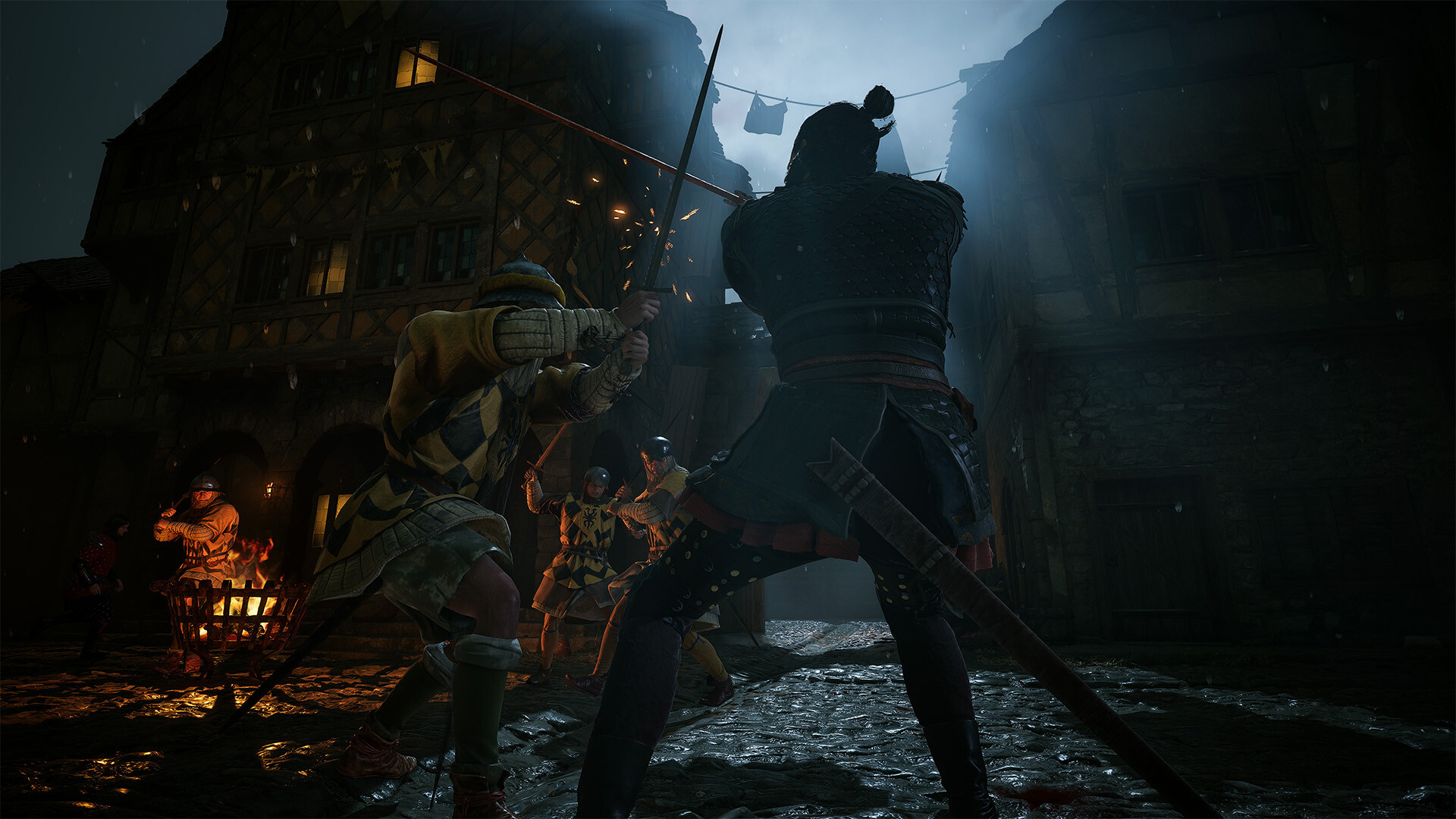
"Then there is the Court system which is essentially Dawnwalker’s way of making Brencis and his forces react to your growing presence in the world."
Consequently, I found myself making a decision which felt closer to Dawnwalker’s central design. Yes, I could spend my time undermining the Vale’s occupiers, but I opted to seek out Anca instead. Her quest was a more potent lead, bringing the promise of personal growth. It’s not that the rebellion isn’t important. The game, instead, made me measure one possibility against another. And, importantly, Dawnwalker doesn’t tell me which decision is correct.
In these moments, when the world works in tandem with the clock, the Vale isn’t a world dotted with quest markers needing to be cleared. Instead, it’s full of people whose circumstances are often difficult to walk away from. A plague-abandoned village outside Svartrau’s city walls, overgrown and stalked by strange mutant wolves, shows me what happened when the Vale’s pre-existing order collapsed. Elsewhere, in the city, evidence of illicit arcane practices lie hidden away in shut off attics. Earlier, I encountered a NPC living alone in a makeshift warren. She was too young to articulate the horrors she’d experienced.
In these examples, and countless others, we see that where Dawnwalker’s world lacks geographical diversity it makes up for in narrative cohesion and intrigue. Individual places still occupy a distinct identity by what happened there, and the stories people left behind. It’s just that everything loops back to consequence. Should I visit the NPCs wooden palace? Should I find more evidence of locked-away witchcraft? Do I need to follow the glowing apparition in the woods? Perhaps it can all wait – there are only 24 days left.
If the 30-day countdown is among Dawnwalker’s most intriguing ideas, its vampirism is its most evocative. Coen’s transformation feels like more than a narrative development to unlock a new set of abilities; it fundamentally changes how he traverses the world and interacts with the people within it. He can drink blood to restore health, warp through shadows, scale walls, and even assume the form of a wolf to sprint the forest trails.
In combat, human Coen’s swordplay is deliberate and impactful. Blocking, deflecting, and parrying feel intuitive, with well-timed counters and dodges triggering a satisfying slo-mo. Enemy attacks are indicated directionally, where matching your defence to the arrow shown retains your stamina. Timing windows, on medium difficulty at least, are generous that soon enough I was perfect-parrying and returning swing with fluidity. There’s a physicality to daytime combat, even if the modest moveset meant I craved more variety earlier than the skill tree could provide it.
Yet, by nightfall, vampire Coen’s combat becomes more expressive. Shadowstep gives me an extra way to evade attacks, while claws sharpen the rhythm of encounters. Rather than relying on healing items, I can tear into an enemy’s neck to replenish health through violence. Vampiric fights balance patience with explosive aggression, and they’re considerably more fun.
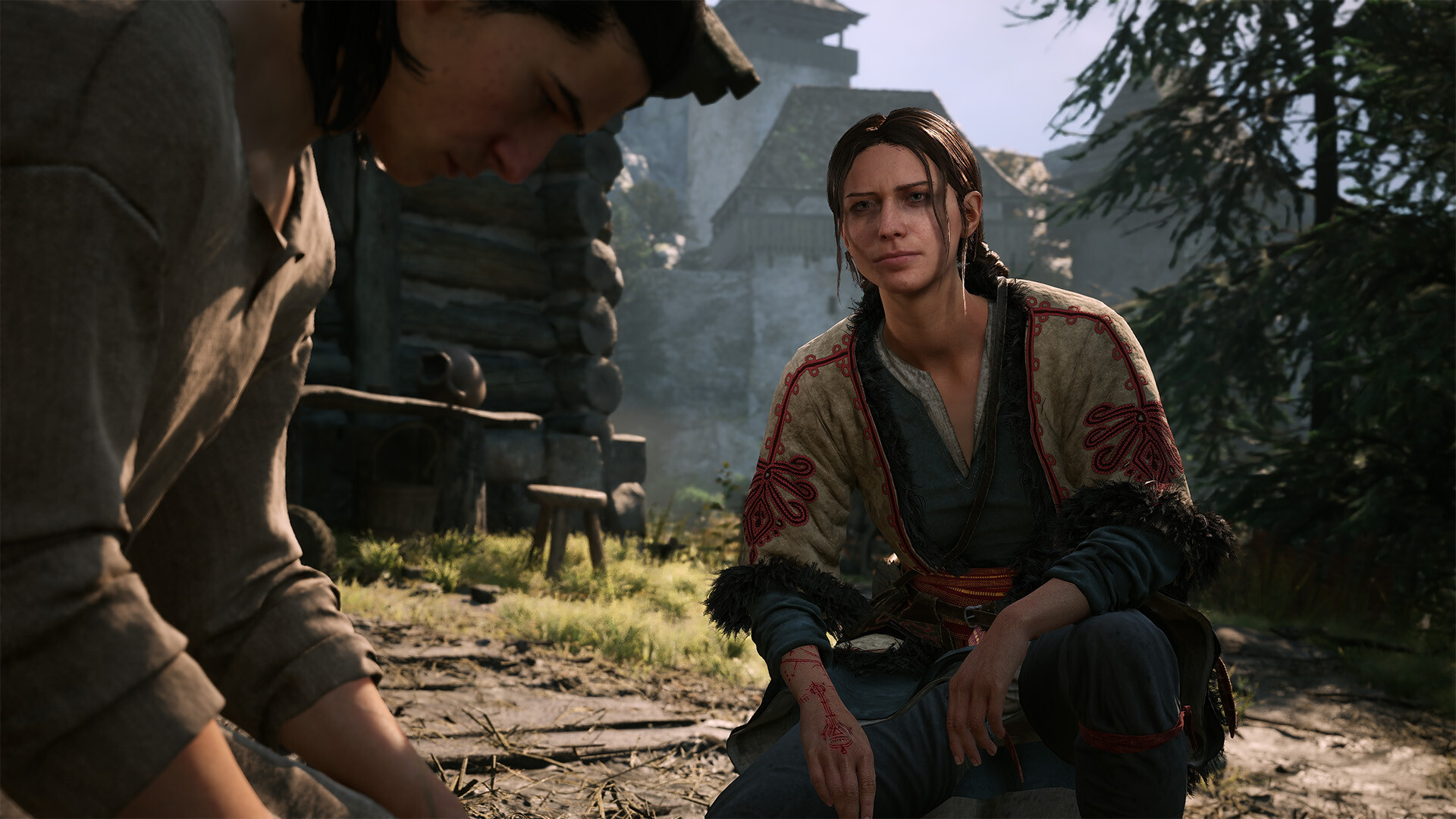
"In combat, human Coen’s swordplay is deliberate and impactful."
This does, however, present a contraction in Coen’s dichotomy. See, Dawnwalker doesn’t want vampirism to be explicitly desirable. Daytime Coen wields witchcraft too, giving a magical edge to the pragmatic swordplay, but really this is more about what Coen thinks. He’s continually repulsed by his nighttime behaviour, even when feeding on animals. Drinking the blood of a deer, for instance, is a cruel, uncomfortable act, with Coen’s repulsed remarks reinforcing the idea that his supernatural power comes at a moral cost. Yet, the game rewards you for fully embracing them. The vampire is faster, more mobile, and less vulnerable than being human.
In other words, Dawnwalker makes Coen’s clandestine temptations feel remarkably tangible, making me wonder why I’d ever want to return to being human. It feels wrong… no, actually, it is wrong, but I enjoy it handsomely, even if Coen feels despair. And maybe this is the point the game is teaching me: if Coen is to learn about responsibility, perhaps he needs other humans and animals alike to suffer his bloodthirsty actions.
Yet, for all the uncomfortable pleasure of being a vampire, Dawnwalker’s world doesn’t always reflect his perilous stature. See, back in the prologue, vampires are introduced as terrifying and merciless, yet once night falls I can walk into settlements, chat with townsfolk, and pass by soldiers without causing alarm. A couple of frightened NPCs suggest the game knows I should be feared, but their reaction was rare. If I am indeed turning into a monster, I’d like the human world to recognise it.
Tensions between Coen’s vampiric form and the world are found elsewhere too. Scaling walls, slipping through gaps, and crossing rooftops can make supernatural traversal feel wonderfully freeing, but rough edges are impossible to ignore. Coen’s feet sometimes lose their centre when climbing, while awkward transitions from vertical scaling to walking can send him tumbling clumsily to the floor. During a specific mission, I transformed back into human form while inside a bell tower that I’d only gotten there through vampiric traversal. Luckily, I’d already found a key to leave, but it left me wondering whether the game had accounted for such consequences of its day-night system.
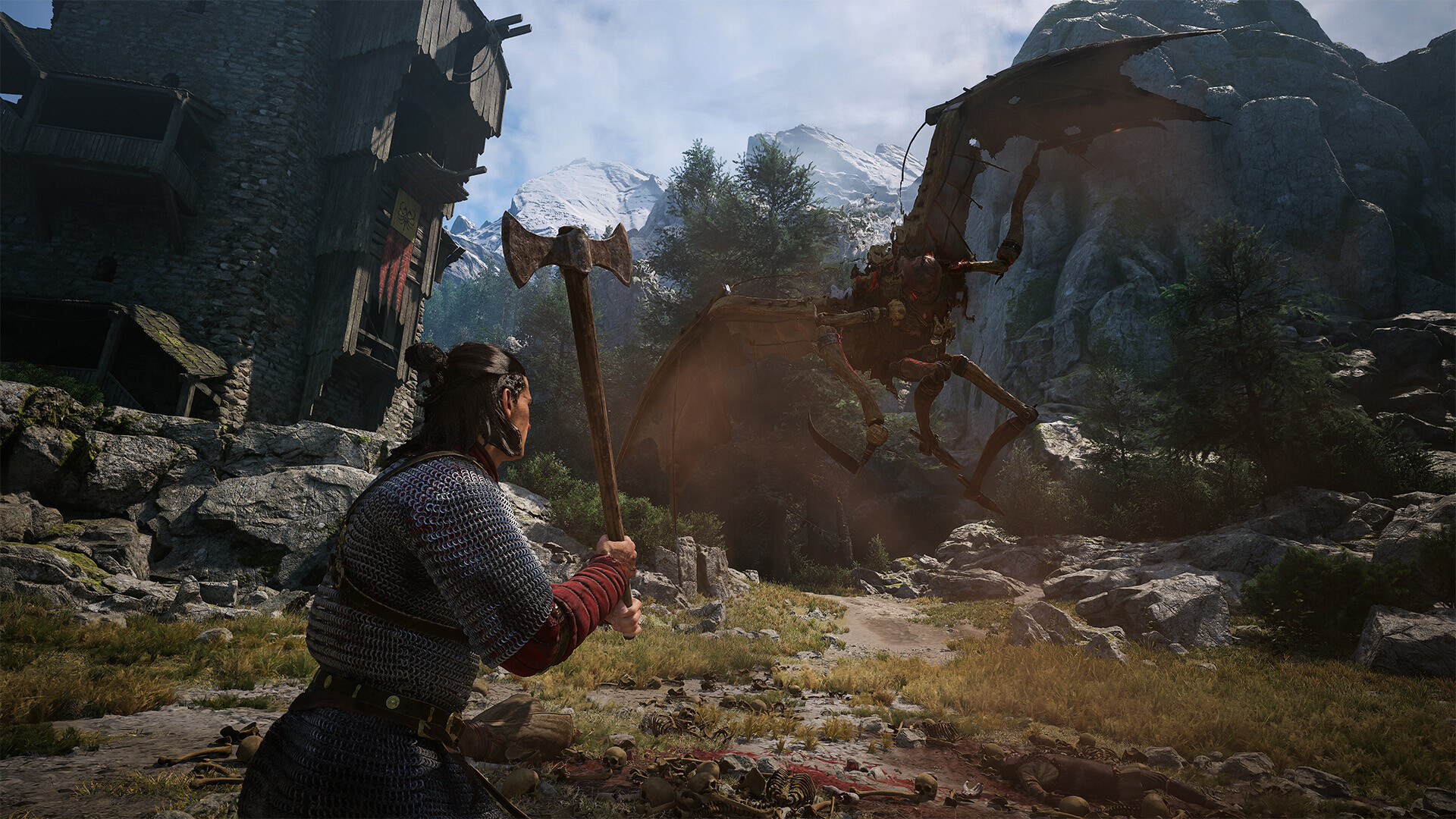
"The game is at its best when I’m inhabiting Coen; asking myself what he should do rather than following videogame impulses. "
Anca’s initial mission is a strong quest for other reasons too, demonstrating the personal weight such excursions bear. Her tragic history with the place contradicted my pragmatic approach, culminating in a decision she didn’t agree with. I wasn’t sure if I’d made the right call, but the game leaves me free to make it, with reasonable explanations sitting either side of my choice. It’s this uncertainty that makes role-playing in Dawnwalker it’s most worthwhile.
Later, a relatively simple prison rescue demonstrated this effectiveness too. Two prisoners accused one another of betrayal, and rather than blindly choosing a side, I searched for evidence. Finding none, I freed them both, with the decision potentially coming back to haunt me later. However, the fact I opted to investigate instead of condemning one or the other – or, indeed, sucking their necks and moving on – shows that as you progress through the campaign, Dawnwalker gives you opportunities to grow Coen beyond weapon skills and crafting recipes.
And, the game is at its best when I’m inhabiting Coen; asking myself what he should do rather than following videogame impulses. See, despite the intoxicating power of vampirism, Coen seems desperate to preserve his humanity. In-tandem with the ticking clock, The Blood of Dawnwalker’s best quests present tough personal decisions; not asking me what I want but what I think Coen wants.
Sometimes, its ambitions don’t always work. The world can feel strangely indifferent to Coen’s vampiric form, vertical traversal lacks polish, and combat progression, with its inherent skill trees, feels slow to blossom. And, furthermore, some activities regress into familiar open-world busywork, despite the narrative developments. Yet, none of these shortcomings stopped me from wanting to discover what happens next. For all its rough edges, The Blood of Dawnwalker has given me something incredibly rare: a reason to care about the consequences of inaction.
This game was reviewed on PlayStation 5.
A genuinely influential time-limit system, forcing me to choose my priorities. Compelling choices, and memorable, dramatic consequences of inaction. Vampirism exploration and combat feels expressive and distinct.
Rough character animations and vertical traversal. Strangely, the world rarely reacts to Coen’s vampiric form. Combat and skill tree progression is slow to develop.