





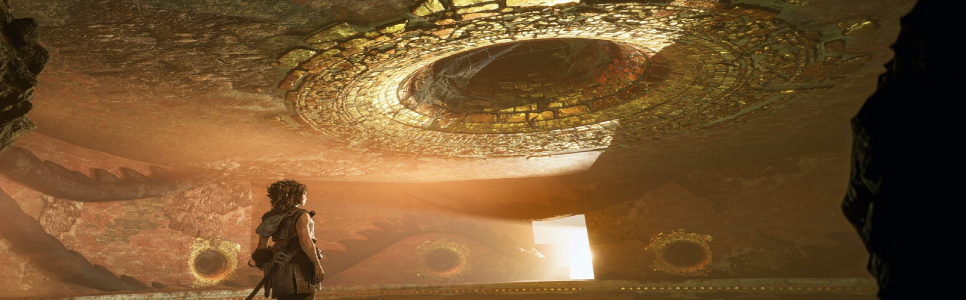
Following the release of Resonance: A Plague Tale Legacy, the team at Asobo Studio were kind enough to have a chat with us about the title. Lead game writer Carol Ann Bañuls and creative director David Dedeine discussed a variety of topics with us, such as the decision to go with an entirely new protagonist and how the team decided to offer variety in combat.
Sophia is far more capable in direct combat than Amicia was, but vulnerability and danger have always been central to A Plague Tale. How did you make the player feel powerful enough to enjoy the new combat without losing that sense that Sophia is constantly in danger?
CARA: I think the key was to make Sophia feel capable without ever making her feel invincible. Amicia has to face violence later in her life, and she survives it; Sophia, on the other hand, was born into that world. She’s a plunderer, she learned to fight from a very young age, and we wanted the player to feel that through the gameplay.
But being good at fighting doesn’t mean you’re safe. Sophia can take on enemies directly, but she’s still vulnerable. She can be overwhelmed, surrounded, or caught off guard, and the world around her remains dangerous.
From a narrative perspective, we wanted that vulnerability to come from the character herself. Sophia is confident and capable, but still young. She can be impulsive, she can take risks and sometimes her confidence gets her in trouble.
So the feeling we wanted wasn’t “I’m playing a powerful warrior”, it was more, “I know what I’m doing, but I still need to be careful.” That balance was really important to us.
David : Our guideline was “every hit counts” and “the dagger wins the fight”. It was a way to be sure Sophia stays vulnerable, like her opponents, but also that her style of fighting was not about brute force but about being sneaky, directly connected to her plunderer background. The overall goal was to deliver a combat style as close as possible to the storytelling, and the general grounded tone of the series.
Because players who experienced Requiem already know the woman Sophia eventually becomes, what challenges did writing a prequel present when it came to giving her journey meaningful stakes and surprises?
CARA: That’s actually one of the things that made the writing particularly interesting. We didn’t want to simply create a ‘young Sophia’ who would have the same characteristics, but just younger. We needed to capture something of her, whilst also revealing a person who was still finding her way.
Because we already know the woman she becomes, we could pull on those psychological threads and ask ourselves: what happened to her? What experiences shaped her beliefs, her behaviours?
Her relationship with violence is a good example. In Requiem, she tells Amicia that she refuses to kill or even fight. So we could ask ourselves why someone who grew up among plunderers would draw such a strong line there. Maybe it’s because of trauma, or maybe because she’s already seen — or even experienced — that darker side of herself and absolutely refuses to go back there.
So the challenge wasn’t really about hiding where Sophia would end up. It was about making players understand how she got there.
Sophia and Theseus have very different styles of combat and movement. How did you make both characters feel mechanically distinct without effectively having to build two separate games?
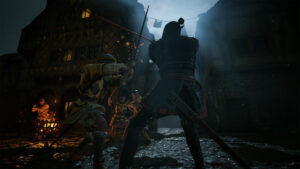
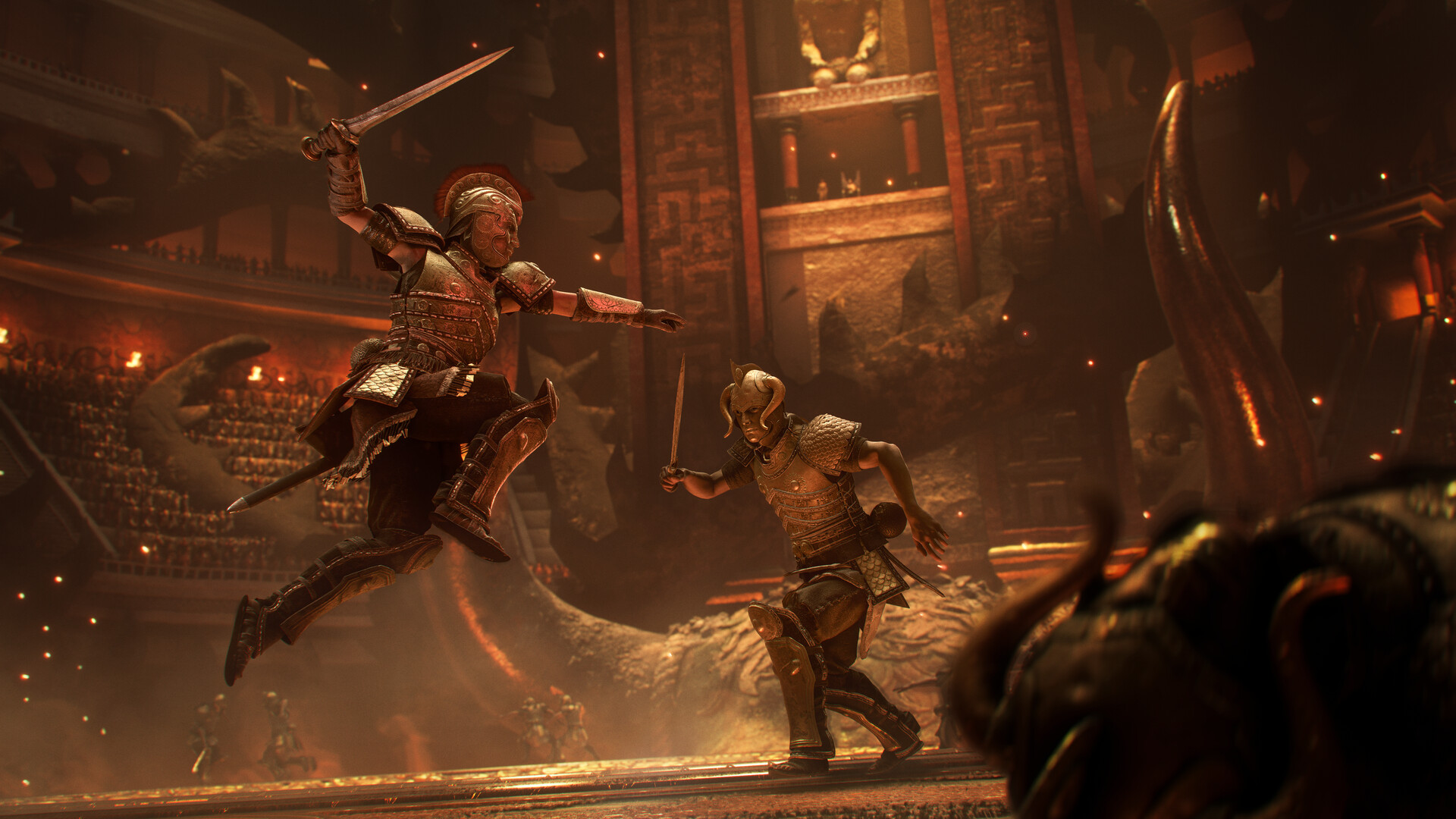
David: We wanted Theseus to feel like a gladiator fighting against other gladiators involving armor and heavier weapons. We also needed to avoid making players lose their bearings during these sequences, as they are too short for them to learn entirely new gameplay mechanics. As a result the pacing is slightly slower to give more weight, and even though the gameplay is the same, the animation team did awesome work to make it feel different thanks to a new set of animations, very iconic, with this typical gladiator flavor involving a sense of show tied to the nature of the “Minos Games” she is participating in.
Minotaur’s Island exists across two vastly different historical periods. How did you design the locations so that players can recognise echoes of the same place across both eras while ensuring each version still feels visually and mechanically distinct?
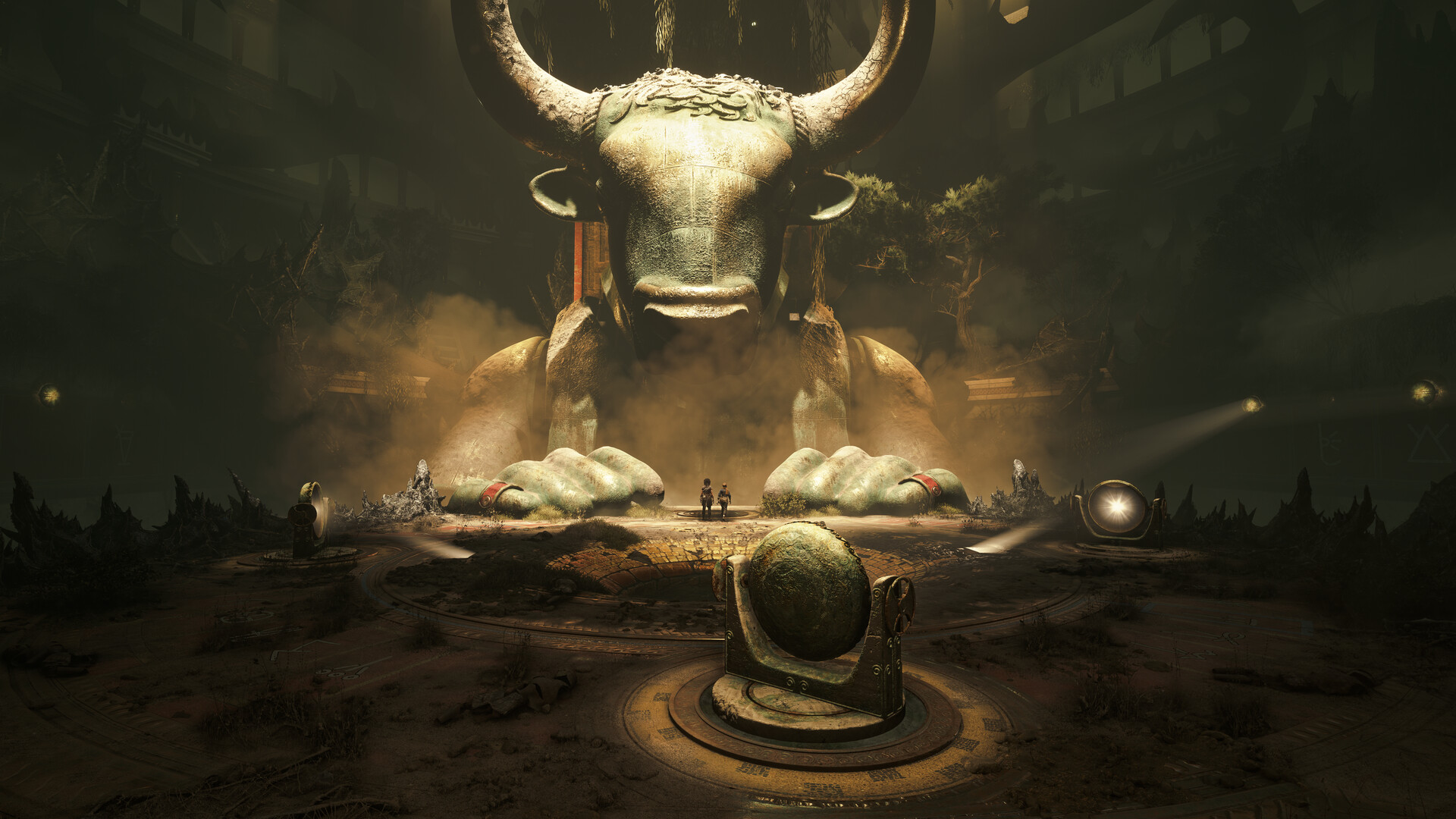
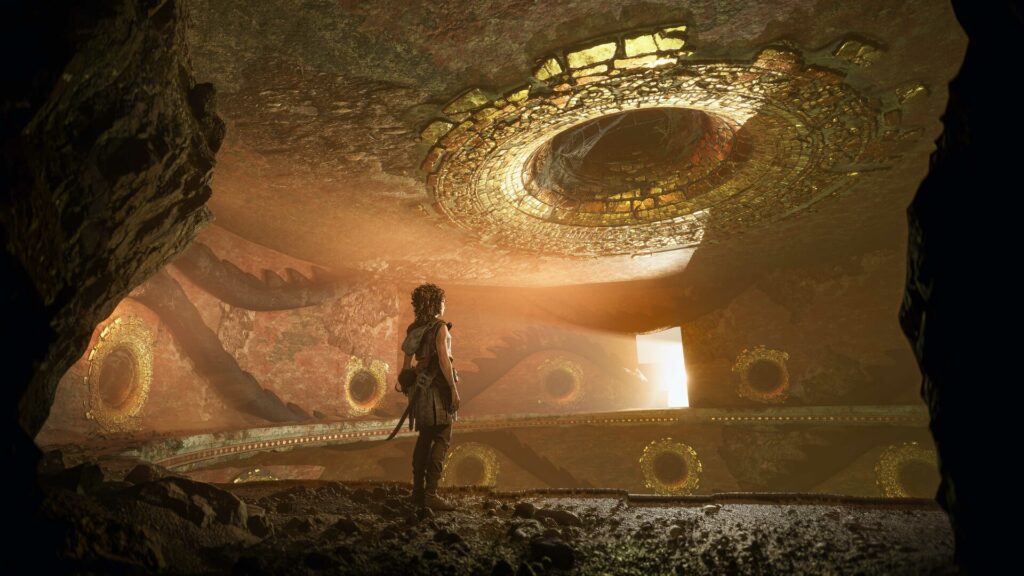
David: It was a huge challenge. To summarize, we had to make it readable that Sophia, during the Middle Ages, was exploring ancient ruins and, at the same time, playing Theseus in the same places, but 2,500 years before. Our chance here was that we, contemporary players, tend to forget how colorful and clean these places were when they were built, so we played with that idea: ruins in Sophia’s time are like we know them; paint and ornaments are gone or washed out, and the colors of the stone and the materials are the only remaining visible things.
As we wanted to avoid the “guided tour” feel, we tried to bury them as much as possible, as the island had been abandoned for 2,000 years. Then, for the Theseus period, we made everything clean and neat, and gave back the very saturated colors used at that time on these buildings.
Ultimately, it was a very interesting journey for the whole team to dive into this historical subject.
Leni accompanies Sophia during portions of her journey. Companion characters can sometimes give puzzle solutions away before players have had a chance to think for themselves, so how have you balanced making Leni useful without having her become an automatic hint system?
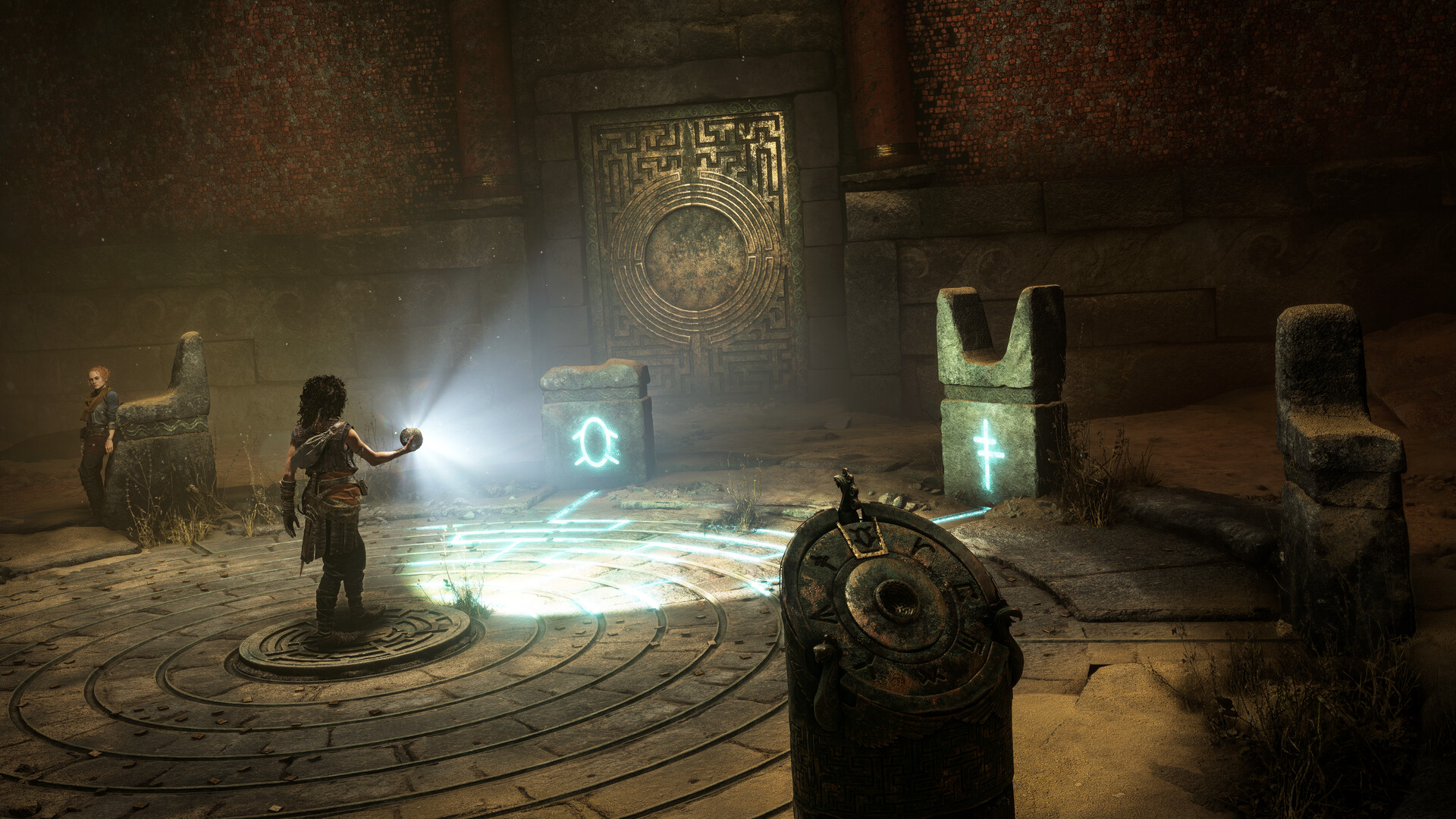
CARA: We wanted to leave that control to the player. When Leni has something useful to say, the player can choose to interact with her and ask for a hint. If they don’t want one, they can simply ignore it and figure things out for themselves.
So Leni never automatically gives the solution away. That way she can still be a helpful companion without taking away the feeling of discovery.
You’ve said that the Macula manifests differently in Resonance. Beyond what that means for the story, did this new interpretation also allow you to create gameplay mechanics or situations that simply wouldn’t have been possible with the rats in Innocence and Requiem?
David: Yes, we knew that, at least in a Medieval setting, it would have been hard to keep the light vs. rat mechanics fresh, both visually and in terms of gameplay. We also needed something more dynamic and interactive than the rats to match the more action-adventure mood of Resonance, compared to Innocence and Requiem, where the rats are quite often used as puzzle elements from a gameplay perspective.
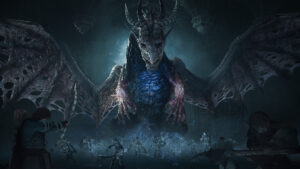
The new manifestation of the Macula in Resonance is closer to a blind and deaf creature, only able to detect recent motion as if it were a scent. As a result, these sequences give more freedom of action to the player, permanently wondering what the best next move is, knowing that it can switch from stealth to a chase and vice versa at any moment.
How much will Resonance change or deepen our understanding of the Sophia we eventually meet in Requiem, and can longtime players expect it to recontextualize any elements of the wider Macula storyline?
CARA: I definitely think players who know Requiem will see Sophia differently after playing Resonance. You get to see where some of her strength comes from, but also where some of her emotional defenses come from. She’s not born as the very controlled and confident woman we meet later. She has to become that person.
As for the wider Macula storyline, yes, Resonance adds another piece to the puzzle. In particular, Resonance confirms that the Macula can manifest itself in different ways; this gave us the opportunity to explore another aspect of this phenomenon. So hopefully, longtime players will come away with more questions as well as some answers.
The PlayStation Store lists Resonance as PS5 Pro Enhanced. What specifically can PS5 Pro players expect in terms of resolution, image quality, ray tracing or frame rate compared to the standard PS5?
David: PS5 Pro gives players the opportunity to play with the best resolution and graphical settings at 60 fps.
What are the targeted resolution and frame-rate modes on PS5, Xbox Series X and Xbox Series S? Will players have a choice between quality and performance modes?
David: Players have the choice between two modes (on PS5 and Xbox Series X): Native and Performance. PS5 and Xbox Series X run in Quality mode at native 1440p, upscaled to 4K at 30 fps, and in Performance mode at native 1080p, upscaled to 1440p at 60 fps. Xbox Series S is limited to 30 fps, or 40 fps on 120Hz displays, at 1080p without high-end performance mode toggles.
On PC, your recommended specifications currently target 1080p/60 FPS at Ultra without upscaling or frame generation. What support can players expect for technologies such as DLSS, FSR or XeSS, frame generation, ultrawide displays and unlocked frame rates?
David: Resonance supports DLSS 4.5/5 depending on the hardware. FSR is also fully supported, providing an alternative for non-Nvidia users. XeSS, Intel’s upscaling technology, is also supported. Regarding in-game Frame Generation, we support both Nvidia and AMD cards. Framerates are fully uncapped, allowing high-refresh-rate monitors to run well past 60 FPS depending on your GPU. Ultrawide displays are supported natively.
Resonance supports DualSense haptics and adaptive triggers on PS5. How extensively are those features being used—for example with sword combat, parrying, traversal or the Minoan sphere puzzles?
David: We really love the DualSense and how it really improves immersion. So the list is pretty long: in combat, a successful parry causes the DualSense to vibrate in a distinct way, mimicking the sensation of blades actually clashing, while the controller also provides feedback when Sophia draws or sheathes her sword, and naturally, when she lands a strike.
During exploration, you can feel spikes bursting from the ground or the sound of petrified ground cracking apart. Interactions such as opening a chest or using a Minoan mechanism, the prism, or the lenses all trigger DualSense vibrations.
The controller vibrates on the right or left side depending on a creature’s distance from Sophia and its position relative to the camera; this logic is applied to the vast majority of cutscenes as well.
Haptic features are also utilized with the dagger: the haptics indicate the charge time, stopping once the charge is complete. The grappling hook makes use of this too; when pulling in enemies, there is resistance up to the midpoint of the trigger, which initiates the hook’s release, at which point the resistance vanishes completely.
Finally, we also used the controller’s speaker to enhance the connection with Arianne; for instance, the stronger the resonance, the louder Arianne’s voice becomes. These are just examples of the incredible work done by the team on this topic.
And lastly, are you done with Amicia? Requiem ended with enough hints for a future, no?
David: There are several hints in Requiem and Resonance of what could be explored. And we have lots of different ideas to continue to develop the A Plague Tale universe. We just want to be 100% sure that we will bring something fresh and authentic while creating an even better experience than the previous ones. It takes time, and I can’t say any more right now.
That being said, rest assured that Amicia has been alive in our hearts since Innocence. We will see.