





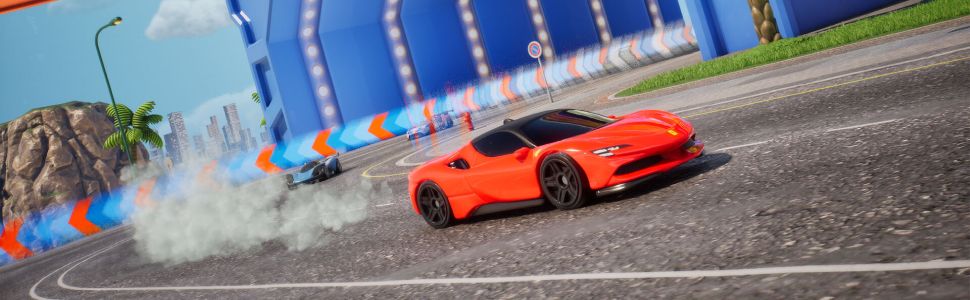
Hot Wheels Infinite Rush is a racer fixated with momentum; the playful and carefree kind, like a child chopping their hand through a tower of wooden blocks. Infinite Rush made me think of how my kids play, not because the game is ostensibly toy cars careening through miniature playgrounds, but because kids are not concerned with precision. They just want to see debris.
"Infinite Rush made me think of how my kids play"
On its easiest difficulties, Infinite Rush is a casual cruiser. But, ramp up the challenge and its forgiving toy-car physics transform into exhilarating, barely controllable chaos. It’s an arcade racer not concerned with nailing corner entry or kissing apexes. When set to Very Hard, just keeping your little plastic machine pointing the right way is enough. Bumpers be damned – if I wanna bounce and ricochet toward the finish line then I’m gonna.
The game does facilitate my childlike carelessness though, with flipped cars that auto self-right, quick positional resets with a press of the right shoulder button, and, when streaming through the open playgrounds, obstacles that can be smashed to pieces like paper-mache piñatas.
Hot Wheels Infinite Rush is an accessible, frictionless racer. It’s why Easy mode works, and it’s also why Very Hard’s intensity works too. The game’s momentum-first design continually pulls you forward. The question, however, is this: can a lack of resistance sustain a lengthy campaign of racing events, diversions, and open world collect-a-thons? Or, will the adult in me want the toybox to fight back?
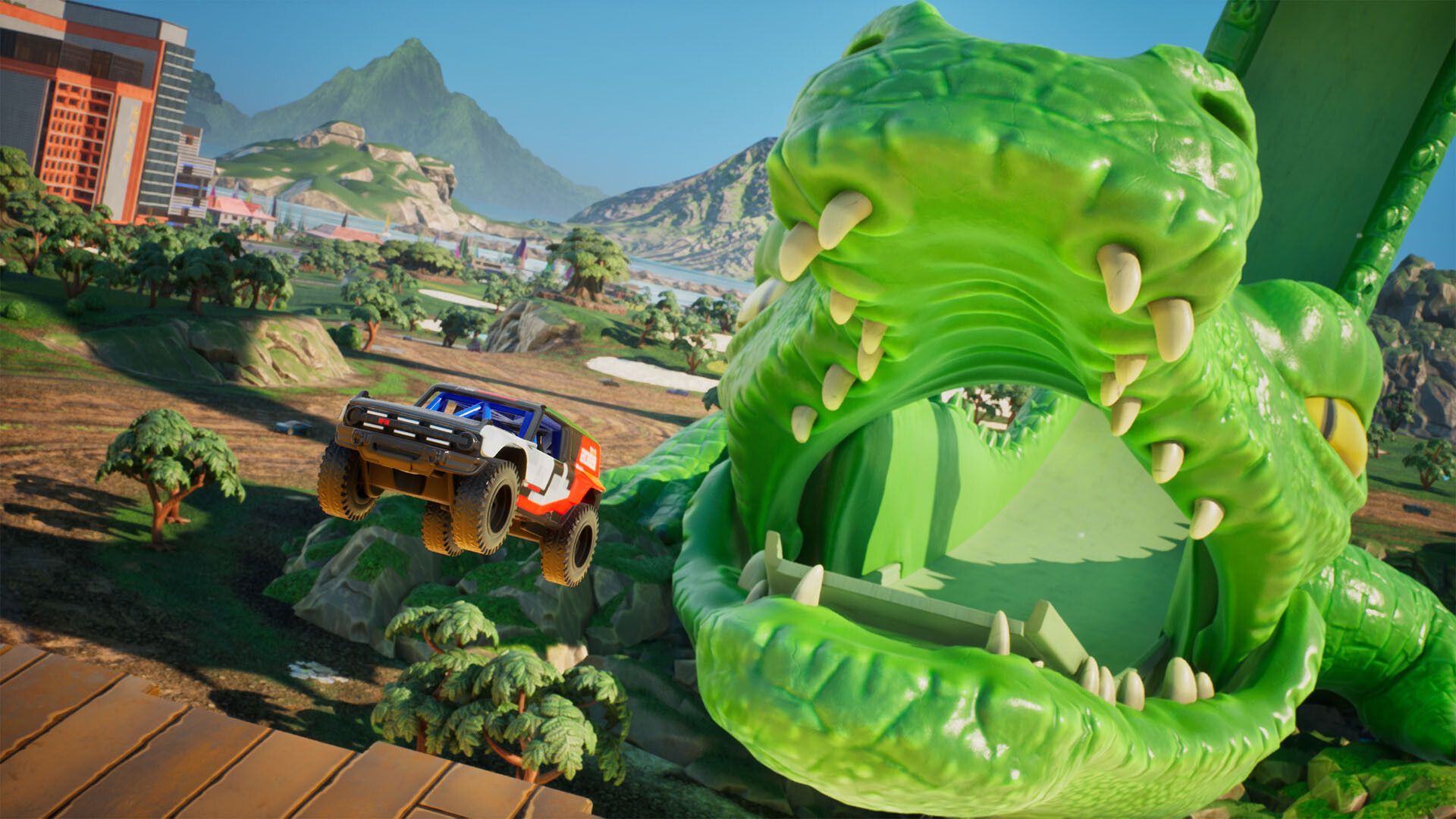
"Hot Wheels Infinite Rush is an accessible, frictionless racer."
Anyway, let’s start with the four vehicle classes: the self-explanatory Speeders and Drifters, the weighty, powerful Titans, and the Versatiles which sit somewhere between all three. Each harbours intuitive propulsion and handling except the Titans. See, Infinite Rush’s driving is centred around brake-triggered drifting, but the Titans don’t naturally suit it. In other words, they can barely sustain a useful slide. Their nose skews inward, and they’re less fun to hurtle through the open world than the other car types. If you encounter an emergent Daredevil – a rogue speedster whom you can challenge to a one-on-one race, with you adding their vehicle to your collection should you see the checkered flag first – then you’ll want to switch to a faster, more effective car type. Titans have powerful boosts, sure, but the game’s aforesaid momentum revolves around drifting just as much as throttling it out of corners. Really, enjoyment behind the wheel of a Titan only emerged once I maximised the difficulty.
In essence, Infinite Rush in Easy mode is straightforward and trouble free – ideal for children. Medium offers slightly more resistance, while races in Hard become noticeably more competitive. Yet, I don’t wish to big myself up, but even on Hard I still didn’t find a meaningful challenge, so I switched to Very Hard, and this – as I’ve already alluded – is where the game transformed. The jump was significant, and almost instantly my driving became more erratic. Corners could barely be contained, tiny mistakes became consequential, and victories felt earned. The nature of open world cruising doesn’t change, aside from perhaps Daredevils being harder to catch. It’s during races, elimination events, and the Daredevils where intense difficulty is found. And, for me, it made the extensive checklist of open world events more meaningful.
Still, all four difficulty modes are viable, and Infinite Rush doesn’t tell you how to play. Instead, through its momentum-first design, you can decide whether the game is an easygoing toybox or a fight for survival, with the latter, importantly, never feeling like a grind. If my car did end up pointing the wrong way, I didn’t care.
And, as for progressing through the maps themselves, well, again, supporting the momentum-first philosophy, they arrive quickly. Structured around completing events – races, stunts, time trials, speed traps – across an island to unlock a one-on-one boss-style encounter, you don’t spend too long pursuing victories before the next island appears. Wheelswood is predominantly a grid-based city, while Tentacle Bay is a coastal resort with golf courses and water parks. Gearville is another city, this time surrounded by desert and dirt tracks, while my favourite is a Japan-themed island of dense metropolis, water canals, ancient architecture, and rock gardens.
Each harbours a wealth of jumps, ramps, loops, and destruction, and they’re a breeze to traverse, even if the visual distinction between them isn’t always pronounced. Gears and stickers provide mechanical encouragement to explore, but there’s joy-a-plenty in simply careening through each’s freewheeling layout. None are enormous enough to get lost. They’re compact playgrounds designed to keep you moving.
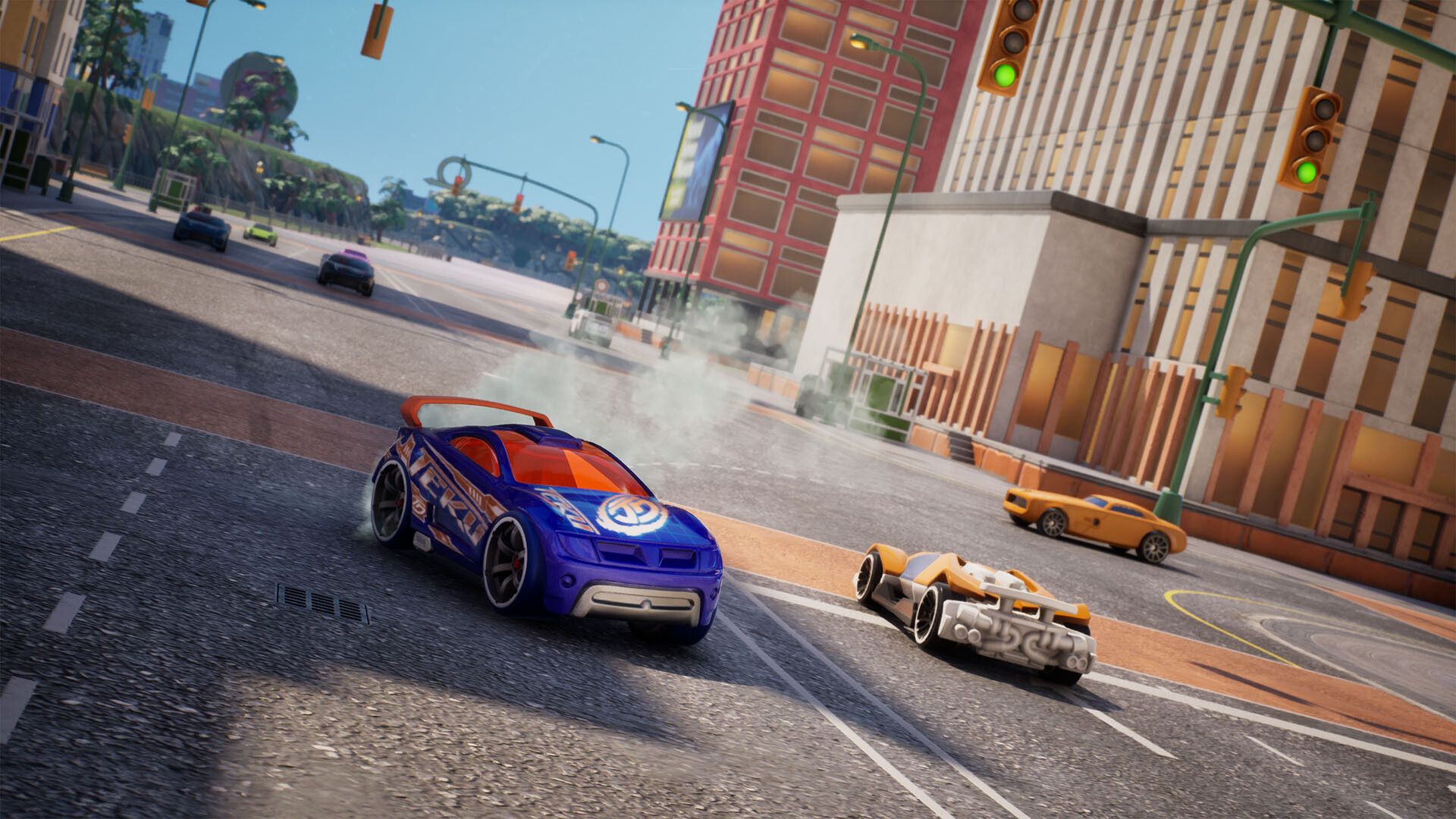
"Still, all four difficulty modes are viable, and Infinite Rush doesn’t tell you how to play."
Less successful to this ethos the Gearville’s mountainous undulation, which can make waypoints difficult to locate. Likewise, dynamic events need to be noticed and chased to initiate, with a randomness that could feel frustrating to completionists.
That said, there’s always a pleasing momentum to expanding Infinite Rush’s garage. Cars are unlocked by winning races, taking on the Daredevils, completing timed delivery runs, or simply visiting the dealerships scattered across the island, as well as some secret sellers that dynamically appear later. Dealerships require Rush Coins, which are earned both conventionally through events and organically by tearing across the open islands, performing drifts, narrowly avoiding traffic, and smashing through the environment. Even aimless driving, then, feels productive, with Rush Coins consistently arriving at a steady rate.
Only on occasion did I wish currency accumulation was more generous. There are so many appealing cars to collect, alongside boost effects, and dash sounds, that I sometimes found myself impatiently eyeing the next purchase. Don’t get me wrong – the grind is never oppressive. But, a little extra reward so I could expand my garage at a pace which matches the momentum elsewhere would have been appreciated.
Likewise, once cars are in your garage the ways you personalise and develop them comes slowly, and the augmentations aren’t particularly meaningful once they arrive either. Four tiers of perks can improve your acceleration, handling, boost recharge, and more, but the fine-tuning they offer is slight. The cars are easy to drive as they are, so I never truly felt as though I’d crafted a speed demon or battering ram despite there being perks to enable such builds. Furthermore, higher tiers took a while to unlock, and finally reaching the most powerful tier only yielded one specific perk, and it remained the sole high-tier perk for a long while.
Another customisation tool is the livery editor, and it remained merely functional and fiddly throughout. Changing colours and finishes is straightforward, but placing decals precisely – particularly when attempting symmetrical designs – is unnecessarily awkward. A simple option to mirror placement would help. More frustratingly, equipping a completed livery requires several trips through menus. It’s an odd amount of friction given gameplay is built around movement.
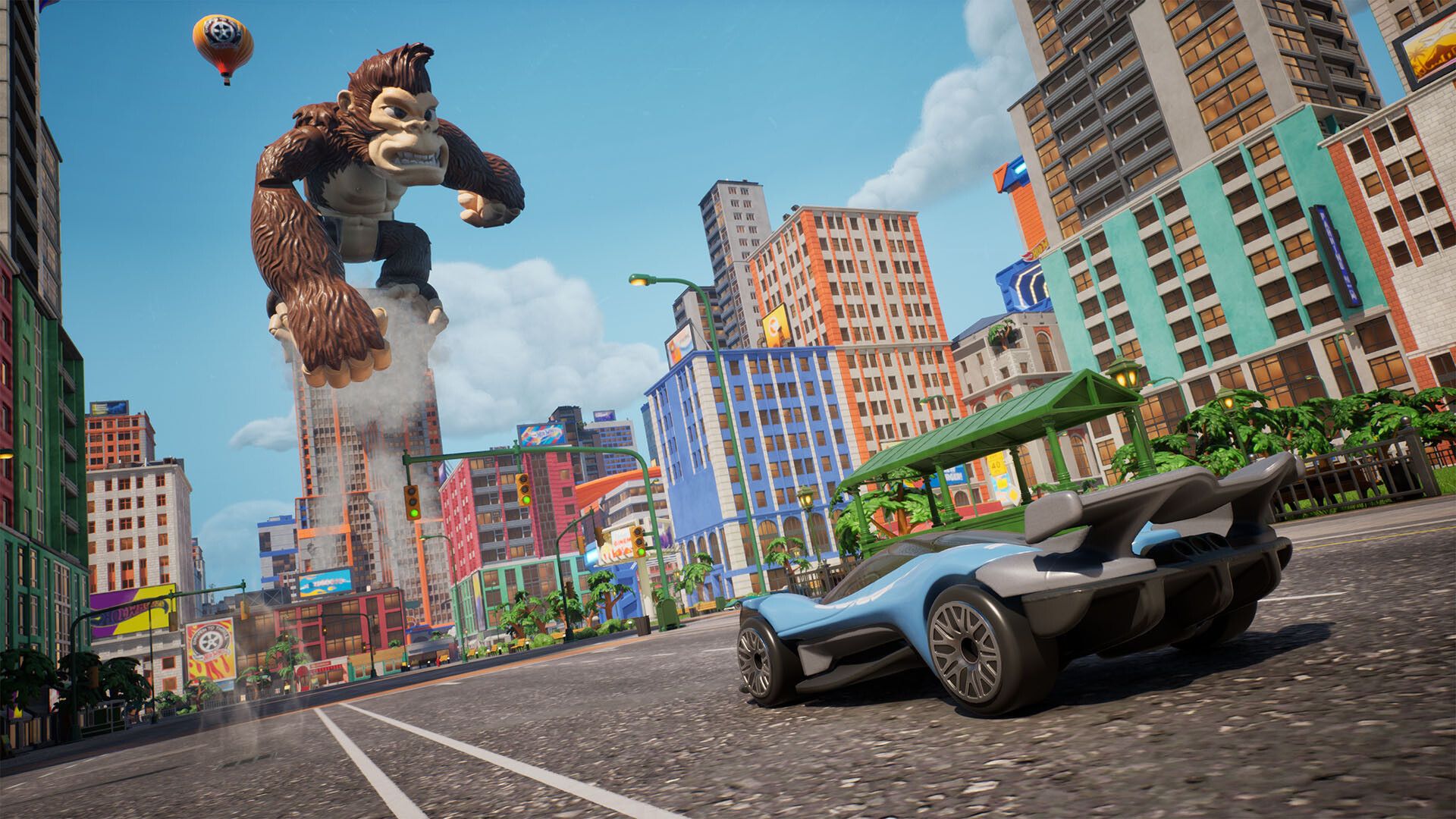
"Only on occasion did I wish currency accumulation was more generous."
Likewise, the track creator is undermined by cumbersome UI despite a broader potential for creating outlandish circuit designs. Like playing without adult supervision, piecing bits of looping track together stirred the childlike glee in me once again, but the creator’s setup doesn’t foster spontaneous building like it should. My first attempt at a corkscrew demonstrated how easily it was to create something technically spectacular but completely unusable, too; the builder needs planning and foresight, whereas spontaneity should be in the front seat. There’s an excellent creative tool here, and, indeed, a course of unfathomable loops, cannon fire, magnetic roads, and a dinosaur emerged in later attempts in spite of the interface’s roadblock.
Elsewhere, Infinite Rush looks every bit the part, with popping colour and superbly detailed cars that occasionally look indistinguishable from their plastic counterparts. Milestone’s affinity for vehicles shines here, with slow-motion shots showcasing each panel’s texture and detail. Engine sounds are equally impressive, offering plenty of coarse, characterful variety.
Local multiplayer is less convincing. Basic races and elimination events are supported, but there’s no option to freely explore the islands. Given the game’s playful, toybox-like design, this feels like a missed opportunity – especially for families like mine, where six-year olds simply want to mess around and create destruction together.
Ultimately though, Infinite Rush understands the Hot Wheels fantasy. It isn’t about precise racing or perfect cornering, and while its easiest difficulties might seem too forgiving for adults, the sheer speed and spectacle of throwing little plastic cars around at unreasonable velocities awakened a childlike glee in me. I genuinely didn’t care if I won or lost, I just wanted debris.
This does bring the question back: is a largely frictionless experience enough to sustain a lengthy campaign? Unfortunately, I don’t think it is. In fact, I do believe the game would benefit from more focused career progression akin to earlier Hot Wheels titles. This isn’t to say the open worlds aren’t worth your time, but there needs to be a little fight back. Alas, I’ll be sticking with Very Hard difficulty, because, at least, it transforms frictionless toy-car physics into some genuinely exhilarating arcade racing.
This game was reviewed on PlayStation 5.
Hardest difficulty transforms the racing into exhilarating, chaotic arcade action. Colourful open worlds packed with jumps, shortcuts, collectibles, and destruction. A huge library of cars and consistently excellent vehicle presentation.
Career progression lacks the focus and resistance needed to sustain a lengthy campaign. Customisation and track creation tools held back by cumbersome interfaces. Titan cars feel poorly suited to the game’s drift-focused driving mechanics.