






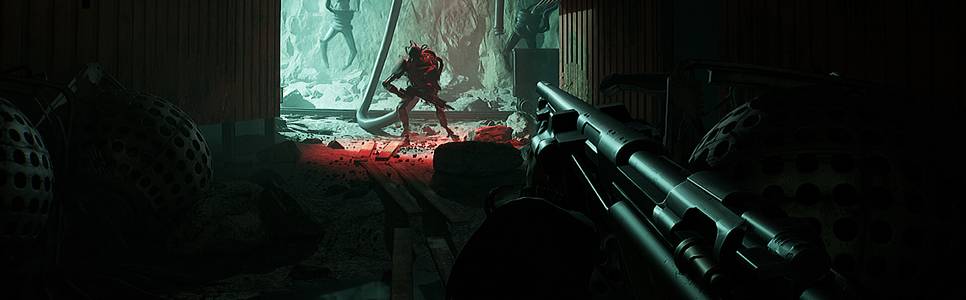
INDUSTRIA 2 is poised to build meaningfully on its predecessor, retaining its dystopian atmosphere but placing greater emphasis on pace and storytelling, all while carefully balancing exploration and combat to enhance slow-burning tension. In fact, developer Bleakmill appears to be refining every aspect of the experience, from more deliberate gunplay and overhauled AI, to richer visuals and unsettlingly tactile sound design.
With a strong survival horror influence underpinning its immersion, here are fifteen things to know about INDUSTRIA 2.
Game Overview
INDUSTRIA 2 is shaping up to be a tightly focused, narrative-driven first-person shooter that places its bleak, monochromatic atmosphere squarely in the crosshairs. You’ll once again step into the shoes of Nora, a scientist trapped in a surreal parallel dimension. Picking things up after she’s sought refuge in an abandoned location, she ventures out into the post-industrial world for a sequel which appears committed to delivering an introspective, story-led experience. This time around, exploration is poised to carry as much weight as the gunplay itself.
Slow and Methodical
INDUSTRIA 2 is the polar opposite to a run-and-gun shooter. It follows a deliberate, survival horror-like pace, where otherworldly forests, ghost towns, and mechanical factories alike demand patience and solemn observation. Enemies appear entirely robotic, and they’re not always thrown at you in waves. Instead, they’re placed with care, turning every confrontation into a tense exchange. In INDUSTRIA 2, a chaotic approach rarely prevails.
An Unsettlingly Personal Story
INDUSTRIA established the parallel world overruled by rogue AI ATLAS, but common complaints centred on the low emotional stakes in what was a promising premise. As a course correction, this sequel appears to dig deeper into Nora’s past, as it has been revealed that she may have played a significant role in the creation of the very machines that haunt the world she’s stranded in. This revelation should add an air of unsettling accountability to her journey, reframing each encounter as something more personal.
Diegetic Systems Ground Immersion
Immersion is clearly a priority for this sequel – frankly, it is in any game – but in adopting diegetic inventory and crafting systems INDUSTRIA 2 hopes to ground immersion with tangible mechanics. See, rather than pulling you out of the world into abstract menus, these systems – like the inventory scroll she whips out of her backpack – are integrated directly into Nora’s reality. There’s the sense that everything from managing resources to building tools is designed to enforce believability against the preternatural backdrop.
The World is a Post-Industrial Nightmare
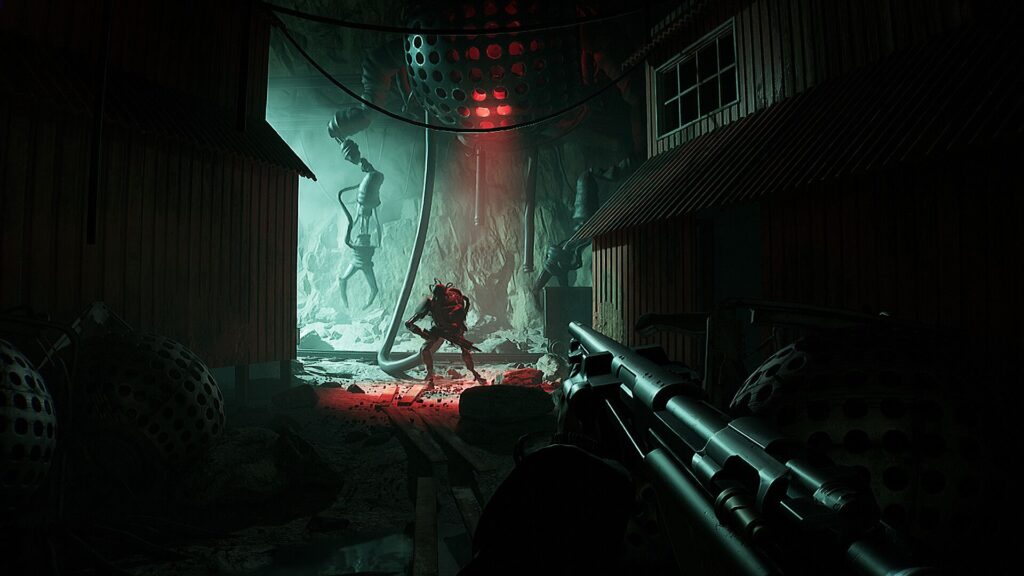
Parts of INDUSTRIA 2’s setting lean heavily into post-industrial decay, where sprawling, impossible architecture appears constructed from organic machinery. These locations bring to mind Armored Core’s colossal factories, and perhaps even the biomechanical nightmare of Scorn. It’s a world where towering structures and labyrinthine spaces create unease through their defiance of logic, and we’ve more to say on the bio-horror angle later.
Five Distinct Weapon Types and Craftable Explosives
Combat will revolve around five distinct weapon types, however these don’t appear to be high-end, complex military-grade firearms but the more ramshackle pistols, shotguns, rifles and the like you find in Stalker. Further, each weapon can be upgraded with various attachments – silencers, extended magazines, special firing mods – suggesting a progression system which honours investment and experimentation with numerous possible loadouts. Elsewhere, explosives in the shape of small firebombs are craftable, adding another tactical option when overwhelmed with enemies.
Enhanced Melee
Compared to its predecessor, where clunky pickaxe melee was a common painpoint, INDUSTRIA 2 appears to place greater emphasis on close-quarters combat. That said, melee-only runs don’t seem possible, more that scattered detritus can be grabbed and used in situ – metal pipes, and so on. In the sequel’s Steam demo, melee weapons will break after a few swings. In terms of game design, this ensures found items can be used spontaneously, but not wholly relied upon. Yet, it can erode immersion when something metallic only lasts a few hits before snapping. It’ll be interesting to see how the devs balance this in the finished game.
Bio-Mechanical Horror
The developers have been upfront about the body horror, specifically mentioning robotic and bio-mechanical viscera. While the original INDUSTRIA included unsettling visuals, this sequel sounds like it’s pushing the techno-gore much further, potentially into disturbing territory. Whether it reaches this intensity remains to be seen, but with the sequel exploring numerous decrepit, claustrophobic environments, amplified body horror would certainly mirror the tone.
Powered by Unreal Engine 5
Built in Unreal Engine 5, INDUSTRIA 2 brings a noticeable leap in visual fidelity. Immediately present is the wholesale use of Lumen’s dynamic lighting potential, punctuating the oppressive darkness of industrial interiors with sparse illumination that bounces and reflects believably. Environments are more detailed, textures are rich with weather and decay, and physics-based interactions impart a tactile feel to moving objects, plugging cables, and crafting ammo. Let’s hope INDUSTRIA 2 isn’t plagued by the same performance issues affecting other titles made in UE5, as the shift in visual immersiveness the engine brings is proving dramatic.
A Short, Focused Experience
The first INDUSTRIA had a runtime of four hours, which many, as already alluded to, feel didn’t provide ample-enough time for the narrative to bloom. Well, INDUSTRIA 2 isn’t set to break the mould already set out by its predecessor in campaign length. This one’s slated to run for approximately four-to-six hours. However, the devs have been vocal about acting on feedback, and while the sequel is indeed another short experience, they’re assuring us that it will be a tightly focused, highly curated experience, where brevity works in the narrative’s favour.
Sound Design Is a Core Pillar
Interestingly, the game’s Steam page highlights sound design as a key pillar to the overall experience. We say interesting, as this isn’t something every shooter calls attention too, suggesting INDUSTRIA 2’s immersive-sim elements will dominate over gunplay. Audio, then, will build tension, whether through environmental ambience, mechanical echoes, or ghostlike murmurs hanging in stale air. That said, footsteps, weapon reloading, the sound of Nora’s opening backpack, each of these sounds is sharply polished too, supporting the Steam description’s audio-centric pledge.
Influence Shifts Toward Survival Horror

While the original INDUSTRIA wore it’s Half-Life inspirations openly, all this emphasis on detailed lighting, tactile sound design, and shuffling investigation points to the sequel taking a different route. Evidently, the developers are looking toward modern survival horror to establish the sequel’s aesthetic, explaining its careful mix of exploration and combat to heighten tension, alongside an increased emphasis on scarce ammunition and resource management.
Overhauled Enemy AI
Enemy behaviour has been upgraded for this sequel. Rather than simply reacting to your actions, enemies now inhabit environments befitting of their design – humanoid robots follow patrol routes, mechanical arachnids scurry through dusty burrows, and humans tiptoe with the same trepidation you likely will. However, during a gameplay trailer, whereby the player shoots a room-scanning tripod in earshot of three human explorers, the AI doesn’t showcase behaviour exactly how you’d expect enemies in the vicinity of gunfire to react. However, that footage was taken from gameplay earlier in development. Hopefully, the same situation in the finished game will yield enemies who startle at the pop of gunfire, as less predictable enemies leads to more threatening encounters.
Release Date and Platforms
INDUSTRIA 2 launches on April 15th. On release, it’ll be a PC-exclusive, with Steam, GOG, and the Epic Games Store currently listing the game for pre-order. Currently, consoles haven’t been officially announced. The first INDUSTRIA saw its console version arrive nine-months after the original launch, so something similar can’t be ruled out here.
PC Requirements
To adequately run INDUSTRIA 2, you’ll need at minimum an Intel i5-8600, AMD Ryzen 5 3600, or equivalent CPU, Nvidia GeForce RTX 2060 or similar GPU, and 8GB RAM. Recommended hardware, as per the game’s Steam page, includes an Intel i7-8700K CPU, GeForce RTX 3080 GPU, and 16GB RAM. The game also requires 20GB storage.