






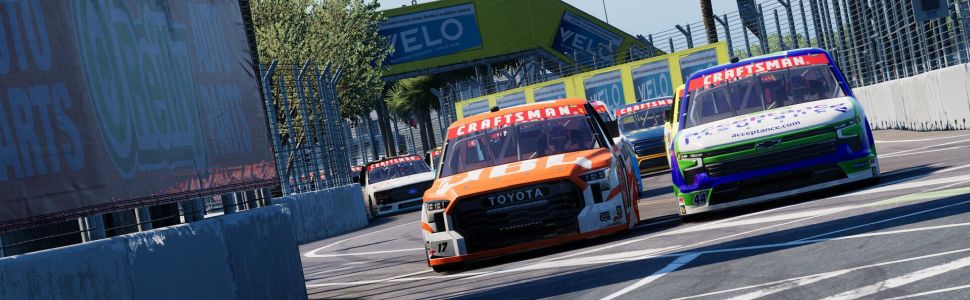
NASCAR, like all motorsport, is defined by precision. Yet, its heavy stock cars are notoriously un-aerodynamic, demanding preciseness in different forms compared to F1 or IndyCar. Hurtling toward a banked curve, a driver will be in a constant state of micro-adjustment – feathering the throttle, partially braking, maintaining a racing line, and positioning anywhere from a car’s width to a quarter inch away from the outer wall. NASCAR 26 captures this combination of deftness and brute force, with developer iRacing Studios showcasing the appeal of weighty machinery travelling at 190 miles per hour.
"The driving sensation in NASCAR 26 is the star."
If there’s one thing I can immediately say, it’s that the driving sensation in NASCAR 26 is the star. And, for me, its balancing demands led to a more profound state of mind where I found joy in repeating the same process lap after lap. Across oval and tri-oval layouts especially, when my tyres felt locked in the groove, I entered an unblinking flowstate.
My driving was rarely perfect, with NASCAR’s characteristically round circuits scrutinising imperfections harder than more traditional tracks. An unsettled entry pushes you wide of the apex; getting back on the throttle too quickly compromises your exit; a millisecond’s over-aggression on the brake pedal leaves you fighting to recover the racing line. So yes, while you’re invariably chasing perfection across fifty, seventy, even a hundred-plus laps, rarely do you reach it. The trick, instead, is in how you keep things smooth and steady without over-correcting.
So, like real-life then, are NASCAR 26’s constant micro-adjustments. And, reinforcing this is the game’s refined tyre model – coming as a follow-up to NASCAR 25’s substantial rework – with iRacing Studios doubling the number of tuning parameters while decoupling lateral and longitudinal force. The result is a car that responds more convincingly to the competing demands of acceleration, braking, cornering, and drafting, so even minor inputs can prove significant, and you’ll feel their impact immediately on the track.
However, it did take some extensive controller recalibration to get there. Initially, I found the default settings far too responsive, particularly on the straights where the smallest steering corrections sent the car zigzagging across the track like I was drinking behind the wheel. Braking presented a similar problem, with the delta between left trigger and in-game application feeling noticeably delayed. If I missed a braking point in training, I’d prefer it was down to my moderate skillset rather than something calibrated directly into the game.
Fortunately, to remedy this – and perhaps aware that the default settings won’t suit everyone – NASCAR 26 ships with a suite of controller parameters, allowing you to adjust dead zones, steering non-linearity, speed sensitivity, damping, and braking response. After copious experimentation I found a calibration that softened the straightline skittishness, so I was able to engage with the car’s behaviour while establishing a sense of weight that was strangely absent before my extensive fine-tuning.
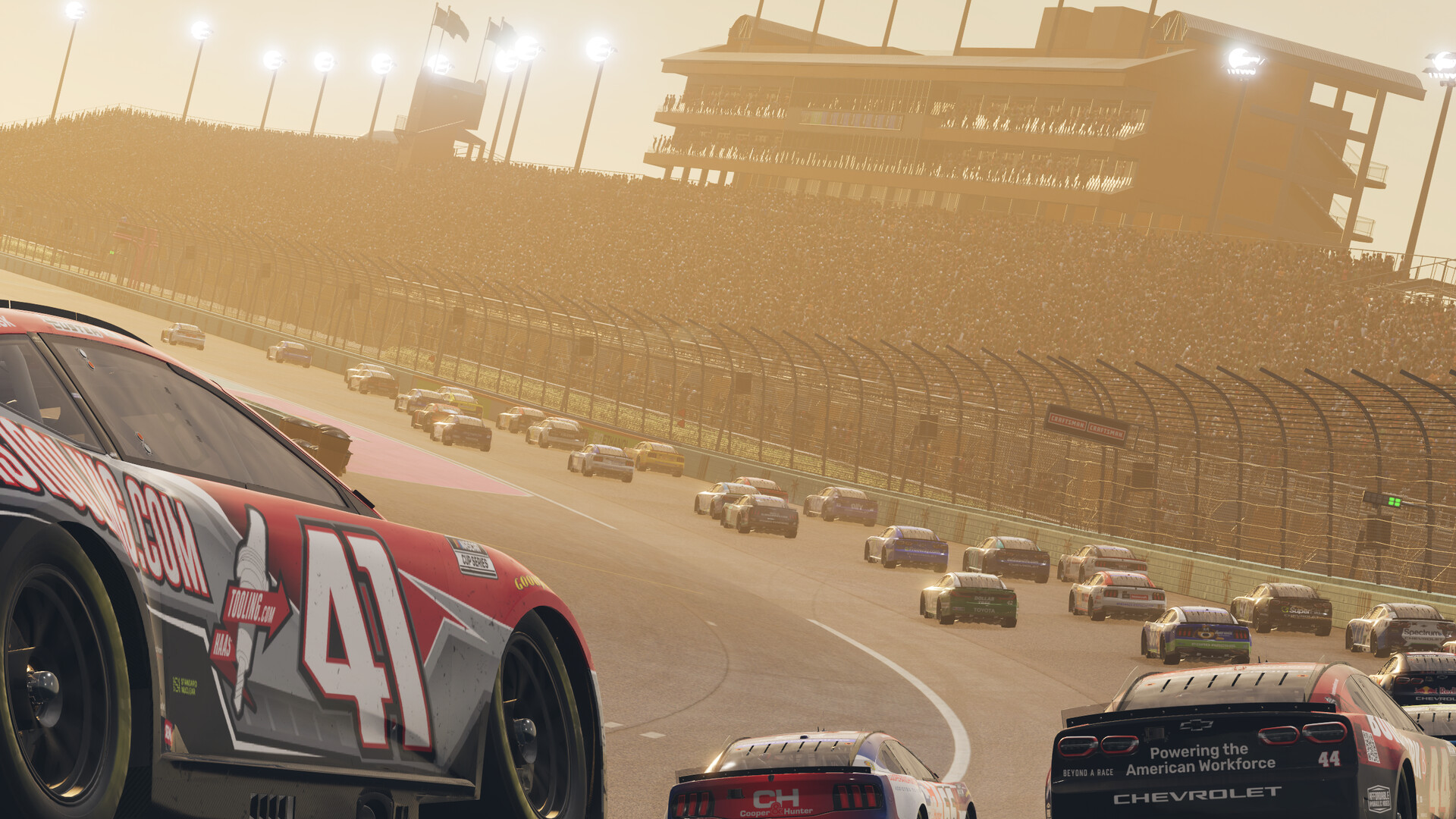
"NASCAR 26 ships with a suite of controller parameters, allowing you to adjust dead zones, steering non-linearity, speed sensitivity, damping, and braking response."
And while the controller’s calibration options were explained in the menu, the same can’t be said for your vehicle’s setup systems. Spring rates, bump and rebound, tyre pressures, sway bars, brake bias; all can be adjusted but the game didn’t explain what any of these parameters actually do. So, while I often like to tinker with my vehicle setup in other racers, I don’t retain the numerical knowledge to understand how to glean extra performance out of my machine. Here, I needed guidance, but the game doesn’t provide it. As a result, I stuck to the much simpler tight-or-loose presets knowing that I’d otherwise have been able to tame my car’s handling beyond controller calibration if, for instance, I knew which camber setting to choose.
Still, when everything eventually clicked, and when I wasn’t wrestling with the controls, the patient pursuit for precision indeed became meditative. NASCAR 26 achieves something remarkable in that the repetition of oval racing doesn’t feel like repetition at all. More like a mindful exercise in continually trying to get the next lap closer to perfect.
NASCAR 26’s attempts at authenticity go beyond reactive car handling. iRacing Studios has worked alongside NASCAR for generations, and that relationship is evident in the game’s attempts to recreate the ritual of a race weekend. The broadcast presentation, branding, trackside atmosphere, and visual spectacle aim to make each event feel like a genuine broadcast, but the overall feeling isn’t especially electric. New smoke, particle effects, dynamic lighting, and cockpit interiors add to the occasion, while the addition of burnouts brings some welcome personality to celebrating a victory.
Authenticity stretches to Peak Performance too, a training mode that puts Jamie McMurray in your ear while you observe useful visual markers around each circuit. Signs, cones, and advertising decals are taught as reference points for braking, turn-in, and throttle, and eventually you stop following the coloured racing line altogether in favour of reading the track. For a newcomer, this mode is an excellent way to learn the language of NASCAR.
And, Peak Performance’s bitesize track guides become the first step toward circuit mastery. Bristol, with its claustrophobic concrete and relentless cornering is like pressure-cooked NASCAR, demanding a different rhythm to the blistering straights of Indianapolis or the drafting battles of Daytona and Talladega. Pocono, meanwhile, rewards experimentation across its unusually wide tarmac, where multiple racing lines produce different approaches to a corner.
Yet, NASCAR’s road and street courses don’t offer the same rewards. On Watkins Glen, Sonoma Raceway, or San Diego’s Naval Base Coronado the heavy stock cars became clumsy, difficult to position, and prone to bumps and paint swapping. The reason for this, I feel, is the game’s handling model, which is favourably tuned for ovals over traditional track layouts. The experience was less convincing as a result, where precision gave way to crude racing.
Street racing in NASCAR 26 masked tyre degradation, too, which has grown in importance this year. At Indianapolis, I felt the car becoming less stable on corner entry as my tyres deteriorated, with my pace gradually falling away. Then, after fitting fresh rubber, the difference was dramatic, with me able to blast past multiple opponents on a single straightaway. Deciding when to pit, then, is more than a matter of maintenance, with strategic implications whether you opt to preserve track position or pit early for a late performance advantage.
Fuel consumption adds another consideration, forcing you to balance outright pace against how long you can remain on track. The thing with tyre degradation in this game, though, is that the performance differences are perhaps too pronounced. In Pocono, I opted to stay out for a couple of laps whilst my rivals pitted, only to find myself with too much ground to recover on the leader when I’d finally had my stop. Back in Indianapolis, I carved through the field too easily on an offset strategy. The problem here, though, was that I was a lap down after a pitstop blunder.
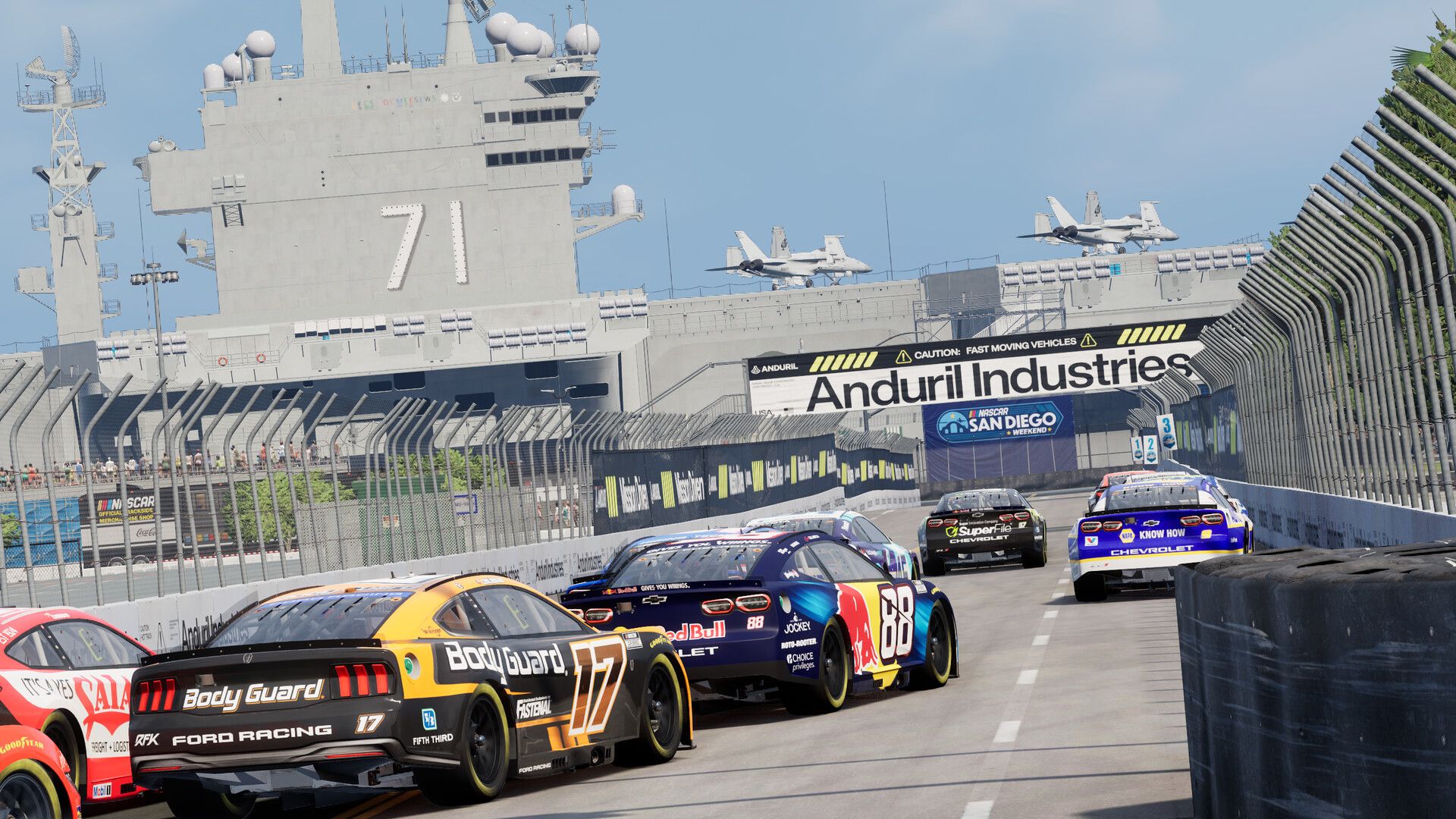
"Authenticity stretches to Peak Performance too, a training mode that puts Jamie McMurray in your ear while you observe useful visual markers around each circuit."
While the effects of old rubber are easy to measure, NASCAR 26’s new Dynamic Track feature is more difficult because its influence never felt particularly obvious during my play though. Conceptually, I’m compelled; as rubber builds on the circuit, the optimal racing line widens and encourages you to search for new grooves.
I certainly saw AI drivers moving higher as races progressed, but I rarely felt the need to change my own approach. Any performance drop-off or enhancement always felt to me like conventional tyre degradation rather than a track-wide evolution. Perhaps it’s deliberately subtle, but either way I’d prefer Dynamic Track to impose itself more forcefully during races.
Similarly, the distinctions between NASCAR 26’s four series were hard to parse. Shared between Cup, O’Reilly, Trucks, and ARCA are the same driving characteristics, although ARCA’s notably slower pace makes it a less enticing experience. There are differences in speed and braking behaviour, with Trucks, for example, able to full-throttle round Nashville while O’Reilly cars need to lift before cornering like their Cup counterparts, but these distinctions aren’t pronounced enough to alter how you approach a race. Jumping between series felt like a cosmetic novelty rather than an opportunity to learn a new discipline.
Elsewhere, career mode gives NASCAR 26 a place to earn progression, beginning with a humble ARCA season and gradually building towards the higher tiers of the sport. Good performance earns reputation which unlocks better sponsorship deals and money-making opportunities, while conventional income can be spent on repairs, car upgrades, and improving your team’s facilities. It’s a pleasing, if admittedly mild, ecosystem, where longer-term strategic depth takes time to reveal itself. Early decisions feel immediate, but the prospect of investing in your operation gives every dollar a purpose. The downside, however, will vary between players; repairs can become expensive, particularly if you’ve a habit of rear-ending your opposition. Resources are quickly stretched, meaning partial repairs and safer driving habits become the optimal way to eventually fund performance upgrades, new staff, and team development.
Outside Career, NASCAR 26 offers a modest selection of ways to experience its racing. The Chase provides a standalone postseason competition, allowing you to enter as one of sixteen drivers in a playoff encompassing ten rounds without committing to a full season beforehand.
Paint kit, meanwhile, provides extensive scope for customising your own liveries, while various quick race formats – each modifiable by race length, tyre wear and fuel consumption rates, and more, giving you a swift way to get back behind the wheel. None of these modes change the driving experience, but they provide useful alternatives to Career’s multi-season progression.
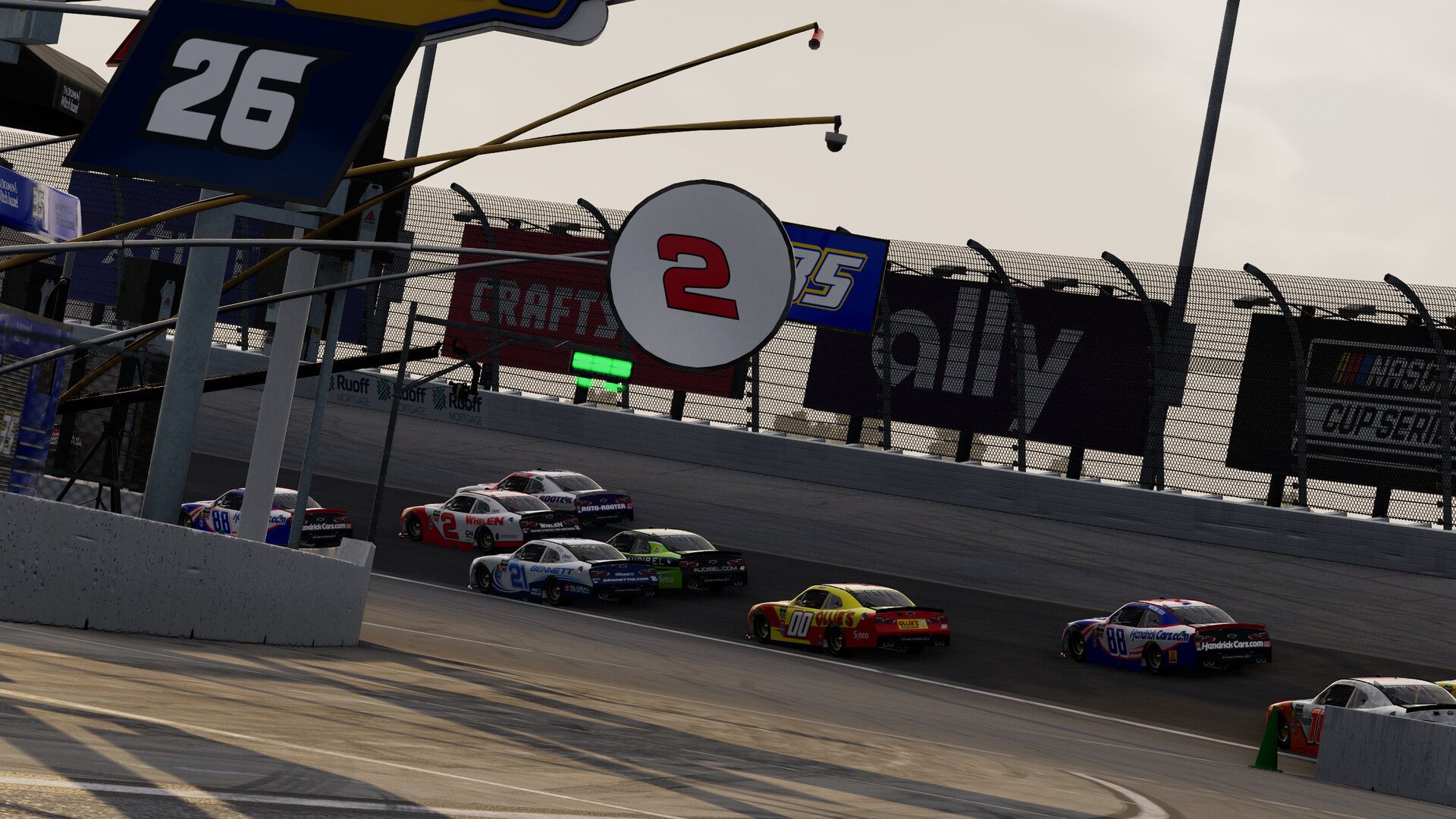
"Outside Career, NASCAR 26 offers a modest selection of ways to experience its racing."
So, in summary, NASCAR 26 surprised me. As someone coming to NASCAR with more experience of traditional circuit racing, I expected the endless ovals to feel repetitive. Instead, I found myself obsessing over incremental improvements; carrying a fraction more speed into corners, finding the fastest line, feathering the throttle a little more carefully. Like I said at the outset: NASCAR 26, for the most part, nails its driving model, making precision driving feel rewarding in a way few racing games manage.
That said, the game isn’t without its shortcomings. Dynamic Track never felt as influential as I expected, and the four series don’t feel sufficiently distinct to justify their inclusion (beyond simply providing multiple tiers to progress through during Career mode).
Extensive controller recalibration meant I had to work for my immersion, but once I’d sussed out the right settings for me the patience, aggression, and precision that make stock car racing so distinctive emerged. It isn’t a flawless simulation by any means, but after countless laps chasing the perfect line, I’ve come away from NASCAR 26 with a better understanding of why this particular brand of racing can be so hypnotic.
This game was reviewed on PlayStation 5.
Excellent, precision-focused driving model. Peak Performance is a superb tool to learn tracks. Tyre degradation adds meaningful depth to races.
Dynamic Track evolution lacks noticeable impact. The four vehicle series feel too similar. Controller and vehicle setup requires a lot of tinkering.