






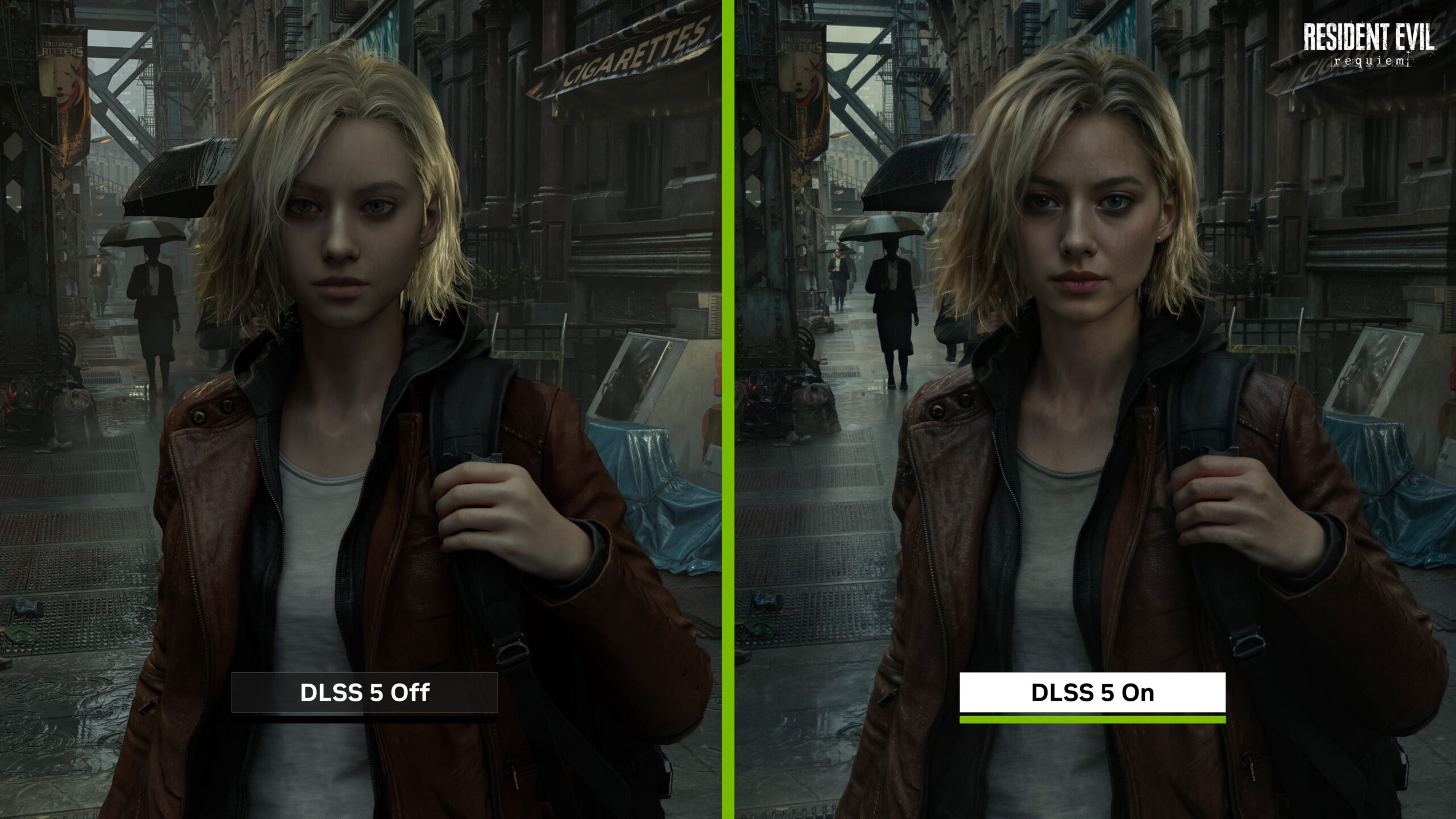
In a new video interview, Nvidia CEO Jensen Huang has attempted to further curb some of the criticism faced by the company for its showcase of DLSS 5. Speaking to Lex Fridman, Huang noted that he also doesn’t like the appearance of “AI slop”. However, he went on to claim that DLSS 5 doesn’t function in the same way.
“I think their perspective makes sense and I can see where they’re coming from, because I don’t love AI slop myself,” said Huang on the subject of backlash against DLSS 5. “You know, all of the AI generated content increasingly looks similar and they’re all beautiful. So, I’m empathetic towards what [critics] are thinking.”
As for how DLSS 5 functions, however, Huang made a note of the technology being “3D conditioned, 3D guided.” This, he said, means that artists have complete control over the in-game geometry, which is then used by DLSS 5 to generate its visuals.
“I showed several examples of it, but DLSS 5 is 3D conditioned, 3D guided. It’s ground truth structure data guided. And so the artist determined the geometry, we are completely truthful to the geometry in every single frame,” he said.
This isn’t the first time that Huang has spoken out against the backlash to DLSS 5. Earlier this month, he was asked about the technology’s reception among the larger gaming audience by Tom’s Hardware editor-in-chief Paul Acorn. He responded by calling critics “completely wrong”.
“Well, first of all, they’re completely wrong,” Huang said. “The reason for that is because, as I have explained very carefully, DLSS 5 fuses controllability of the geometry and textures and everything about the game with generative AI.” He also reiterated that developers can “fine-tune the generative AI” depending on the kind of output they want, and that it “doesn’t change the artistic control.”
“It’s not post-processing, it’s not post-processing at the frame level, it’s generative control at the geometry level,” he said.
Discussing the fact that developers can go as far as coming up with a “toon shader” or a game where everything is “made of glass,” and continue to have power over the DLSS 5 development kit. “All of that is in the control — direct control — of the game developer,” he explained. “This is very different than generative AI; it’s content-control generative AI. That’s why we call it neural rendering.”
More details about how DLSS 5 works were revealed by Jacob Freeman as part of an interview where he was asked about how the technology was trained, and how it handles things like PBR (physically based rendering) materials. In this discussion, Freeman confirmed that DLSS 5 takes a 2D image of a game, along with its motion vectors, as its input to then output its own image.
As for how the technology makes significant changes to things like characters – as seen with the Resident Evil Requiem example in the original showcase – Freeman didn’t offer too much information. Rather, he simply said that “the underlying geometry is unchanged. Also worth mentioning this is a very early preview of the tech.”
For more on DLSS 5 and its backlash, take a look at what journalists and developers have said. Also check out the report indicating developers and artists from Capcom and Ubisoft were left in the dark about the technology.