





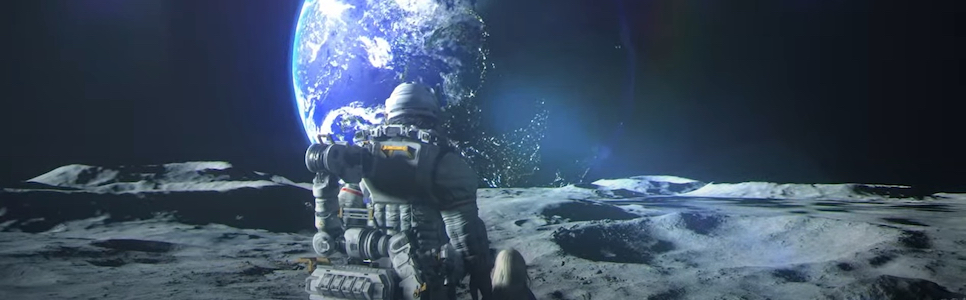
The road to Pragmata has been a long one. First announced more than half a decade ago, the sci-fi shooter has gone through long periods of delays, prolonged radio silence, the developers being unwilling to share anything about what to expect from the game, and widespread questions over whether it will ever even release.
Contrary to what many thought for a good while, however, Pragmata is finally here, and happily enough, it is somehow worth the wait. It combines the skin of a sci-fi shooter experience that isn’t afraid to have fun with the genre’s tropes with a gameplay core that innovates on staples in brilliant ways, delivering a final product that almost perfectly toes the line between uniqueness and familiarity.
Pragmata sees players playing as Hugh, a spacefaring technical expert who, along with his team, is sent to the moon by his corporate overlords after they lose contact with everyone on Earth. Quickly upon arrival, Hugh finds not only a moon devoid of the human population he expects to find, but also robots and rogue AI functions running amok, and a mass production-scale 3D printing system going haywire in the trippiest ways.
"Though it doesn’t do an awful lot to step outside of genre norms, Pragmata’s story does a solid job of keeping players engaged."
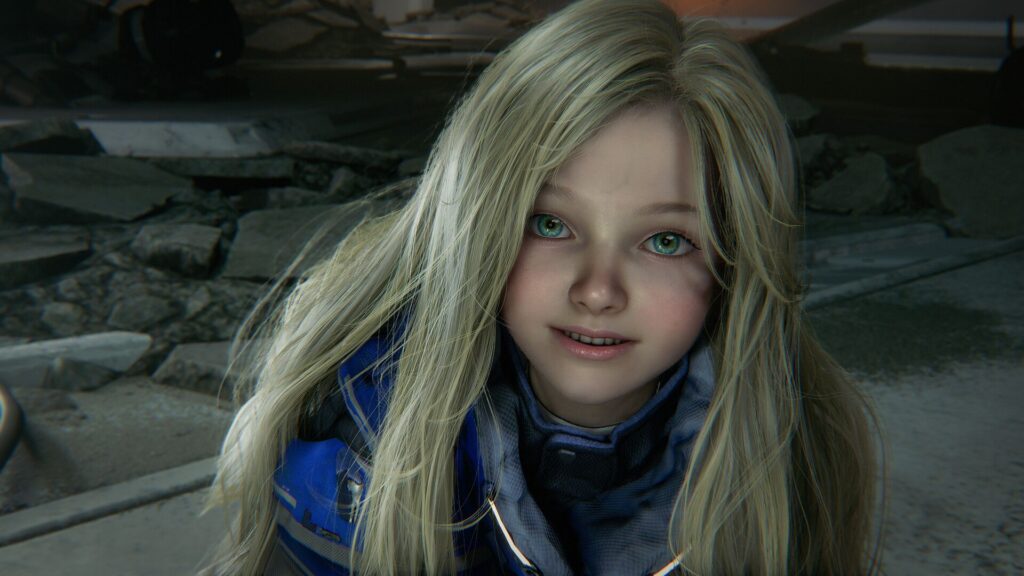
After crossing paths and joining forces with Diana – an android (or a Pragmata) modeled the shape and personality of a little human girl – it falls to Hugh to not only make his way through rogue robotic forces on the moon, but get in contact with Earth and unravel the mystery of wat exactly went wrong in his lunar surroundings.
Though it doesn’t do an awful lot to step outside of genre norms, Pragmata’s story does a solid job of keeping players engaged. On top of doling out bits and pieces of lore and backstory details at a good pace to keep peeling back the layers on its core mysteries, the game also excels with its central duo of protagonists.
Hugh, the human that you play as, is a relatively ordinary protagonist in and of himself, but Diana is an interesting enough character to carry things on her own for the first couple of hours- until the dynamic between the two really starts blossoming.
A leading duo of a lead being accompanied by a young, naïve companion is by no means new to video games, and it wouldn’t entirely be accurate to say that Pragmata does it in a way that it is in any way new- but this is an excellent example of top notch execution making up for a lack of new ideas. Neither Diana nor Hugh as individual characters have much that you can point to as an instantly unique hook, but Diana’s personality and the heartwarming bond that she forms with Hugh remains an inarguable highlight of Pragmata from the game’s beginning until its very end.
Something else that contributes massively to how well its core premise and setting work is how visually arresting the game is. Again, the game doesn’t necessarily do much here that you might not have seen in other sci-fi media before, but the its execution well-trod ideas leaves little to be desired. On a technical level, Pragmata does what top quality games have (mostly) consistently done in recent memory, especially when running on the RE Engine, and delivers a sharp, gorgeous experience that runs with little to no hiccups and pushes the envelope in interesting ways.
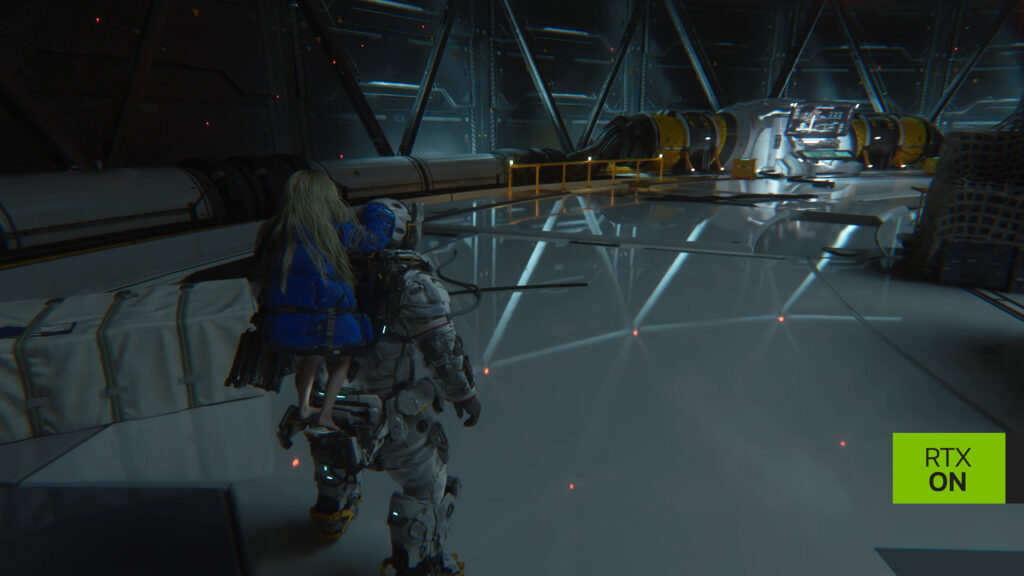
"Unlike a regular shooter, most shots you fire at does don’t do a ton of damage- key to all encounters is Diana’s ability to hack enemies."
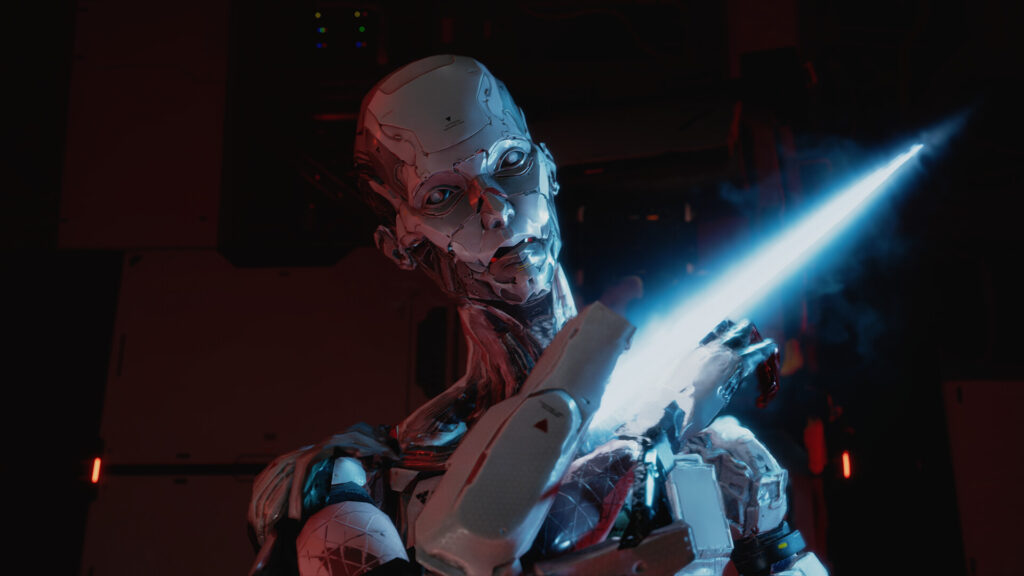
That is backed up by excellent art design, from the surreal, mind-numbing, eerie, and not-quite-right facsimiles of familiar locations that you find themselves in to the vast variety of robotic enemies that you take on, from the humanoid grunts and flying drones to the way more twisted designs that you face as you get deeper into the game.
Pragmata’s biggest strengths lie not in the story that it tells, but in how it plays. On surface, it may look like just a regular science fiction third person shooter, and sure enough, in a lot of fundamental ways, that is ultimately what it is. At the same time, however, Pragmata blends its core familiar gameplay mechanics with some fascinating twists that lend it quite a unique flavour.
Chief among those twists is Pragmata’s central hacking mechanic. Unlike a regular shooter, most shots you fire at does don’t do a ton of damage- key to all encounters is Diana’s ability to hack enemies. When you take aim at one, a minigame overlay pops up, tasking you with navigating a minigames with your controller’s face buttons, with the aim being to get from the starting point to the finish while passing through as many useful nodes as possible- all in real time, while still dealing with all enemies and their attacks.
On paper, it sounds like it could easily be clunky or overwhelming, but Pragmata handles its hacking and shooting combat perfectly. The two core pillars blend unexpectedly well together. The hacking never feels slow or cumbersome, instead adding not only a unique twist to the otherwise tried and true over the shoulder shooting, but also a palpable sense of urgency to the proceedings every single time whether you’re squaring off against an enemy. When you’re taking on larger groups of enemies or bosses and mini-bosses in particular, Pragmata’s blend of hacking and shooting really, truly shines.
Combat benefits from the game’s strengths in other areas as well. Take, for example, the variety that the game exhibits in the enemies you take on throughout the experience. The bots that fight in Pragmata not only differ greatly from each other in their visual designs, but also in what they’re capable of in combat and the unique threats they pose.
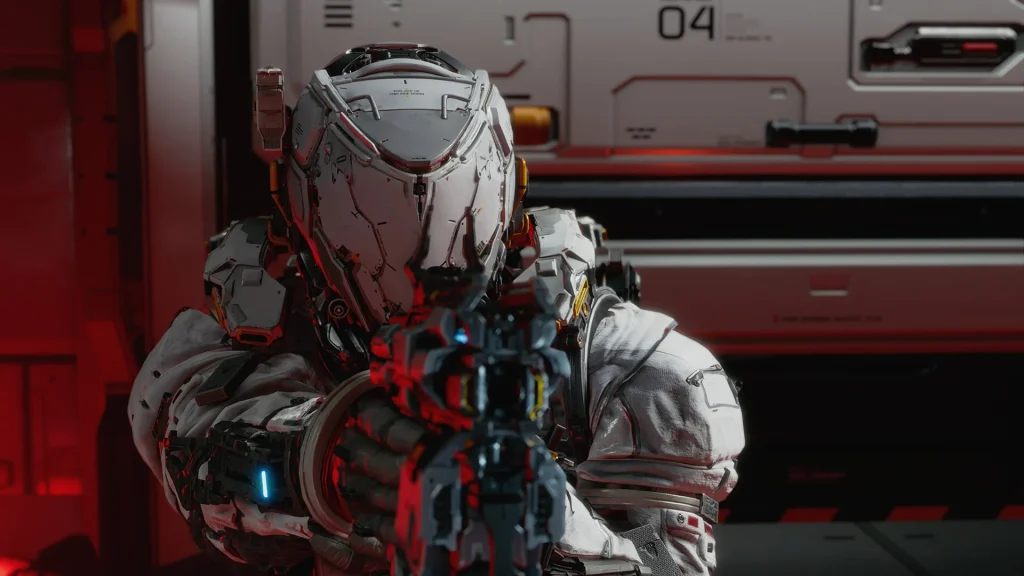
"Solid progression mechanics help keep things interesting as well."
They demand different tactics in everything from how they move about to what weapons and abilities they’re weak to, while things get particularly interesting when you’re faced with groups of multiple types of enemies, and you’re required to juggle everything in your arsenal in real-time in the right way. When encounters in Pragmata get really hectic and explosive, that’s when the game is at its best- and that happens often.
It’s not just the enemies in the game that boast strong variety. There’s a range of weapons to use as well, from defensive kinds that provide tactical support and offensive ones that focus on dealing damage to those that can prove particularly useful in situations that demand crowd control.
Then there’s Diana hacking abilities, which, in addition to making enemies significantly more vulnerable to damage, can freeze them in place, link multiple of them together for group hacks, and much more. Add to that things such as innate and passive abilities and mods, and it doesn’t take long for combat in Pragmata to become a frantic, fast paced, explosive, and thoroughly enjoyable affair.
Solid progression mechanics help keep things interesting as well. Pragmata is a fairly focused experience in more ways than one, which very much applies to the progression as well, but the game still manages to deliver tight and engaging upgrade and customization mechanics. Between different weapons, weapons, mods, abilities, upgrades, and more to unlock, there are a decent number of ways that you can tailor your builds and loadouts to how you want to play, even without a ton of flexibility.
"As mentioned earlier, this is a very focused experience, which is something that it also exhibits in its level design."
In fact, the game’s surprisingly expressive progression mechanics come in quite handy on the occasions you find yourself facing a boss or challenge that might be a bit too strong for you in the moment- returning to an earlier area to grind more resources and come back better equipped to face whatever challenge is trumping you never really feels like a chore, which is always an impressive accomplishment for a game.
Those progression mechanics work particularly well given Pragmata’s structure. As mentioned earlier, this is a very focused experience, which is something that it also exhibits in its level design. Pragmata is a largely linear game that funnels you from one area to the next, while also having you consistently return to a central hub.
Levels are mostly pretty tight and contained, though they do often have plenty of shortcuts, optional areas, and intertwining paths to explore, with checkpoints scattered about that allow you to fast travel to the Cradle, your central hub, in addition to serving as respawn points following deaths.
The game handles its structure well, primarily because of how tight and focused it keeps things. It never feels too expansive, which also means deaths and checkpoint respawns are never too frustrating, even if they can sometimes get a little annoyingly repetitive. Meanwhile, on top of being able to maintain an excellent sense of pacing and forward momentum thanks to its design style, Pragmata also manages to ensure that it doesn’t completely trim off exploration.
"It has been a long time coming, yes, but it’s fair to say that Pragmata is worth the wait."
There’s plenty of room to explore still, and quite a few genuinely useful upgrades and collectibles to find. Newly learned abilities also often make revisiting older areas feel valuable, while ancillary unlocks earned through optional content also allow you to expand the Cradle in fun ways. There is, of course, also the plain and simple fact that the game also boasts enjoyable movement and light platforming mechanics. All said, despite the fact that combat is where Pragmata’s biggest strengths lie, other gameplay aspects around the combat are also quite engaging.
Pragmata is, ultimately, quite an interesting game. In a lot of ways – from its story and setting to many of its gameplay and design pillars – it’s a game that is content to follow along well-trod paths, though even while doing so, it never feels bland or boring, thanks to how immaculately and confidently it executes on those tried and true ideas.
Crucially, however, it also elevates those ideas with some novel core concepts of its own, chief among them being its surprisingly well-done blend of hacking and shooting combat, not to mention its spectacular visual design.
This game was reviewed on PlayStation 5.
Interesting setting and premise; Diana is a great character; Diana and Hugh’s dynamic is a heartwarming one; Unique blend of hacking and shooting gameplay; Thrilling, frantic, high-octane action; Impressive variety in enemies, weapons, abilities, and more; Rewarding progression mechanics; Focused level design, engaging exploration; Visually arresting art style; Technically impressive visuals.
Hugh is a relatively bland protagonist; Sticks to sci-fi tropes a bit too much at times.