





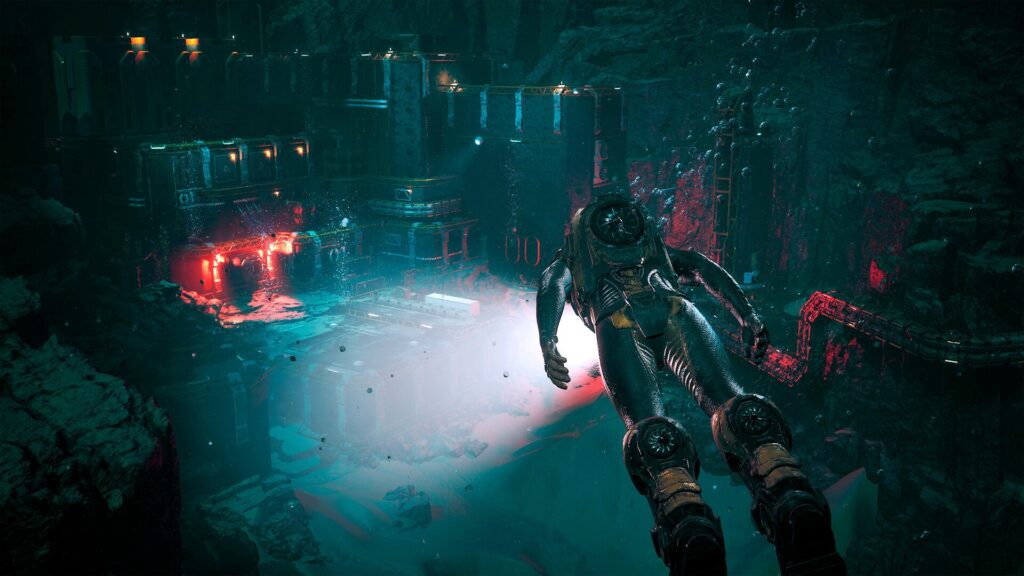
On its surface, The Cosmic Abyss looks like yet another survival horror game set in yet another Lovecraftian-inspired world. Its visual design, its opening sequence, even its title all hint toward the type of terrifying, heart-pounding experience that Lovecraftian worlds so easily lend themselves to and are so popular today. Instead, developer Big Bad Wolf uses the familiar setting as a backdrop for a unique and diverse puzzle game.
Narratively strung together with an otherworldly mystery, the game focuses on a handful of intricate puzzles that offer multiple independent solutions and force you to solve increasingly difficult questions, largely without holding your hand. Ultimately, The Cosmic Abyss, like its titular character, uses its overtly ominous presentation to hide even more secrets to discover underneath.
"Where The Cosmic Abyss differs from many of its counterparts, though, is in its lack of combat."
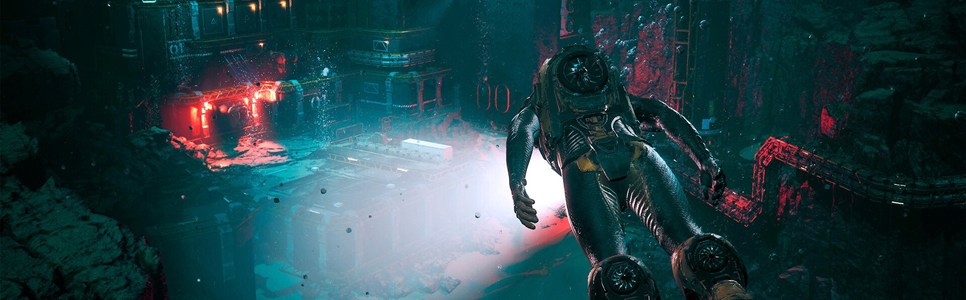
The Cosmic Abyss puts you into the shoes of Noah, an ocean investigator looking into the mysterious disappearance of a group of miners on a deep-sea expedition. Because of the nature of the investigation, you are sent alone with only your AI companion, Key, to track the miners and quickly find yourself sent through a portal to another world and set out on a mission to both understand the mysterious and unsettling world you’ve found yourself in and ultimately find your way back home.
Though it might be inexplicable to send someone alone on this type of mission, it properly sets the tone for the ominous and secluded experience you have through Noah, and naturally, as a Lovecraftian horror game, you begin to come across signs of other races with intelligence far beyond humans and terrifying supernatural beings.
Where The Cosmic Abyss differs from many of its counterparts, though, is in its lack of combat. While it’s possible to die at the hands of a monster on a couple occasions, this is a linear puzzle game wrapped in an atmospheric horror shell, as most of its 7 main chapters consist of one complex self-contained puzzle. These puzzles strike a delicate balance between forcing you to explore each area thoroughly and learn the rules of the game without becoming overly obtuse.
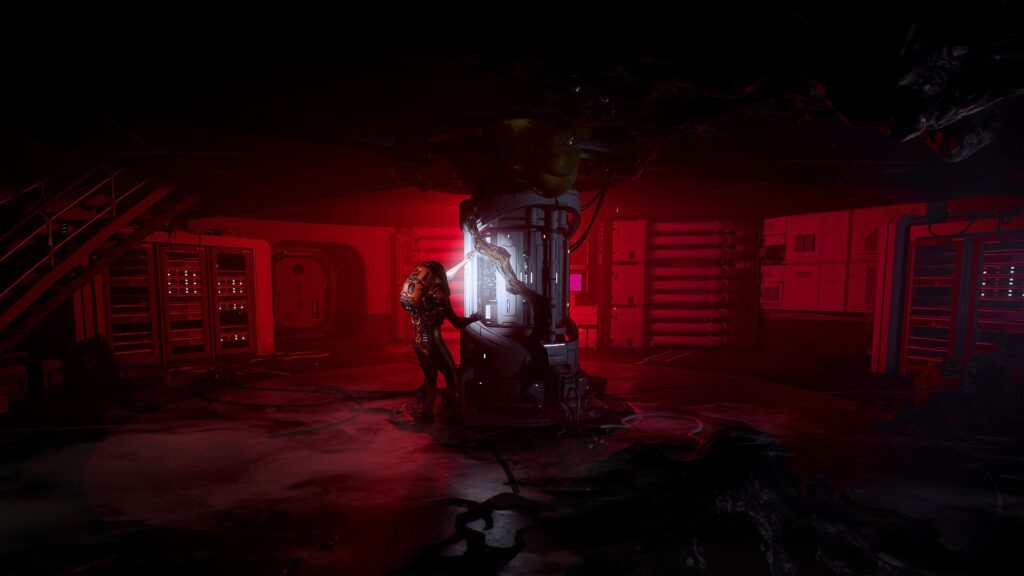
This is where you can clearly tell the influences from immersive sims like System Shock in the way you explore each area and are forced to largely handle things on your own. One highlight puzzle, for example, sees you having to open a portal on the other side of an uncrossable body of water. To do this, you have to learn the steps to complete a sacrificial ritual by translating the ritual’s steps, locate a number of crowns throughout blood-red waters, and manipulate the crowns in the right ways to trigger the ritual. Structurally, many of the puzzles, including this one, are familiar, but they each have a distinct eerie atmosphere with strikingly beautiful visuals and largely intuitive level design that propels you to always be finding new clues, even in areas you thought you’d already explored completely.
One of the key ways this is done is through your Sonar ping, which allows you to match frequencies with certain objects and locate other objects in the area with the same material. This means that the game doesn’t highlight every key item needed to progress. Those crowns, for example, are made from Bones, and you can only search for the other crowns made of the same material once you’ve found the first.
"On top of this, there are options to ask for more help from your AI companion in the form of three additional clues in certain situations."
This is a clever way to keep pushing you to experiment if you get stuck, even if this is where the game’s creativity can give way to opaqueness when you don’t quite know if you even have the material you’re searching for. As you work through each chapter, the puzzles increase in variety and difficulty. Another puzzle has you finding a way to either destroy or get around a massive otherworldly monster by finding its weaknesses, and later game puzzles require you to truly come to grips with the world you’ve entered and the characters within it.
When you put it all together, these puzzles can get very challenging very quickly, but fortunately, the game offers a bevy of accessibility options that help you solve them. Each discovery is placed on the game’s Mental Map, which allows you to sort clues, color code information, and often pose a deduction question that, when paired with the correct clue, gives you further information to help answer a question.
This system can be finnicky, especially when you’ve solved a question yourself but the correct clue for the deduction isn’t clear, but for puzzles with this much background and this many disparate clues, the Mental Map is an incredibly helpful way to sort and organize information, especially if you’re coming off multiple play sessions or just want to avoid having to backtrack just to read an old tablet.
On top of this, there are options to ask for more help from your AI companion in the form of three additional clues in certain situations. Some of these are direct answers to the puzzle, while others are less clear and more directional, but having these as optional additional help is a refreshing way to give the player a bit more of a hand when they need it without being overly invasive.
This is the type of game where knowing the solution to puzzles will ultimately hamper replay value, but to counteract it here, most puzzles have two independent solutions that connect with an in-game feature called Corruption that reflects how much you’ve given in throughout the game. Where puzzles have multiple solutions, one is typically slightly easier or more transparent but increases Noah’s Corruption, while the other is more difficult or complex but either reduces or has no impact on his Corruption level.
For example, the puzzle involving the sacrificial ritual, when completed, increases Noah’s Corruption by going through with a human sacrifice to open that portal, but there is an alternative path to open the portal through an underground electric system. Though they’re both solutions to the same problem, they hardly overlap, and this approach offers a ton of flexibility in how you approach each chapter.
The Cosmic Abyss incorporates these choices on a narrative level by making Corruption an evolution of the moral slider. Chapters are interlaced with cutscenes that pull you further into this mysterious world as you follow the paths of the miners and have further revelations about yourself. There are immediate questions about the motivation of the miners to come to this place that subtly touch on the theme of corporate greed and power, but the overall narrative becomes more of a milquetoast Lovecraftian ride that hits many of the same plot points that you’d expect from this setting.
"There’s enough variety to make the runtime never feel overly long, and the optionality within each chapter provides a significant amount of replay value."
The performances are passable if a little stiff, but the writing often leaves something to be desired with the way it conveys information. It doesn’t always seem to know its expectations of the audience’s awareness of the lore, so characters can flip between overly explaining a revelation to having full conversations about it without introduction.
This sometimes clunky dialogue makes it feel like an exercise in getting from one visually interesting place to the next where the appeal is often more in the visual variety than in any major narrative reveals. Your corruption level directly impacts the final act, with multiple endings based on how much you’ve given in throughout the game. Combined with the opportunity to solve different puzzles, these different pieces of content offer an intriguing reason to come back for another 10-to-12 hour run through the campaign.
On the technical level is where the game flounders, at least at launch. Environments are beautiful and highly populated with dozens of clues and other interactable items, but this often comes at the expense of performance. Much of my experience was plagued with an apparent memory leak bug that caused the game to slow down over time and ultimately crash, particularly when looking through the text-heavy Mental Map. It’s a shame because when it runs well, this game is incredibly smooth with almost instantaneous loading, and while it saves frequently enough that it didn’t end up costing any significant time, it’s still an immersion-breaking experience.
Though familiar in its setting, The Cosmic Abyss uses the known Lovecraftian environment to enable the creative and intricate puzzles at the center of the experience. The constantly unsettling atmosphere provides an appropriate backdrop for you to explore each area and answer the increasingly complex questions the game throws your way, and there’s a satisfying sense of progression as you continuously unlock new clues and solve deductions.
The Cosmic Abyss is clever, varied, and propulsive, and while it doesn’t break new ground narratively, The Cosmic Abyss brings enough new to the table with its puzzle design to warrant revisiting a well-trodden influence.
This game was reviewed on the PlayStation 5.
Intricate puzzles with multiple unique options, Beautiful environments, Quick loading.
Underwhelming narrative, Performance issues.