





Yes, Soulslike has become shorthand for challenge. Any action-adventure where death is punished, where combat demands precision, or its world is mysterious and complex, then it’s caught in FromSoftware’s net. On one-hand, labeling something as Soulslike brings clarity to expectation. You gain an idea of what to expect, even if, arguably, not every game labelled as Soulslike is indeed Soulslike. On the other hand, players are getting burned out – even as an increasing number of non-FromSoft developed titles are holding their own in a crowded space.
Look, what the genre needs is innovation. A fresh perspective, something novel, if only to rejuvenate fatigue.
Well, incoming from Ghostrunner devs One More Level is Valor Mortis, a self-declared Soulslike fought in first-person. Set in a supernatural, Napoleonic nightmare, Valor Mortis – while not the first attempt – might be the most serious stab yet at shifting Soulslike’s surgical precision to first-person. With melee combat, especially, first-person perspectives are where countless games have struggled. Spatial awareness, depth perception, field of view; how will One More Level ensure responsiveness and fluidity when the camera naturally frames the action tightly?
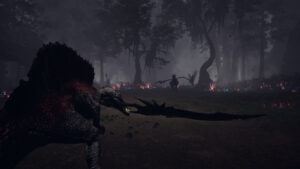
Before we get there, first you need resurrecting. Valor Mortis begins facedown in the mud. You are the walking corpse of William, a downed soldier mysteriously reanimated by the order of Napoleon’s screeching whispers. You stalk a soggy battlefield’s aftermath, a hellscape of fresh death and fog, unsure of who, if anyone, was victorious. You’re not alone: more undead walk too, occult forces acting as narrative flesh to wrench from charred bones. If Soulslike is also shorthand for bleakness, Valor Mortis ticks every box.
And the game’s Napoleonic setting could prove a masterstroke, giving One More Level leeway for multi-directional storytelling, worldbuilding through alternative history and fantasy. As famous for defeat as he is societal reform, Napoleon Bonaparte’s legacy appears here to provide a playground for numerous phantasmagorical what ifs: like, what if Bonaparte knew how to raise the dead – would he still have lost the Battle of Waterloo?
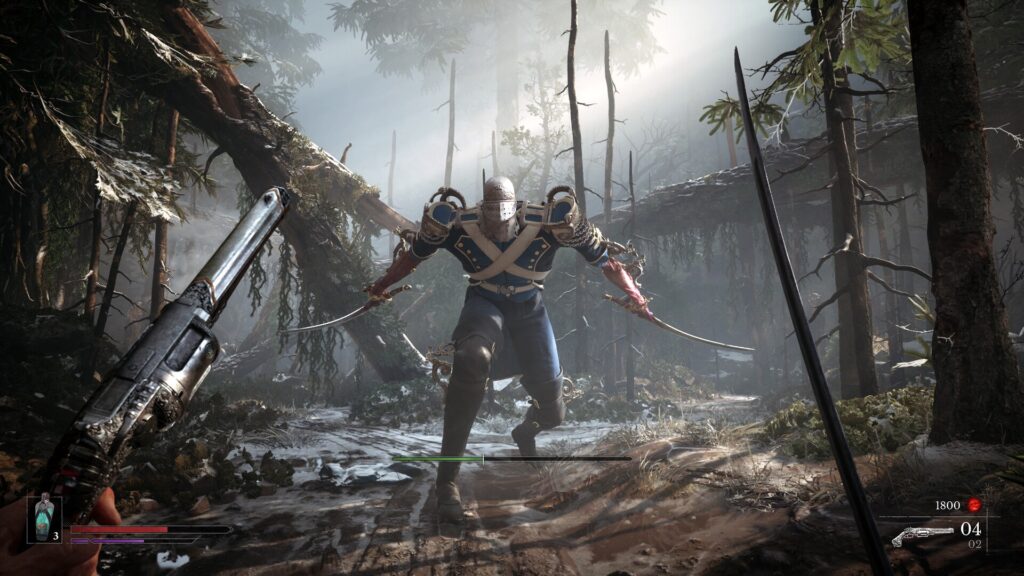
Yet, as primed for fantastical retelling as the Napoleonic Wars are, we run into Valor Mortis’ first concern: are these murky battlefields built for readability? Watching early gameplay footage, stepping through sodden, miserable, overcast miasma, the predominant tones are grey and brown. Enemy silhouettes aren’t as high-contrast as you’d think they need to be, given the game’s stated desire to replicate Soulslike’s demanding combat.
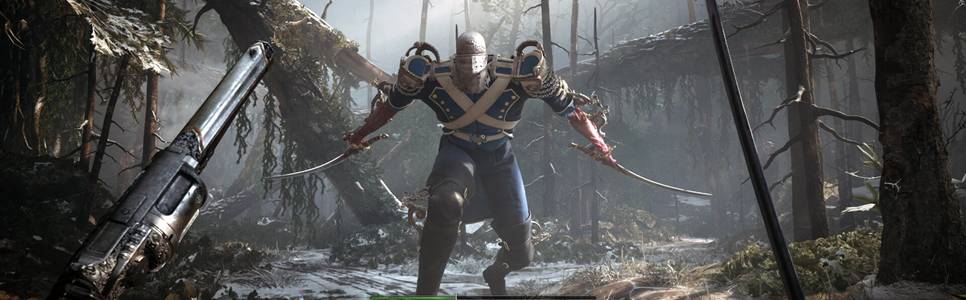
Yet, there’s no need to jump the gun – stonework villages, forests, and icy plains also occupy reveal trailers and artwork shared by the developer. Each setting is grim and dimly lit, suggesting, perhaps, that the studio is looking to push a specific way to play their Soulslike beyond the demands imposed by a narrower field of view. You’ll need patience, and to be deliberate, choosing your actions carefully. New ways to manage space, even. See, where Valor Mortis’ setting sells the fantasy, it’s in design and artstyle which ultimately reinforces close-quarters clarity.
To hit the fluid satisfaction which only a good Soulslike can, their design relies on readable telegraphs, tight timing windows, balanced hitboxes, and – the glue holding it all together – awareness of surroundings. When tightening the action into first-person, issues are introduced: depth perception, difficulty reading wide attacks, tunnel vision, and reduced peripheral awareness. These are all undeniably harder to overcome in first-person.
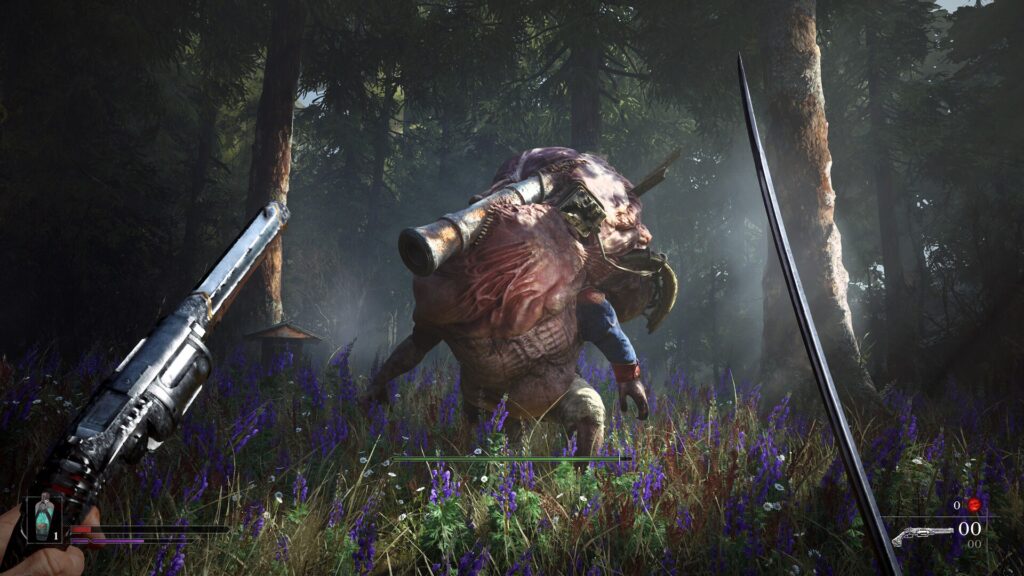
So, what does Valor Mortis do to overstep these potential pitfalls? Well, Soulslike’s traditional building blocks are all present – light and heavy attacks, limited healing items, block, dodge, and parry manoeuvres, multiple health bars, stamina, and stagger meters – but there is a big mechanical identity shift amongst that feature list. See, blocking still causes chip damage, which will undoubtedly push you toward perfecting your parries Sekiro-style. However, timing windows appear, at this current pre-alpha stage, to be more forgiving than FromSoftware’s shinobi epic.
Look, you might be concerned by this, but there are two things to consider: one, these wider timing windows may narrow as the game goes on, or could be refined altogether in later builds. And two, slightly wider windows, when compared to Sekiro et al, are a potential necessity for first-person. There needs to be a challenge, but the difficulty should always be manageable.
Still, it’s all in the feel isn’t it? Mastering strict precision brings satisfaction in flow, but Valor Mortis might not be aiming for this; we could have some sort of accessible hybrid in our hands, instead of pure, masochistic punishment. Whether that replicates Soulslike’s feel or brings something new to the table, well, we’ll have to wait and see.
Either way, parrying is the centrepiece, offering a rhythmic beat that’s accentuated by the studio’s Ghostrunner lineage. There’s still flow, momentum, and readability, it’s just different to what you imagine given the game’s Soulslike framing. Plus, given the elemental transmodification abilities – shooting fire from your hands like an 18th century-set System Shock – Valor Mortis, after all, seems to be mixing immersive-simulation into its identity.
Yet, no matter the arsenal, or the powers, flow or momentum, there’s one make-or-break issue which One More Level are still working on: field of view. See, fighting multiple enemies in first-person is notoriously messy. Taking on the game’s huge bosses inevitably means their hulking limbs swing from out of shot if you get too close.
Valor Mortis’ default viewpoint is undeniably tight, but the devs are addressing this. An FOV slider has now been added, appearing in settings after the bulk of playtest footage has already been uploaded to YouTube. While there isn’t much viewable evidence out there at present, increasing FOV might lower fidelity or reduce intimacy, but playability is sure to have received a boost.
There is a hidden counterpoint to widening FOV too, and it harkens back to our suggestion you’ll need to adapt to managing space in a new way. This is because you’re positioned right inside the danger zone; skirmishes aren’t abstracted to third-person, meaning the fight stays between player and enemy. Warring with perspective is thrown out in favour of carefully paying attention. If the narrow field of view means you can’t perceive your surroundings, then take a step back. Observe what’s going on – you do this when studying your opponent’s attack in Soulslikes anyway. Narrow FOV doesn’t change the process; it simply reshapes immersion.
If the studio gets a handle on some of the game’s other stated problems – difficulty deciphering depth perception – as in, sometimes the sword plunges deep while other times it’s a swing and a miss – and reading enemy telegraphs without resorting to overexaggerated animation, then Valor Mortis will instantly elevate itself beyond earlier first-person Soulslike experiments.
Games like the melee-heavy Elderborn which struggled with readability, Witchfire which diluted the experience with FPS and roguelike elements, Warhammer 40,000: Darktide with its excellent, yet imprecise hit feedback, or Kingdom Come: Deliverance which admittedly doesn’t follow the Soulslike loop at all despite its duelling depth. If One More Level solves the perspective issues, then Valor Mortis could become the most convincing “true” first-person Soulslike yet.
And really, in discussing Soulslike’s DNA, or in speculating whether Valor Mortis imbues the same lineage or if it incorporates too much immersive simness to be a true innovation in the genre, the bottom line is this: the game has insane potential. Whether precision-first combat can be executed faithfully in first-person remains unknown, but if anyone can pull it off its One More Level – with their already-demonstrated grasp of motion and camera control in Ghostrunner.
The game still has a way to go, but if the potential showcased in trailers and gameplay footage so far is anything to go by, whether it fully hits its Soulslike ambitions or not, Valor Mortis is set to inject some much needed innovation into the first-person gamespace.
Note: The views expressed in this article are those of the author and do not necessarily represent the views of, and should not be attributed to, GamingBolt as an organization.