





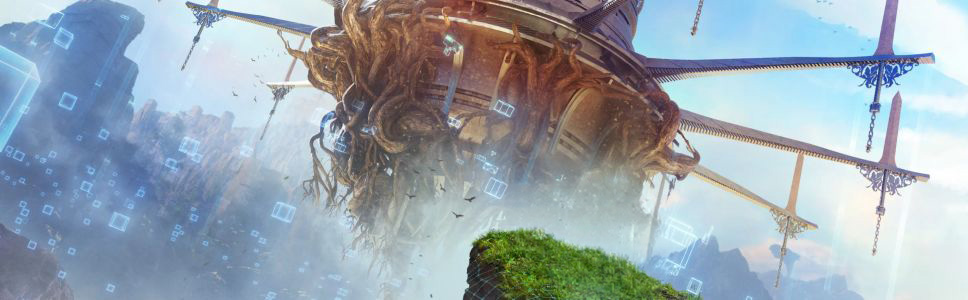
Echoes of Aincrad believes Sword Art Online’s main attraction isn’t series protagonist Kirito, or indeed co-protagonist Asuna, but the virtual reality world in which they’re trapped. It asks: what would you do if you were stuck inside Aincrad? Would you wield an axe or a greatsword? Would you embrace kinship as you battle to escape, the same as Kirito and Asuna?
On paper, Echoes of Aincrad commits to this premise whole-heartedly. There are countless opportunities to personalise your adventure through custom avatars, build profiles, weapons, and more, but rarely do your choices meaningfully shape the journey. Instead, alas, Echoes of Aincrad is summarised as an opportunity not taken.
"Immediately apparent is the setting’s bathing gloom of light."
The game contextualises its beginning as Sword Art Online’s beta phase; you’re inserted into a subterranean mix of buildings and caverns – sometimes ornate, other times crumbling – and you’ll rush to unite with your party. Along the way, the game slowly trickles input controls, mechanics, and instructions to you, both on-screen and later through companion Iori.
Immediately apparent is the setting’s bathing gloom of light. It hangs in the air like illuminated mist, reflecting off pools and brick surfaces, inviting you deeper into the dungeon. The affable lighting extends later to the outside, with sun flares, fuchsia and golden-hour tones blending with lullaby-like piano to create an altogether welcoming atmosphere.
There is one major drawback, however, that no amount of pleasantness can mask: the game’s sluggish pacing. And, sadly, issues with pace permeate through almost every activity you’ll undertake inside the colossal floating castle. See, each quest can be broken down into, say, one-minute loops whereby you’ll run through a corridor, encounter some enemies, slay said enemies, nab their loot, and run on to the next encounter. Occasionally you’ll encounter a boss, or an environmental detail shadowed by a lore-revealing icon, but the pattern remains the same.

"Immediately apparent is the setting’s bathing gloom of light."
The lingering pace interrupts cutscene dialogue with jarring silence too. Echoes of Aincrad’s characters comprise your typical anime archetype: whimsical and quirky, their childlike naivety balancing superhero bravery that fans of the show or anime writ large will recognise, but strange pauses throughout every conversation undo a lot of the animation’s charm. Your avatar, a mute protagonist whom you’ll mould to your own vision after the prologue’s conclusion, only exacerbates things; nodding along, shaking their head, or waving hello in eerie silence.
And the game’s pacing isn’t a result of the developers not understanding the source material. The story – ten thousand players engaged in a VRMMORPG, where death on the inside means death in the real world – is set up appropriately. There’s even early intrigue as companions made during the beta don’t appear once the campaign begins. But mechanical and narrative pacing is the most significant indication that the game largely fails to execute its premise.
Another example is found in the characters themselves, who seem strangely relaxed after discovering the peril they’re in. Together with NPCs and non-player avatars blurring together, the danger in Aincrad never feels tangible.
And while danger does exist outside the sanctuary of Aincrad’s settlements, combat, for all its good ideas, is laced with yet more friction. Hit detection feels loose, enemies can strike you from outside your field of view, while the lock-on camera struggles to visualise particularly large bosses if you get too close.
Before entering the fray, you’ll team up with a partner, starting with basic light and heavy attacks. But your moveset, unlike the pace of a quest itself, expands quickly: Sword Skills are weapon-specific special moves which unlock as you gain weapon proficiency; Combination Skills see you and your companion execute flashy attacks on an opponent together, while Support Skills are traits unique to each partner – healing circles, weak point detection, treasure chest location, that sort of thing, all paid for by an SP meter which recharges with every landing blow. Combined with cooldowns for special moves, and an extensive suite of powerups, projectiles, healing, and utility items accessible via the D-pad, your arsenal for attack and defense grows sizeably, and must be used strategically.
The question the game doesn’t answer, though, is how influential your choice of partner is to mission success. You can direct them to attack the creature you’re locked on to, or tell them to swing their blade at whatever is in front of them, but the effect is the same whoever you have by your side. And actually, there’s a deeper question here: does a partner’s individual abilities even synergise with your own? If they do, the feeling is negligible. Whilst, again, Echoes of Aincrad’s partner system is a good idea, its execution is disappointing.
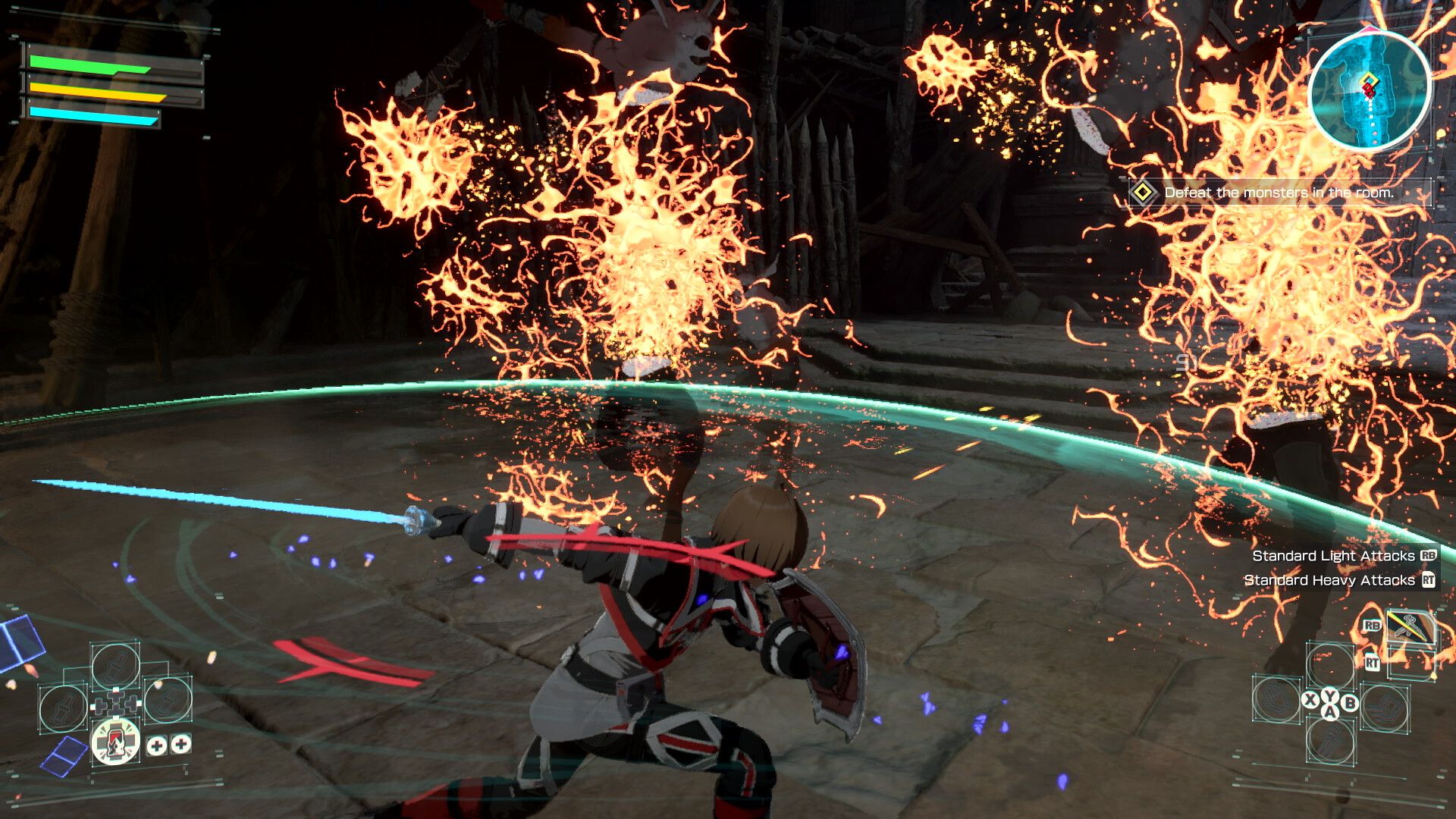
"The question the game doesn’t answer, though, is how influential your choice of partner is to mission success."
That said, as alluded to earlier, Echoes of Aincrad is banking on its biggest draw being your avatar itself, and once your creation is made and thrust into the mainframe, the promise of build variety reveals itself. See, as you endure quests you’ll earn growth points which you can spend skewing your character toward a tank-like archetype, an agile specialist, or something in-between. Investing in strength, however, didn’t feel rewarding at first, with enemy difficulty scaling in tandem with your leveling seeming to erase any sense of growing stronger.
Similarly, weapon distinctions felt largely cosmetic. But persevere and you’ll land on recognisable builds eventually, where build-appropriate weapons establish rhythms rather than simply different damage values. Take the sledgehammer-swinging power build, characterised by heavy commitment and slow recovery, while the nimbler rapier build has faster attacks and better mobility at a cost of damage dealt. The differences do exist, and chasing your preferred playstyle is possible, but it’s subtler than expected.
Really, the biggest enemies to the game’s design are the aforementioned pacing, and yet the more quests you undertake the more repetition seeps in, in objectives and locations alike. You’ll chart the same forest, spelunk the same cave, tackle the electric wolf boss more than once. Straying from the beaten path doesn’t always prove worthwhile either, where defeating optional bosses opens closed-off areas where a gold chest usually sits; its rewards identical to any freely discoverable chest throughout the world. In fact, the greatest benefit to detouring is in revealing shortcuts – a fallen bridge, for example, can be rebuilt once you’ve trekked to the other side of the chasm (a saving grace when you have to chart the same stretch of valley in a later quest).
The overarching problem is this: Echoes of Aincrad continually asks you to revisit familiar spaces, but it rarely evolves what you do in them.
All of these drawbacks make the act of playing in Death Game Mode, a permadeath mode accessible to special edition owners and completionists that deletes your save file on defeat, seem like a punishment rather than a reward. The mode fits the tension of Sword Art Online’s fiction, sure, but it also amplifies the sluggish pacing, exorbitant running, and repetition. It is hard to see many players opting to give this mode a go.
All in all, Echoes of Aincrad does succeed in portraying the expansive VR world away from Kirito and Asuna, but only just. It gives enough options to forge your own creation, although the immersion in your avatar’s journey would be better served if they talked to their companions. Sadly, the game’s biggest struggles – its pacing, mechanical friction, and repetition – far outweigh the positives that can be gleaned out of buildcrafting and atmosphere design. For those reasons, Echoes of Aincrad is a tough sell, even if you’ve the patience of a veteran.
This game was reviewed on the PlayStation 5.
An atmospheric world elevated by welcoming light and a tranquil soundtrack; Flexible character builds and weapon styles offer just enough meaningful, if understated, variety; Combat’s Sword Skills and Combination Skills bring tactical depth.
Sluggish pacing permeates throughout, while repetitive quest design undermines the adventure; Partner mechanics and player customisation don’t always influence gameplay as much as promised; Loose combat animations, awkward camerawork, and uneven hit detection cause friction.