






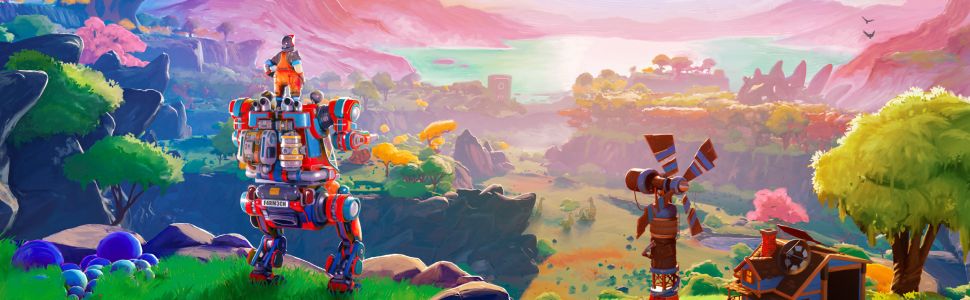
FLAME BREAK first released Lightyear Frontier as an Early Access game all the way back in March 2024. Since then, the studio has released plenty of updates to add more content, systems, and polish, and more than two years after its initial release, it is now ready to bring Lightyear Frontier to 1.0. The core premise of the game is quite simple; you’re a settler who finds themselves stranded on a strange alien planet. While you can’t really make contact with Earth since it’s too far away, you can still contact nearby colonies, and they need a lot of help. Thankfully, the planet you’re on is abundant in resources, and it is now up to you to help out your fellow settlers survive, and you have a large and powerful mech that can quickly cut down trees and smash rocks.
"Thankfully, the planet you’re on is abundant in resources"
Discussing Lightyear Frontier presents an interesting conundrum. It often feels like the title is facing a bit of an identity crisis. While much of the title feels like it might belong squarely in the cozy game genre, since there aren’t really any threats outside of environmental effects like tornadoes or certain flying plants that like sneaking up on you and exploding, the gameplay mechanics encourage taking a slow and measured approach to the resource collection that forms the core gameplay loop, there’s also an aspect of automation that never quite feels like it reaches its full potential. This leaves Lightyear Frontier feeling like it’s stuck in this weird limbo where it can’t really pick an aspect of its gameplay to fully commit to.
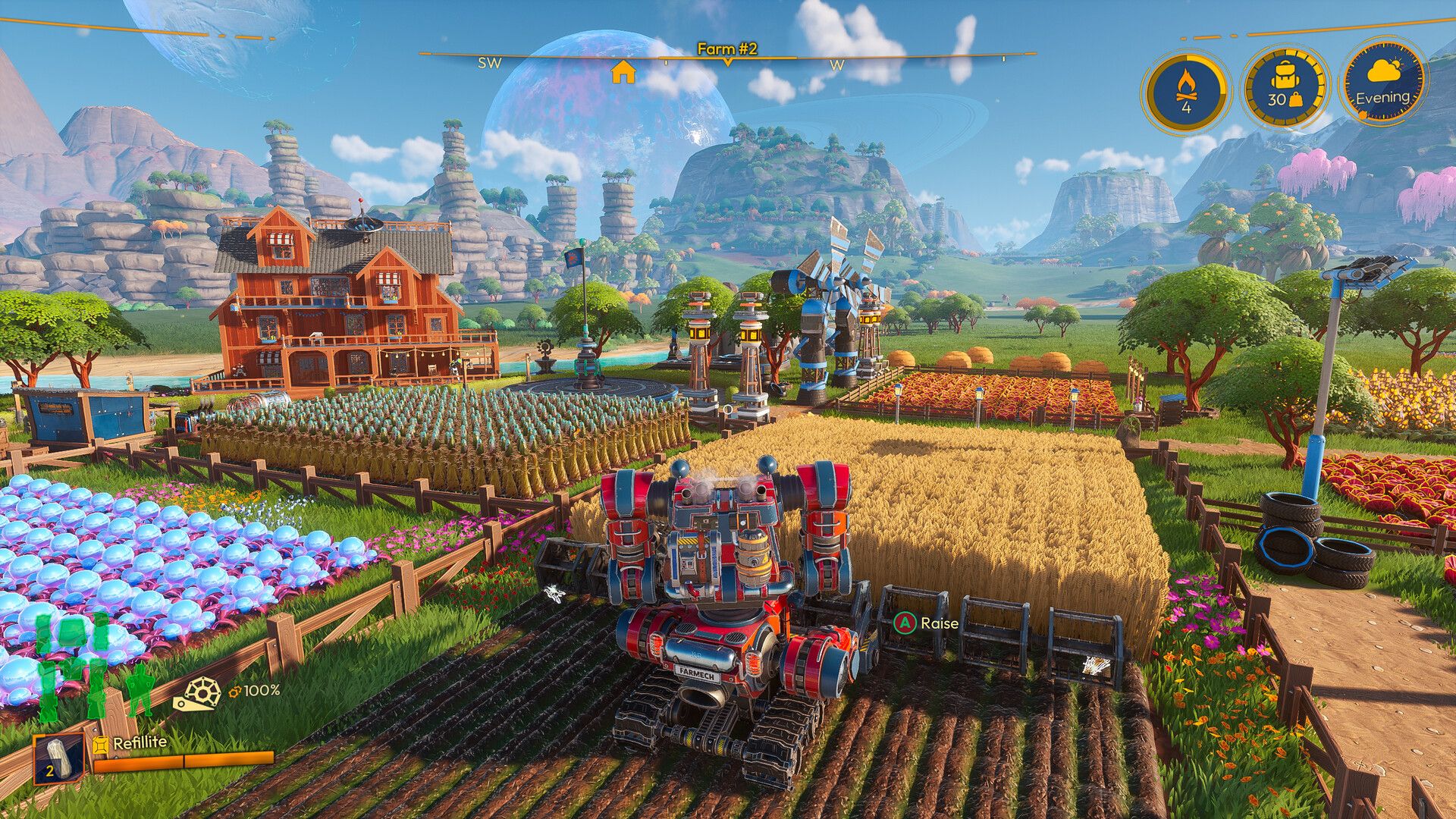
A simple example is the farming system, which will also take up most of your time since crops tend to serve as the biggest bottleneck throughout the progression in the game. It starts out simple; you plow some land, plant seeds, and water your crops, and eventually, your crops will have grown up and you can get your hands on Wheat, Rabbages, Polyberries, Caroots or any of the other sci-fi plants you decide to grow. A small amount of complexity is then added by each crop having a “type”: Nitrogenic, Potassic, or Phosphoric. Each one of these properties can interact with the other, resulting in mutations and richer yields. The types also have an effect on the soil itself, enriching it in certain ways, and encouraging the idea of crop rotation.
For example, planting wheat – a nitrogenic crop – into a potassic field will give you a mutated harvest that will reward you with regular wheat as well as a mutated strain, which often tends to be yet another demand by the settlers. The same system can also be used to improve yields. Using the wheat example again, planting it in a phosphoric field will give you more crops per harvest than you would have otherwise gotten.
"It often feels like the title is facing a bit of an identity crisis."
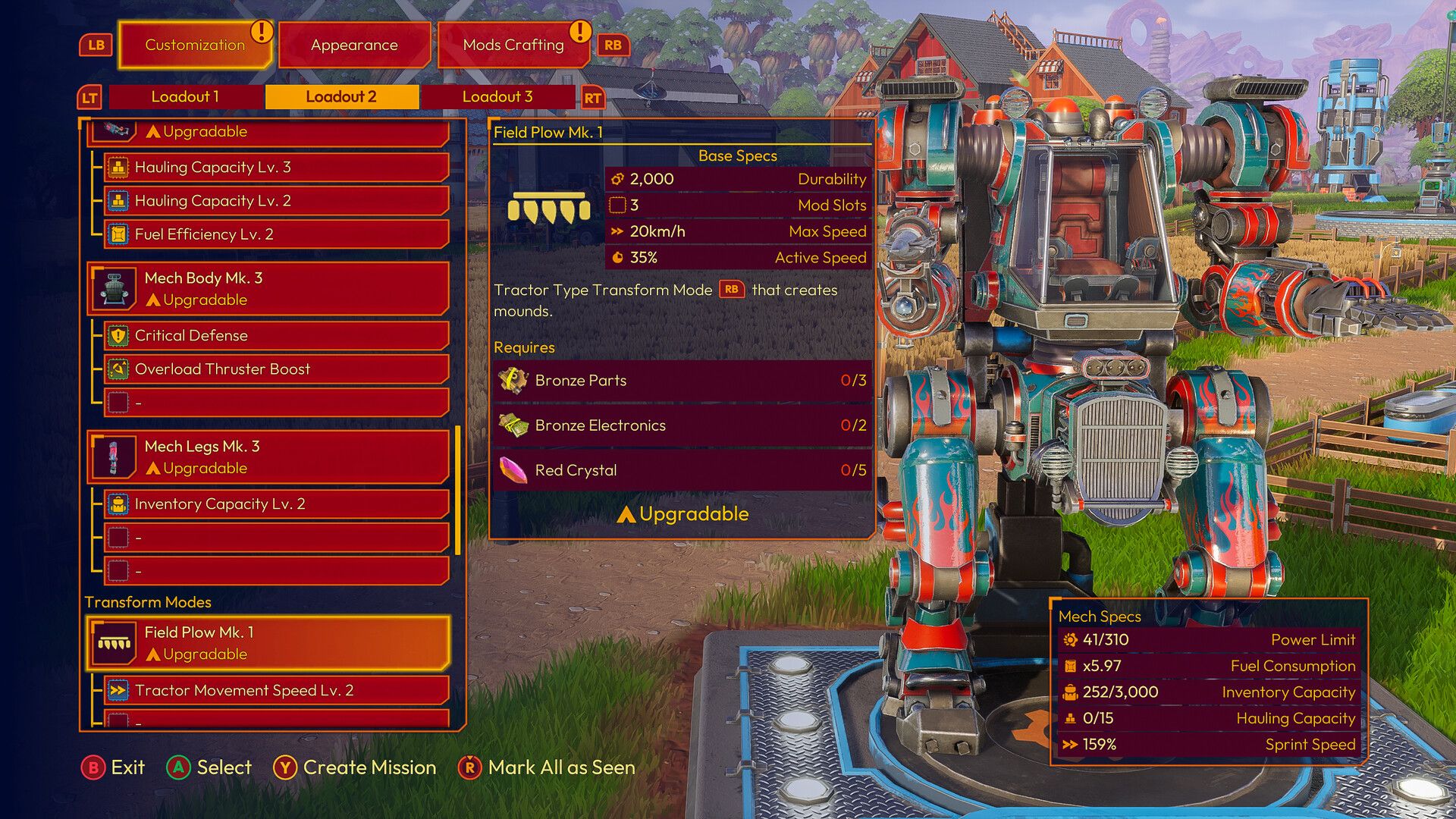
Now, it’s also worth noting that Lightyear Frontier gives you access to one major tool that sets the game apart from many of its contemporaries – a mech. This mech can be upgraded and customized to perform a variety of tasks, and is often the best tool for the job despite feeling a bit clunky in the earlier parts of the game. When it comes to farming, your mech can be equipped with a couple of Transform Modes that aim to make things a bit easier – Field Plow and Field Harvester. Through these modes, your mech can allow you to potentially set up farms at an industrial scale, with many plots set up for each one of the crops you need to grow. Similarly, the Field Harvester mode can be used to quickly harvest the fruits of your labor rather than having to manually go to each crop to gather it individually. The mech can also be equipped with an Irrigation Hose that can be used to quickly water all of your fields.
The mech has its own system of progression; as you make your way through the various in-game Milestones, you’ll also gain the ability to craft upgraded parts, new mods, and even different modes for your mech. The upgrades tend to be fairly straightforward, providing beneficial boosts to things like inventory space, speed, and the ability to carry large objects. The mods are where we get more granular upgrades, like increasing the diameter of your Irrigation Nozzle.
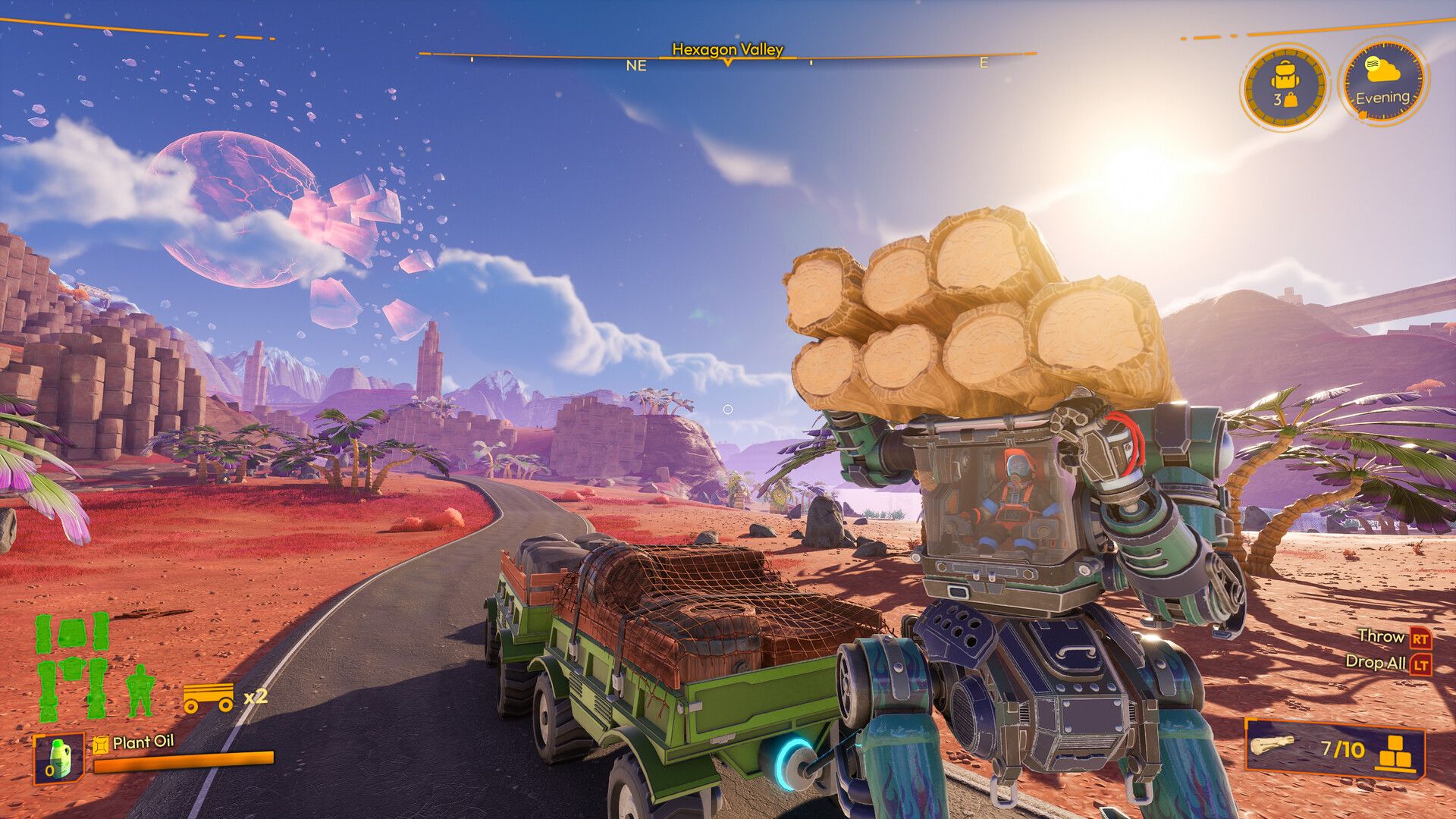
The farming aspects of Lightyear Frontier are where the mech feels the most meaningful. Unfortunately, while you still need the mech to mine for resources or gather other materials like lumber in efficient ways, the systems never quite feel like they come together in a satisfying manner. With wood as an example, you can chop down trees, which break apart into logs. These logs can then be manually chopped to get your hands on the resources, or if you’ve progressed far along the technology tree, you can carry these logs to a saw mill that can slice them up more efficiently, resulting in a higher yield of wood. Speaking of ores, they face a similar problem in this regard, further exacerbated by the fact that you can only carry a few logs or ores at a time, and you can’t even use any of your other tools while you’re carrying them.
The whole process feels quite clunky, even once you get your hands on a cart that can be hooked up to your mech allowing you to carry several logs and ores simultaneously as you make your slow trek back towards your heavy machinery. Sure, you can travel faster with a cart attached if you’re in Trailblazer mode, but this also makes jumping across deep rivers more difficult. It also doesn’t help that you can’t fast travel while carrying these larger objects, making the prospect of setting off to find wood or metals feel tedious right from the outset.
"This mech can be upgraded and customized to perform a variety of tasks, and is often the best tool for the job"
There are a few automation tools provided to you in Lightyear Frontier, like Automation Pipes, intakes and outlets on storage structures, and machines into which things can be fed. The system itself is easy to understand and quite simple – you can essentially connect the right machine to your storage with the Automation Pipe, set the machine to create the thing you need, and you’re done. However, there are two larger problems with the game that hamper the automation gameplay. The first is that you simply don’t have enough room to build out the factories that this game wants you to build. Unlike in games like Factorio or Satisfactory, in Lightyear Frontier, you’re limited to building within the confines of your outpost’s borders. While this border can be expanded, the process in itself is a massive resource sink that will take plenty of time to get enough land to build a large facility on.
Much of the earlier parts of Lightyear Frontier will have you stuck with a single outpost around which you can build things out, with the ability to create more coming in as you make your way through the Milestones. While this system makes sense for a game with more survival crafting elements, it feels like an unnecessary hurdle for a more relaxed experience like Lightyear Frontier. The game doesn’t even have many threats that could potentially destroy your buildings aside from an exploding flying plant and the occasional weather effect like a tornado – both of which are easy enough to deal with – so the outposts serving as a “safe haven” also ends up feeling redundant.
The second big issue is that the automation tools come simply too late in the game. You have to hit Milestone 4, each Milestone needing you to send several rounds of resources to neighboring colonies. By the time you’ve hit Milestone 4, you’re likely to have already been on your way to setting up several small farms, since much of the resources you send revolve around farming, and a couple of small barns with machines in them that can quickly craft things like seeds, oil, or wires. While this is certainly an improvement over the Milestone 9 requirement that used to be there in Early Access, I still think it’s too late, and that the game’s automation systems would have been much more effective if they were available right off the bat.
Generally speaking, the automation aspects of Lightyear Frontier feel fairly half-baked and tacked-on, which could be explained by the fact that the original Early Access incarnation of the game was released without it. The process never really gets more complex than turning, for example, rocks into sand, and then into clay, and as a result, you don’t really get to deal with the more interesting challenges presented by other automation games. The core objective of sending resources to colonies also doesn’t really support the automation aspects much, since most of the things you send out will be food, the creation of which can’t really be industrialized outside the use of your mech. Generally speaking, this leaves the automation system feeling relatively unnecessary, since most of the materials you get from it will likely be spent just on upgrades for your own mech.
"Generally speaking, the automation aspects of Lightyear Frontier feel fairly half-baked and tacked-on"
Bringing up comparisons with Satisfactory again – another game where you have to constantly send resources into space to climb up the tech tree – Lightyear Frontier’s demands for industrial-grade production come in too late for it to feel like an engaging part of the core loop.
Farming and automation together also feel at odds with the emphasis Lightyear Frontier places on exploration. Every second you spend outside of your base is time you could have instead used for farming or material gathering. While there isn’t a strict timer on which you have to send out resources to the other settlers, this still means that your progress is going to slow down to a crawl if you decide to experience the beautiful world instead of plowing fields and planting seeds. While FLAME BREAK has reduced the number of resources needed by the settlers over time, it is still an incredibly grindy affair, and you’ll end up spending several in-game days just waiting for your crops to grow so that you can make some progress through the Milestones. These issues are alleviated if you have some friends playing with you, since you can split up the work to ensure that more resources are gathered and sent out into space. However, since I played entirely solo, the grind was intense.
Despite these issues, however, I still have to admit that I enjoyed my time with Lightyear Frontier, since the farming aspects feel especially relaxing. The mental juggling you often have to do when it comes to figuring out your crop rotations, making sure that the right things are growing on the appropriate plots, and even the panic of running out of seeds, felt like a compelling gameplay loop on its own. Interestingly, the farming mechanics also encouraged exploration quite a bit, since you need to set out into the world to find new plants that can then be turned into seeds so that you can grow more of them.
The exploration itself was also quite enjoyable, and the mech feels quite enjoyable to control as long as you’re not lugging around heavy objects. Even the simple act of running around at high speeds allowed for minor displays of skill, like using rocket boosts to break your fall as you run off a cliff or making use of short bursts to further speed up your sprinting. Lightyear Frontier has a few distinct regions: Outset Peaks, Frostpeak Ridge, Hexagon Valley, Sandswept Highlands, and The Hollow Marsh, with the last two arriving with the 1.0 update. Each one of the regions has its own quirks that largely present themselves through the local flora and fauna having evolved to live there, as well as through the various traversal challenges they present. Hexagon Valley, for example, has you weaving in and out of small valleys, while the Sandswept Highlands is a rocky area that will put your jump button to good use.
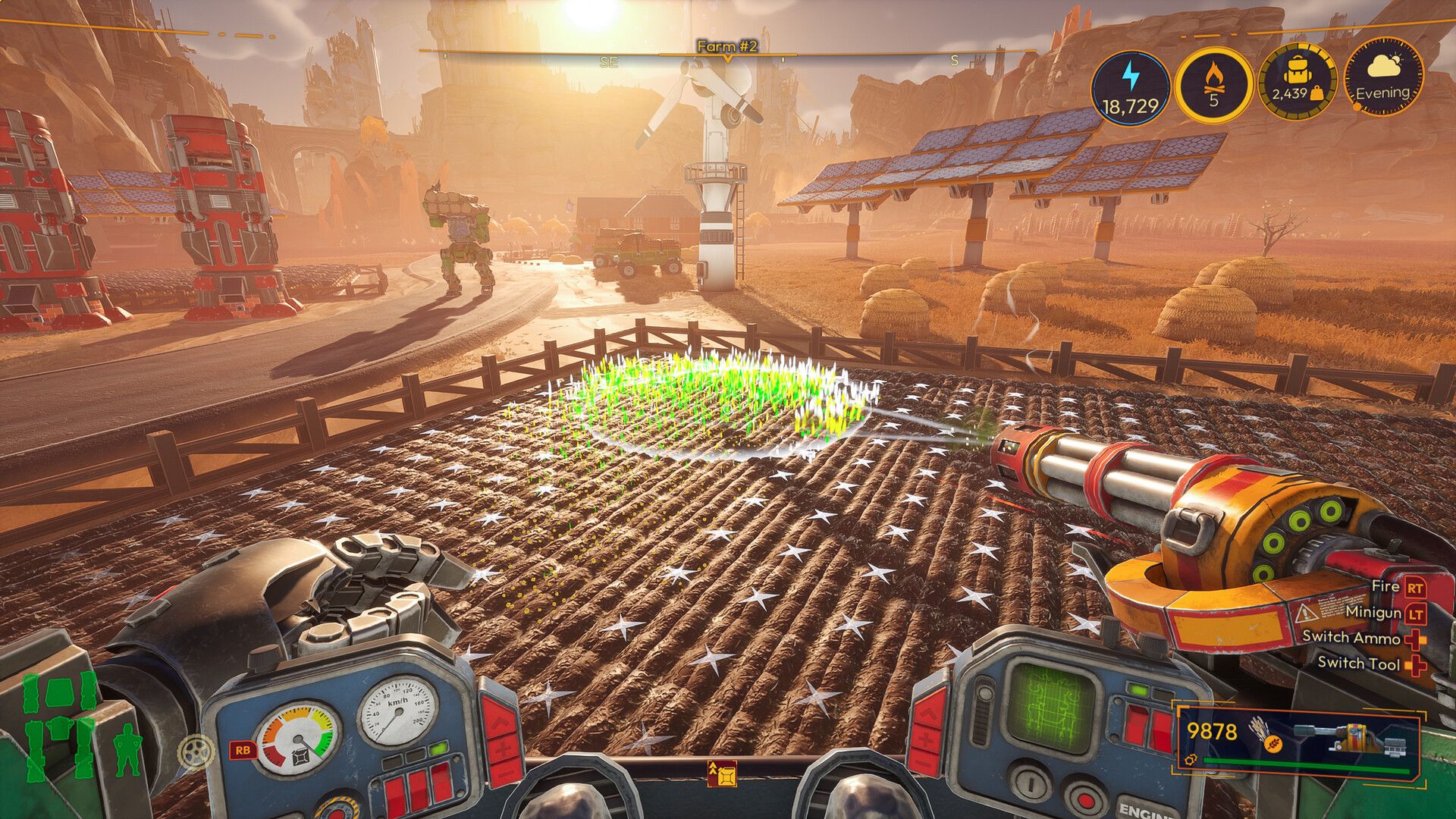
"The fact that Lightyear Frontier features simple building options also enhanced my enjoyment"
Aside from the sheer joy of exploration and the ability to find new crops and ores, however, there is little reason to actually set out into the larger world of Lightyear Frontier. You can’t exactly set up a new factory or farm where you find these resources, which makes their beauty all but meaningless until you’ve finally progressed far enough to be able to set up a second outpost. The fact that the routes to get to these zones can often be winding and downright tedious also doesn’t help matters. However, I wouldn’t downplay the sheer beauty of these regions either, with Sandswept Highlands being a highlight for me thanks to the massive skeleton of a colossal beast that seemingly died along its mountains a long time ago. The Hollow Marsh is a more challenging area to reach. However, your struggles are rewarded with a striking view, since the entire zone has a strange color palette with blue grass and red water.
The fact that Lightyear Frontier features simple building options also enhanced my enjoyment. The fact that I didn’t have to worry about things like structural integrity and needing to add support beams was great. It also opened up the door to potentially more impressive structures, which can come in quite handy when you want to set up multi-layered factories. Building out your base also involves leveling up its “coziness” factor, which can be done by adding various decorative items. Coziness is about more than just making the place look nice, however, and resting in an outpost with high coziness levels also provides buffs, like a chance to get more resources when harvesting, or the ability to deal critical strikes when piloting the mech.
The beauty is further helped by the fact that Lightyear Frontier is a good-looking game. It is packed to the brim with gorgeous vistas that can give you anything from verdant, rolling plains, to snow-covered peaks, and even a gorge that seems to be lined with strange hexagonal structures. The beautiful scenery served as one of the biggest rewards for my attempts at exploration throughout the game. When it comes to performance, I never experienced any issues while playing the title with its graphics settings maxed out.
I was running Lightyear Frontier at 1440p with frame rates well over 140 on a PC with an AMD Ryzen 7 7800X3D CPU, a Radeon RX 7800XT GPU, and 32 GB of RAM, and I never faced issues like stuttering or even pop-in, despite playing the game at native rendering resolutions or tools like frame generation.
I can’t really praise the audio in a similar way, unfortunately. While the sounds of your mech doing just about anything have been captured with a wonderful sense of weight and momentum, other things, like the atmospheric sounds of trees swaying in the wind or animals hanging out nearby started feeling fairly repetitive. The soundtrack is also in a similar spot, feeling quite dull in its attempts to be peaceful, and I often found myself listening to a podcast on the side just to stave off the boredom of staring at my crops growing.
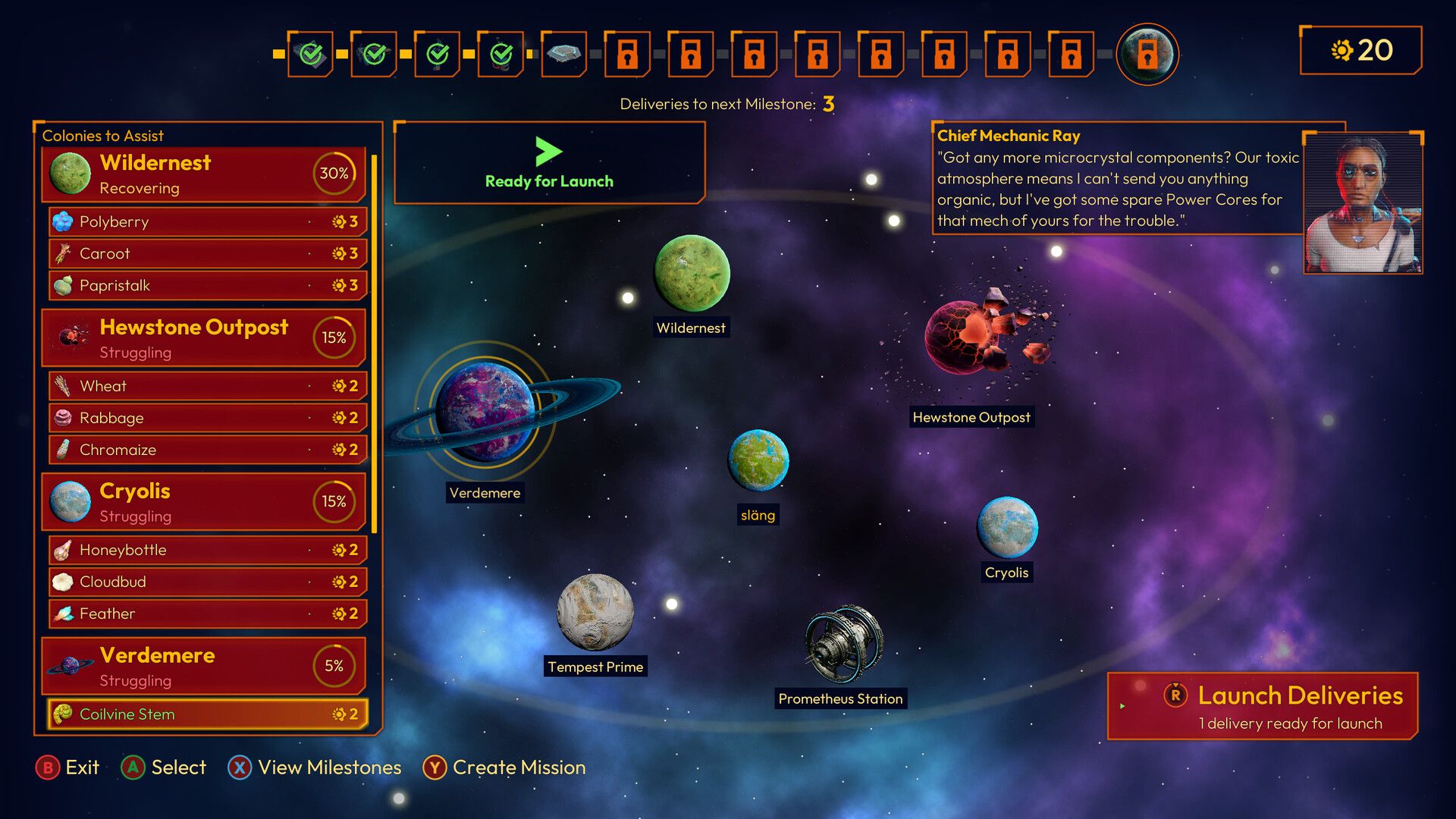
"When it comes to story, Lightyear Frontier doesn’t really have much of one outside of the initial setup."
Speaking of which, Lightyear Frontier also has an entire system that revolves around taming the various animals you can find throughout the world. After you feed them, these animals will start being more friendly towards you, and will often repay your kindness by finding precious materials for you. The system even extends to the ability to incubate your own pets. This is done by finding eggs in various nests, which can hatch into friendly creatures. These can be kept in your farm, where they can roam around and randomly drop resources.
When it comes to story, Lightyear Frontier doesn’t really have much of one outside of the initial setup. You get a few short character arcs that play out over the course of the deliveries you make to neighborhood colonists, culminating into everyone working together to make a gigantic, final delivery. While a fine enough finale on its own, the long amount of time it took me due to the massive amounts of grinding required to send them resources meant that I had stopped finding these characters particularly endearing. Despite this, however, the final story beats put a neat bow on these characters, and you still get to continue playing.
Another side story also plays out at the same time, giving a few hints about the world you’re stuck on. It was once occupied by a highly-advanced species that was capable of building massive factories and transit networks. You find the ruins of these, along with a few artifacts that can be analyzed to provide you with some further hints about the nature of this species. However, with one exception, the only reward you get from this are a few cosmetic items that you can build in your outposts to decorate them, and the story of the species itself never results in a satisfying end since it’s likely meant to offer some moody background lore rather than present a full narrative by itself. The only exception to this was a series of puzzles I found in underground shelters that gave me a mech mod allowing my mech to run across water.
Lightyear Frontier offers a relaxing experience that starts feeling fairly repetitive from just a couple of hours in. It is let down by its sense of pacing, with the most interesting tools like automation arriving too late, and puts too many constraints on your efforts to set up a factory. Despite this, however, there are definitely some great reasons to play the game, especially if you enjoy setting up farms while playing around with concepts like crop rotation. Along with this, just roaming around the beautiful world in the mech can also be quite fun.
This game was reviewed on PC.
Beautiful world that’s engaging to explore; The mech is fun to ride; The farming system is compelling.
The pacing of progression is too slow; The automation systems are held back by too many other aspects of the game; Generally grindy and repetitive right from the early sections.