




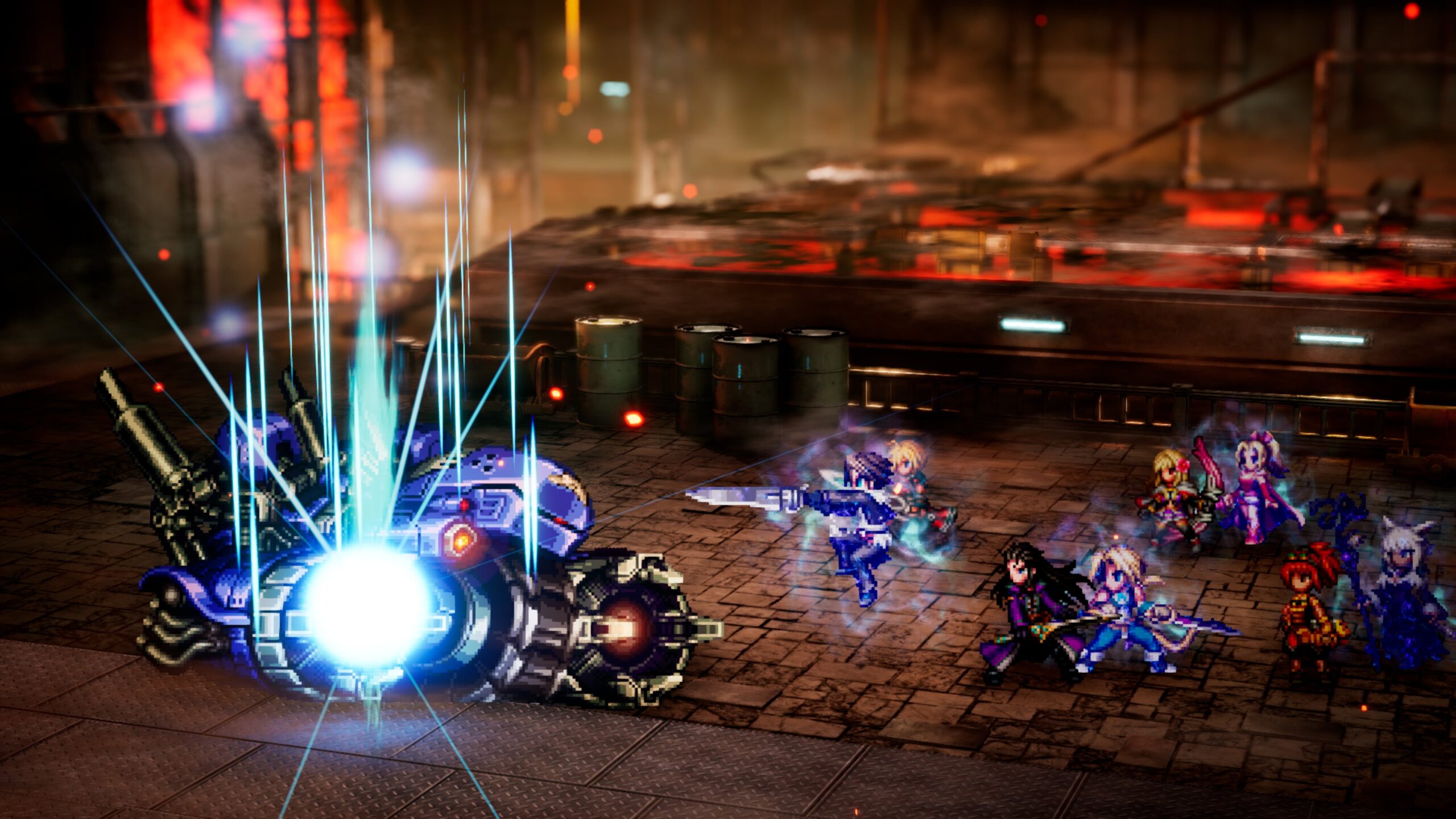
Following the recent release of Final Fantasy Resonance – which came out to critical acclaim – producer Kiseki Nakashima has revealed that he had to fight Square Enix’s leadership to make Resonance more than just a simple port of Final Fantasy Brave Exvius. In an interview with Bloomberg, Nakashima spoke about the pushback he faced from Square Enix executives who wanted a port that would be faster to make and relatively simple.
Nakashima, however, had other ideas. “I didn’t want to go down that route. I wanted to create an original version for consoles that was a full-blown gameplay experience.” As for how the project came into existence, he spoke about the “really disappointing” feedback that Final Fantasy Brave Exvius was getting. While many were interested in checking it out for its story, they simply “didn’t want to play it just because of the gacha elements.” He went on to note that this was “another reason we wanted to make this a console game, to bring it to a wider audience.”
Final Fantasy Resonance was released across PC, PS5, Xbox Series X/S, Nintendo Switch, and Nintendo Switch 2 just last month. Its story takes place in the kingdom of Grendshelt. Rain and Lasswell – a pair of young knights – are tasked with investigating a strange disturbance at a nearby shrine. Upon finding the shrine’s magic barrier having been shattered, the two encounter a dark knight – the Vertias of the Dark – who goes on to destroy the Earth Crystal housed within the shrine.
Complicating matters is the appearance of a young woman, Fina, who doesn’t seem to have any of her memories. She saves Rain and Lasswell from dying to Veritas of the Dark, and the three gain the ability to harness the crystallized essence of warriors from distant lands – dubbed Visions. They set off on an adventure to save the remaining crystals and stop Veritas of the Dark.
In our review, we gave Final Fantasy Resonance a score of 9 out of 10 thanks to its engaging narrative, likeable cast of characters, excellent use of the HD-2D art style, and a mechanically layered and deep combat system. Our only complaint was that the overall storytelling is fairly rote and predictable.
On the subject of the HD-2D art style, Nakashima had spoken about how the team experimented with many different styles before arriving at this one. Among these experiments was the idea of superimposing 2D effects on other 2D effects.
“But ultimately, we felt that HD-2D – this fusion of dots and 3D – was the most suitable way to represent both the challenge of new expressions and a cinematic game experience. We wanted to go further in representing things. We played with scale for enormous creatures like Bahamut or airship arrivals, and we also played with camera work, which we didn’t think was possible in 2D.”
He also noted that the team had to “adjust everything pixel by pixel” due to the difficulty in blending 2D and 3D assets together while still keeping a coherent vision of the game’s art style.