







Well, it’s the end of a wait that’s felt longer than it has been in reality, but the Steam Machine is finally on the shelves. It’s quite an interesting machine (pun intended), to be sure. It plugs into your TV, plays a massive library of games, has an SD card slot out front for easy switching from your Steam Deck to your living room, and functions well as a SteamOS-based console even though it could be considered quite the opposite.
However, its price tag puts it at a premium over even the PS5 Pro, and that’s a cause for concern. At $1049 for a 512GB variant that functions on par with the base PS5 and Xbox Series X, it’s made our thoughts wander to what the next generation of gaming hardware could bring to the table and has us wondering what such offerings could cost. As always, there’s more to the issue than meets the eye, and we’re going to come at this from multiple angles. Let’s get started.
Leaving Traditions Behind
The old console model is the first thing that comes to mind, as it’s what the Steam Machine aimed to tackle before component shortages and the subsequent increase in prices forced Valve to pass on additional costs to its players. When you put that against how consoles have often absorbed losses they take on expensive hardware only to earn that back via game sales, subscriptions, peripherals, and platform fees, the Steam Machine’s disruptive potential becomes a little clearer.
However, that isn’t the only variable to consider. The PlayStation and Xbox have traditionally been closed-off ecosystems, with both Sony and Microsoft using all the factors we’ve mentioned above to try to surge ahead of their rivals. Throw in other gaming systems like the Switch into the mix, and the pattern becomes clearer. Big brands have used exclusivity and their unique USPs to ensure consumer loyalty and recoup the losses from discounted entry points over the duration of a console generation.
That means it can be hard for gamers to switch over to a rival, considering that they’ve had around seven years to build a library of games that would then become redundant if they were to give another system a try. Valve’s arguing against that route with the Steam Machine, bringing a PC/console hybrid that’s about as open-ended as they come thanks to a Linux-based operating system with a SteamOS overlay.
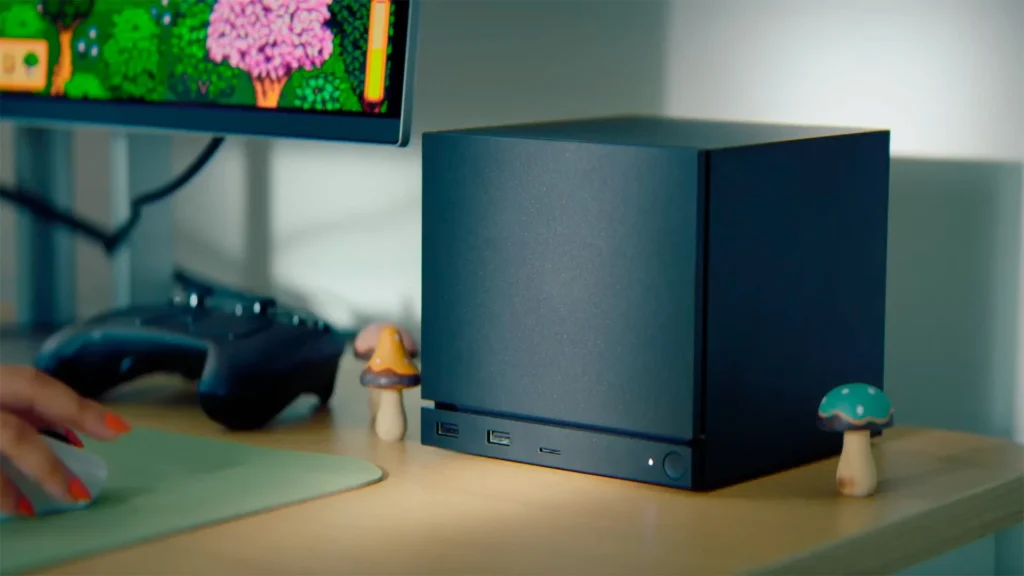
Yes, you’re paying a premium, but you also get the flexibility of a PC in a machine that gels pretty well with your living room setup thanks to its compact size and an approach to heat management that we must tip our hat to. That’s a more open-ended alternative to the PS5 or Xbox that could also run as a reasonably powerful PC if the need arises, since you could even run Windows on it and plug in a keyboard and mouse to get some work done from the comfort of your couch.
There’s value in both approaches, no arguments there, but there is the pressing concern that both Sony and Microsoft must now think long and hard about what they’re going to do about pricing their next-gen offerings. Absorbing hardware costs heavily in the interest of subsidization, both companies risk losing out on profit margins. Not doing so could raise prices, which isn’t going to make a lot of console gamers happy. It’s a frying pan and fire kind of situation that needs careful navigation if the next generation of consoles is to sustain the value that they offer to gamers.
The Rising Tide Of Prices
It’s probably a good idea to think about the price hikes on Sony’s PS5 lineup at this point. As of March 2026, the PS5 Disc Edition now sits at $649.99, while the PS5 Digital is at $599.99, and the PS5 Pro is pushing dangerously close to the thousand-dollar mark, with its retail price at $899.99. While it’s all well and good to support Sony, a manufacturer known for its quality gaming hardware over many years, and say that there was no choice but to hike up prices, that still doesn’t address worries about what the PS6’s price could be when it comes out.
Things are equally troubling with the Xbox Series. The Xbox Series S is now $100 dearer if you’re looking at a 512GB model, while the 1TB versions of both the S and X are now $150 more expensive. What’s worse, the 2TB models are now discontinued. Heck, even Lenovo has stated that memory prices may never return to normalcy.
Microsoft might be facing a tricky situation, all things considered, as Project Helix seems to be shaping up quite well, although it’s deep in development. However, as it’s being built to play both Xbox and PC games, that could put its value proposition quite close to what the Steam Machine is currently offering, and that’s without considering the promise of “leading performance” from the brand’s upcoming next-gen powerhouse.
With plans to ship out alpha hardware to developers in early 2027, it’s clearly getting closer to its final launch, as is the PS6. In the case of Project Helix, the PC/console hybrid angle could likely be a very justifiable reason for a higher price, especially for enthusiasts, but we’re concerned that such a situation could affect the mass-market relevance that it so clearly needs if it’s to take on the PS6. Exclusive games are a great way to get that going, but are they going to be enough to justify paying a high price for them? That’s something that remains to be seen. Either way, it’s a possibility that Project Helix’s goals may come into conflict with each other and be an obstacle to its success.
We’re aware that all of this is a tad speculative at this stage, but the Steam Machine has given us valid reasons for our concerns thanks to its price. But what could be done about them?
A Smart Way Forward
Well, you might not like what’s on our mind, but allow us to explain. We think delaying both the PS6 and Project Helix could be a smart choice for Sony and Microsoft. It isn’t because we think none of us are ready for a generational leap that could make modern gaming even better than it is today, not in the slightest. But at this point, with hardware prices and supply being what they are, it’s going to be a tall order to match retail prices with the value that’s on offer.
Both the PS6 and Project Helix need to come in at a time when a higher price tag is justified by an undeniable value proposition. Without it, we don’t see too many people looking to buy new consoles since their PS5s and Series X consoles, along with handhelds, the Switch 2, cloud gaming and other libraries, let them enjoy the best of whatever gaming is offering, albeit at a slightly lower performance that still works just fine since it’s what they’re already used to.
It’s going to be very easy to just wait out an upgrade, forcing Sony and Microsoft to either lower prices or weather low demand for new consoles. For the past few generations of consoles, upgrading to whatever next-gen offerings were available was a matter of better graphics, improved loading times, better frame rates, ray tracing in the case of the PS5 and Xbox Series, and bigger, more ambitious worlds that pushed the boundaries of what a modern gaming experience could achieve.
That’s the way it should be if you ask us, with each iteration of the PlayStation and Xbox working to give gamers a solid reason for an upgrade that goes past being an enthusiast, for whom a new console is a must-have, day-one purchase. Nothing wrong with that per se, but there’s a risk of alienating gamers who would like nothing more than a shiny new console but are priced out of joining in on the fun when the PS6 and Project Helix come along.
The Steam Machine has shed light on a facet of gaming hardware that console owners aren’t fully aware of yet, but the current situation has shown us all what those hidden bills look like. It brought the question of price and affordability to next-gen consoles, and we worry that launching either or both models too soon runs the risk of turning console gaming into a luxury purchase instead of a convenient, mass-market solution. It isn’t going to be entirely on the manufacturers, given the current cost-component environment, but it’s sure as hell going to be a factor if the prices are too high for the average gamer to make the leap to next-gen consoles.
We’re hoping to tell you that we were wrong to worry at some point, but all the evidence now points to a late 2027 to early 2028 launch for the PS6 and Project Helix. And while it’s certainly going to be interesting to see how Sony and Microsoft try to offset price increases, it’s going to be pretty saddening to know that so many of us won’t be playing the best games of the next few years in the best possible ways that they’re meant to be enjoyed.
And that would definitely be a disappointment all around.
Note: The views expressed in this article are those of the author and do not necessarily represent the views of, and should not be attributed to, GamingBolt as an organizati