






A new Nintendo console brings new hardware features and gimmicks, which, in turn, brings new games designed specifically to showcase those features. In the tradition of Wii Play back on the original Wii, or ARMS for the original Switch, the Switch 2 gets Drag X Drive.
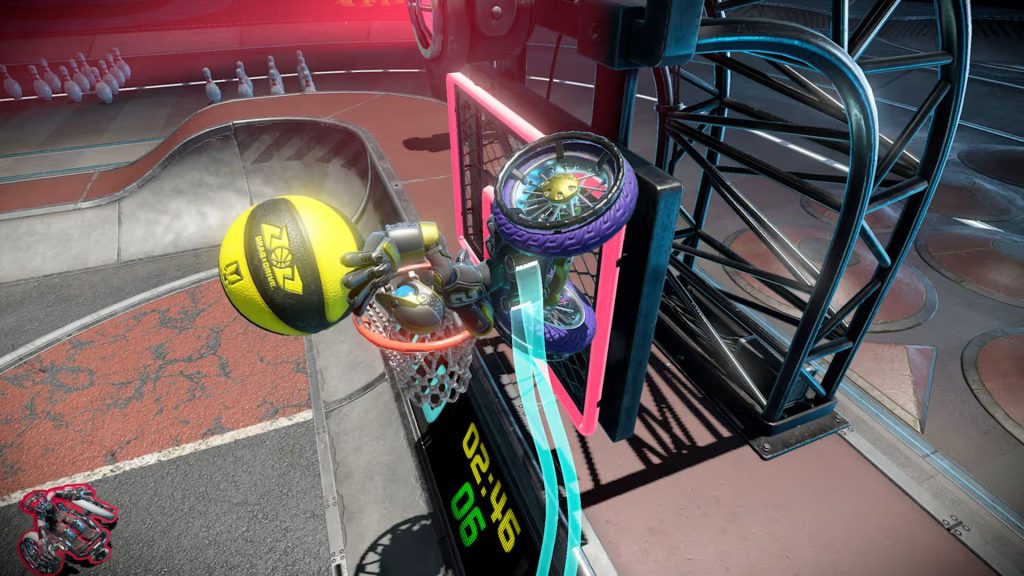
Conceptually, everything about this game sounds interesting. It’s a game about wheelchair basketball (though, curiously, the game itself never quite seems to refer to it as such), which is inherently an interesting concept to make a game around; then on top of that, this is a game designed to showcase the mouse control capability of the Switch 2. The entire game is played by holding two Joycon 2 controllers as mice and using their motion to control the movement of the individual wheels on your wheelchair as you play basketball.
It’s definitely an interesting concept, but the final game ends up coming up unfortunately short. Earlier I mentioned ARMS. While ARMS too was designed to showcase the Joycon controllers’ motion capabilities, it was also a full fledged game on its own merits, coming with a fair bit of content, post-launch support, an obviously high budget for its audiovisual presentation, and even options to play the game without using the signature motion controls at all – making it a normal unique fighting game for those who had no interest in playing one with motion input. All of that made ARMS a reasonably easy recommendation, and the game went on to accumulate a dedicated fanbase for itself over the years.
"There is no single player campaign of any sort, which I think is a missed opportunity, because I feel like it would address a lot of the game’s shortcomings."
Very little of that is true for Drag X Drive. The game comes with very little content, for example. You get to play multiplayer games either locally or online, and you can play single player games against bots. And… that’s about it? There’s a tutorial mode, of course, and there are some fun time or score attack challenges that are included, but ultimately, outside of playing these core matches, the game doesn’t really give you anything to do.
There is no single player campaign of any sort, which I think is a missed opportunity, because I feel like it would address a lot of the game’s shortcomings – a campaign would not only provide a chunk of added content which immediately raises the value proposition, but it would also let players get familiar with the controls better, and presumably give players more to work towards – whether it is unlocking new characters, or customization options, or stadiums, or titles, or anything.
Some of that is in the game already, to be fair. For example, technically you can customize the look and play style of your character in-game, and some of those customization options are unlocked by completing specific tasks in-game (such as playing a certain number of matches, winning a certain number of matches, scoring a certain number of points, performing a certain number of tricks… you get it). The options here are fairly limited, however, and more importantly, not particularly compelling.
"Unfortunately, the lack of content and audiovisual flair counts against the game fairly heavily, because there isn’t much else here."
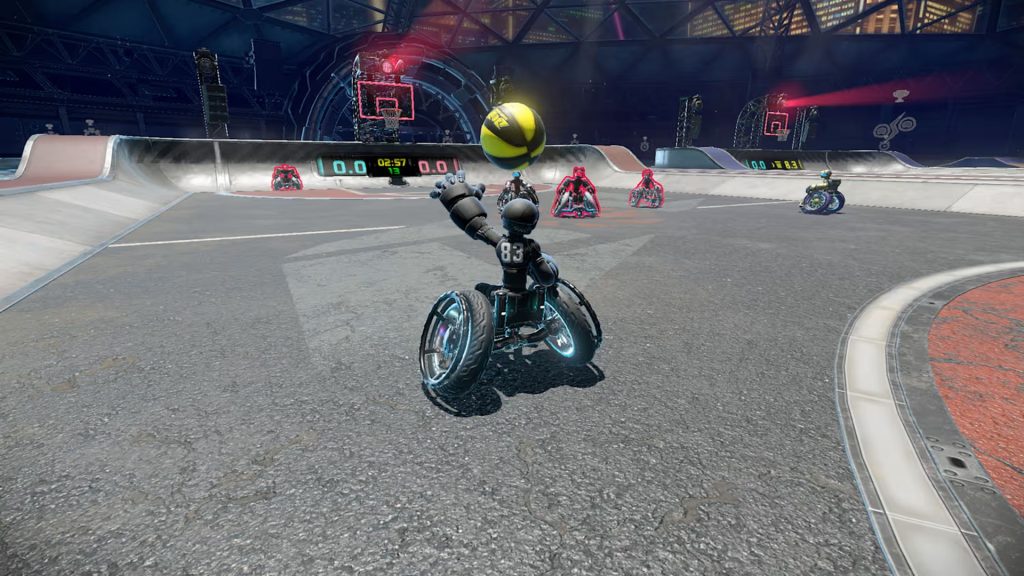
This brings us to what has been the central observation or criticism of Drag X Drive from the moment it was revealed earlier this year – the audiovisual presentation. Some Nintendo games have charm, personality, and a sense of aesthetic. The character designs stand out, the environments are tactile and beckoning, and the games as a whole are designed with a toy style mentality, inviting you to interact with them and seeing how they react in unexpected ways. A lot of this simply is not true for Drag X Drive, which uses unfortunately bland and drab character designs, with minimal customizations allowing for opportunities to fix that.
This is something where a campaign, with proper designed characters presumably, could have helped give the game more material to work with – because right now we have some fairly generic, unremarkable looking chibi figures in these wheelchairs, and they don’t look cool enough for me to care at all about customization options for them.
This lacking style and aesthetic extends from the character design through to the rest of the game. There’s no particular color in the environments, and the menus and UI are totally bland. Puzzlingly enough, the actual game design still retains that core playful Nintendo sensibility – the main “menu” basically puts you in a series of courts where you go around and select modes, but it is also littered with things for you to interact with that serve no purpose other than simply being there for you to play – things like bowling pins you can run into and knock over, or half pipes for tricking, or even jump ropes. The core game design still has that Nintendo spark – it’s just the utter lack of content and audiovisual charm that’s muddying that.
Unfortunately, that lack of content and audiovisual flair counts against the game fairly heavily, because there isn’t much else here. The core of the game, the gameplay – is actually pretty good. The mouse controls work fairly well, the haptic feedback is good, and the controls are well thought out, allowing for a surprising degree of player expression. There’s also some interesting depth here, between the tricks and the team dynamics, especially in multiplayer, but ultimately, there isn’t enough for this to be a whole game. Equally importantly, as impressive as the controls are, they are not as reliable or responsive as simple buttons would be.
"I think this game would definitely have gone down better if, rather than being a whole standalone product that has to be assessed by itself, it had been a part of a larger collection of mini games."
There can be times when it feels like you are fighting the controls – this happens a lot less frequently than for any motion controlled game I can think of, which is a testament to how well the mouse controls are implemented, but it happens more than it would in a game that uses buttons. And that is a problem, because that core gameplay is the only thing the game has going in its favour – if the controls mess with that, there’s very little left to pick up the slack. Unlike with something like ARMS, you also cannot switch to regular controls to play this game – either you are playing with mouse controls, or you are not playing this at all.
I think this game would definitely have gone down better if, rather than being a whole standalone product that has to be assessed by itself, it had been a part of a larger collection of mini games. It has a surprising amount of depth, and the core mechanics are fun to engage with. But the absolute lack of content, combined with the lacking audiovisual presentational aspects, and the occasional control issues, all create a lot of problems to consider.
At a budget $20 price, Drag X Drive is not breaking the bank, and may be cheap enough for several to pick it up as an impulse buy, to have a game that shows off what the mouse controls should be like – but even at that price, it has enough issues that unfortunately hold it back from being something, if not special, then more.
This game was reviewed on Nintendo Switch 2.
Unique concept, fun multiplayer, playful design.
Lack of content, bland presentation, limited customization.