





Survival crafting game Valheim has been on an incredibly long and arduous journey since its 2021 Early Access release. Developer Iron Gate has continued to support the game with a variety of updates that have brought in a host of new content, from new boss fights to unique regions, and even more equipment and other items to craft. With the 1.0 update, we now have our last biome of the game – the Deep North – along with other content additions, as well as a hefty serving of general polish.
Despite all of the additions, however, the core gameplay loop of Valheim has remained as strong as ever, and the polish added to the game with the 1.0 update has only made what was already a fantastic survival crafting game feel even better to play. At its best, Valheim offers a meditative experience that is often punctuated by intense action sequences whenever you take on the bosses that make up the main progression blockers of the game.
Valheim kicks things off following the death of your character, armed with little more than a leather tunic and a torch, you have to figure out how to survive, thrive, and ultimately, put to rest the legendary Forsaken that roam the lands.
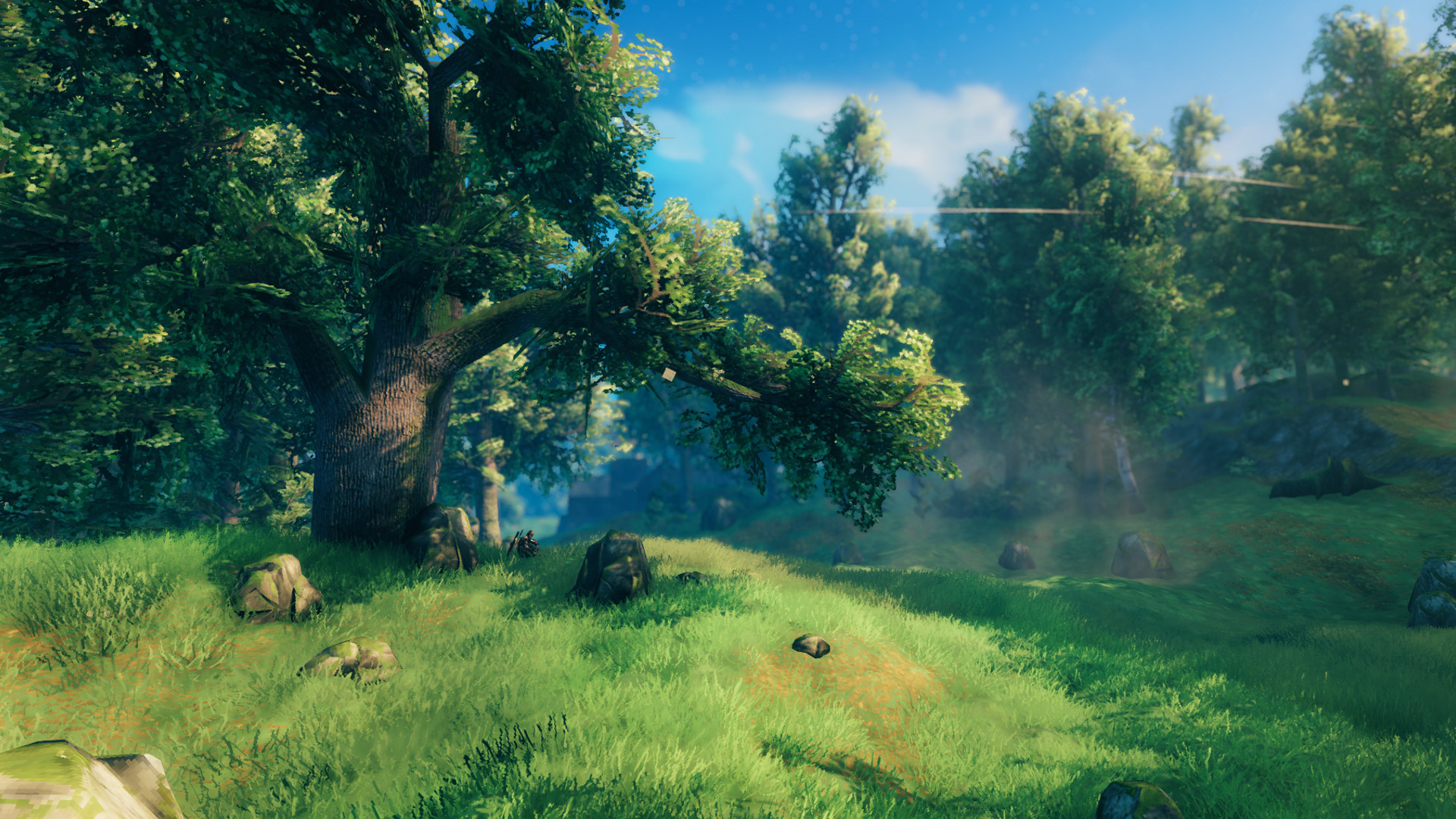
First things first, the general visual style of Valheim remains one of its most endearing traits. The title makes use of a hybrid style that blends modern lighting and other graphical techniques with low-resolution textures, resulting in a dream-like atmosphere. The low depth-of-field ensures that just about everything in the background that you aren’t directly looking at is at least slightly blurred, further adding to the dreamlike nature of the realm.
The core gameplay loop of Valheim is quite simple and largely falls in line with other games in the genre; you get your hands on materials that can then be used to create equipment and structures. Along the way, you’ll also have to deal with environmental factors like the region being too hot or too cold for you, necessitating specialized equipment to deal with the extreme temperatures.
You start out with little to your name, and after punching a few branches and picking up some loose rocks, you can then begin crafting some gear that makes the process of getting more materials easier. Stronger axes mean you’ll be able to get your hands on wood at a quicker rate, for example.

"The fact that the opening zone is relatively benign when it comes to threats is a good thing"
One interesting thing that sets Valheim apart from many of its contemporaries is how its hunger system works. Rather than penalizing you for running out of food, you are instead encouraged to eat because the food can offer a variety of buffs. This starts out in a simple way, and the progression slowly brings you up to making food that can boost just about every stat you have.
After you’ve managed to set up a simple enough base of operations with a crafting bench, a place to cook your food, a roof over your head, and a bed that allows you to instantly skip the night, you’ll find yourself just about ready to take on the first Forsaken boss – the Eikthyr. The fight is a simple one, largely meant to test whether or not you’ve figured out the core gameplay loop, and beating the mythical deer-like creature opens up the game quite a bit, giving you access to a few new crafting recipes, and finally giving you the ability to mine larger boulders for more steady access to materials like stone and limestone by letting you make a pickaxe.
The fact that the opening zone is relatively benign when it comes to threats is a good thing, since death has a harsh punishment in Valheim. On the default server settings, you are essentially stripped of all belongings and thrown back to the last place you rested. This means that you’ll have to make your way back to where you died in order to get your things back. Along the way, you’ll also be quite vulnerable to other threats, since all of your previously-equipped gear is lying with your corpse as well.
The core combat itself is quite simple, and essentially split into two distinct styles: melee and ranged. While in melee, you have access to a typical three-hit combo attack, the ability to block, and while using appropriate shields, parry. You can also simply choose to avoid damage by rolling out of the way. Players who prefer ranged combat can craft a variety of bows as well as an arsenal of different arrows, each of which can have its own distinct effect like elemental damage or status ailments like poison. Both methods of combat can be further augmented by using magical weapons that add additional effects to it. The Storm Fang bow, for example, gives you a 20 percent chance to cast the Chain Lightning spell whenever you hit something with an arrow.
"The ebb and flow of combat is determined by how well you manage your stamina."
Throughout all of this, the ebb and flow of combat is determined by how well you manage your stamina. Just about every action in a fight, be it pulling back on your bow string or simply blocking an attack with a shield, comes with a stamina cost, and players will have to be careful about how they manage their stamina. Running out can have dire consequences, potentially leaving you unable to avoid an incoming hit that might end up killing you. Because of this, the food system comes in quite handy, since just about every edible item in the game offers at least a minor boost to stamina, and you can have three active food buffs at any given time.
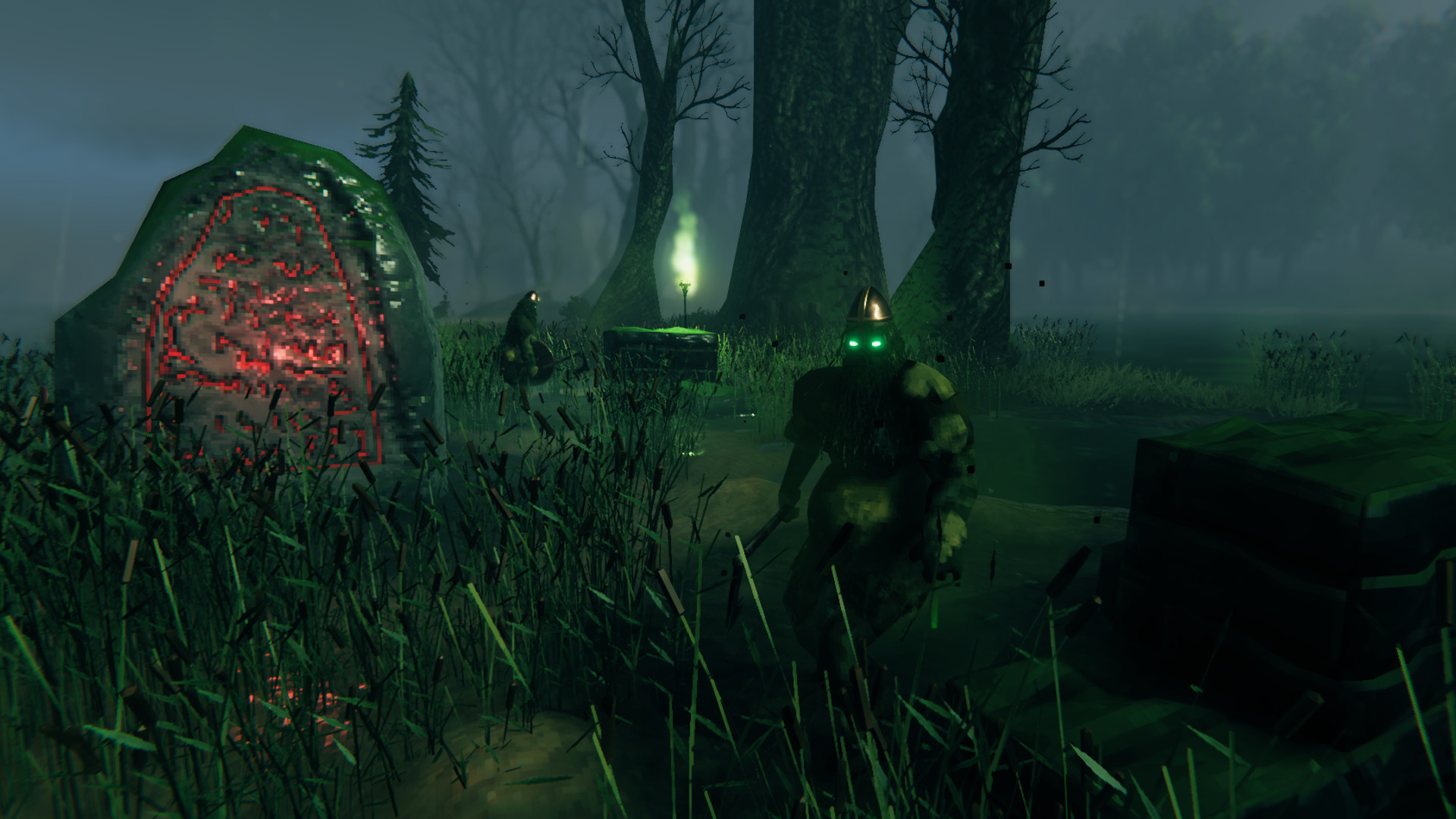
The fighting system can only really be as good as the enemy design, and Valheim doesn’t really disappoint in this regard. You’ll get to take on a variety of creatures, from animals to more mythical things like Greylings, the latter of which essentially serve as your main encounters in the early-game. Eventually, you’ll start taking on more powerful enemies, like trolls, shamans, and ghosts. The true highlights of the game, however, are the boss fights. Along with having their unique attack styles to deal with, you will also need to ensure that your resistances to various effects are up to par. The Swamp biome’s boss, Bonemass, for example, deals an incredible amount of poison damage. Fader in the Ashlands, on the other hand, focuses on fire damage.
The combat has also seemingly gone through a fair bit of balance changes to ensure that magic doesn’t feel like the only way to viably take on major fights in the late-game. I largely stuck to a melee-centric playstyle, allowing me to take on most challenges just fine. Sure, I died to bosses plenty of times, but that’s par for the course regardless of your build until you actually figure out the boss’s attack patterns and abilities.
Valheim also has a great way of encouraging players to build up their houses beyond making it simply functional with four walls and a roof. Each structure has a Comfort level associated with it, and having high Comfort also means that your character gets the appropriate level of the Rested state. As you get deeper into the game, the buffs offered by being Rested can be quite useful, since you get bonuses to health, stamina and Eitr regeneration, as well as a boost to XP gained from doing just about anything. The duration of the Rested state depends on your Comfort level, which can be further raised by adding decorations and furniture to your buildings. At its most basic, one level of Comfort can be achieved simply by having a warm fireplace and some shelter.
"Valheim also has a great way of encouraging players to build up their houses beyond making it simply functional with four walls and a roof."
Exploration in Valheim tends to be a mixed bag. Depending on the biome, you’ll either have to deal with large stretches of nothing really happening aside from you running around and hitting trees, punctuated by a few seconds of combat. When you do find something interesting, it can feel incredibly rewarding. Abandoned towns, for instance, can often be home to chests that will give you a plethora of new materials that will boost your general progression.
Further into the game, you might even end up running into a dungeon full of enemies to take on. The dungeons themselves aren’t particularly deep when it comes to gameplay, and you won’t be seeing much in the way of puzzle-solving here. However, they still tend to be quite enjoyable since you get to test out your combat capabilities against a variety of enemies.
After you’ve killed the Eikthyr, you will have essentially conquered the starting island, and will find yourself with a need to set forth to a new location to discover brand-new materials that can be used to craft stronger equipment. Valheim generally follows a relatively linear progression of biomes that start getting more challenging – and often more tedious – the further you go.
While Meadows and Black Forest essentially share an island, giving you plenty of time to explore your immediate surroundings after spawning into the game and getting your hands on some decent gear as you take on boss fights, you will eventually find yourself needing to find or craft a boat that can take you to other islands, and this is where the biome progression starts to shine.
Assuming you got your hands on the Swamp key that allows you to enter the biome, you’ll eventually find yourself staring at mountain peaks in the horizon, which gives you the next mid-term goal – the Mountains biome. Similarly, players who prefer sailing can instead make it their goal to find the island with the Plains biome. This essentially marks the mid-game point of Valheim, and you’ll be spending much of your time in these three biomes as you slowly build a steady supply of consumables and equipment before taking on the next challenges.
While the Meadows, Black Forest, Swamp, Mountain, and Plains biomes are relatively mundane and present the kinds of environmental challenges you’d expect, the general quality starts diving down once you’ve made it far enough into the game to reach the Mistlands biome.
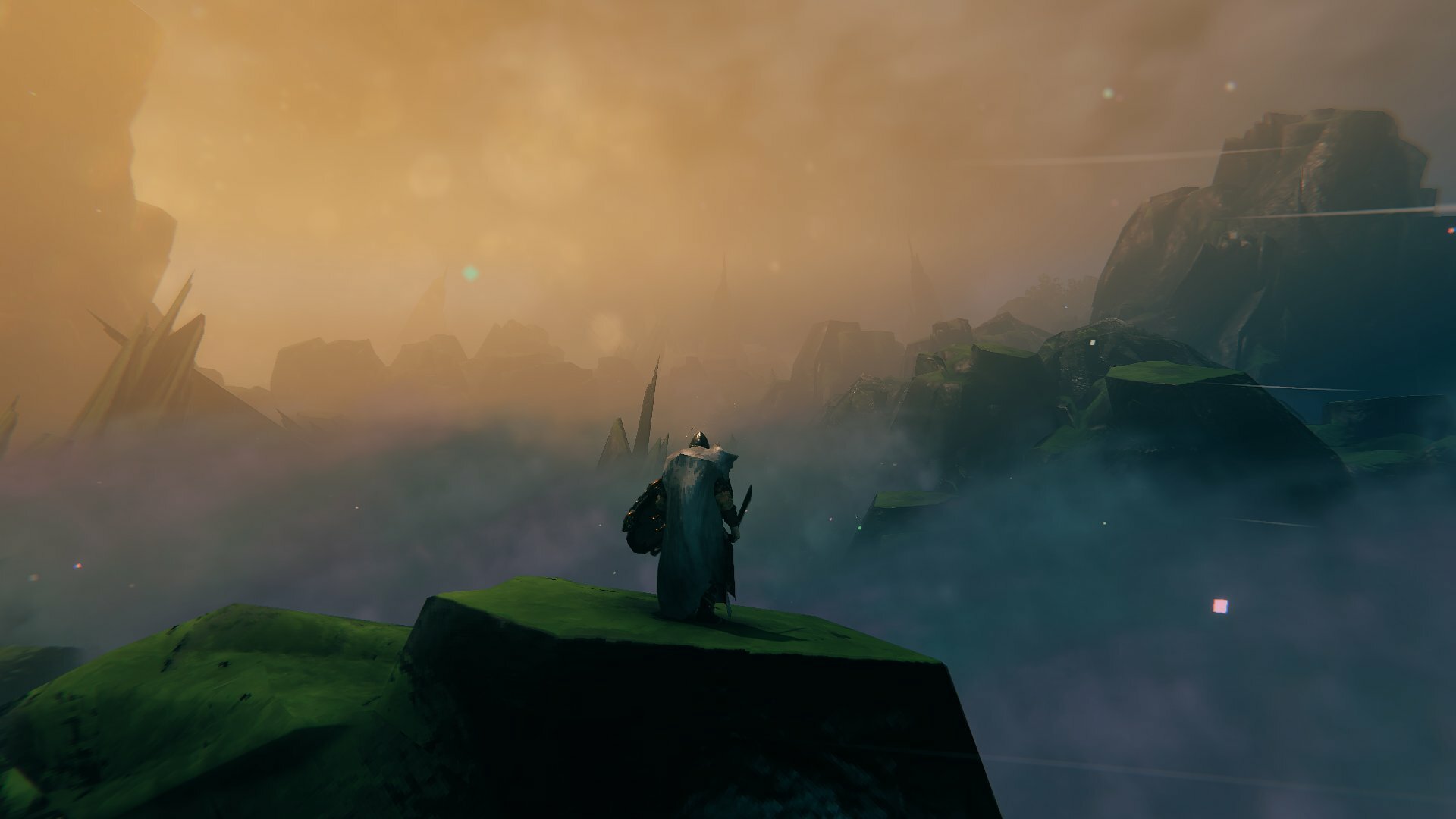
" I found the Mistlands biome to have actively detracted from my general enjoyment of playing Valheim."
Mistlands, as its name implies, has a permanent layer of mist throughout the biome, making standard exploration borderline impossible. To deal with this, you have to get your hands on some bespoke equipment that serves little other function aside from making Mistlands more tolerable – the Wisp Torch. Using it, players can permanently clear out some of Mistlands’ mists. Unlike regular torches, the Wisp Torch also doesn’t prevent enemies from spawning nearby, so you can’t really replace your typical light source with it. The entire process feels quite tedious since you have to remember to throw down a new Wisp Torch on a regular basis.
Some of this tedium is alleviated once you can craft a Wisplight accessory that creates a fog-clearing radius around your character. However, this also means that you’ll have to give up an accessory slot that could have better been used for something like the Wishbone, which can detect hidden resource nodes, or the Haldor, which massively boosts your carrying capacity for precious resources and gear. The accessory also has its own minor issues, like the fact that the small Wisp orb follows you around, which means that taking a sharp turn will end up separating it from you for a moment, making you vulnerable to the mist. Generally, the accessory also ends up feeling like a half-measure for a mechanic that adds little else aside from tedium.
This ultimately results in a region that, while initially interesting to explore thanks to the mist adding quite a bit to the overall atmosphere, starts feeling exhausting to travel through not just for your in-game character, but for you as a player as well. Despite the initial excitement of having discovered a new region, I found the Mistlands biome to have actively detracted from my general enjoyment of playing Valheim. The region takes a massive step in turning exploration – a tense and often joyous part of the core gameplay – into a tedious affair since I now had to juggle different kinds of torches just to be able to see things.
Thankfully, the boss fight that caps off the Mistlands – The Queen – is an enjoyable experience that involves delving into and fighting your way through an entire dungeon. The problems created by the biome’s verticality have also been somewhat mitigated with the introduction of the grappling hook. However, as a whole, Mistlands represents a major point where you might essentially halt your progression through the game since it’s just so tedious.
The follow-up – the Ashlands biome – doesn’t really improve things, and starts off on a poor note by looking a bit boring. Thankfully, it doesn’t really have a gimmick like the mist, making exploration generally more straightforward and enjoyable. Considering it’s a lava-filled zone, however, playing around in the Ashlands isn’t quite a simple task. Roaming around can be dangerous, and even building structures becomes more challenging since the extreme heat and cinder rain causes structures to quickly deteriorate.
You can’t even sail to the biome on a typical wooden boat; you’ll have to use the Drakkar from The Queen to survive the journey across boiling hot water. The need to deal with the biome’s unique terrors with things like shield generators also starts feeling fairly tedious at a certain point, making Ashlands as a whole feel like just a minor improvement over Mistlands.
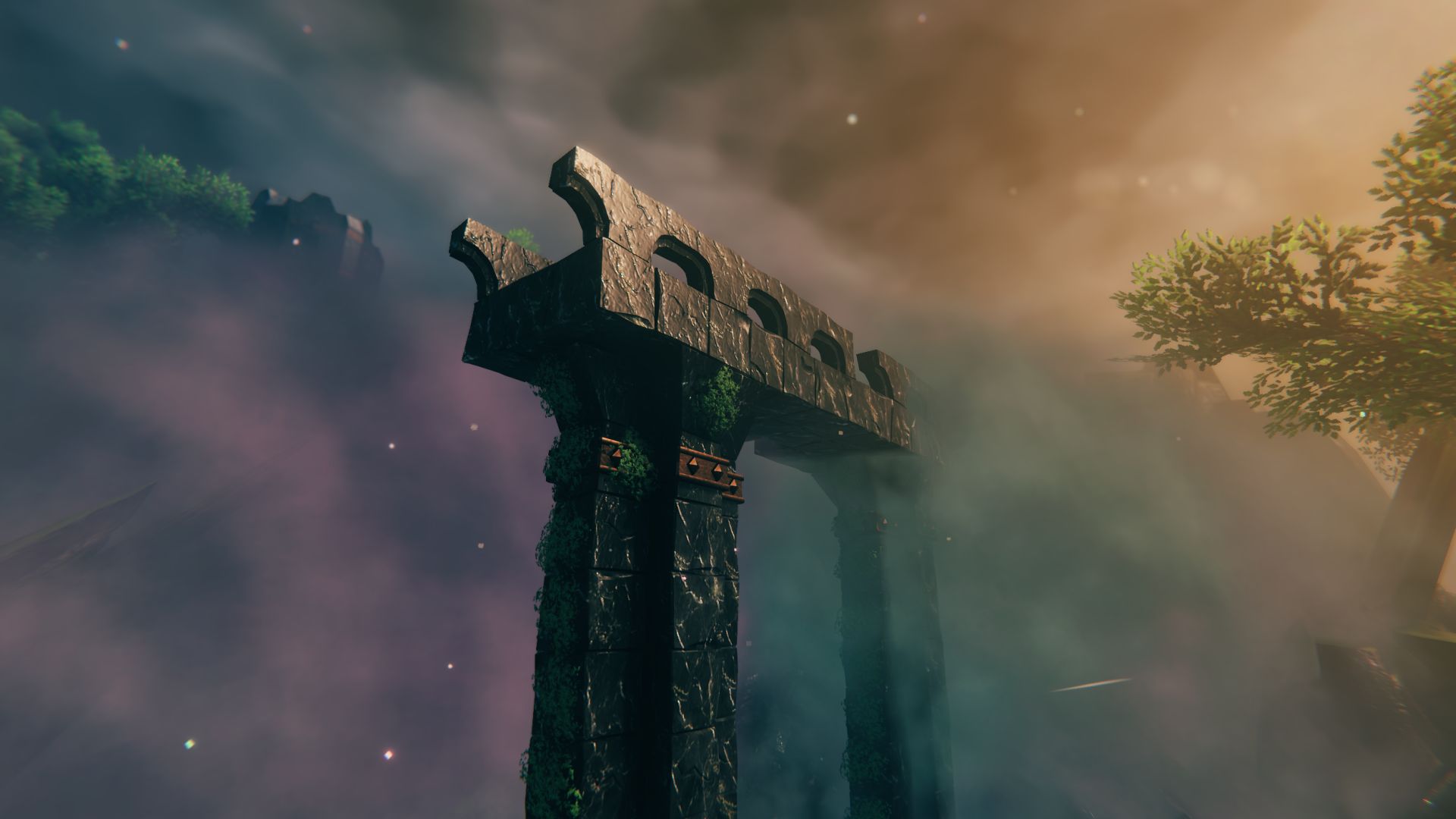
"Mistlands represents a major point where you might essentially halt your progression through the game since it’s just so tedious."
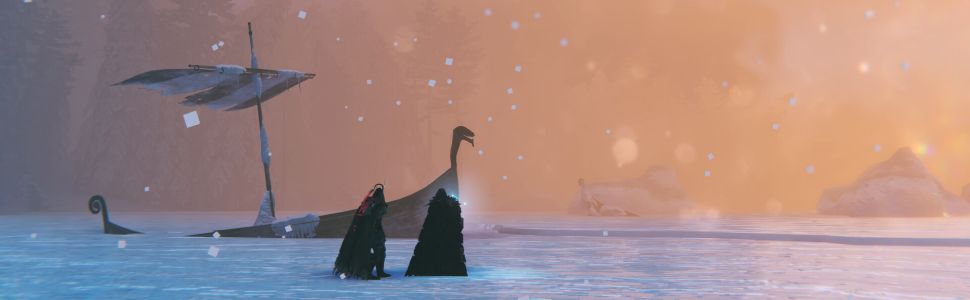
The latest – and possibly final – addition to Valheim‘s ever-growing list of biomes is the Deep North introduced with 1.0. Offering a sharp contrast from both Mistlands and Ashlands, Deep North is downright gorgeous, especially when you first manage to get there. The snowy region has plenty of awe-inspiring sights, from frozen beaches to haunting and sometimes creepy abandoned villages. The biome also presents a solid arc in the progression, slowly ramping up the danger as you get deeper into the region.
Aside from the biting cold of the biome, the biggest new challenges presented by the Deep North are in the new types of dungeons that can be found if you explore some of the ruins scattered around the area. These dungeons aren’t optional either; story progression will need you digging deep into the ruins, and even tend to be some of the best spots to find the biome-specific materials that can be used to craft a variety of new equipment.
Generally speaking, Deep North feels like a phenomenal addition to Valheim, wrapping up its general exploration and combat loop quite well in the process. Despite its emphasis on ice and snow, the biome never really feels boring, and the fact that it doesn’t have any particular gimmick that does little aside from adding to the tedium of gameplay makes it a genuinely enjoyable place to explore. There’s also a fair bit of verticality here, making the grappling hook even more useful as you get closer to the end of the journey. The biome also has plenty to offer, with a progression system that revolves around slowly making your way through the new Gates of Mokhalla dungeon, each door requiring a bespoke key you craft.
The progression of Valheim from biome to biome feels quite natural; after spending quite a bit of time in any given biome, having discovered all of the materials and crafting recipes it has to offer, you’ll ultimately find yourself getting on a boat to look for the next island. Defeating bosses also helps in this regard, since items they drop often tend to naturally lead you into heading towards the next biome. More experienced players can even shuffle around the order of the biomes, and make their way to the Plains as soon as they find a boat, for example. The order of the biomes, interestingly enough, works well in terms of linear progression, while still giving players plenty of agency to decide their next course of action.
Unfortunately, one of Valheim‘s biggest weaknesses – its building system – hasn’t really been fixed with the 1.0 release. Structures can still feel awkward to build out, with pieces like walls or roofs only being placeable at particular angles. While it offers a considerable level of freedom in how you build your structures out, the general process often feels quite awkward. Finding the correct camera angle and position to build even a basic four-walled house, for example, leads to plenty of poking and prodding to make sure that you’re in the right place and have your crosshair pointed at the precise location. If your roof happens to be too high up, you might even end up having to build a set of temporary stairs.
The steep material cost for building these things also tends to feel quite grindy, especially when playing solo on default settings. Co-op mitigates this quite heavily, since players can freely share not only materials, but structures as a whole with each other. Thankfully, Iron Gate has also provided plenty of options that allow players to alter how materials can be found, and if you’re playing by yourself, I heavily recommend making use of this feature to increase the drop rate for just about everything.
I should note that building my first shelter took me almost an entire hour on default settings just because of how annoyingly little wood drops early on when you can cut down entire trees. Similarly, other aspects of early progression also feel much slower than they should. As has been the case with most games in the genre, while solo play in Valheim is perfectly doable, co-op has always felt like the ideal way to play, since spending some time with friends is also an excellent way to alleviate the boredom that can arise from downtime when you’re building or exploring the world.
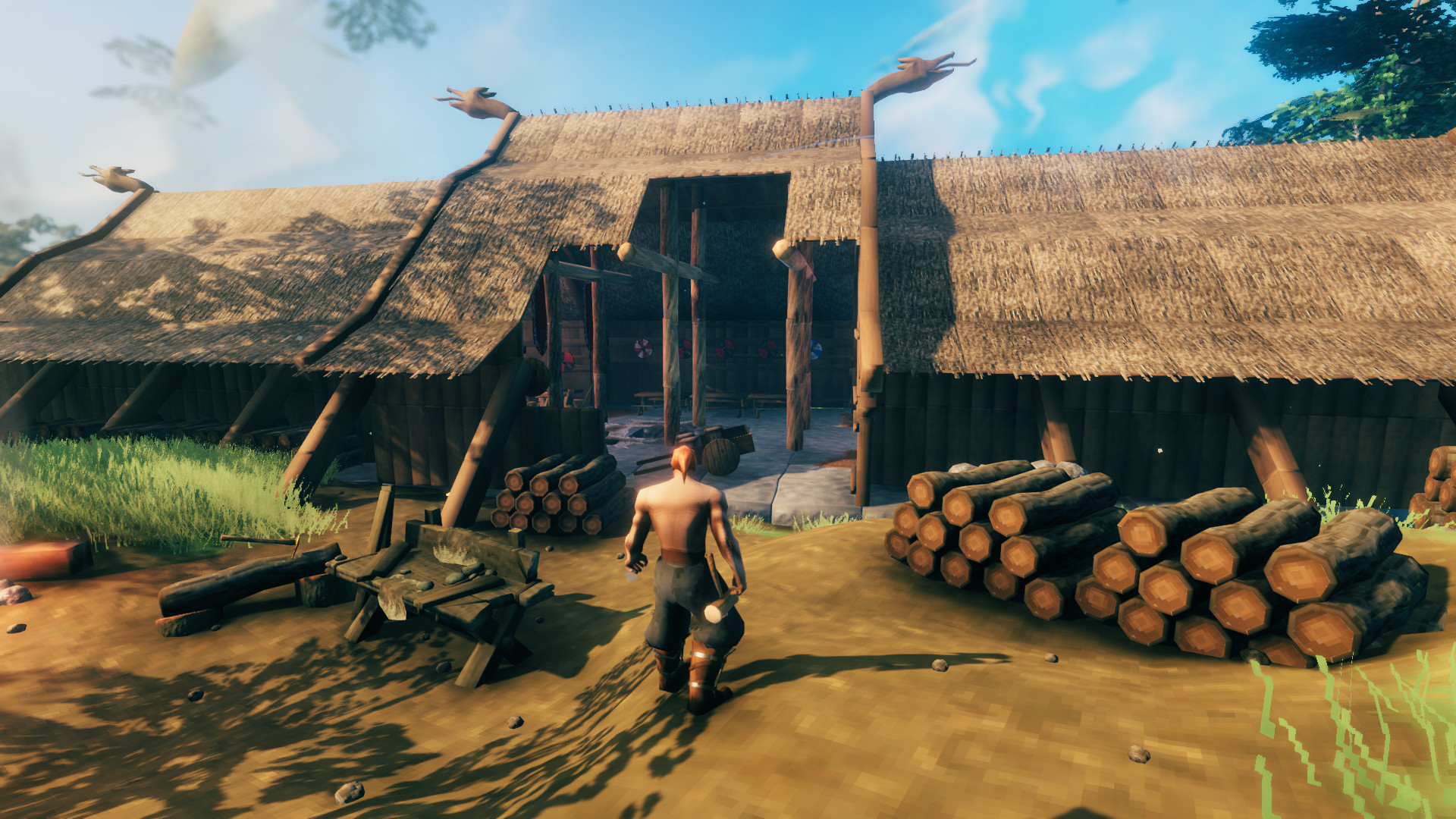
"While solo play in Valheim is perfectly doable, co-op has always felt like the ideal way to play."
On the plus side, the building system is quite in-depth, and offers plenty of room for player expression with a variety of material styles that can be used to give your structures distinct identities. Larger rooms also require proper structural supports to prevent parts of the structure from collapsing. Along with this, you also get plenty of decorative items, and even thrones, that can be placed throughout your settlement. Aside from looking cool, these items also contribute to the Comfort level offered by your base.
The building system also ties into the farming system, since you’ll get the ability to plough fields with a hoe and set up your own little farm to make sure that you have a steady stream of edible food. The farms can also be decorated to quite an extent with structures like fences and statues. All in all, despite a little awkwardness when it comes to putting together structures and habitats, the building system offers an impressive level of freedom.
With much of Valheim‘s core gameplay loop revolving around creating friction that players have to learn to overcome by themselves, the general quality-of-life features throughout the game are welcome additions. Along with intuitive menus and a progression system that never gets confusing, the title also eventually allows you to build and use portals to get around the world in quicker ways. Things don’t get too easy with portals, however, since, depending on the type of portal, some materials won’t make it through to the other side. While I personally found this to be a key aspect of how well Valheim balances the line between important gameplay-enhancing friction and tedium, players who don’t want to bother can simply change a setting in their World’s options to allow materials to be carried over as well.
The UI as a whole also felt quite well thought out, with your inventory grid giving you a good idea of what you’re carrying and how much free space you have left. The weight system also doesn’t really feel too oppressive, and even at the base level, a character can walk around with an incredible amount of materials and equipment. Sorting through chests is also relatively painless thanks to shortcuts allowing you to move entire stacks of items around.
The 1.0 release of Valheim also runs quite well. While I never had any performance issues with the game even during its Early Access days, the latest update has been running smoothly at 144 FPS and 1440p on a PC with an AMD Ryzen 7 7800X3D CPU, 32 GB of RAM, and a Radeon RX 7800XT GPU. Performance dips only came about when the game was autosaving, and only lasted for around a second before things went back to normal. Even loading in new biomes never really created a dip in frame rate while playing solo. When it comes to co-op, however, things will end up depending on the horsepower of the system running the server.
Speaking of which, Valheim has quite a bit of emphasis on being immensely replayable. Along with being able to generate a brand-new world whenever you want, you also get plenty of options to fine-tune how your new world works, like seeds that can be used to procedurally generate precise copies of others’ worlds, as well as a variety of modifiers, like how often you get raided by enemies, how many materials drop, and even whether or not portals can allow materials to travel alongside you. These options also give another way for the more creativity-minded players to enjoy the building systems by, for example, essentially removing all costs associated with buildings.
Valheim is currently in the best state that it has ever been, and new additions like Deep North and the grappling hook go a long way in alleviating the still-present issues with Mistlands and Ashlands. When it comes to long-term play, however, many players will likely find themselves dropping off the progression curve around the time they reach Mistlands, and I can’t really blame them.
The biome still represents Valheim at its most tedious, and things haven’t really changed enough in that regard even with 1.0. That major sore spot aside, however, Valheim also provides plenty of ways for players to manage the precise level of tedium they might want to deal with when it comes to material drop rate, which is a welcome addition to just about any survival crafting game. While some might enjoy the long grinds for logs and stones just to build a small house, I personally think the sheer amount of time you spend getting even simple materials feels like unnecessary padding.
This game was reviewed on PC.
Deep North is an excellent new biome that caps off the game in a satisfying way; The core gameplay loop of gathering, building, and boss fights remains engaging; Even solo play is quite fun thanks to the dense atmosphere throughout Valheim; The grappling hook is fun to use.
Mistlands and Ashlands remain major pain points and progression blockers; Early game material gathering can feel quite tedious.