






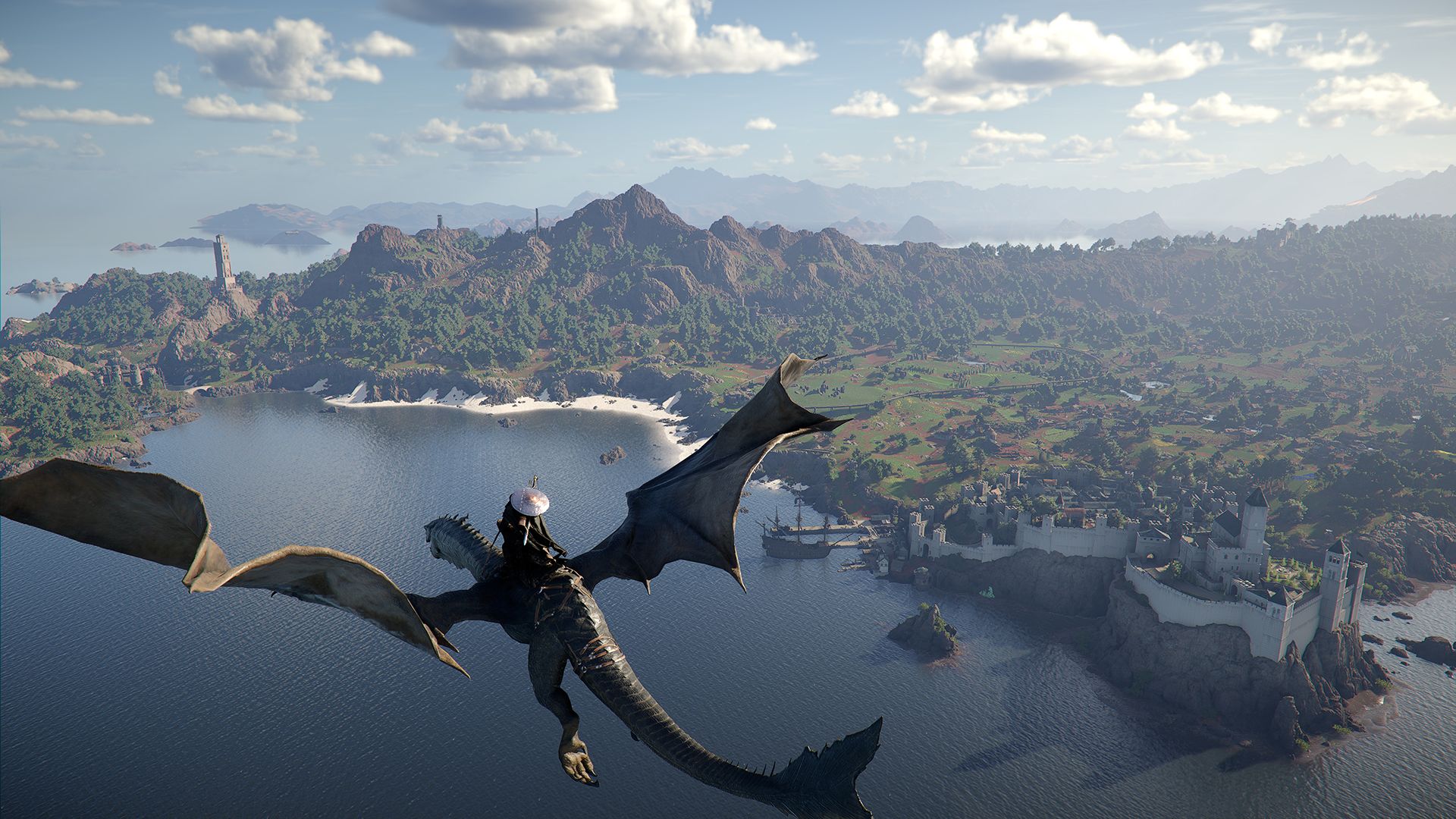
Whether you’ve been following it since the first gameplay primers dropped or watched the latest overview trailer, everyone can agree that Crimson Desert is a massive game. Pearl Abyss has spoken about how the world of Pywel is bigger than Red Dead Redemption 2’s map, and at least twice the size of Skyrim’s playable open world.
But video games, like many things, are constantly subject to the numbers game. How long is the experience? How many hours? And while marketing and strategic planning expert Will Powers didn’t provide a figure when speaking to Destin Legarie (transcription via WCCF Tech), he offered more context on how massive the experience really is.
“Respectfully, I dislike this question,” he said, regarding how long it would take the average player to clear the campaign. “I understand why it is asked, but players devour games in different ways. Some barrel through the main campaign immediately, but providing a specific number is difficult. If I give a large number, parents with limited time may feel discouraged or intimidated by the game.
“Conversely, students with more free time might find the same number too small. Regardless of the figure I provide, it feels like a losing proposition. I have been consistent in my refusal to provide a specific number, but I can say the game is massive. What I appreciate about it is the flexibility; you can choose what to do in each session based on your available time. There is a constant sense of progression and reward, even in the smallest activities.
“Last week, I spent 50 hours playing the game. I sat down and played for 50 hours, focusing primarily on side content. I was not even fishing; I was mining, upgrading weapons, and testing mechanics. Since there is a set difficulty for all enemies, you can grind to overcome challenges through sheer willpower if you choose. This is an intended design choice.
“We never want a player to feel they must simply ‘get good’ to proceed. If you invest time, you can beat everything. Alternatively, an incredibly skilled player could run right through it. The game should not prevent progression simply because a player does not understand a specific mechanic.
“It is impossible to provide a definitive answer for open-world games because people rarely follow only the critical path. However, the main campaign represents only a small percentage of the overall content. For me, the game truly expanded after the credits. I realized I had barely scratched the surface of certain factions and their entire quest lines.” Which is pretty crazy, considering there are dozens and dozens of factions in the game.
“Because I work on the game, I am aware of the available content,” continued Powers, “Yet even after finishing the story, I realized I had missed entire areas because I was too focused on the main path. There is a vast amount of content to return to, including deep customization options and systems to invest time in. The developers’ approach was to create an open world that encourages exploration. Their strength lies in creating emerging, immersive worlds where players can spend thousands of hours.”
Hearing that Pywel offers an extensive amount of content aside from the core story isn’t too surprising, but the fact that the latter comprises only a “small percentage” of the game? That’s pretty nuts. How many unique weapons and equipment can players discover? What kinds of hidden boss fights exist? Is there a mount that surpasses the Dwarven-engineered mech and dragon seen thus far?
You also need to factor in that there are two other playable characters aside from Kliff with their own unique skills and weapons. Regardless of how many hours players end up spending, I stand by what I said earlier: Crimson Desert’s world is looking like an all-timer, and I can’t wait to see more.
Fortunately, we won’t have to wait very long since it launches on March 19th for Xbox Series X/S, PS5, and PC. Graphics options on consoles have yet to be detailed, but PS5 Pro support is confirmed.