





If this Xbox Developer_Direct proved anything – aside from the fact that Game Freak can make a visually gorgeous title when given the opportunity – it’s that you should never bet against Playground Games. Opening the show with Forza Horizon 6 and showcasing its gorgeous take on Japan is one thing, but the main attraction was Fable. As Xbox’s biggest game this year, perhaps of the past many years, it had to deliver, never mind living up to the legacy of Lionhead’s classics, and after so many delays, surely something had to give.
But lo and behold, Playground knocked it out of the park.
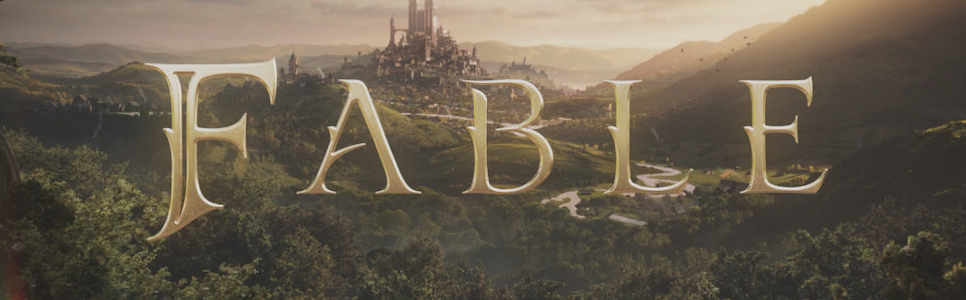
Currently set to launch this Autumn for Xbox Series X/S, PC, and PS5, Fable isn’t necessarily a reboot or a remake so much as a new beginning. It’s the development team’s take on Albion with the core fantasy of “go anywhere, do anything, be anyone.” Role-playing is such a fundamental core of the franchise, but its particular brand – that of living in a fairytale – exists in a different stratosphere beyond other greats. And yet Playground Games didn’t just execute on the appeal of the originals – it’s evolving the formula in some meaningful and genuinely innovative ways.
Take the morality system, for instance. For decades, video games have followed the same principles – do something good and people love you, but do something bad, and you’re scorned. Between completing missions to build a reputation, there have been morally grey decisions which teeter on the edge of choosing the lesser evil or committing sins for the greater good. With Fable, the development team decided that morality isn’t a “sliding scale” but what others think of your actions.
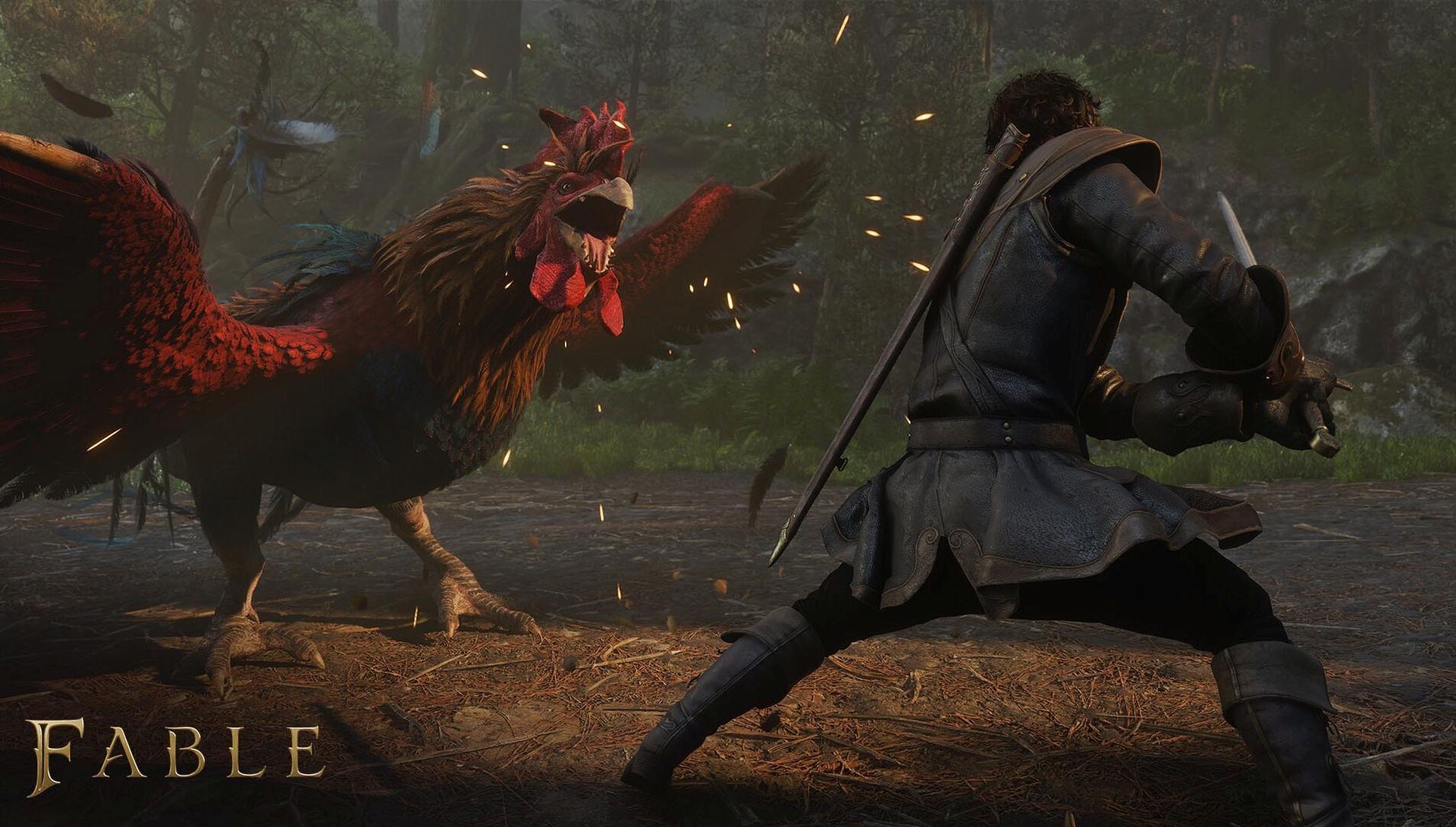
Going around and assailing chickens, a franchise staple, earns you that unique title if at least one person sees it, but that doesn’t mean everyone will disapprove. In Fable, morality is in the eyes of the beholder – having a reputation for one thing could make you well-liked in one place and despised in another. It sounds simple at first, but with over 1,000 handcrafted NPCs, there’s a whole lot of variance in how the world perceives you.
But what if you gain a reputation for other things? What if you’re a thief in one settlement and a gentleman (or lady) in another? Well, people will perceive you differently, allowing you to carefully curate multiple identities based on your actions, just like in the real world. And once again, not everyone may like you, even if you’re the nicest, most benevolent landlord in town.
That’s another aspect which has me so tickled. If you’re looking to be a hero for hire, slaying cockatrices and Hobbes, maybe spend some time blacksmithing, go right ahead. But you can also become a landlord and just buy up all the properties. Walk into a business, and they’ll address you as “boss.” You can also own a house that someone rents and then evict them. So while several people will echo your greatness and generosity through the streets, there’s that one guy who hates your guts because you evicted him for fun. Maybe that reputation will spread as you wrong others, but slip a few coins to the town crier to sing your praise, and it won’t really matter.
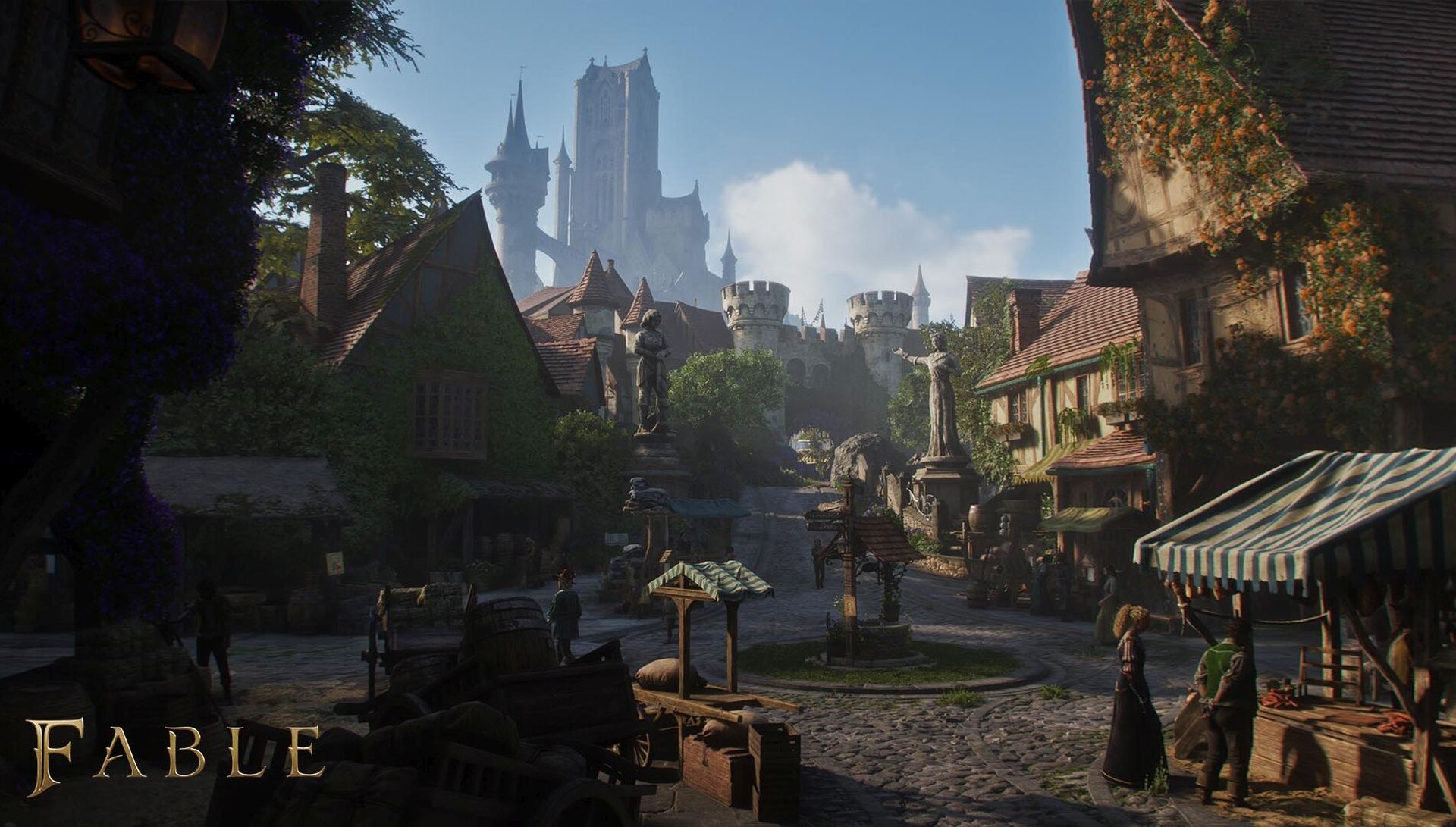
The fact that there are over 1,000 handcrafted NPCs, each with their own backstories and fully voiced conversations, is already impressive enough (and yes, they actually have schedules, getting up at set times to go to work). But being able to interact with them on this scale, forging not just a single heroic legacy but multiple, based on how they view you, is awe-inspiring. These alone explain why Fable took so long to develop.
And yet, there’s even more.
There is a set path – a hero’s calling, if you will – where the player awakens their powers and pursues a mysterious individual after their grandmother and village are turned to stone. You’re told to seek the Heroes’ Guild in Bowerstone, and yet, you can forego that entirely to just go anywhere. From the very moment that you set out, the entire world is open. No restrictions. It’s effectively about the kind of story you want to write for yourself, and how to go about achieving that.
If that means subjugating entire settlements by becoming a tyrannical landlord, then so be it. However, it could also mean dealing with that giant on the outskirts of town, and deciding whether he should live or die, thus highlighting yet another classic: Actions have consequences. I can see myself earning a reputation as a “giant slayer” for taking him down. It’s also possible that others will view me as a nuisance because now his big, fat corpse is littering the countryside (and I don’t even want to imagine what the smell will be like). Will there be violent disagreements over whether I was justified or not? Time will tell, but I wouldn’t be surprised.
Granted, there’s still a lot that’s yet to be revealed in terms of balance, since Playground didn’t want player level to inhibit where they go. I also need to see more of the combat, but right now, the fact that enemies can accidentally hurt each other is already promising. Just like the rest of the game, you can choose a fighting style that best fits already has me intrigued. Based on what we’ve seen, combat looks crunchy, although some additional polish is definitely needed when it comes to overall animations.
And yet, that doesn’t diminish how beautiful the world of Albion looks. Throughout the years, hearing that Fable would take cues from The Witcher 3 in terms of its combat had me somewhat worried. Was the development team going to ape all aspects of fantasy from CDPR’s classic, and slap the Fable name on it? Much to my relief, no. Fable embraces the fairy tale aspect of the franchise with aplomb – from the art style and the events to the humor and the personalities.
As much as I would like another massive open world to explore, 2026 already has me covered on two fronts with Crimson Desert and Grand Theft Auto 6 (assuming the latter isn’t delayed). Microsoft needed Fable to really stand apart and justify pulling others in – a day one launch on PS5 is nice, but it needed even more. From a skeptic who side-eyed this game for years, wondering if it grew too ambitious for its own good, I think it’s safe to say that Playground Games has pulled it off.
There are still so many ways that it could go wrong or end up falling short (or even cause a delay). For now, though, Fable looks to be living up to the years of hype around it. In a way, it’s great that the team held off on really showcasing everything until it was good and ready, and the fact that we’ve seen all this without knowing anything about where the story could go, who the big bad is (if they exist) or what other stories await is as enticing as it is scary. Even character creation, a staple of every game in the franchise, was only lightly touched on, but the results are impressive enough.
I won’t go as far as to say that Xbox is saved or anything, but one thing is for sure: Fable is back, and Playground Games may finally deliver on its ambitious premise.
Note: The views expressed in this article are those of the author and do not necessarily represent the views of, and should not be attributed to, GamingBolt as an organization.