






It’s funny how Returnal, a game that lacked many of the essentials many would expect from a roguelite, ended up becoming one of my favorites in the genre. Heck, it also became one of my favorite bullet-hell titles. I never really thought it would get a sequel, or even what Housemarque could do if it did. But then along comes Saros.
If you’ve seen even the most basic smidge of Returnal gameplay, then Saros will be immediately familiar. The multitudes of bullet patterns, sometimes forming a rose-colored bath of death; the HR Giger-esque architecture in locations, be it mechanical or vaguely human-like; the profile of a protagonist who isn’t all that he seems; and, of course, the hunger to know more, long after the credits roll.
However, Saros doesn’t just emulate Returnal’s mechanics; it expands upon them. You could have told me that it’s just a bigger, more feature-packed version of that winning gameplay, and I would have never been more locked in. The best part is that Housemarque goes even further, leveraging its brand-new setting and characters in intriguing ways while exploring the various depths of madness humanity can sink into. And it does all of this while still delivering some of the best third-person shooter/bullet hell-like gameplay out there, if not the best, packaged within this entrancing narrative – at times flitting between a dream, and at others, a confusing nightmare.
"But Rahul Kohli is the clear star, and he’s able to turn in an understated, reserved performance, and gradually turn things up when the cracks begin to form. And that will happen, slowly, gently, as you speak with your companions between runs or indulge in cinematic cutscenes."
It all starts with Arjun Devraj waking up in an unknown location on Carcosa, as he dons a sun necklace and presses forward. Sadly, a painless death isn’t what awaits, as he quickly succumbs to the planet’s horrors before being sent back to The Passage. While empty at first, he meets a fellow crewmate, Tarn, seemingly driven mad by the Eclipse. Quick thinking on behalf of his commanding officer, Sheridan Bouchard (played by Jane Perry), ensures his survival, but things are far from peachy.
Other crew members emerge, shocked at Arjun’s return, and slowly, the whole sordid deal begins to unravel. The Soltari corporation sent expeditions, known as Echelons, to Carcosa to mine the valuable resource called Lucenite. But after no response from three of them, it’s on Echelon IV to investigate and find out what’s happening.
What it discovered was a world where the Eclipse rules, changing those under its spell, including the terrifying wildlife that roams the lands. Wanting to know what happened to the previous Echelons, Arjun sets forth into Carcosa, searching for answers. Of course, he has other motives for doing so – and even joining this expedition in the first place – which forms a major crux of the journey. But for now, he’s seemingly unaffected and driven to search for answers alongside potential survivors.
As you’d probably expect, the entire cast is excellent in their roles. Jane Perry is effortless as Bouchard, a commander who’s clearly out of her depth, yet trying her best to keep some semblance of command. Ben Prendergast adds some sense of stability in his role as Jerome, a fellow Soltari enforcer who’s surprisingly fatalistic. But Rahul Kohli is the clear star, and he’s able to turn in an understated, reserved performance, and gradually turn things up when the cracks begin to form.
And that will happen, slowly, gently, as you speak with your companions between runs or indulge in cinematic cutscenes. Saros has other ways to learn more about them and the rest of the world through logs, and hearing their pre-expedition selves explaining why they’d be best for the mission offers some much-needed context on their lives (and what they think of Arjun).
"It’s challenging enough to create so much variety in your average indie rogue-lite/like; that Housemarque is offering up these different sections with such immaculate architecture and presentation, while ensuring they’re distinguishable in at least one way from everything else, is incredible."
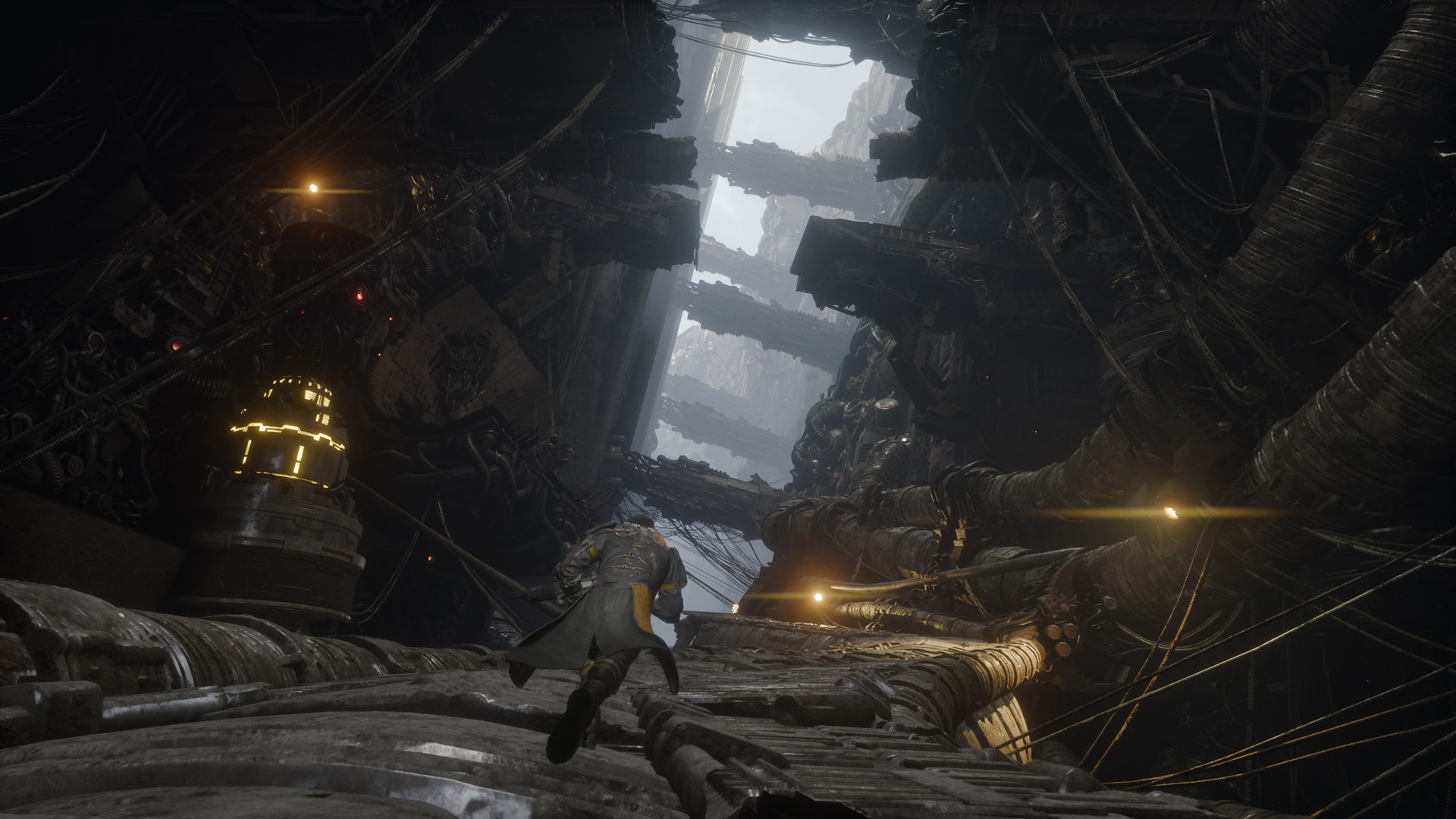
Of course, that’s only really the beginning, so it’s back to Carcosa, starting with the appropriately named Shattered Rise. Ruins of what was once a thriving civilization, intermixed with stunning vistas and ravines, offering only a taste of what the planet has in store (as above, not so below, and vice versa in many cases). Whether it’s the machinations of the Ancient Depths, their twisted tunnels packed with drilling equipment and sentient robots none too happy to see you, or the ever-mysterious city, Carcosa is simply brimming with gorgeous environments and architecture. The music is extremely well-tuned to it all, adding to the ominous tone when the action is more low-key but pumping out heavy, industrial, discordant beats during combat. It’s almost like you’re in a battle trance, and it’s awesome.
Then again, this is a rogue-lite, which means that the planet is constantly changing. Saros doesn’t take a fully procedurally generated approach to level design, but randomly arranges different hand-crafted sections for each run. One section could have two moving platforms, each towards a reward, and you need to pick one. The other could be a light puzzle that requires hitting some hidden switches to unlock a gate leading to a reward.
While having new sections to explore is always a good thing in a roguelite, sprinkling in parts that players have already experienced, especially in a game like this, requires a balance. You want players to feel like they’re mastering the biome without overwhelming them. Too many familiar-looking areas can dull any sense of wonder. Too much that’s new, and you start dulling the mastery aspect, making previous runs feel useless in the knowledge provided.
Saros strikes a seamless balance between the two – it’s almost like a feeling of déjà visité that scratches at your mind until you know what’s happening. It’s challenging enough to create so much variety in your average indie rogue-lite/like; that Housemarque is offering up these different sections with such immaculate architecture and presentation, while ensuring they’re distinguishable in at least one way from everything else, is incredible.
There are plenty of other ways that these biomes feel fresh, however. You’ll discover audio logs, holo logs and text documents from previous Echelons – and your own – talking about what’s happening. The Databank gradually fills up with messages regarding allies and enemies. And then there’s Carcosa’s environment itself, conveying the traces of past conflicts and other horrors beyond understanding between the odd mural or two.
"However, this is Housemarque, and it didn’t stop there because you also have the Corruption mechanic – another interesting twist. Usually, when the Eclipse is active, enemies will throw yellow projectiles at you, which reduce your max health on contact."
Things take a deeper turn when the Eclipse is activated, tinging the world in a reddish glow (to start with) as the walls sprout tentacles. These same tentacles will realistically bend around as you walk past them – another creepy detail, though it’s far from the last.
Plenty of other things undergo a transformation, which brings us to combat. You have a primary weapon and alternate firing mode to start with – certain weapons are autolock, with projectiles homing directly on enemies, while others require manual aiming. Like Returnal, the most basic means of survival is dashing and jumping over projectiles, and killing everything before it can kill you, which fuels your adrenaline and grants different buffs.
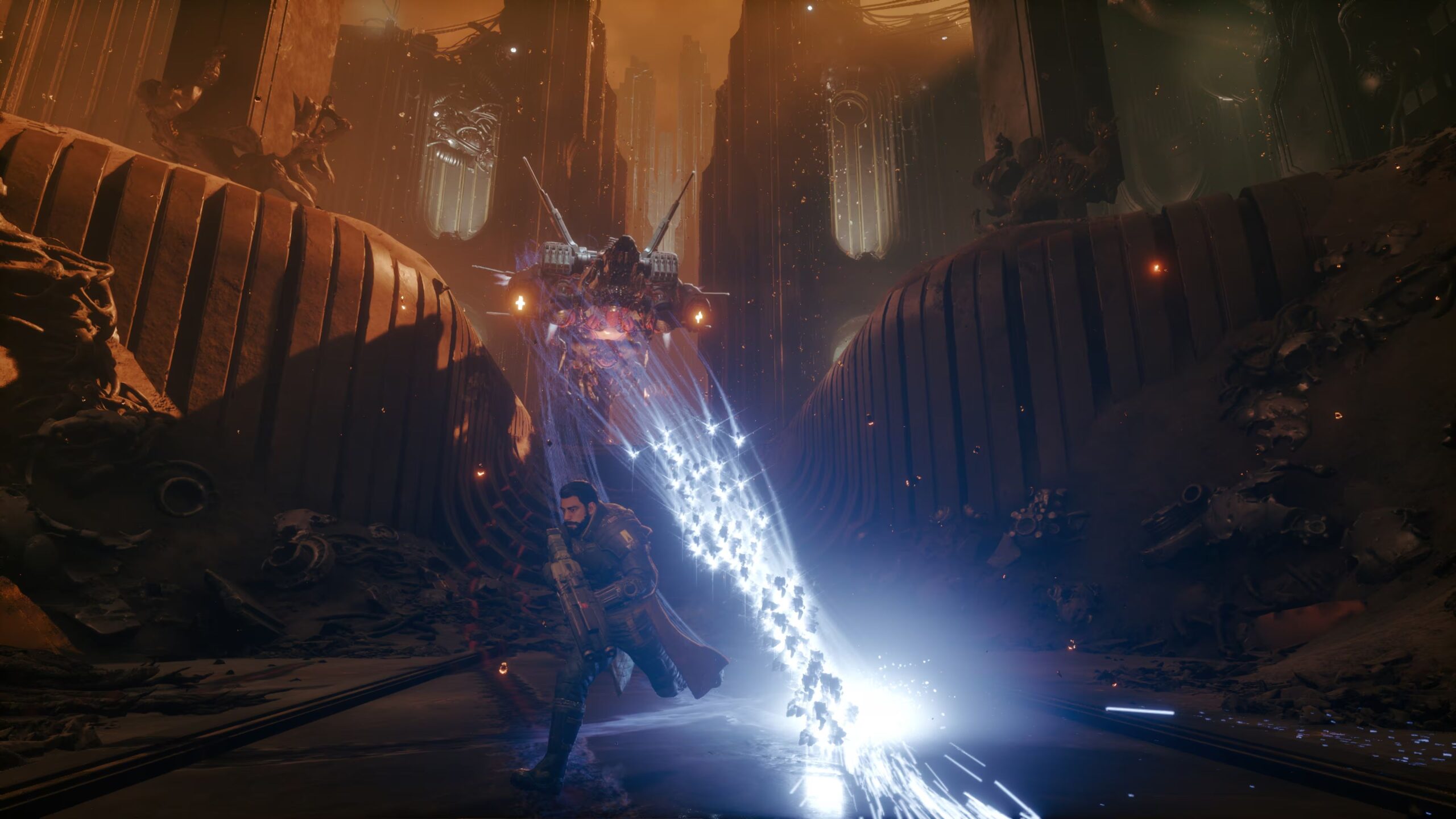
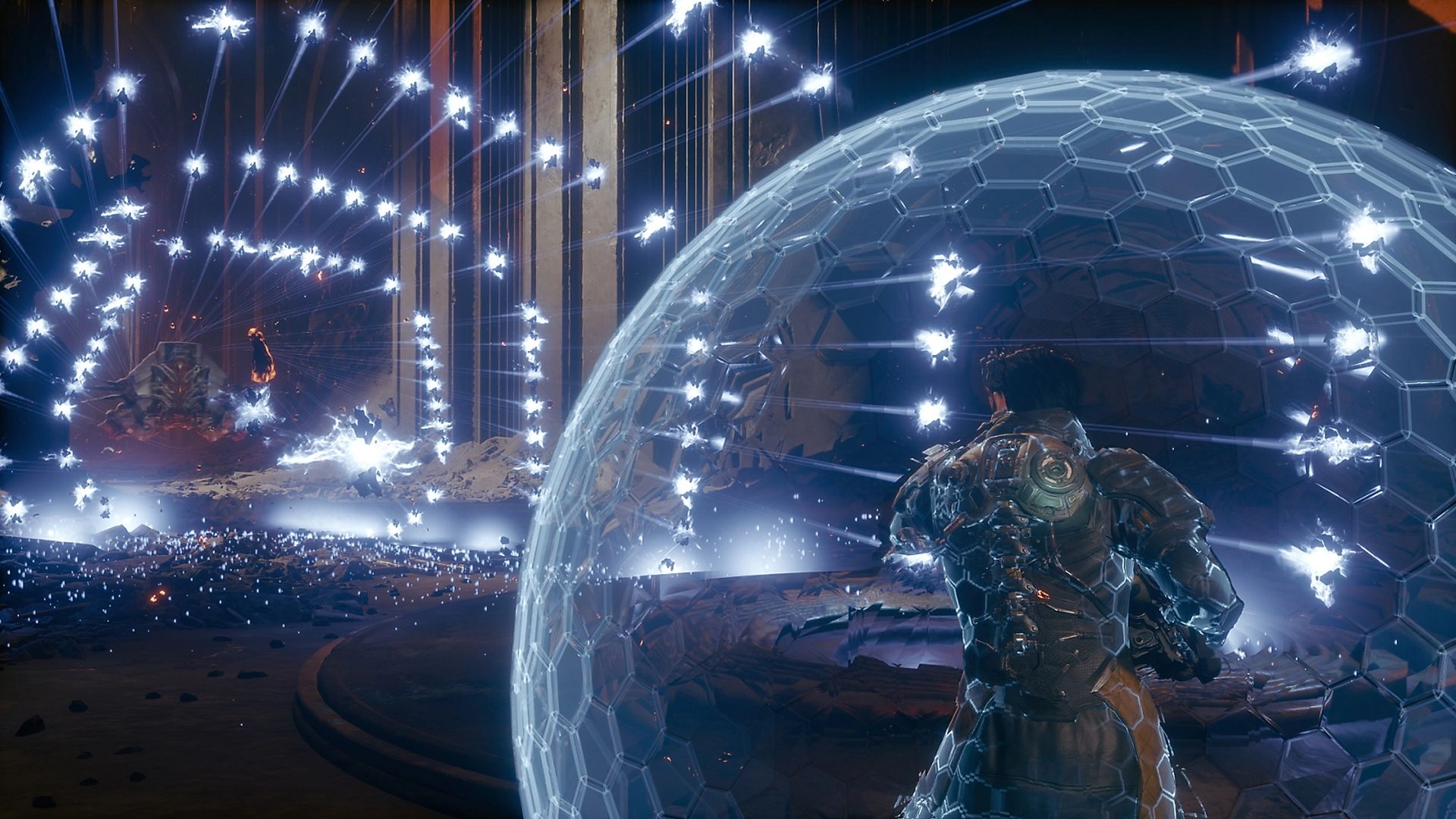
The biggest new addition is the Soltari shield. Ode to some of my favorite shmups, Ikaruga and Drainus, that included this mechanic, where you can absorb projectiles. Arjun won’t immediately unleash that power back at enemies here – instead, the projectiles fuel the new Power weapon. So right away, you’re looking at bullets as resources to harness. And while the starting Power weapon, Prominence, is ideal for some quick and dirty explosions, you’ll unlock other options, like the Dispiritor, which fires dozens of small homing projectiles that essentially infect an enemy. Kill them, and a small turret or tornado of the same cells forms, which can then infect other foes.
However, this is Housemarque, and it didn’t stop there because you also have the Corruption mechanic – another interesting twist. Usually, when the Eclipse is active, enemies will throw yellow projectiles at you, which reduce your max health on contact. This can be cleansed with Power weapon usage, even if you don’t get the health back (unless there’s an Artifact perk active). But then the ability to absorb corrupted projectiles becomes available, and it becomes a game of risk vs. reward, especially if you’ve already taken a few hits from the boss. Why not use that missing health to take on some Corruption, fueling your Power weapon in the process?
There is such a thing as being “too greedy,” however, and I don’t mean corrupting yourself so much that you only have a smidgen of health. Your shield has a duration, and any red projectiles or lasers – not to mention energy rings – will instantly break it, rendering you helpless for a period. But for me, it scratches that bullet hell itch, where pushing the limit is encouraged, and understanding the path to winning isn’t as exciting as consistently executing it. And if all this wasn’t enough, there’s also a parry mechanic, where you can deflect the energy from red projectiles back at enemies.
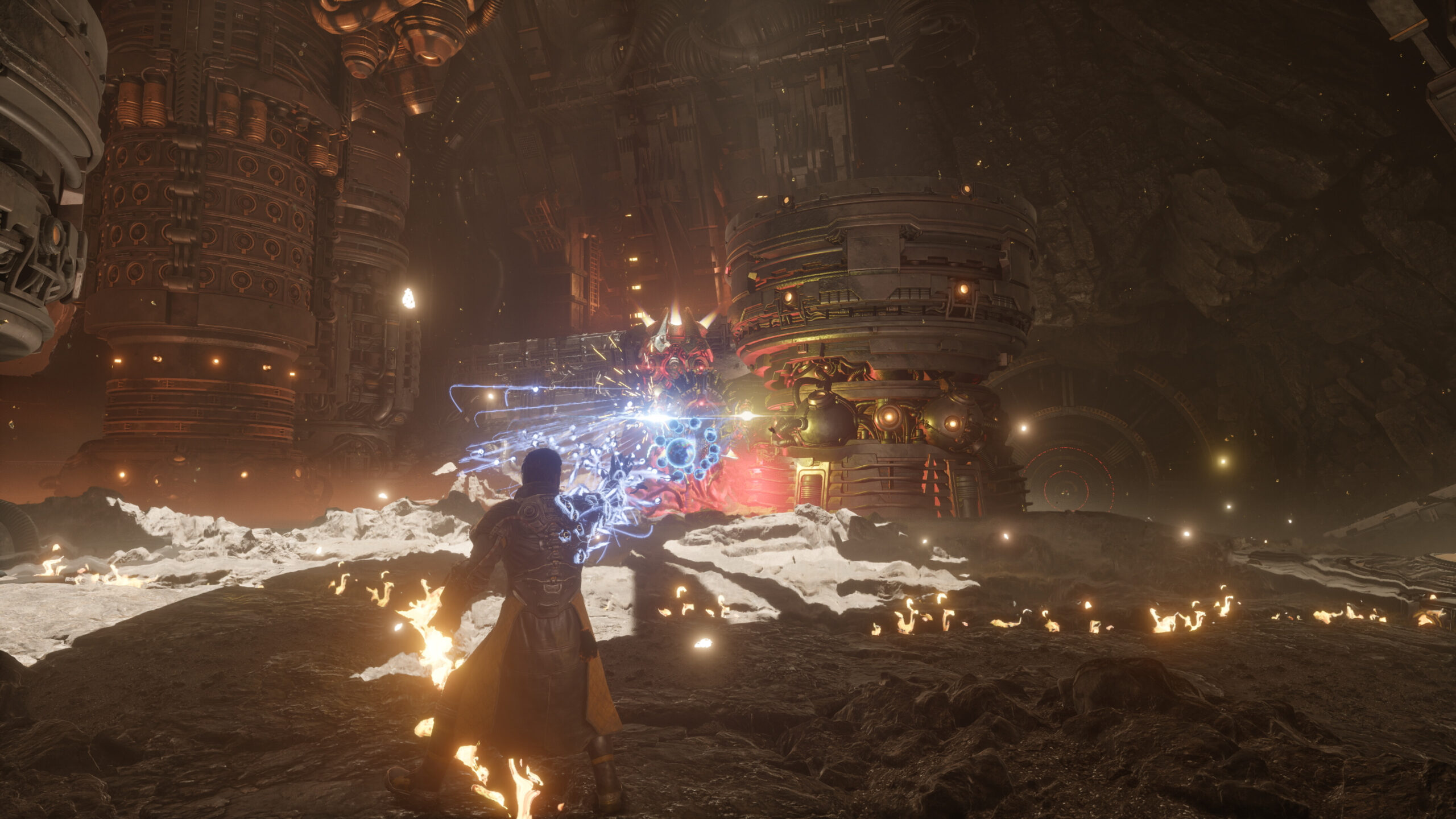
"If it wasn’t clear by now, Saros feels incredible to control, and thus accommodates a good many playstyles, whether you’re the type to hang back and pelt foes from a distance, using the environment as cover, or intimately understand what an enemy is going to do next before punching them in their face (or what appears to be their visage)."
If you can sense a shield turret is about to unleash a bloody rain, mark it as return to sender and blow them up from afar. So yes, on top of Drainus/Ikaruga, Housemarque added a bit of Sekiro into the mix, and it’s awesome, adding even more opportunities to harness bullets as resources. Absorb those corrupted projectiles for my Power weapon or punch the energy from red projectiles back at an enemy, potentially staggering them? Decisions, decisions.
If it wasn’t clear by now, Saros feels incredible to control, and thus accommodates a good many playstyles, whether you’re the type to hang back and pelt foes from a distance, using the environment as cover, or intimately understand what an enemy is going to do next before punching them in their face (or what appears to be their visage). Perhaps my only annoyances are when attempting to dash and accidentally riding a zipline or trying to pick something up, but the game slingshots me towards a grappling point instead, since they’re tied to the same button.
Its rogue-lite gameplay isn’t so much about crafting an entire build around a single primary or Power weapon – though some perk rolls are definitely better than others – as adapting to the circumstances. That also carries some risk vs reward, as you could take up a higher Proficiency weapon, even if it’s not your preferred type, for the sake of more damage and then try to reroll for something better. Maybe you’ll save those rerolls until the boss is next, and try for the best perk combo on a preferred weapon (which can also be done for Artifacts and Power weapons).
The only real drawback is that rogue-lite fans used to having extensive control over their loadouts may find it annoying that they can’t freely replace all of their Artifacts in favor of better ones during a run. You get one removal during a run – that too after several hours into the story – and that’s it, which lessens the desire to run through all the biomes rather than simply returning to The Passage. After all, why should one care about the slabs containing potential Artifacts when you can’t even pick them up, and your weapon of choice is more or less wreaking havoc?
Aside from returning to base and fast-traveling to and from any biome that you’d like, not to mention the ability to suspend a run and resume later, Housemarque accommodates players in many other ways. The Armor Matrix features a range of permanent unlocks, from increased health and shield duration to more Lucenite gain. Collecting Halcyon also nets other benefits, such as more Artifact slots, longer durations for Lucenite to remain on the ground, more health from Second Chance, and whatnot. It’s fairly easy to understand, but not super streamlined with branching paths for prioritizing the passives you want. It also remains fairly well-balanced, since you’re stopped by a node that requires defeating a boss to net further upgrades.
"A combination of several elements somewhat soured me on the ending, but it’s still a pretty strong story, one with some deeply overarching themes about human nature that kept me thinking hours after it was all said and done."
Then there are the Carcosan Modifiers, which essentially affect things like enemy damage received and dealt, whether Artifacts will carry negative effects, and so on. And while I appreciate this for essentially dictating the level of challenge that you want, you shouldn’t expect a Pact of Punishment-style progression system here. It’s simply for rogue-lite/bullet hell fiends like me who want to actually feel something when the base game isn’t doing it.
There are no extra rewards, extra lore bits (at least, none that I could uncover), nothing, which feels like a missed opportunity. On the bright side, it helps further mix up runs, like turning off the Armor Matrix and actually embarking on a more traditional, rogue-like loop, trying to decide which stat I want to lean into for my build, and really mulling over the different Artifacts.
Perhaps my biggest gripe with Saros is the ending. No spoilers whatsoever – no, not even a hint, but it simply left me wanting more. Sure, there will be plenty of logs to mop up, and I enjoyed going through everything to really assemble the full picture of what happened on Carcosa, but this style of storytelling is very much akin to Returnal.
It probably won’t be much of an issue for someone who takes their time, but being able to blast through the story in about 12 hours – entirely obsessed and driven by the plot the entire time, make no mistake – just made the inevitable credits feel like that much of a downer. However, this is coming from someone who finished Returnal in roughly the same amount of time, that too without any mid-run saves, and cleared the first biome of Saros on the first try. Your mileage may very well vary.
A combination of several elements somewhat soured me on the ending, but it’s still a pretty strong story, one with some deeply overarching themes about human nature that kept me thinking hours after it was all said and done. I still yearn for a dedicated post-game activity, maybe something akin to Returnal’s Tower of Sisyphus that could at least provide that near endless challenge of trying to beat other players’ high scores. Perhaps some time after launch, with the addition of co-op to boot.

"When you have a beautiful, stupendous creation, irresistible in its truth, like Saros, I’m more than content to serve."
When I first laid hands on Saros, it felt like everything I ever wanted, and then some, especially after waiting for so long. Having spent an extensive time with it, I don’t have that same sense that every single little desire of mine was met, but that’s perfectly fine when confronted with such a robust experience with some of the best third-person shooter gameplay, combined with a nuanced bullet hell system and progression that feels consistently rewarding. I lost count of the number of times my jaw was left agape, either due to the environmental wonders before me or from the many memorable encounters against its bosses.
The fact that I keep returning, even though the story is essentially wrapped, may be a curse in some ways. It probably means I’ve already begun the inevitable wait for the threequel, and to see what terrible new loop Housemarque has planned next. But when you have a beautiful, stupendous creation, irresistible in its truth, like Saros, I’m more than content to serve.
This game was reviewed on PS5.
An incredible aesthetic that mixes HR Giger's biomechanical art-style with body horror and cosmic horror. Addictive third-person shooter gameplay. Soltari Shield adds a fantastic new layer of complexity, further enhanced by the introduction of corrupted projectiles. Excellent boss fights. Stellar world-building, supported by excellent performances across the board from its cast. Fantastic soundtrack.
The ending can leave you wanting more, and it runs both ways. Some occasional control snafus. Carcosa Modifiers feel like a missed opportunity for something deeper.