





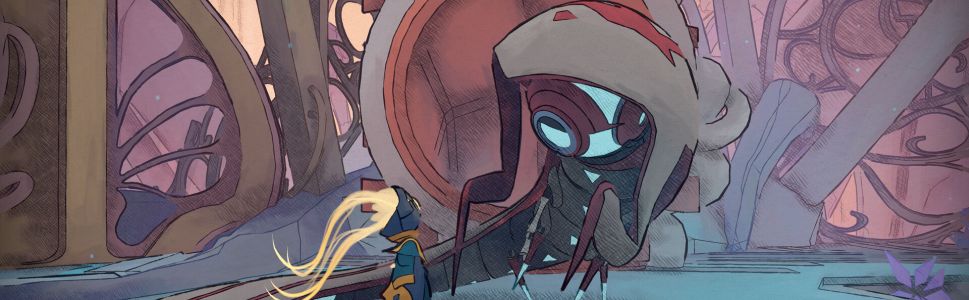
MIO: Memories in Orbit is a worse version of Hollow Knight: Silksong, and immediately, that may put off any potential genre fans. As accurate as it may be, I feel it’s a more nuanced judgment than you’d think. The latter is such a strong bar after all – not meeting it isn’t the end of the world, and on a scale, Douze Dixièmes’ side-scrolling action platformer is certainly a commendable effort. On the other hand, there are several similarities between the titles, from the grappling and mid-air combat to the doom-ridden scenario, the feeling of exploring a wondrous yet ruined world, and how you’re taught new abilities. Mio even has a downward dash to fall more stylishly, though it’s much more of a tool for faster descent than Hornet’s.
If you’re hankering for a gorgeous aesthetic, challenging and unique boss fights, and a great soundtrack, then Memories in Orbit may very well fill that Silksong-sized hole in your life, caveats aside. However, taken on its own, it’s a solid effort bogged down by a few questionable design choices.
The Vessel is the setting – a massive space-faring ship filled with sentient robots, led by the Heart and five different Voices – The Breath, The Spine, The Hand, The Blood and The Eye. Upon awakening, however, Mio finds the ship in ruins and the Voices unresponsive. By reconnecting with the Keepers, she eventually learns that The Vessel is on the road to destruction, unless she can kickstart the Heart by what else but gathering the different Voices.
"It’s a good thing, then, that the gameplay holds up. Those familiar with the genre will know the drill: Melee strikes, double-jumping (which is unlocked from the get-go), gliding, grappling – all of it feels responsive enough, and the rate at which Mio learns new abilities is pretty brisk."
It’s a decent set-up, even if the characters feel underdeveloped. The Voices are chief among them – ironic, given that they have voice-acting – but it’s also an issue affecting Mio. You’ll see her cryptic thoughts while traversing inner self stages, which are far, few, and ill-timed since I’m too busy trying to master the new ability. Otherwise, it feels like the story belongs more to Tomo, who’s investigating the Vessel and revealing all sorts of revelations through datapads they’ve left behind.
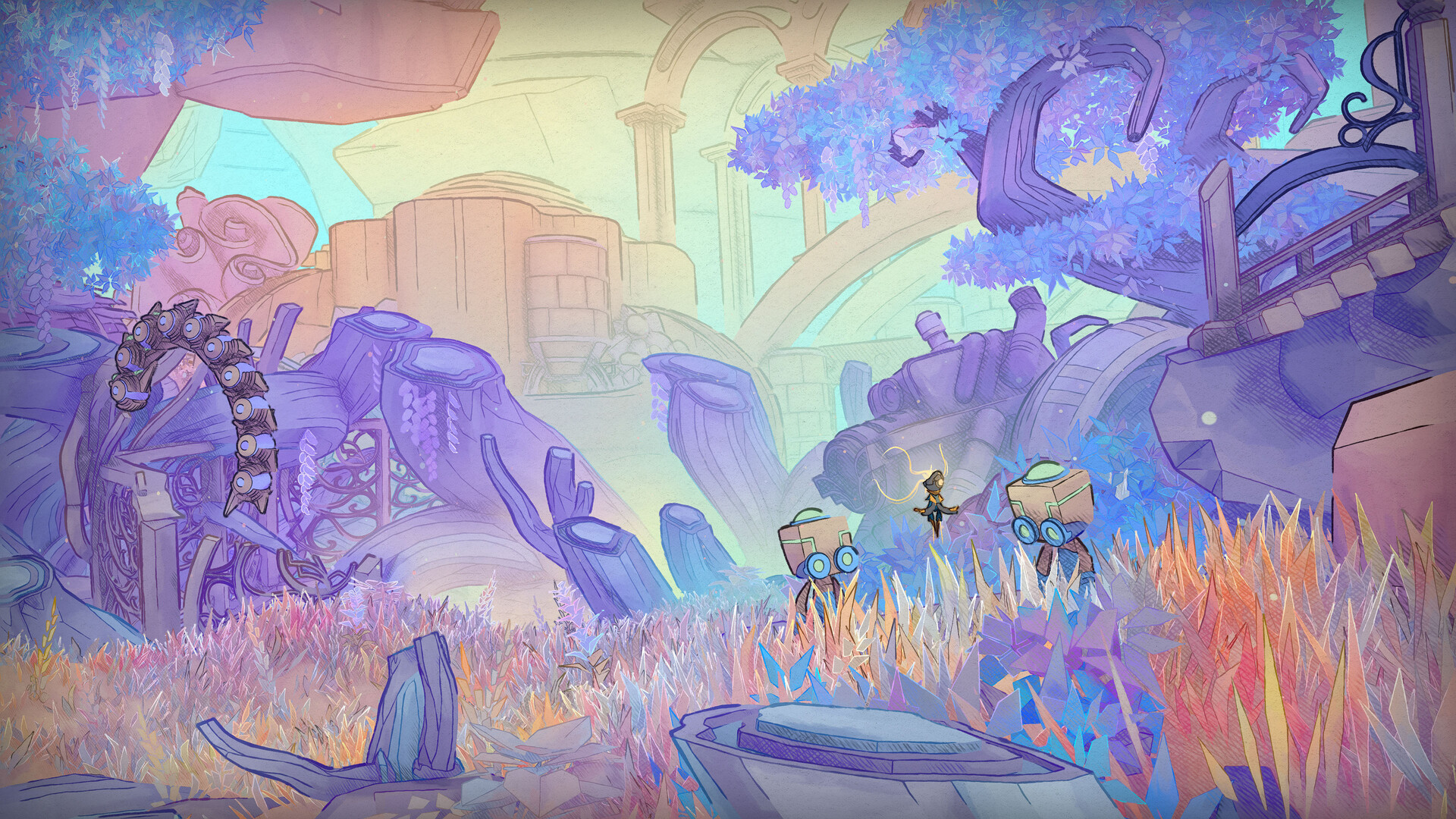
The environments, especially the stunning backgrounds, have stories to tell, even if they can be boiled down to, “Well, it used to look nice, until so and so.” Occasionally, you’ll come across these robot husks that are beyond repair. What stories could they have told? Why don’t they get their own datapads? The additional context beyond their names could have made for some great world-building.
You’ll encounter other random bots throughout The Vessel who offer their own takes on situations, like telling you about the status of each Voice. Occasionally, some will require help, and it’s about as eventful as it sounds. Then there’s Ati, Mio’s sister, who doesn’t want you to obtain all the Voices, though her appearances are so sporadic that I’m hard-pressed to really care. The plot isn’t completely throwaway, and there can be some decent moments and revelations. Still, the resolution to almost every Voice’s story feels lackluster, save for, perhaps, The Hand, who probably has the most involved “arc”, if you could call it that.
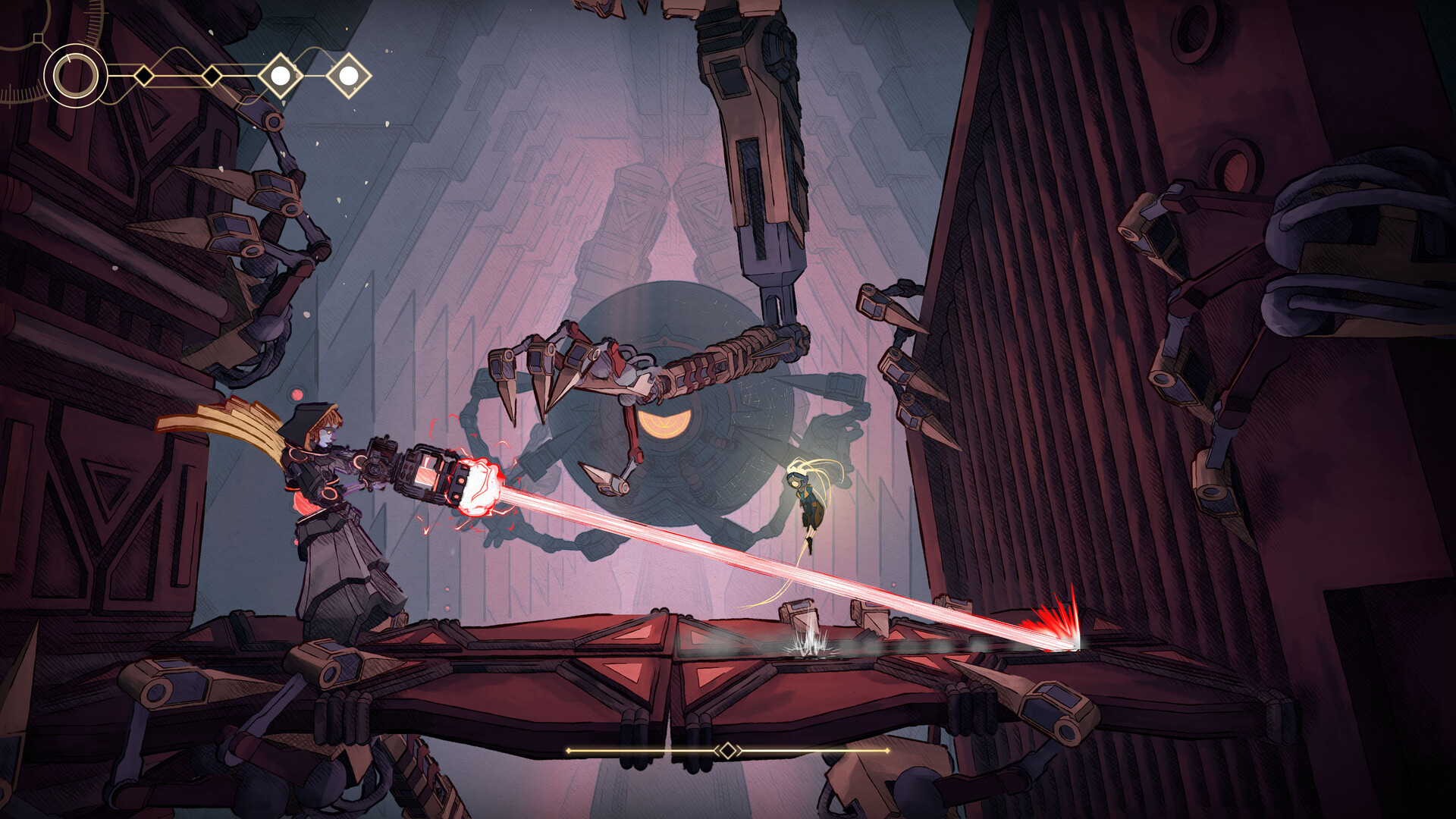
It’s a good thing, then, that the gameplay holds up. Those familiar with the genre will know the drill: Melee strikes, double-jumping (which is unlocked from the get-go), gliding, grappling – all of it feels responsive enough, and the rate at which Mio learns new abilities is pretty brisk. Several of these fall outside the norm, such as the spider-like striding. It not only offers the ability to hang off walls, but also navigate ceilings. Mid-air combat is also notable because hitting a target grants another jump, letting you stay off the ground, consistently chaining hits together.
"And as responsive as the actual hits can feel, there isn’t much variety to your tactics. You don’t receive sub-weapons or anything like that. The closest thing to damage upgrades is manipulating Mio’s internal memory to slot in new Modules."
However, there are some elements that…I wouldn’t call them bad per se, but they take getting used to, and really curtail any creativity in your traversal. First is the energy system. Gliding, grappling…er, arachnid locomotion all require energy. Think of it as the game’s stamina system – when it’s empty, you can’t perform any of those actions. While bouncing off certain enemies can return a bit, and landing on the ground speeds up the process, striking other environmental objects will fully restore energy, allowing one to chain movement abilities together. So, of course, Memories in Orbit leverages this to introduce several twisted platforming sections where you need to bounce off of an object to grapple to another point, using the remaining jump left to hit another object so you can stride on some grates, and so on.
The problem with this is that a single mistake can result in resetting yourself to a point several meters away. Oh, you survived navigating the Blightwater away from the death wall to a platform, but didn’t get that one grapple afterwards? Do it again. It thus becomes an exercise to execute all these motions and memorize the placements of everything you need to keep the energy flowing. And suffice it to say that grappling, sometimes falling short when it feels like it shouldn’t, or the lackluster bounce from a downward strike, can feel all the more annoying in those circumstances.
There’s also the problem with the dash, the first being that it’s not really a dash. It’s more like a deflect, except it’s not. So what is it? I suppose it’s more like a perfect dodge mechanic without many of the benefits (like time briefly slowing down, counter-attacking, and so on). The fact that its cooldown can feel so long if you mess up, and that it’s not exactly reliable when trying to chain dodges together, results in a slightly awkward feel.
And as responsive as the actual hits can feel, there isn’t much variety to your tactics. You don’t receive sub-weapons or anything like that. The closest thing to damage upgrades is manipulating Mio’s internal memory to slot in new Modules. Being able to remove HUD elements like an enemy’s health bar or Mio’s status to free up space for, say, increased damage as health lowers, or a stronger third hit on your combo is pretty neat. But that’s pretty much all you get in terms of unique combat options.
"A solid experience with some quirky mechanics, some that work better than others, combined with an above-average story and strong presentation, is enough, given its pricing. Yet I couldn’t help expecting something more."
Other bizarre elements include the lack of any healing option, at least that I was able to discover during the main story path. Fast travel requires finding specific entities named Overseers. Otherwise, look forward to some lengthy back-and-forth when trying to get from one area to another. And while the map feels pretty well-paced given its general size, some of the runbacks can be downright brutal at times. That said, the boss fights are quite good, each offering unique challenges and fitting with their locations.
It certainly contrasts MIO’s gorgeous art style. Between the detailed shading in the environments and characters, alongside the excellent array colors. Striking a fine balance between sci-fi, nature, and the industrial, it’s a strong aesthetic, and likely what draws most to the game in the first place. However, the music is even better. Certain tracks carry a, for lack of a better word, Risk of Rain vibe; others offer an electronic vibe that channels Daft Punk, of all things, and it’s pretty great.
Even after completing the story and having more left to discover, I wasn’t exactly pining to return to Memories in Orbit. A solid experience with some quirky mechanics, some that work better than others, combined with an above-average story and strong presentation, is enough, given its pricing. Yet I couldn’t help expecting something more.
This game was reviewed on PC.
Responsive movement and controls with some rather innovative movement skills. Unique setting backed by gorgeous aesthetic and a slick soundtrack. Challenging boss fights that will push you to the limit.
Core characters aren't really well-established or expanded upon, giving you little reason to care about their fates. Fast travel mechanic is annoying, as are some runbacks. Lack of healing can make for frustrating exploration and platforming. Minuscule combat variety.