






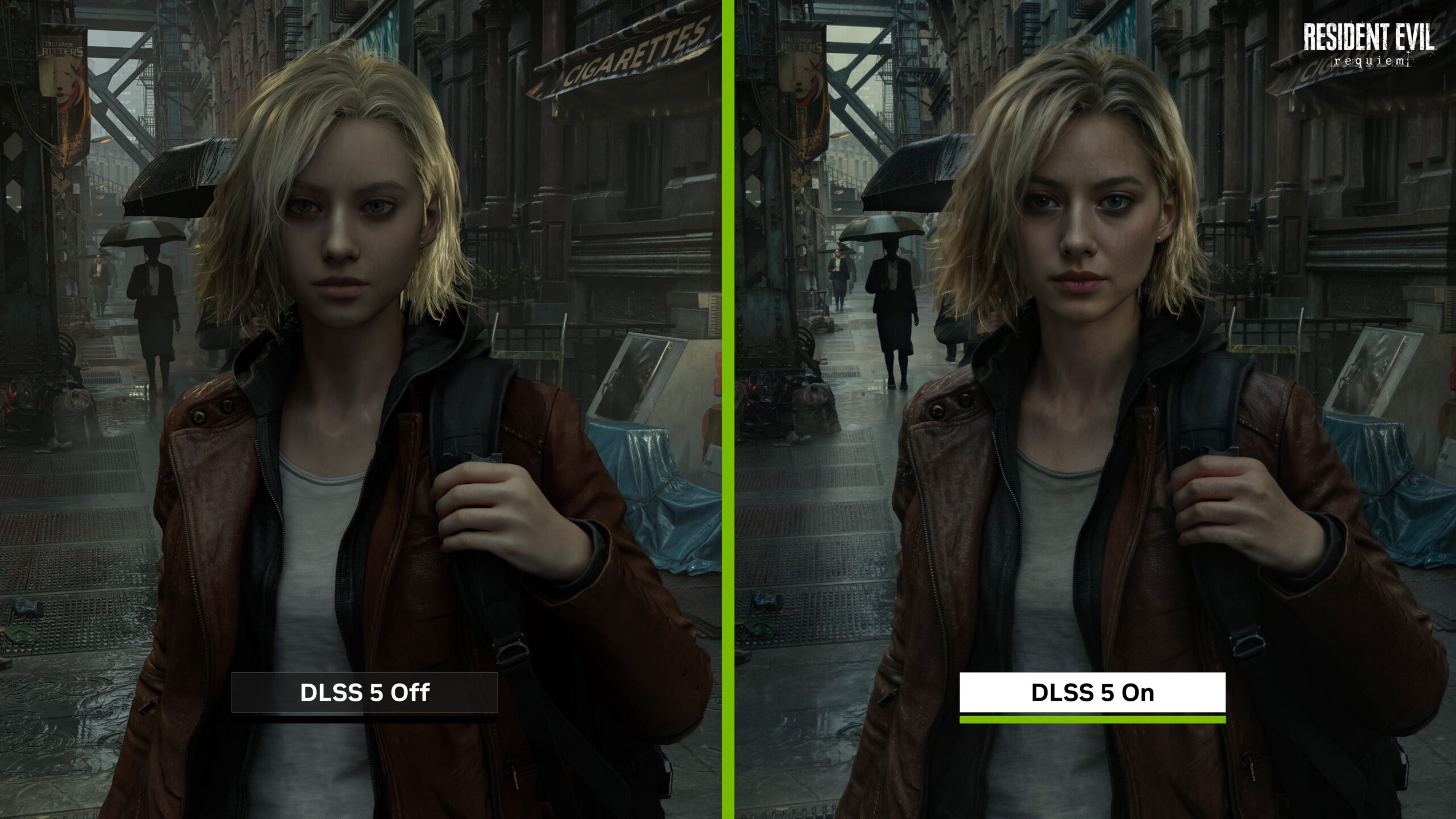
Despite its success, Capcom’s Resident Evil Requiem was among the games caught up in the controversy surrounding Nvidia’s DLSS 5 showcase from March. In an interview with Eurogamer, Masato Kumazawa was asked about controversy, to which he replied by saying that fans of the games who spoke out against the transformations to the face of protagonist Grace Ashcroft were “a positive” for the company when it came to character design.
“The fact a lot of players commented they really liked the original design of Grace and didn’t want to see it changed was a positive,” he said. “It meant we got the design right and points to the fact that Grace quickly established herself as a fan favorite, that people had such strong opinions on her design.”
When it came to aging up characters, as we saw with Leon S. Kennedy in Resident Evil Requiem, game director Koshi Nakanishi said that Capcom doesn’t have a “cast iron rule” about characters growing older with each entry. This means that, with younger characters, Capcom doesn’t “feel the need to replace [its most recognisable faces] with younger characters… we don’t really think of it in those terms.”
“I mean, I think Leon is really appealing in his current form,” he said. “And who knows, we could bring him back when he’s 70, and I’m sure he’ll still be a great character.”
Unfortunately, however, neither Kumazawa nor Nakanishi addressed the controversial transformations Grace’s face went through at the hands of Nvidia’s DLSS 5 technology directly.
As soon as Nvidia had showcased the technology, it attracted quite a bit of criticism, thanks in large part to just how many changes were made to Grace’s character design. This included changing up her face’s bone structure and even applying makeup to an FBI agent who is on her way to investigate a series of murders.
Among the critics of the technology was Noclip’s Danny O’Dwyer, who said that DLSS 5 was turning “everyone into yassified, looks-maxed freaks.” RPGSite’s Alex Dondaldson also took to social media to call the effect “uncanny & weird.” He went on to write, “I wonder how much devs can get in and tweak the model to their artistic intent.”
A report from later on in the month indicated that developers from Capcom and Ubisoft found out about DLSS 5 at the same time as the rest of the world, and that they hadn’t been told about their games being part of Nvidia’s showcase. “We found out at the same time as the public,” said a Ubisoft developer. Capcom’s developers were noted as being particularly shocked, since the company was described as being quite “anti-AI” for game development.
Nvidia CEO Jensen Huang has defended DLSS 5, and when it came to comparisons with “AI slop” he noted that the technology wasn’t really comparable to images generated through the use of generative AI tools.
“I think their perspective makes sense and I can see where they’re coming from, because I don’t love AI slop myself,” said Huang on the subject of backlash against DLSS 5. “You know, all of the AI-generated content increasingly looks similar, and they’re all beautiful. So, I’m empathetic towards what [critics] are thinking.”
Resident Evil Requiem is available on PC, PS5, Xbox Series X/S, and Nintendo Switch 2. Check out our review for more details.